Global Government Cloud Market Highlights
| Market Size (2025) | USD 33.4 Billion |
| Forecast Size (2032) | USD 80.2 Billion |
| CAGR | 14.50% |
| Base Year | 2025 |
| Forecast Period | 2026-2032 |
| Largest Region | North America |
| Fastest Growing Region | Asia |
| Largest Segment | Cloud Storage |
| Fastest Growing Segment | Identity, Access Management (IAM) |
| Leading Companies | Amazon Web Services, Microsoft Corporation, IBM Corporation, Oracle Corporation, Google Cloud |
Global Government Cloud Market Size & Growth Rate (2026-2032)
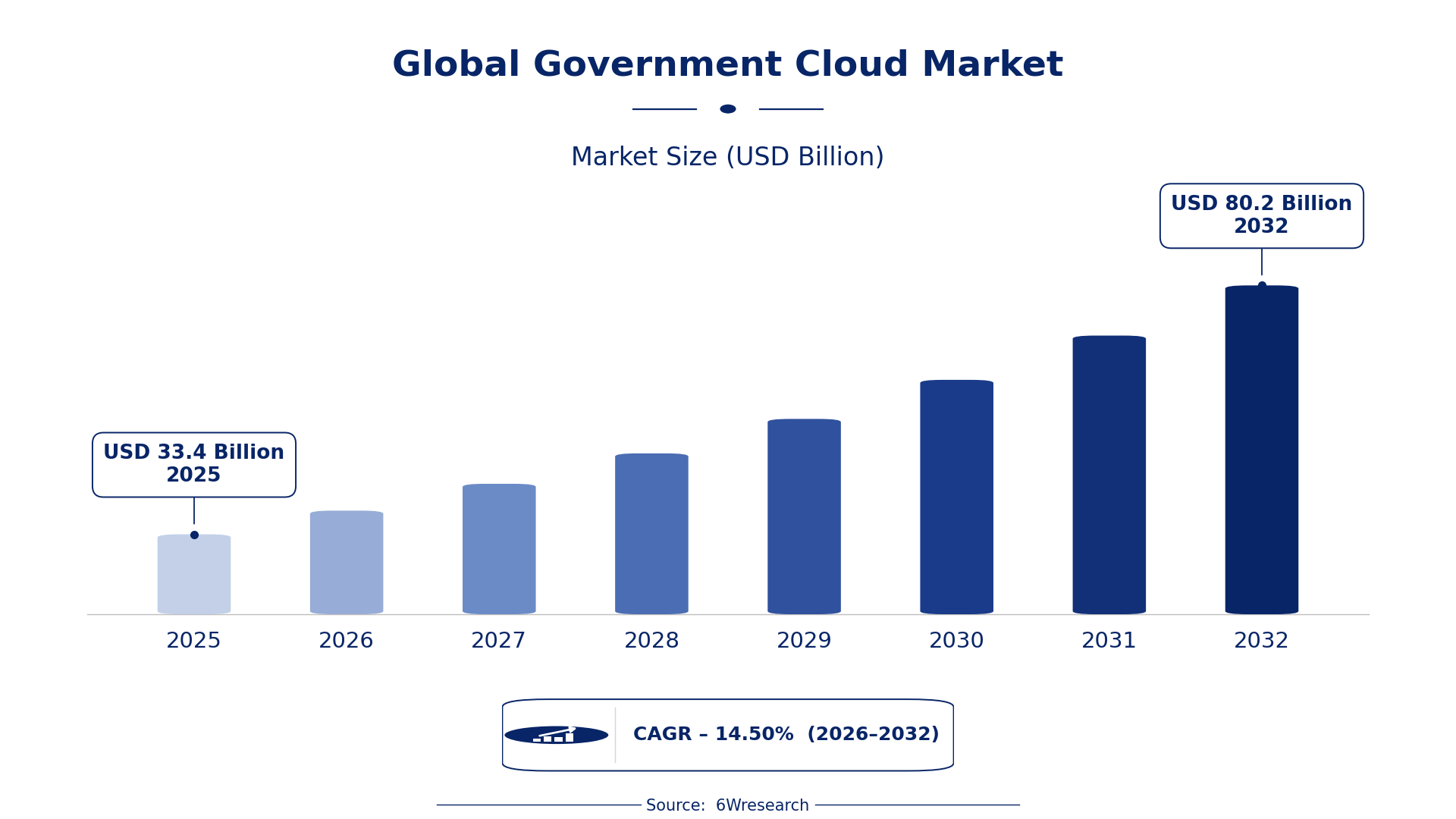
The Global Government Cloud Market was estimated at USD 33.4 Billion in 2025 and is projected to reach USD 80.2 Billion by 2032, growing at a CAGR of 14.50% from 2026 to 2032.
Global Government Cloud Market Synopsis
The Global Government Cloud Market is witnessing transformative shifts due to the increasing need for efficient digital services. Government agencies are urgently modernizing their IT infrastructure to enhance service delivery while optimizing operational costs. This transition is not merely about cloud adoption; it emphasizes a strategic pivot towards more integrated, secure, and effective cloud solutions tailored for public sector challenges.
As government cloud strategies evolve, specific demands from sectors like healthcare and defense are influencing product development. Market leaders are investing heavily in specialized offerings that meet compliance and security requirements. The rising emphasis on data sovereignty and privacy laws globally has created a unique environment where government entities seek robust cloud solutions that align with regulatory frameworks.
Global Government Cloud Market Year-wise Growth Rate and Key Drivers
This graph illustrates the annual growth rates of the Global Government Cloud Market from 2022 to 2032, highlighting a steady upward trajectory and projected expansion over the forecast period.
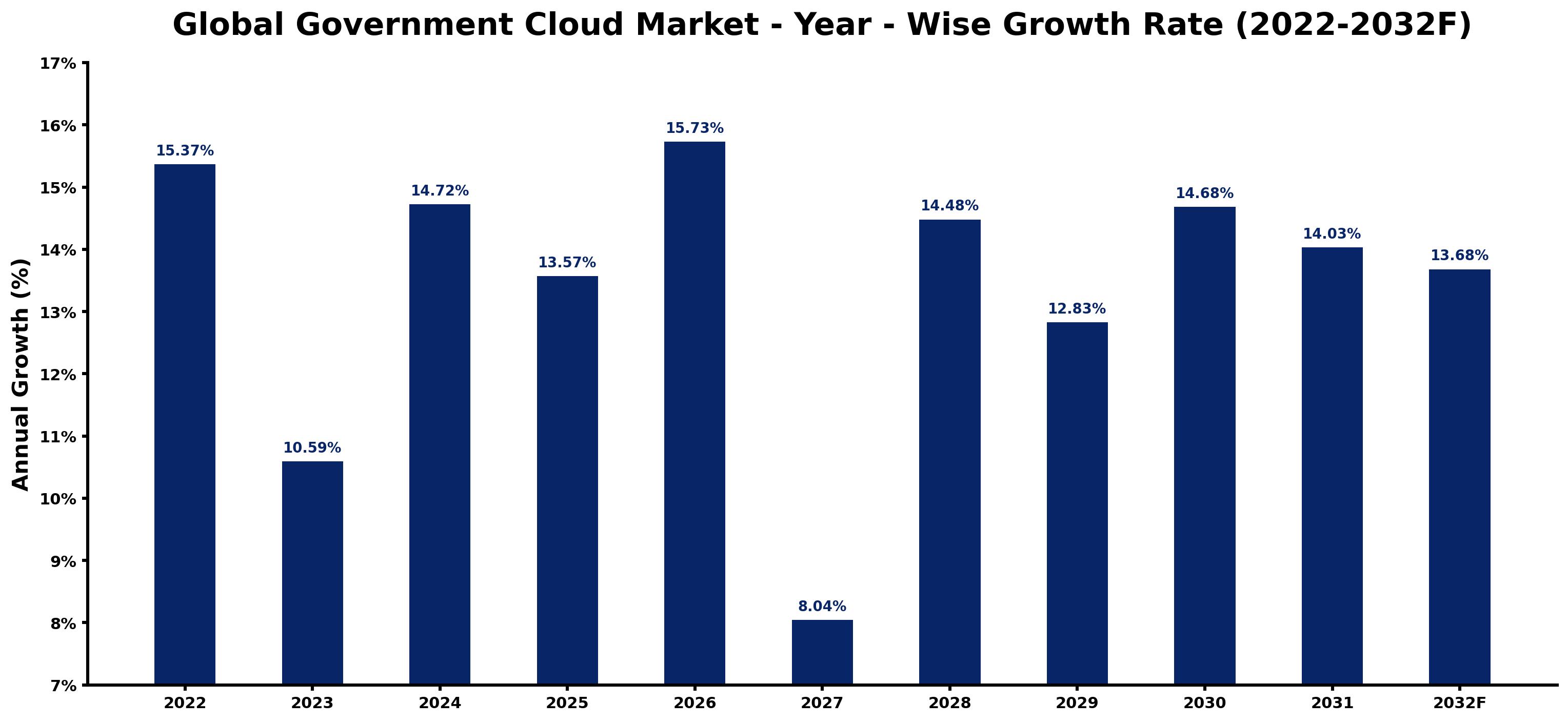
The table below presents the year‑wise growth rates along with the key drivers influencing the market
| Year | Growth Rate (%) | Major Drivers |
| 2022 | 15.37 | Expanding cloud infrastructures enables governments to enhance digital service delivery. |
| 2023 | 10.59 | A shift toward stricter cybersecurity frameworks changes government cloud implementation strategies. |
| 2024 | 14.72 | Government agencies actively recruit skilled IT professionals to manage cloud migrations. |
| 2025 | 13.57 | Increased reliance on SaaS subscription models accelerates government cloud adoption across sectors. |
| 2026 | 15.73 | Sustainability trends drive investments in energy-efficient cloud data centers for governments. |
| 2027 | 8.04 | User-centric cloud solutions shape government procurement practices, adapting to user demands. |
| 2028 | 14.48 | Regulators influence raw material costs, affecting cloud service pricing in government sectors. |
| 2029 | 12.83 | As supply chain dynamics stabilize, governments optimize procurement of cloud services. |
| 2030 | 14.68 | Across North America, government cloud solutions expand to meet regional operational needs. |
| 2031 | 14.03 | Municipalities invest in edge computing technologies to enhance local government services. |
| 2032 | 13.68 | Enhanced API ecosystems facilitate mergers and acquisitions within government cloud offerings. |
Note - Market size estimations and growth projections presented in this report are based on 6Wresearch's proprietary research methodology, combining internal industry data, secondary research, and primary validation, updated periodically to reflect current market conditions. As markets evolve rapidly, figures for certain industries may vary slightly and are intended as informed estimates rather than absolute figures. For the most current market sizing, we recommend validating figures with a 6Wresearch analyst.
Global Government Cloud Market Key Takeaways
Below are some of the specific key takeaways from the market, including:
- North America holds approximately 48% market share in 2025 due to substantial government spending on digital infrastructure.
- Cloud Storage is expected to dominate the market with a share of around 55% in 2025 as agencies prioritize data management solutions.
- Identity, Access Management (IAM) is projected to grow at a CAGR of 18.0% from 2026 to 2032 due to increased security concerns.
- Governments worldwide allocated over USD 20 billion in 2023 specifically for cloud technology upgrades.
- AWS and Microsoft are the leading providers, together accounting for 70% of the government cloud service market.
Evaluation of Restraints in Global Government Cloud Market
While the Global Government Cloud Market is expanding, several restraints must be addressed. Notably, compliance with regulatory frameworks poses significant challenges. For example, the Federal Risk and Authorization Management Program (FedRAMP) requires cloud service providers to meet stringent security standards, which can be costly and complex, often exceeding USD 250,000 for compliance preparation. Additionally, governmental concerns over data security and privacy have led to hesitancy in fully embracing cloud solutions, as evidenced by several public sector organizations delaying or canceling projects in 2023 due to these apprehensions.
Global Government Cloud Market Trends
The market is witnessing a discernible shift toward hybrid cloud solutions, allowing government entities to leverage both public and private cloud capabilities. This addresses security concerns while providing scalability. For example, the U.S. Department of Defense is currently implementing a hybrid cloud initiative expected to be fully operational by 2025. Furthermore, increasing investments in AI integration are reshaping service delivery models; the UK's Government Digital Service is exploring AI-driven analytics to enhance decision-making processes. This trend is expected to redefine IT resource management significantly in the coming years.
Global Government Cloud Market Opportunities
The expanding landscape of the Global Government Cloud Market also presents myriad opportunities for targeted growth. One notable area is the rise of digital transformation initiatives, with government agencies earmarking substantial funds to modernize aging infrastructure. For instance, Australia's Digital Transformation Agency has allocated AUD 1.2 billion (approximately USD 800 million) towards its 2024 cloud infrastructure initiatives. Additionally, sectors such as defense are increasingly allocating resources for specialized cloud solutions; the U.S. Army recently awarded four contracts valued at $540 million for tailored cloud services. These opportunities underline the market's potential for growth and the necessity for vendors to innovate rapidly.
Global Government Cloud Market by Solutions
The leading solution in the Global Government Cloud Market is Cloud Storage, which commands approximately 55% share in 2025, as agencies prioritize data management and cost savings. Meanwhile, Identity, Access Management (IAM) is the fastest-growing segment, with a CAGR of 18.0% from 2026 to 2032, driven by escalating security and compliance demands. The robust growth in IAM is a reflection of the increasing need for secure access control mechanisms as the government sector increasingly faces cyber threats.
Global Government Cloud Market by Services
In terms of services, Support and Maintenance leads the market with a share of about 45% in 2025, driven by the essential need for ongoing technical support for cloud solutions. However, Integration is set to be the fastest-growing service segment, expected to achieve a CAGR of 16.5% from 2026 to 2032. The rising complexity of cloud configurations necessitates enhanced integration services, ensuring seamless interoperability across diverse platforms used by governmental agencies.
Global Government Cloud Market by Service Model
Infrastructure as a Service (IaaS) is the leading model in the Global Government Cloud Market, comprising approximately 50% market share in 2025, as it offers flexible resource management essential for government operations. Conversely, Software as a Service (SaaS) is set to experience the fastest growth, projected to attain a CAGR of 15.0% from 2026 to 2032, as agencies increasingly seek accessible, on-demand software solutions that optimize operations and enhance user experience.
Global Government Cloud Market by Deployment Model
The largest deployment model in the Global Government Cloud Market is Public Cloud, expected to capture around 60% share in 2025, offering scalability and cost efficiency that governmental entities require. However, Hybrid Cloud is anticipated to grow the fastest, with a CAGR of 19.0% from 2026 to 2032, fueled by the demand for a balanced approach that maintains security while enabling flexibility across services.
Global Government Cloud Market by Region
North America is the largest region in the Global Government Cloud Market, commanding approximately 48% share in 2025, facilitated by substantial public sector investments and advanced digital infrastructure. On the other hand, Asia is projected to be the fastest-growing region, with a CAGR of 16.0% from 2026 to 2032, driven by government initiatives in countries like India and China focusing on digital transformation and smart city projects. The concentration of emerging technology hubs in these regions further catalyzes this growth.
Government Initiatives in the Global Government Cloud Market
The regulatory environment surrounding cloud technology for government applications is actively evolving. Governments worldwide are initiating policies to foster cloud adoption, focusing on security, compliance, and overall transformation of public services.
- General Services Administration (GSA), Cloud Smart Strategy, 2019 – This initiative aims to encourage federal agencies in the U.S. to adopt cloud solutions that meet security and compliance standards.
- European Commission, European Cloud Initiative, 2016 – This ongoing initiative aims to enhance the digital economy within the EU by promoting cloud solutions and ensuring data sovereignty.
- U.S. Department of Defense, Joint Enterprise Defense Infrastructure (JEDI), 2020 – This planned initiative will modernize the DOD’s cloud infrastructure, improving collaboration and data access across various military branches.
- UK Government Digital Service, Digital Strategy, 2021 – This ongoing government plan seeks to further develop cloud capabilities for public services, enhancing the efficiency of service delivery.
Future Insights of the Global Government Cloud Market
The landscape of the Global Government Cloud Market is set for dynamic changes as agencies increasingly prioritize data-driven decision-making. Initiatives such as the UK's Government Digital Service, which is focusing on AI analytics, indicate a shift towards integrating advanced technology for better service outcomes. The drive for enhanced cybersecurity will likely lead to increased investments in IAM solutions, especially given the projected 18.0% CAGR for the segment from 2026 to 2032. These trends suggest that government cloud strategies will evolve significantly, emphasizing enhanced security and innovation.
Global Government Cloud Market Latest Developments
Recent activities among key players indicate robust advancements in the Global Government Cloud Market. These developments emphasize the competitive edge required to meet growing agency-specific demands.
- Amazon Web Services recently completed the integration of its cloud services with enhanced data security measures in early 2023, strengthening its foothold in government markets.
- Microsoft launched a specialized governmental analytics platform in late 2022, aimed at facilitating real-time data insights for decision-making among public sector clients.
- IBM is currently rolling out dedicated cloud solutions for defense sectors, with anticipated completion by mid-2024, reflecting an emphasis on compliance and security.
- Oracle is bolstering its government cloud services through partnerships with local authorities in Asia, targeting deployment strategies by early 2025 to enhance regional presence.
Global Government Cloud Market Key Players and Industry Positioning
The competitive structure of the Global Government Cloud Market is becoming increasingly consolidated, dominated by notable players offering specialized services. These major companies differentiate themselves through advanced technologies, compliance expertise, and tailored service offerings that meet specific regulatory requirements.
| Leading Company | Core Strength | Strategic Focus |
|---|---|---|
| Amazon Web Services | Robust cloud infrastructure and comprehensive service portfolios | Investment in security enhancements for government compliance |
| Microsoft Corporation | Integration capabilities with legacy systems | Development of analytics-based solutions for informed decision-making |
| IBM Corporation | Expertise in data management and AI | Focus on defense and regulated sectors with tailored cloud solutions |
| Oracle Corporation | Strong database management systems and enterprise applications | Regional partnerships to drive localized solutions |
| Google Cloud | Innovative data analytics and machine learning capabilities | Emphasis on collaborative platforms for government projects |
In a rapidly changing market, the importance of differentiating offerings becomes crucial. Participants must continually innovate and align with government compliance needs to secure their market positions.
Key Attractiveness of the Report
- 10 Years of Market Numbers
- Historical Data Starting from 2022 to 2025
- Base Year: 2025
- Forecast Data until 2032
- Key Performance Indicators Impacting the Market
- Major Upcoming Developments and Projects
Key Highlights of the Report:
- Global Government Cloud Market Outlook
- Market Size of Global Government Cloud Market, 2025
- Forecast of Global Government Cloud Market, 2032
- Historical Data and Forecast of Global Government Cloud Revenues & Volume for the Period 2022-2032
- Global Government Cloud Market Trend Evolution
- Global Government Cloud Market Drivers and Challenges
- Global Government Cloud Price Trends
- Global Government Cloud Porter's Five Forces
- Global Government Cloud Industry Life Cycle
- Historical Data and Forecast of Global Government Cloud Market Revenues & Volume
- Historical Data and Forecast of Global Government Cloud Market Revenues & Volume By Solutions for the Period 2022-2032
- Historical Data and Forecast of Global Government Cloud Market Revenues & Volume By Cloud Storage for the Period 2022-2032
- Historical Data and Forecast of Global Government Cloud Market Revenues & Volume By Disaster Recovery for the Period 2022-2032
- Historical Data and Forecast of Global Government Cloud Market Revenues & Volume By Identity and Access Management (IAM) for the Period 2022-2032
- Historical Data and Forecast of Global Government Cloud Market Revenues & Volume By Risk and compliance management for the Period 2022-2032
- Historical Data and Forecast of Global Government Cloud Market Revenues & Volume By Others (reporting and analytics, and security and vulnerability) for the Period 2022-2032
- Historical Data and Forecast of Global Government Cloud Market Revenues & Volume By Services for the Period 2022-2032
- Historical Data and Forecast of Global Government Cloud Market Revenues & Volume By Training, consulting, and education for the Period 2022-2032
- Historical Data and Forecast of Global Government Cloud Market Revenues & Volume By Support and Maintenance for the Period 2022-2032
- Historical Data and Forecast of Global Government Cloud Market Revenues & Volume By Integration and Migration for the Period 2022-2032
- Historical Data and Forecast of Global Government Cloud Market Revenues & Volume By Service Model for the Period 2022-2032
- Historical Data and Forecast of Global Government Cloud Market Revenues & Volume By Infrastructure as a Service (IaaS) for the Period 2022-2032
- Historical Data and Forecast of Global Government Cloud Market Revenues & Volume By Platform as a Service (PaaS) for the Period 2022-2032
- Historical Data and Forecast of Global Government Cloud Market Revenues & Volume By Software as a Service (SaaS) for the Period 2022-2032
- Historical Data and Forecast of Global Government Cloud Market Revenues & Volume By Deployment Model for the Period 2022-2032
- Historical Data and Forecast of Global Government Cloud Market Revenues & Volume By Public Cloud for the Period 2022-2032
- Historical Data and Forecast of Global Government Cloud Market Revenues & Volume By Private Cloud for the Period 2022-2032
- Historical Data and Forecast of Global Government Cloud Market Revenues & Volume By Hybrid Cloud for the Period 2022-2032
- Historical Data and Forecast of North America Government Cloud Market Revenues & Volume By Solutions for the Period 2022-2032
- Historical Data and Forecast of North America Government Cloud Market Revenues & Volume By Cloud Storage for the Period 2022-2032
- Historical Data and Forecast of North America Government Cloud Market Revenues & Volume By Disaster Recovery for the Period 2022-2032
- Historical Data and Forecast of North America Government Cloud Market Revenues & Volume By Identity and Access Management (IAM) for the Period 2022-2032
- Historical Data and Forecast of North America Government Cloud Market Revenues & Volume By Risk and compliance management for the Period 2022-2032
- Historical Data and Forecast of North America Government Cloud Market Revenues & Volume By Others (reporting and analytics, and security and vulnerability) for the Period 2022-2032
- Historical Data and Forecast of North America Government Cloud Market Revenues & Volume By Services for the Period 2022-2032
- Historical Data and Forecast of North America Government Cloud Market Revenues & Volume By Training, consulting, and education for the Period 2022-2032
- Historical Data and Forecast of North America Government Cloud Market Revenues & Volume By Support and Maintenance for the Period 2022-2032
- Historical Data and Forecast of North America Government Cloud Market Revenues & Volume By Integration and Migration for the Period 2022-2032
- Historical Data and Forecast of North America Government Cloud Market Revenues & Volume By Service Model for the Period 2022-2032
- Historical Data and Forecast of North America Government Cloud Market Revenues & Volume By Infrastructure as a Service (IaaS) for the Period 2022-2032
- Historical Data and Forecast of North America Government Cloud Market Revenues & Volume By Platform as a Service (PaaS) for the Period 2022-2032
- Historical Data and Forecast of North America Government Cloud Market Revenues & Volume By Software as a Service (SaaS) for the Period 2022-2032
- Historical Data and Forecast of North America Government Cloud Market Revenues & Volume By Deployment Model for the Period 2022-2032
- Historical Data and Forecast of North America Government Cloud Market Revenues & Volume By Public Cloud for the Period 2022-2032
- Historical Data and Forecast of North America Government Cloud Market Revenues & Volume By Private Cloud for the Period 2022-2032
- Historical Data and Forecast of North America Government Cloud Market Revenues & Volume By Hybrid Cloud for the Period 2022-2032
- Historical Data and Forecast of United States of America Government Cloud Market Revenues & Volume for the Period 2022-2032
- Historical Data and Forecast of Canada Government Cloud Market Revenues & Volume for the Period 2022-2032
- Historical Data and Forecast of Rest of North America Government Cloud Market Revenues & Volume for the Period 2022-2032
- Historical Data and Forecast of Latin America (LATAM) Government Cloud Market Revenues & Volume By Solutions for the Period 2022-2032
- Historical Data and Forecast of Latin America (LATAM) Government Cloud Market Revenues & Volume By Cloud Storage for the Period 2022-2032
- Historical Data and Forecast of Latin America (LATAM) Government Cloud Market Revenues & Volume By Disaster Recovery for the Period 2022-2032
- Historical Data and Forecast of Latin America (LATAM) Government Cloud Market Revenues & Volume By Identity and Access Management (IAM) for the Period 2022-2032
- Historical Data and Forecast of Latin America (LATAM) Government Cloud Market Revenues & Volume By Risk and compliance management for the Period 2022-2032
- Historical Data and Forecast of Latin America (LATAM) Government Cloud Market Revenues & Volume By Others (reporting and analytics, and security and vulnerability) for the Period 2022-2032
- Historical Data and Forecast of Latin America (LATAM) Government Cloud Market Revenues & Volume By Services for the Period 2022-2032
- Historical Data and Forecast of Latin America (LATAM) Government Cloud Market Revenues & Volume By Training, consulting, and education for the Period 2022-2032
- Historical Data and Forecast of Latin America (LATAM) Government Cloud Market Revenues & Volume By Support and Maintenance for the Period 2022-2032
- Historical Data and Forecast of Latin America (LATAM) Government Cloud Market Revenues & Volume By Integration and Migration for the Period 2022-2032
- Historical Data and Forecast of Latin America (LATAM) Government Cloud Market Revenues & Volume By Service Model for the Period 2022-2032
- Historical Data and Forecast of Latin America (LATAM) Government Cloud Market Revenues & Volume By Infrastructure as a Service (IaaS) for the Period 2022-2032
- Historical Data and Forecast of Latin America (LATAM) Government Cloud Market Revenues & Volume By Platform as a Service (PaaS) for the Period 2022-2032
- Historical Data and Forecast of Latin America (LATAM) Government Cloud Market Revenues & Volume By Software as a Service (SaaS) for the Period 2022-2032
- Historical Data and Forecast of Latin America (LATAM) Government Cloud Market Revenues & Volume By Deployment Model for the Period 2022-2032
- Historical Data and Forecast of Latin America (LATAM) Government Cloud Market Revenues & Volume By Public Cloud for the Period 2022-2032
- Historical Data and Forecast of Latin America (LATAM) Government Cloud Market Revenues & Volume By Private Cloud for the Period 2022-2032
- Historical Data and Forecast of Latin America (LATAM) Government Cloud Market Revenues & Volume By Hybrid Cloud for the Period 2022-2032
- Historical Data and Forecast of Brazil Government Cloud Market Revenues & Volume for the Period 2022-2032
- Historical Data and Forecast of Mexico Government Cloud Market Revenues & Volume for the Period 2022-2032
- Historical Data and Forecast of Argentina Government Cloud Market Revenues & Volume for the Period 2022-2032
- Historical Data and Forecast of Rest of LATAM Government Cloud Market Revenues & Volume for the Period 2022-2032
- Historical Data and Forecast of Asia Government Cloud Market Revenues & Volume By Solutions for the Period 2022-2032
- Historical Data and Forecast of Asia Government Cloud Market Revenues & Volume By Cloud Storage for the Period 2022-2032
- Historical Data and Forecast of Asia Government Cloud Market Revenues & Volume By Disaster Recovery for the Period 2022-2032
- Historical Data and Forecast of Asia Government Cloud Market Revenues & Volume By Identity and Access Management (IAM) for the Period 2022-2032
- Historical Data and Forecast of Asia Government Cloud Market Revenues & Volume By Risk and compliance management for the Period 2022-2032
- Historical Data and Forecast of Asia Government Cloud Market Revenues & Volume By Others (reporting and analytics, and security and vulnerability) for the Period 2022-2032
- Historical Data and Forecast of Asia Government Cloud Market Revenues & Volume By Services for the Period 2022-2032
- Historical Data and Forecast of Asia Government Cloud Market Revenues & Volume By Training, consulting, and education for the Period 2022-2032
- Historical Data and Forecast of Asia Government Cloud Market Revenues & Volume By Support and Maintenance for the Period 2022-2032
- Historical Data and Forecast of Asia Government Cloud Market Revenues & Volume By Integration and Migration for the Period 2022-2032
- Historical Data and Forecast of Asia Government Cloud Market Revenues & Volume By Service Model for the Period 2022-2032
- Historical Data and Forecast of Asia Government Cloud Market Revenues & Volume By Infrastructure as a Service (IaaS) for the Period 2022-2032
- Historical Data and Forecast of Asia Government Cloud Market Revenues & Volume By Platform as a Service (PaaS) for the Period 2022-2032
- Historical Data and Forecast of Asia Government Cloud Market Revenues & Volume By Software as a Service (SaaS) for the Period 2022-2032
- Historical Data and Forecast of Asia Government Cloud Market Revenues & Volume By Deployment Model for the Period 2022-2032
- Historical Data and Forecast of Asia Government Cloud Market Revenues & Volume By Public Cloud for the Period 2022-2032
- Historical Data and Forecast of Asia Government Cloud Market Revenues & Volume By Private Cloud for the Period 2022-2032
- Historical Data and Forecast of Asia Government Cloud Market Revenues & Volume By Hybrid Cloud for the Period 2022-2032
- Historical Data and Forecast of China Government Cloud Market Revenues & Volume for the Period 2022-2032
- Historical Data and Forecast of India Government Cloud Market Revenues & Volume for the Period 2022-2032
- Historical Data and Forecast of Japan Government Cloud Market Revenues & Volume for the Period 2022-2032
- Historical Data and Forecast of Rest of Asia Government Cloud Market Revenues & Volume for the Period 2022-2032
- Historical Data and Forecast of Africa Government Cloud Market Revenues & Volume By Solutions for the Period 2022-2032
- Historical Data and Forecast of Africa Government Cloud Market Revenues & Volume By Cloud Storage for the Period 2022-2032
- Historical Data and Forecast of Africa Government Cloud Market Revenues & Volume By Disaster Recovery for the Period 2022-2032
- Historical Data and Forecast of Africa Government Cloud Market Revenues & Volume By Identity and Access Management (IAM) for the Period 2022-2032
- Historical Data and Forecast of Africa Government Cloud Market Revenues & Volume By Risk and compliance management for the Period 2022-2032
- Historical Data and Forecast of Africa Government Cloud Market Revenues & Volume By Others (reporting and analytics, and security and vulnerability) for the Period 2022-2032
- Historical Data and Forecast of Africa Government Cloud Market Revenues & Volume By Services for the Period 2022-2032
- Historical Data and Forecast of Africa Government Cloud Market Revenues & Volume By Training, consulting, and education for the Period 2022-2032
- Historical Data and Forecast of Africa Government Cloud Market Revenues & Volume By Support and Maintenance for the Period 2022-2032
- Historical Data and Forecast of Africa Government Cloud Market Revenues & Volume By Integration and Migration for the Period 2022-2032
- Historical Data and Forecast of Africa Government Cloud Market Revenues & Volume By Service Model for the Period 2022-2032
- Historical Data and Forecast of Africa Government Cloud Market Revenues & Volume By Infrastructure as a Service (IaaS) for the Period 2022-2032
- Historical Data and Forecast of Africa Government Cloud Market Revenues & Volume By Platform as a Service (PaaS) for the Period 2022-2032
- Historical Data and Forecast of Africa Government Cloud Market Revenues & Volume By Software as a Service (SaaS) for the Period 2022-2032
- Historical Data and Forecast of Africa Government Cloud Market Revenues & Volume By Deployment Model for the Period 2022-2032
- Historical Data and Forecast of Africa Government Cloud Market Revenues & Volume By Public Cloud for the Period 2022-2032
- Historical Data and Forecast of Africa Government Cloud Market Revenues & Volume By Private Cloud for the Period 2022-2032
- Historical Data and Forecast of Africa Government Cloud Market Revenues & Volume By Hybrid Cloud for the Period 2022-2032
- Historical Data and Forecast of South Africa Government Cloud Market Revenues & Volume for the Period 2022-2032
- Historical Data and Forecast of Nigeria Government Cloud Market Revenues & Volume for the Period 2022-2032
- Historical Data and Forecast of Egypt Government Cloud Market Revenues & Volume for the Period 2022-2032
- Historical Data and Forecast of Rest of Africa Government Cloud Market Revenues & Volume for the Period 2022-2032
- Historical Data and Forecast of Europe Government Cloud Market Revenues & Volume By Solutions for the Period 2022-2032
- Historical Data and Forecast of Europe Government Cloud Market Revenues & Volume By Cloud Storage for the Period 2022-2032
- Historical Data and Forecast of Europe Government Cloud Market Revenues & Volume By Disaster Recovery for the Period 2022-2032
- Historical Data and Forecast of Europe Government Cloud Market Revenues & Volume By Identity and Access Management (IAM) for the Period 2022-2032
- Historical Data and Forecast of Europe Government Cloud Market Revenues & Volume By Risk and compliance management for the Period 2022-2032
- Historical Data and Forecast of Europe Government Cloud Market Revenues & Volume By Others (reporting and analytics, and security and vulnerability) for the Period 2022-2032
- Historical Data and Forecast of Europe Government Cloud Market Revenues & Volume By Services for the Period 2022-2032
- Historical Data and Forecast of Europe Government Cloud Market Revenues & Volume By Training, consulting, and education for the Period 2022-2032
- Historical Data and Forecast of Europe Government Cloud Market Revenues & Volume By Support and Maintenance for the Period 2022-2032
- Historical Data and Forecast of Europe Government Cloud Market Revenues & Volume By Integration and Migration for the Period 2022-2032
- Historical Data and Forecast of Europe Government Cloud Market Revenues & Volume By Service Model for the Period 2022-2032
- Historical Data and Forecast of Europe Government Cloud Market Revenues & Volume By Infrastructure as a Service (IaaS) for the Period 2022-2032
- Historical Data and Forecast of Europe Government Cloud Market Revenues & Volume By Platform as a Service (PaaS) for the Period 2022-2032
- Historical Data and Forecast of Europe Government Cloud Market Revenues & Volume By Software as a Service (SaaS) for the Period 2022-2032
- Historical Data and Forecast of Europe Government Cloud Market Revenues & Volume By Deployment Model for the Period 2022-2032
- Historical Data and Forecast of Europe Government Cloud Market Revenues & Volume By Public Cloud for the Period 2022-2032
- Historical Data and Forecast of Europe Government Cloud Market Revenues & Volume By Private Cloud for the Period 2022-2032
- Historical Data and Forecast of Europe Government Cloud Market Revenues & Volume By Hybrid Cloud for the Period 2022-2032
- Historical Data and Forecast of United Kingdom Government Cloud Market Revenues & Volume for the Period 2022-2032
- Historical Data and Forecast of France Government Cloud Market Revenues & Volume for the Period 2022-2032
- Historical Data and Forecast of Germany Government Cloud Market Revenues & Volume for the Period 2022-2032
- Historical Data and Forecast of Rest of Europe Government Cloud Market Revenues & Volume for the Period 2022-2032
- Historical Data and Forecast of Middle East Government Cloud Market Revenues & Volume By Solutions for the Period 2022-2032
- Historical Data and Forecast of Middle East Government Cloud Market Revenues & Volume By Cloud Storage for the Period 2022-2032
- Historical Data and Forecast of Middle East Government Cloud Market Revenues & Volume By Disaster Recovery for the Period 2022-2032
- Historical Data and Forecast of Middle East Government Cloud Market Revenues & Volume By Identity and Access Management (IAM) for the Period 2022-2032
- Historical Data and Forecast of Middle East Government Cloud Market Revenues & Volume By Risk and compliance management for the Period 2022-2032
- Historical Data and Forecast of Middle East Government Cloud Market Revenues & Volume By Others (reporting and analytics, and security and vulnerability) for the Period 2022-2032
- Historical Data and Forecast of Middle East Government Cloud Market Revenues & Volume By Services for the Period 2022-2032
- Historical Data and Forecast of Middle East Government Cloud Market Revenues & Volume By Training, consulting, and education for the Period 2022-2032
- Historical Data and Forecast of Middle East Government Cloud Market Revenues & Volume By Support and Maintenance for the Period 2022-2032
- Historical Data and Forecast of Middle East Government Cloud Market Revenues & Volume By Integration and Migration for the Period 2022-2032
- Historical Data and Forecast of Middle East Government Cloud Market Revenues & Volume By Service Model for the Period 2022-2032
- Historical Data and Forecast of Middle East Government Cloud Market Revenues & Volume By Infrastructure as a Service (IaaS) for the Period 2022-2032
- Historical Data and Forecast of Middle East Government Cloud Market Revenues & Volume By Platform as a Service (PaaS) for the Period 2022-2032
- Historical Data and Forecast of Middle East Government Cloud Market Revenues & Volume By Software as a Service (SaaS) for the Period 2022-2032
- Historical Data and Forecast of Middle East Government Cloud Market Revenues & Volume By Deployment Model for the Period 2022-2032
- Historical Data and Forecast of Middle East Government Cloud Market Revenues & Volume By Public Cloud for the Period 2022-2032
- Historical Data and Forecast of Middle East Government Cloud Market Revenues & Volume By Private Cloud for the Period 2022-2032
- Historical Data and Forecast of Middle East Government Cloud Market Revenues & Volume By Hybrid Cloud for the Period 2022-2032
- Historical Data and Forecast of Saudi Arabia Government Cloud Market Revenues & Volume for the Period 2022-2032
- Historical Data and Forecast of UAE Government Cloud Market Revenues & Volume for the Period 2022-2032
- Historical Data and Forecast of Turkey Government Cloud Market Revenues & Volume for the Period 2022-2032
- Historical Data and Forecast of Rest of Middle East Government Cloud Market Revenues & Volume for the Period 2022-2032
- Global Government Cloud Market - Key Performance Indicators
- Global Government Cloud Market - Import Export Trade Statistics
- Global Government Cloud Market - Opportunity Assessment By Countries
- Global Government Cloud Market - Opportunity Assessment By Solutions
- Global Government Cloud Market - Opportunity Assessment By Services
- Global Government Cloud Market - Opportunity Assessment By Service Model
- Global Government Cloud Market - Opportunity Assessment By Deployment Model
- Global Government Cloud Market - Top Companies Market Share
- Global Government Cloud Market - Top Companies Profiles
- Global Government Cloud Market - Comparison of Players in Technical and Operating Parameters
- Global Government Cloud Market - Strategic Recommendations
Markets Covered
The Global Government Cloud Market report provides a detailed analysis of the following market segments:
By Regions and Countries:
- North America
- Europe
- LATAM
- Middle East
- Asia
- Africa
By Solutions:
- Cloud Storage
- Disaster Recovery
- Identity
- Access Management (IAM)
- Risk
- compliance management
- Others (reporting
- analytics
- security
- vulnerability)
By Services:
- Training
- consulting
- education
- Support
- Maintenance
- Integration
- Migration
By Service Model:
- Infrastructure as a Service (IaaS)
- Platform as a Service (PaaS)
- Software as a Service (SaaS)
By Deployment Model:
- Public Cloud
- Private Cloud
- Hybrid Cloud






































