India Government Cloud Market Size & Growth Rate (2026-2032)
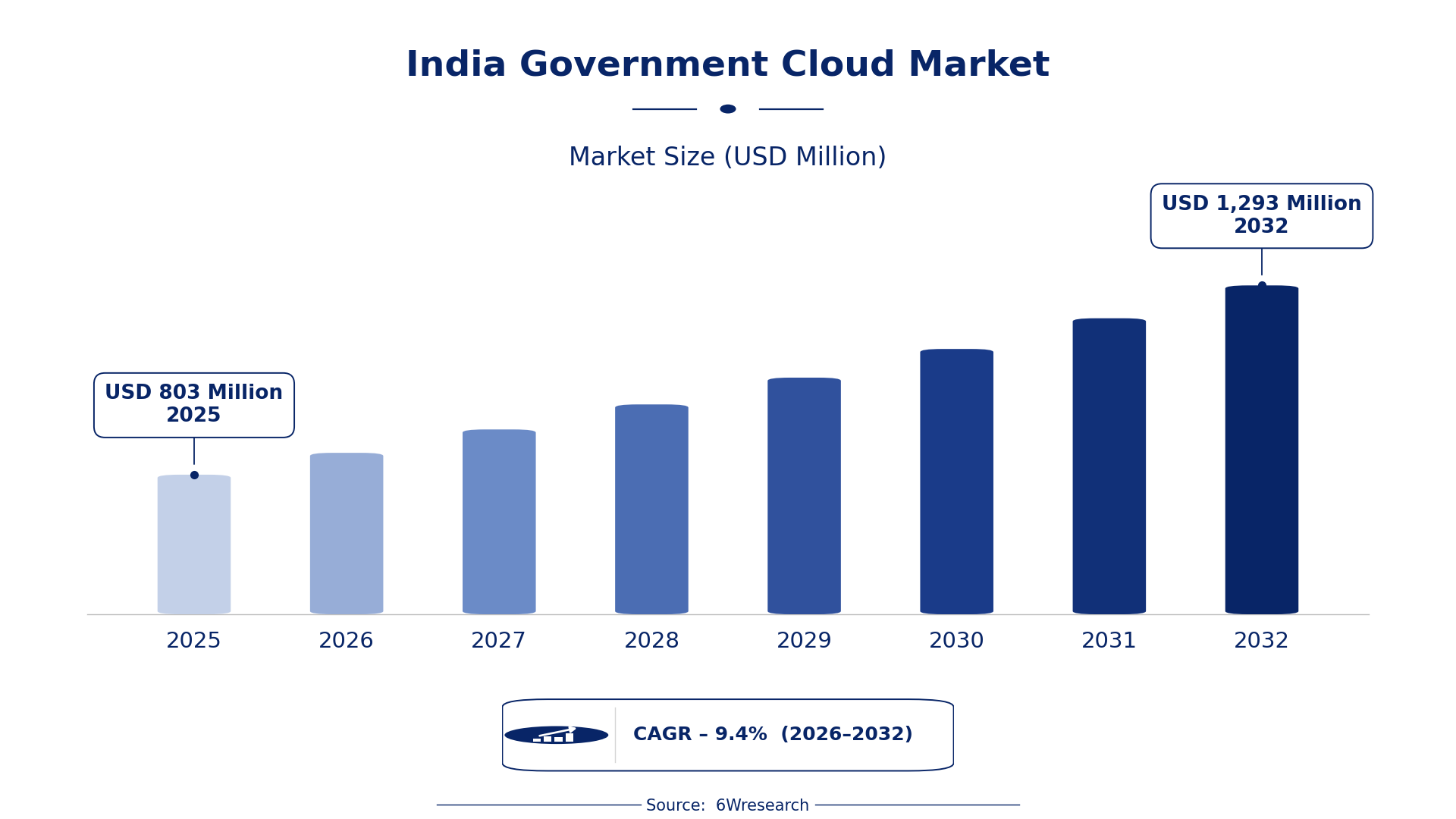
The India Government Cloud Market was estimated at USD 803 Million in 2025 and is projected to reach USD 1293 Million by 2032, growing at a CAGR of 9.4% from 2026 to 2032.
India Government Cloud Market Synopsis
The India Government Cloud Market is witnessing an accelerated shift as government agencies increasingly adopt cloud solutions to enhance service delivery and operational efficiency. This transition is not just about technology; it reflects a broader commitment to modernize public services and improve citizen engagement.
With initiatives like Digital India at the forefront, various sectors, including healthcare and education, are leveraging cloud technologies to streamline processes and secure data. The ongoing digital transformation is reshaping how government entities operate, aiming for transparency and enhanced citizen service.
India Government Cloud Market Year-wise Growth Rate and Key Drivers
This graph illustrates the annual growth rates of the India Government Cloud Market from 2021 to 2032, highlighting a steady upward trajectory and projected expansion over the forecast period.
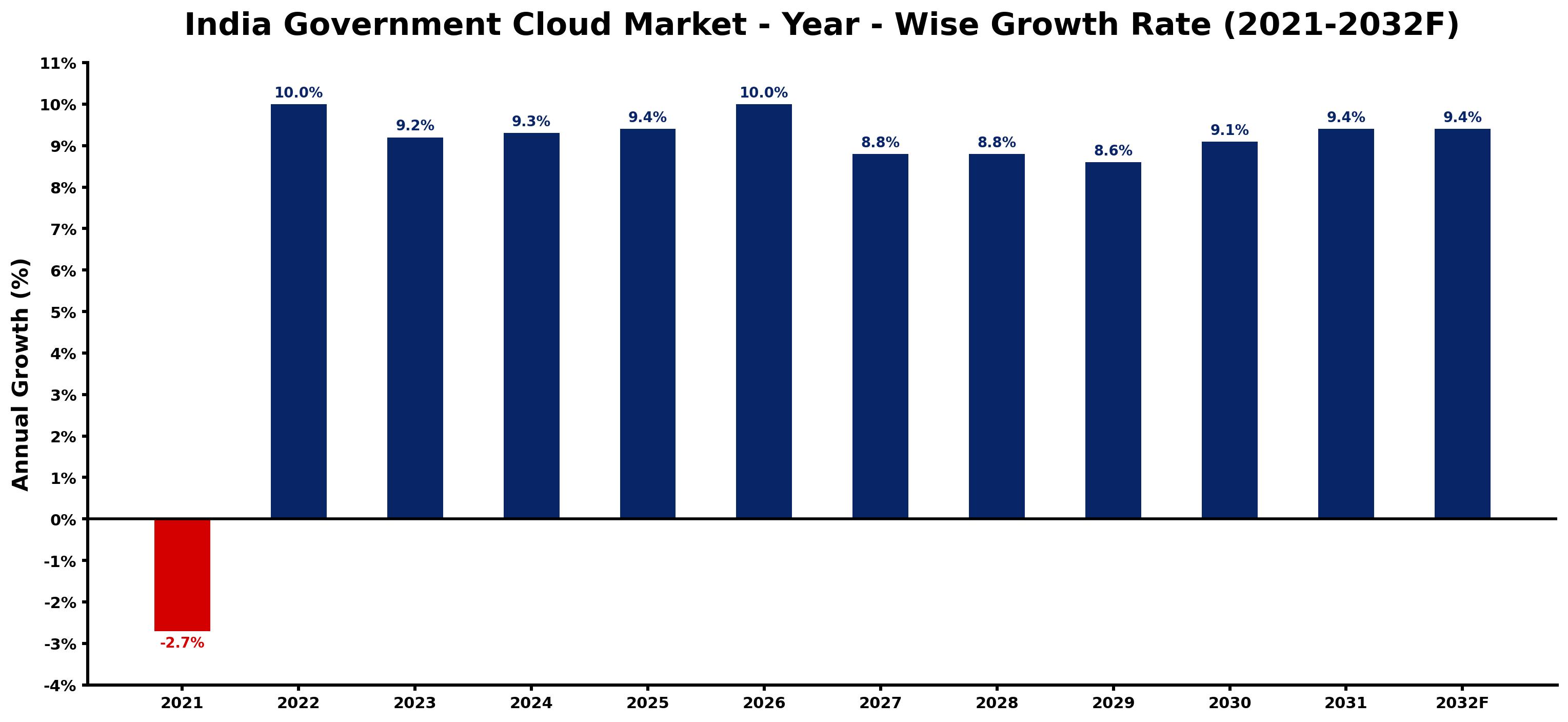
The table below presents the year‑wise growth rates along with the key drivers influencing the market
| Year | Growth Rate | Major Drivers |
| 2021 | -2.7% | Delayed adoption of cloud services by government agencies. |
| 2022 | 10.0% | Digital India initiative promoting cloud adoption in government. |
| 2023 | 9.2% | Increased funding for e-governance projects via NITI Aayog. |
| 2024 | 9.3% | Local cloud hosting regulations supporting data sovereignty initiatives. |
| 2025 | 9.4% | Adoption of GIS technologies enhancing government service delivery. |
| 2026 | 10.0% | Boost from Smart Cities Mission increasing cloud service requirements. |
| 2027 | 8.8% | Cybersecurity regulations driving secure cloud infrastructure investments. |
| 2028 | 8.8% | Government partnership with IT firms for digital service enhancement. |
| 2029 | 8.6% | Growth of hybrid cloud solutions catering to government needs. |
| 2030 | 9.1% | Investment in public health cloud services post-pandemic recovery. |
| 2031 | 9.4% | Launch of National Data Governance Framework improving data use. |
| 2032 | 9.4% | Sustainable Development Goals driving cloud-based public service initiatives. |
Note: Market size estimations and growth projections presented in this report are based on 6Wresearch's proprietary forecasting methodology, utilizing the latest available industry data, government publications, and primary research inputs.
India Government Cloud Market Key Takeaways
Below are some of the specific key takeaways from the market, including:
- The market is primarily driven by the government's digital transformation initiatives.
- Cloud solutions are enhancing operational efficiency and data security across various departments.
- Investment in cloud infrastructure is expected to rise, particularly in e-governance applications.
- Challenges in internet connectivity and compliance with data protection laws remain crucial considerations.
- Key players are tailoring solutions to meet the unique needs of government agencies.
Evaluation of Restraints in India Government Cloud Market
Despite its promising trajectory, the India Government Cloud Market faces several constraints. One significant challenge is ensuring reliable and secure backup services, particularly in regions with inconsistent internet connectivity. Without robust infrastructure, the potential benefits of cloud adoption may remain untapped. Data encryption and compliance with evolving data protection laws are also critical factors that could hinder the pace of cloud integration within government agencies.
India Government Cloud Market Trends
A few trends are shaping the India Government Cloud Market. Firstly, there's a notable shift towards hybrid cloud solutions that allow agencies to balance flexibility and security. Secondly, as cybersecurity threats grow, government agencies are prioritizing cloud services that offer advanced security features. Lastly, the push for open data initiatives is encouraging transparency and fostering greater citizen engagement through cloud-based platforms.
India Government Cloud Market Opportunities
The opportunities in the India Government Cloud Market are abundant. As government entities look to upgrade their IT infrastructure, cloud solutions that offer scalability and cost-effectiveness will be in high demand. The growing emphasis on e-governance initiatives presents avenues for investment in specialized cloud services tailored for various sectors. on top of that, partnerships with private sector players can enhance innovation and service delivery in public administration.
Government Initiatives in the India Government Cloud Market
The Indian government is actively shaping the cloud market through various initiatives that reflect its commitment to digital transformation. Policies and programs are being introduced to enhance the use of cloud technologies in public services, focusing on improving efficiency and accessibility. This strategic alignment of public policy with technology is crucial for driving the adoption of cloud solutions across government agencies.
- A national digital infrastructure upgrade programme launched in 2022 aims to enhance connectivity and access to cloud services.
- A regulatory framework established in 2023 mandates data protection compliance, influencing how cloud services are deployed in the public sector.
- Current initiatives include the implementation of cloud-based solutions in education and healthcare sectors, which are underway to improve service delivery.
- A planned public-private partnership expected to kick off in 2025 aims to expand cloud infrastructure access across rural areas.
- Ongoing discussions about a centralized cloud services platform for government agencies are set to begin in late 2024.
Future Insights of the India Government Cloud Market
Looking ahead to 2026-2032, the India Government Cloud Market is likely to experience significant growth. As digital transformation continues to gain traction, the demand for secure and scalable cloud solutions will increase across various governmental functions. Enhanced data analytics capabilities and integration of emerging technologies such as AI will further propel cloud adoption, making it a cornerstone of public service delivery in India.
India Government Cloud Market Latest Developments
Recent months have seen dynamic changes in the India Government Cloud Market, reflecting an increasing commitment from public agencies to adopt cloud solutions. The focus has shifted towards creating a more secure and efficient digital infrastructure that meets the diverse needs of government functions. This evolution is critical as agencies aim to enhance service delivery and operational capabilities.
- A major technology vendor announced the launch of a government-focused cloud solution in early 2025, aiming to enhance data security protocols.
- In mid-2025, a significant initiative began to migrate various public services to cloud platforms, currently underway with positive feedback from end users.
- Plans for a comprehensive training program for government employees on cloud technologies are scheduled to roll out in Q1 2026.
- A public-private collaboration is expected to begin in late 2025, focusing on developing tailored cloud services for local government bodies.
- By mid-2026, a pilot project for integrating AI capabilities into existing cloud services is planned, reflecting the government’s push towards advanced technologies.
India Government Cloud Market - Key Attractiveness of the Report
- 10 Years of Market Numbers
- Historical Data Starting from 2022 to 2025
- Base Year: 2025
- Forecast Data until 2032
- Key Performance Indicators Impacting the Market
- Major Upcoming Developments and Projects
Key Highlights of the Report:
- India Government Cloud Market Outlook
- Market Size of India Government Cloud Market, 2025
- Forecast of India Government Cloud Market, 2032
- Historical Data and Forecast of India Government Cloud Revenues & Volume for the Period 2022-2032F
- India Government Cloud Market Trend Evolution
- India Government Cloud Market Drivers and Challenges
- India Government Cloud Price Trends
- India Government Cloud Porter's Five Forces
- India Government Cloud Industry Life Cycle
- Historical Data and Forecast of India Government Cloud Market Revenues & Volume By Solutions for the Period 2022-2032F
- Historical Data and Forecast of India Government Cloud Market Revenues & Volume By Cloud Storage for the Period 2022-2032F
- Historical Data and Forecast of India Government Cloud Market Revenues & Volume By Disaster Recovery for the Period 2022-2032F
- Historical Data and Forecast of India Government Cloud Market Revenues & Volume By Identity and Access Management (IAM) for the Period 2022-2032F
- Historical Data and Forecast of India Government Cloud Market Revenues & Volume By Risk and compliance management for the Period 2022-2032F
- Historical Data and Forecast of India Government Cloud Market Revenues & Volume By Others (reporting and analytics, and security and vulnerability) for the Period 2022-2032F
- Historical Data and Forecast of India Government Cloud Market Revenues & Volume By Services for the Period 2022-2032F
- Historical Data and Forecast of India Government Cloud Market Revenues & Volume By Training, consulting, and education for the Period 2022-2032F
- Historical Data and Forecast of India Government Cloud Market Revenues & Volume By Support and Maintenance for the Period 2022-2032F
- Historical Data and Forecast of India Government Cloud Market Revenues & Volume By Integration and Migration for the Period 2022-2032F
- Historical Data and Forecast of India Government Cloud Market Revenues & Volume By Service Model for the Period 2022-2032F
- Historical Data and Forecast of India Government Cloud Market Revenues & Volume By Infrastructure as a Service (IaaS) for the Period 2022-2032F
- Historical Data and Forecast of India Government Cloud Market Revenues & Volume By Platform as a Service (PaaS) for the Period 2022-2032F
- Historical Data and Forecast of India Government Cloud Market Revenues & Volume By Software as a Service (SaaS) for the Period 2022-2032F
- Historical Data and Forecast of India Government Cloud Market Revenues & Volume By Deployment Model for the Period 2022-2032F
- Historical Data and Forecast of India Government Cloud Market Revenues & Volume By Public Cloud for the Period 2022-2032F
- Historical Data and Forecast of India Government Cloud Market Revenues & Volume By Private Cloud for the Period 2022-2032F
- Historical Data and Forecast of India Government Cloud Market Revenues & Volume By Hybrid Cloud for the Period 2022-2032F
- India Government Cloud Import Export Trade Statistics
- Market Opportunity Assessment By Solutions
- Market Opportunity Assessment By Services
- Market Opportunity Assessment By Service Model
- Market Opportunity Assessment By Deployment Model
- India Government Cloud Top Companies Market Share
- India Government Cloud Competitive Benchmarking By Technical and Operational Parameters
- India Government Cloud Company Profiles
- India Government Cloud Key Strategic Recommendations






































