Egypt Government Cloud Market Size & Growth Rate (2026-2032)
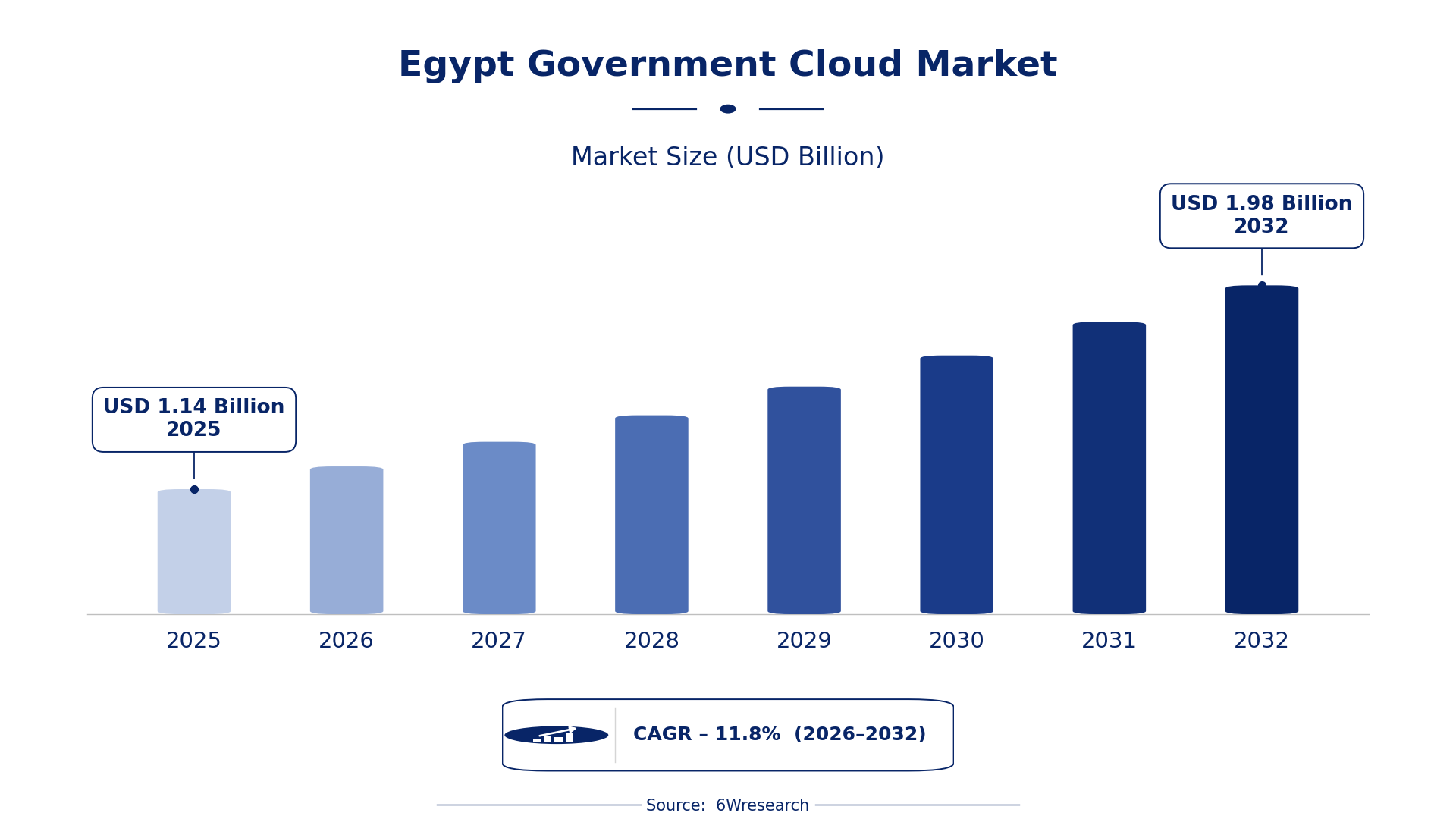
The Egypt Government Cloud Market was estimated at USD 1141 Million in 2025 and is projected to reach USD 1977 Million by 2032, growing at a CAGR of 11.8% from 2026 to 2032.
Egypt Government Cloud Market Synopsis
The driving force behind the Egypt Government Cloud Market is the government's aggressive push for digital transformation. This initiative aims to enhance the efficiency and transparency of public services, making cloud adoption not just a preference but a necessity for government agencies.
As agencies increasingly recognize the advantages of cloud solutions, including improved collaboration and cost savings, demand for Software as a Service (SaaS), Infrastructure as a Service (IaaS), and Platform as a Service (PaaS) continues to rise. This trend signals a robust shift toward modernized operations and citizen-centric service delivery.
Egypt Government Cloud Market Year-wise Growth Rate and Key Drivers
This graph illustrates the annual growth rates of the Egypt Government Cloud Market from 2021 to 2032, highlighting a steady upward trajectory and projected expansion over the forecast period.
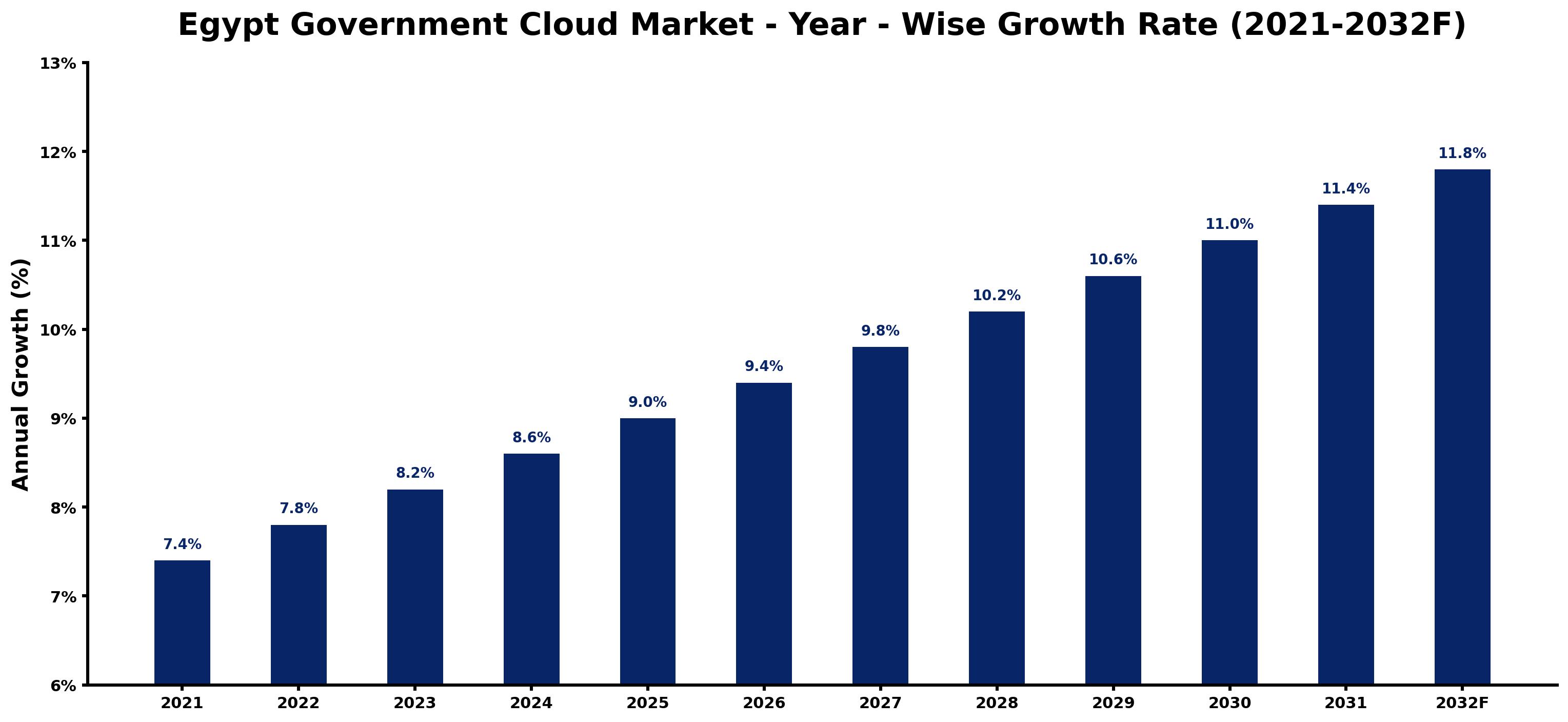
The table below presents the year‑wise growth rates along with the key drivers influencing the market
| Year | Growth Rate | Major Drivers |
| 2021 | 7.4% | Egypt's IT modernization strategy enhances cloud adoption. |
| 2022 | 7.8% | Regulatory reforms boost public sector cloud investments. |
| 2023 | 8.2% | Increasing digital transformation initiatives by government agencies. |
| 2024 | 8.6% | Enhanced cybersecurity measures drive government cloud requirements. |
| 2025 | 9.0% | National Digital Strategy promotes data-driven governance initiatives. |
| 2026 | 9.4% | Local demand for efficient public service delivery rises. |
| 2027 | 9.8% | Public-private partnerships accelerate government cloud service deployment. |
| 2028 | 10.2% | Youth population drives innovation in digital government services. |
| 2029 | 10.6% | Investment in tech startups boosts government cloud solutions. |
| 2030 | 11.0% | Government pledges to reduce operational costs via cloud. |
| 2031 | 11.4% | Strategic focus on smart cities fuels cloud service demand. |
| 2032 | 11.8% | Continued growth in remote working influences cloud infrastructure. |
Note: Market size estimations and growth projections presented in this report are based on 6Wresearch's proprietary forecasting methodology, utilizing the latest available industry data, government publications, and primary research inputs.
Egypt Government Cloud Market Key Takeaways
Below are some of the specific key takeaways from the market, including:
- The market is set to experience a steady growth trajectory fueled by government digital initiatives.
- Cloud solutions are increasingly favored for their ability to enhance operational efficiency and data security.
- Tailored solutions addressing data sovereignty and compliance are becoming essential for government agencies.
- Public-private partnerships are crucial for driving innovation and investment in cloud services.
- The COVID-19 pandemic has accelerated the adoption of cloud technologies within the government sector.
Evaluation of Restraints in Egypt Government Cloud Market
Despite the market's promising outlook, several restraints hinder its growth. Concerns around data security and privacy pose a significant challenge, as government agencies must protect sensitive information from cyber threats. Compliance with local regulations complicates cloud adoption further, particularly regarding data sovereignty. Additionally, many agencies lack the expertise and resources necessary for effective cloud implementation, which can lead to hesitation in migrating critical operations.
Egypt Government Cloud Market Trends
A notable trend in the Egypt Government Cloud Market is the increasing demand for cost-effective and scalable IT solutions. As agencies prioritize digital transformation, there's a marked shift toward cloud-based services that can enhance service delivery and operational efficiencies. Vendors are focusing on advanced security features and data protection, which are essential for gaining the trust of government clients. The rise of remote work models has also intensified the need for reliable cloud solutions that facilitate access to government services.
Egypt Government Cloud Market Opportunities
Opportunities abound for cloud service providers looking to enter the Egypt Government Cloud Market. There is a pressing need for secure and compliant cloud services tailored specifically to government agencies. Innovations that improve efficiency and foster collaboration present significant investment potential. on top of that, as the government continues to modernize its IT infrastructure, providers who can align their offerings with the evolving needs of public services stand to gain a competitive edge.
Government Initiatives in the Egypt Government Cloud Market
The Egyptian government is actively shaping the cloud market through a series of initiatives aimed at enhancing public sector efficiency and security. By establishing a clear regulatory framework and promoting digital transformation, the government is making strides toward a more connected and responsive public service.
- A recently completed initiative involved the launch of the Egypt Government Cloud (EG-Cloud), which centralizes IT resources for better service delivery.
- A currently ongoing effort includes the implementation of a national data protection policy ensuring compliance with local regulations.
- Upcoming plans feature a public-private partnership program aimed at enhancing digital infrastructure across government agencies.
- The introduction of a regulatory framework mandating data residency to ensure sensitive government data remains within national borders.
- A planned digital skills training initiative for government employees to boost cloud technology expertise and facilitate smoother transitions to cloud solutions.
Future Insights of the Egypt Government Cloud Market
Looking ahead to 2026-2032, the Egypt Government Cloud Market is likely to see accelerated growth driven by continued government support for digital transformation. As agencies seek to enhance efficiency and security, cloud computing solutions will become increasingly integral to public service operations. The expansion of high-speed internet infrastructure and a commitment to e-governance initiatives will further catalyze this growth, providing a fertile environment for cloud service providers.
Egypt Government Cloud Market Latest Developments
Recent activity in the Egypt Government Cloud Market reflects a growing commitment to cloud technologies, with various developments aimed at enhancing public service delivery. As agencies continue to adapt to the digital age, the focus has shifted toward more secure and efficient cloud solutions.
- A major technology vendor launched a new cloud service tailored for government operations in early 2025, enhancing data security features.
- An initiative that began in mid-2025 focuses on upgrading the IT infrastructure of local government agencies to support cloud adoption.
- A rollout expected to begin in the second half of 2026 aims to expand internet access to remote government offices, facilitating cloud service utilization.
- A current partnership between government agencies and private tech firms is underway to develop advanced cloud-based solutions for public sector challenges.
- A planned conference scheduled for late 2026 will focus on cloud technology innovations in public service, promoting knowledge sharing among stakeholders.
Egypt Government Cloud Market - Key Attractiveness of the Report
- 10 Years of Market Numbers
- Historical Data Starting from 2022 to 2025
- Base Year: 2025
- Forecast Data until 2032
- Key Performance Indicators Impacting the Market
- Major Upcoming Developments and Projects
Key Highlights of the Report:
- Egypt Government Cloud Market Outlook
- Market Size of Egypt Government Cloud Market, 2025
- Forecast of Egypt Government Cloud Market, 2032
- Historical Data and Forecast of Egypt Government Cloud Revenues & Volume for the Period 2022-2032F
- Egypt Government Cloud Market Trend Evolution
- Egypt Government Cloud Market Drivers and Challenges
- Egypt Government Cloud Price Trends
- Egypt Government Cloud Porter's Five Forces
- Egypt Government Cloud Industry Life Cycle
- Historical Data and Forecast of Egypt Government Cloud Market Revenues & Volume By Solutions for the Period 2022-2032F
- Historical Data and Forecast of Egypt Government Cloud Market Revenues & Volume By Cloud Storage for the Period 2022-2032F
- Historical Data and Forecast of Egypt Government Cloud Market Revenues & Volume By Disaster Recovery for the Period 2022-2032F
- Historical Data and Forecast of Egypt Government Cloud Market Revenues & Volume By Identity and Access Management (IAM) for the Period 2022-2032F
- Historical Data and Forecast of Egypt Government Cloud Market Revenues & Volume By Risk and compliance management for the Period 2022-2032F
- Historical Data and Forecast of Egypt Government Cloud Market Revenues & Volume By Others (reporting and analytics, and security and vulnerability) for the Period 2022-2032F
- Historical Data and Forecast of Egypt Government Cloud Market Revenues & Volume By Services for the Period 2022-2032F
- Historical Data and Forecast of Egypt Government Cloud Market Revenues & Volume By Training, consulting, and education for the Period 2022-2032F
- Historical Data and Forecast of Egypt Government Cloud Market Revenues & Volume By Support and Maintenance for the Period 2022-2032F
- Historical Data and Forecast of Egypt Government Cloud Market Revenues & Volume By Integration and Migration for the Period 2022-2032F
- Historical Data and Forecast of Egypt Government Cloud Market Revenues & Volume By Service Model for the Period 2022-2032F
- Historical Data and Forecast of Egypt Government Cloud Market Revenues & Volume By Infrastructure as a Service (IaaS) for the Period 2022-2032F
- Historical Data and Forecast of Egypt Government Cloud Market Revenues & Volume By Platform as a Service (PaaS) for the Period 2022-2032F
- Historical Data and Forecast of Egypt Government Cloud Market Revenues & Volume By Software as a Service (SaaS) for the Period 2022-2032F
- Historical Data and Forecast of Egypt Government Cloud Market Revenues & Volume By Deployment Model for the Period 2022-2032F
- Historical Data and Forecast of Egypt Government Cloud Market Revenues & Volume By Public Cloud for the Period 2022-2032F
- Historical Data and Forecast of Egypt Government Cloud Market Revenues & Volume By Private Cloud for the Period 2022-2032F
- Historical Data and Forecast of Egypt Government Cloud Market Revenues & Volume By Hybrid Cloud for the Period 2022-2032F
- Egypt Government Cloud Import Export Trade Statistics
- Market Opportunity Assessment By Solutions
- Market Opportunity Assessment By Services
- Market Opportunity Assessment By Service Model
- Market Opportunity Assessment By Deployment Model
- Egypt Government Cloud Top Companies Market Share
- Egypt Government Cloud Competitive Benchmarking By Technical and Operational Parameters
- Egypt Government Cloud Company Profiles
- Egypt Government Cloud Key Strategic Recommendations






































