China Hand Sanitizer Market Size & Growth Rate
According to 6Wresearch internal database and industry insights, the China Hand Sanitizer Market was valued at USD 1.20 Billion in 2025 and is projected to reach USD 2.08 Billion by 2032, growing at a CAGR of approximately 8.2% during 2026–2032.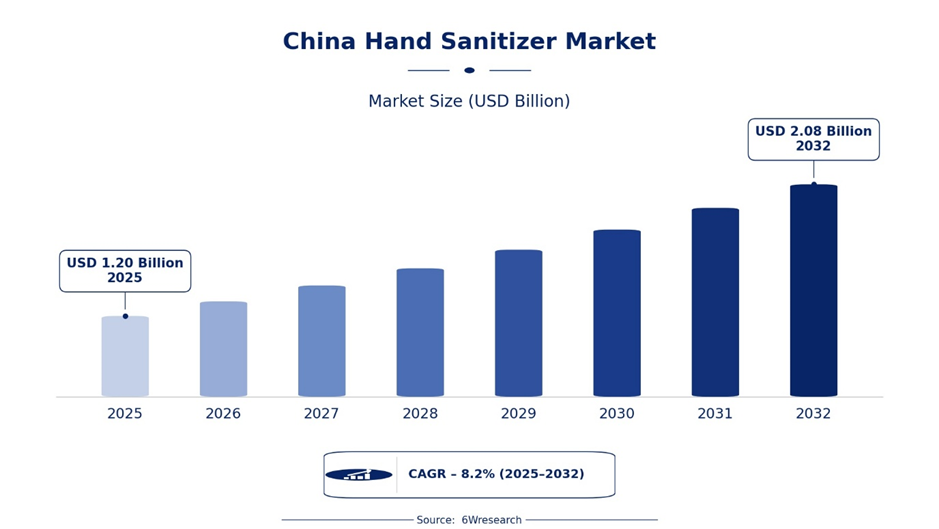
China Hand Sanitizer Market Highlights
|
Report Metric |
Details |
|
Report Name |
China Hand Sanitizer Market (2026-2032) |
|
Market Size 2025 |
USD 1.20 Billion |
|
Market Size 2032 |
USD 2.08 Billion |
|
Absolute Growth 2025–2032 |
USD 0.88 Billion |
|
CAGR 2026–2032 |
8.2% |
|
Peak Annual Growth |
9.4% in 2029 |
|
Forecast Period |
2026–2032 |
|
Historical Data |
2022–2025 |
|
Base Year |
2025 |
|
Leading Product Type, 2025 |
Alcohol Based (78%) |
|
Fastest-Growing Product Type |
Non-Alcohol Based (10.8% CAGR) |
|
Leading Product Form, 2025 |
Gel (52%) |
|
Fastest-Growing Product Form |
Foam (11.5% CAGR) |
|
Leading Distribution Channel, 2025 |
Offline (68%) |
|
Fastest-Growing Distribution Channel |
Online (10.4% CAGR) |
|
Leading End Users, 2025 |
Domestic Household (34%) |
|
Fastest-Growing End Users |
Educational Institution (9.1% CAGR) |
|
Growing Sector |
Foam and non-alcohol hand hygiene products sold through online channels |
|
Key End Users |
Households, hospitals and clinics, schools and childcare operators, hotels and restaurants, offices and retail operators, transport operators, institutional cleaning contractors |
China Hand Sanitizer Market Year-wise Growth Rate and Key Drivers (2022–2032)
This graph illustrates the annual growth rates of the market from 2022 to 2032, highlighting a steady upward trajectory and projected market expansion over the forecast period. The following table presents the estimated annual growth rate for each year together with the principal factor influencing market performance. The values are intended to highlight year-specific drivers rather than to provide a direct comparison between individual years.
|
Year |
Estimated Annual Growth (%) |
Market Rationale |
|
2022 |
5.1% |
Repeated lockdowns in Shanghai and other cities under the zero-Covid policy sustained disinfection demand, though supply disruptions limited volumes. |
|
2023 |
3.4% |
Ending of zero-Covid controls in December 2022 and inventory unwinding normalised demand, producing the weakest growth of the historical period. |
|
2024 |
6.3% |
Resumption of large-scale tourism and events revived purchases of portable sanitiser products across major cities. |
|
2025 |
7.2% |
Expanding instant-delivery services on Meituan and Tmall Supermarket made small-pack hygiene products easier to buy, lifting volumes. |
|
2026 |
7.6% |
Wider adoption of foam dispensers and updated hygiene routines in managed buildings is expected to lift institutional volumes. |
|
2027 |
8.9% |
Launch of milder, moisturising formulations by domestic brands is expected to broaden household use and lift average selling prices. |
|
2028 |
8% |
Intensifying promotional discounting during shopping festivals is expected to moderate value growth as price competition widens. |
|
2029 |
9.4% |
Rising incomes in lower-tier cities and the expansion of organised retail are expected to drive peak category penetration. |
|
2030 |
8.5% |
Higher base volumes and maturing penetration in major cities are expected to moderate incremental growth after the 2029 peak. |
|
2031 |
7.7% |
Plastic packaging restrictions are expected to raise refill and recyclable packaging costs, slowing price-led growth. |
|
2032 |
7.3% |
Substitution by liquid hand wash and wipes is expected to temper growth toward the end of the forecast. |
Note: Market size estimations and growth projections presented in this report are based on 6Wresearch’s proprietary forecasting methodology, utilizing the latest available industry data, government publications, and primary research inputs.
China Hand Sanitizer Market Synopsis
The China Hand Sanitizer Market is anticipated to expand, supported by growing consumer focus on preventive hygiene, wider use of sanitising products in public facilities and the continued development of online distribution channels. Alcohol-based and non-alcohol-based products in gel, foam and spray forms serve households, hospitals, schools, workplaces and hospitality establishments. Post-pandemic hygiene awareness and national health promotion priorities are encouraging regular sanitiser use beyond healthcare environments. The rise of Douyin and Tmall will further contribute to online shopping, but there are well-known brands like Blue Moon, Liby, Dettol, and Safeguard which are increasing their market share through innovative formulas and marketing initiatives.
Market Dynamics Impact Analysis (2026–2032)
|
Factor |
Type |
Impact |
Primary Segment Affected |
|
Hospital infection-control practice and hygiene standards |
Driver |
High |
Healthcare |
|
Growth of livestream and platform retail |
Driver |
High |
Online |
|
Demand for gentle, non-alcohol formulations |
Opportunity |
High |
Non-Alcohol Based |
|
Foam dispensing and refill systems for managed buildings |
Opportunity |
Medium |
Foam |
|
Normalisation of post-pandemic demand |
Restraint |
High |
Alcohol Based |
|
Substitution by soap and liquid hand wash |
Restraint |
Medium |
Domestic Household |
|
Counterfeit and mislabelled products |
Challenge |
Medium |
Online |
|
Packaging and ethanol cost pressure |
Challenge |
Medium |
Gel |
Evaluation of Drivers in the China Hand Sanitizer Market (2026–2032)
Below mentioned are some major drivers and their influence on the market dynamics:
|
Drivers |
Primary Segment Affected |
Why It Matters (Evidence) |
|
Hospital infection-control practice |
Healthcare |
Hospitals must provide hand rub at the point of care, which creates bulk, recurring demand for alcohol-based products. The national health standard WS/T 313-2019 sets hand hygiene requirements for healthcare workers, including defined moments for hand hygiene. |
|
Livestream and platform retail |
Online |
Platforms reach buyers in smaller cities and enable bundles and promotions, which raise trial and repeat purchase of low-ticket hygiene items. Online channels accounted for about a quarter of physical goods retail sales in 2024. |
|
Income growth and trade-up |
Foam |
Higher incomes allow households to move from basic liquid soap to premium sanitisers with better feel and fragrance. National per capita disposable income reached RMB 41,314 in 2024. |
|
School hygiene routines |
Educational Institution |
Seasonal outbreaks of influenza and hand-foot-and-mouth disease lead schools and childcare centres to adopt routine hygiene measures. China has about 290 million students across all education levels. |
|
Domestic tourism and hospitality activity |
Hospitality & Others |
Higher visitor volumes increase the number of public touchpoints where operators provide sanitiser. Domestic tourism reached about 5.6 billion trips in 2024. |
The growth of the market is driven by continued urbanization, with more than 67% of the total population residing in cities, where there is high demand in the densely populated urban centers, where portable hygiene products are utilized regularly. The increased investment in branding by companies in terms of marketing and distribution is contributing to the growth of awareness about the category in secondary cities. Local brands are making investments in pocket packs and refills, which increase the buying frequency of consumers, whereas the foreign brands have extended their range to match Chinese skin and fragrance preferences.
Evaluation of Restraints in the China Hand Sanitizer Market
Below mentioned are some major restraints and their influence on the market dynamics:
|
Market Restraint |
Primary Segment Affected |
Why It Matters (Evidence) |
|
Normalisation of post-pandemic demand |
Alcohol Based |
Stockpiled inventory and emergency buying fade once infection fears recede, which reduces replenishment orders. China ended zero-Covid controls in December 2022, after which pandemic-driven buying unwound. |
|
Substitution by soap and liquid hand wash |
Domestic Household |
Households with piped water often choose soap or hand wash, which are cheaper per use and culturally familiar. Urban water supply coverage is above 99%. |
|
Dangerous goods rules for ethanol products |
Alcohol Based |
Flammability controls raise storage, transport and warehouse costs for manufacturers and distributors. Ethanol solutions fall under UN 1170 in dangerous goods transport classifications. |
|
Dual regulatory pathways |
Non-Alcohol Based |
Products with disinfecting claims and those sold as ordinary hygiene products follow different filing routes, which lengthens launches and raises compliance cost. The Measures for Disinfection Management have applied since 2002 and were amended in 2016. |
|
Price sensitivity in lower-tier markets |
Offline |
Lower-income buyers favour cheaper alternatives and smaller purchases, which limits premium product uptake. Rural per capita disposable income was RMB 21,691 in 2024. |
China Hand Sanitizer Market Challenges
In terms of challenges, short-video retail platforms have attracted unlicensed sellers, and counterfeit or mislabelled products erode trust and price integrity for established brands. Reaching an ethanol content of at least 60% for efficacy ties formulation cost to feedstock prices and limits low-cost reformulation by smaller producers. Plastic pollution control targets for 2025 push brands toward refills and recyclable pumps, which raises packaging cost and requires new filling lines. Multinational and local brands also compete through the 618 shopping festival, where deep discounting squeezes margins and weakens pricing discipline.
Trends in the China Hand Sanitizer Market
Emerging trends shaping the China Hand Sanitizer Industry include the following:
- Transition From Hard-Core to Soft, Gentle Products: Chinese consumers are shifting from hard, highly-alcoholic formulations to products with moisturizers and botanicals, seen in lines of hand sanitizers from Blue Moon and Liby touting their softness. Ingredient-based product reviews take place on social platforms such as Xiaohongshu. Suppliers with the ability to conduct dermatological tests are favored by this trend.
- Shift From Traditional Retail to Live Streaming and Now Shopping: Health products purchases have been transitioning from retail stores to short video live streaming through Douyin and instant commerce delivery through Meituan and JD Daojia, which fit well with low-price point repeat purchase products. Official stores and multipack bundles have been developed on those platforms. This trend favors suppliers that offer flexible small batch packagings.
- Moving away from antibacterial claims to validated and standards-compliant efficacy: Brands are choosing test-based efficacy claims, like 99.9% efficacy on common bacteria and mentioning national hygiene standards. Increasingly, marketplace authorities are asking vendors for test reports and registration files. Accredited lab test data gives vendors a competitive advantage to get listed and buyers in controlled environments have more confidence in the effectiveness of products.
Investment Opportunities in the China Hand Sanitizer Market
Promising investment avenues in the China Hand Sanitizer Market are presented below:
- Gentle non-alcohol formulations: The need for gentler alternatives, driven by sensitive skin and children, creates an opportunity for sanitizers containing quaternary ammonium or plant extracts combined with moisturizers. Investors may pay for building development laboratories and filling lines for non-alcohol sanitizers in gel or foam forms. This is possible through contract manufacturing in Guangdong and Zhejiang province with disinfectant filing according to National Health Commission regulations for products that make antibacterial claims.
- Foam Dispensing and Refill Systems: Controlled buildings are transitioning to touchless foam dispensing systems for effective use and to cut down on wastage. Opportunities lie in foam pumps, wall-mounted and countertop dispensers and refill cartridges that reduce plastic use. Entry is through partnerships with property management and cleaning service companies, supply listings on government and enterprise procurement platforms, and production sites in the Pearl River Delta that serve national distribution.
- Digital Brand Building on Livestream and Instant Retail: Platform retail is where new hygiene brands gain traction fastest, with Douyin, Tmall and Meituan favouring differentiated, content-led products. Investors can fund brand development, content production, fulfilment and customer data capabilities for premium small-pack sanitisers. Entry is through partnerships with multi-channel network agencies, official flagship store operators and third-party logistics providers in Guangzhou, Shanghai and Hangzhou.
Leading Players in China Hand Sanitizer Market
Below is an overview of key companies operating in the China Hand Sanitizer Market:
1. Walch (Wheaton Enterprise / Whealthfields Lohmann Guangzhou Ltd.)
| Company Name | Walch (Wheaton Enterprise / Whealthfields Lohmann Guangzhou Ltd.) |
|---|---|
| Established Year | 2000 |
| Headquarters | Guangzhou, Guangdong, China |
| Official Website | - |
Whealthfields Lohmann manufactures and markets the Walch (威露士) brand, holding the top market share in China for consumer hand sanitizers, foaming hand washes, laundry disinfectants, and surface sanitizing sprays across physical retail and e-commerce platforms.
2. Reckitt Benckiser Group plc (Dettol China)
| Company Name | Reckitt Benckiser Group plc (Dettol China) |
|---|---|
| Established Year | 1932 (Dettol launch) |
| Headquarters | Slough, Berkshire, United Kingdom |
| Official Website | Click Here |
Reckitt Benckiser distributes its flagship brand Dettol (滴露) across major Chinese hypermarkets and digital platforms, offering alcohol-based hand sanitizers, antiseptic liquids, surface wipes, and antibacterial hand soaps designed for personal hygiene and household disinfection.
3. Jifro (Guangzhou Jifro Consumer Products Co., Ltd.)
| Company Name | Jifro (Guangzhou Jifro Consumer Products Co., Ltd.) |
|---|---|
| Established Year | 2007 |
| Headquarters | Guangzhou, Guangdong, China |
| Official Website | - |
Jifro develops, manufactures, and distributes consumer disinfectant sprays, instant hand sanitizers, multi-surface antibacterial liquids, and household cleaning products, holding a significant share of China’s mass-market hygiene segment.
Government Initiatives in the China Hand Sanitizer Market
The Planning Outline for Healthy China 2030, announced in 2016, establishes public health and sanitation as priorities for the nation, and the Healthy China Initiative 2019–2030 specifies 15 initiatives, including one for the prevention of infectious diseases. Disinfection Management Measures (2002; amended 2016) govern disinfectant products, and the national standard GB 27950-2020 specifies the hygiene standards for hand sanitisers.
Implementation is the responsibility of the National Health Commission and the National Patriotic Health Campaign Committee, which runs the National Hygienic Cities initiative, a three-year review process for cities. Global Handwashing Day on 15 October is observed through school and community campaigns coordinated by health authorities and education departments, while the State Administration for Market Regulation supervises product quality and labelling in retail and online channels.
Future Insights of the China Hand Sanitizer Market
The China Hand Sanitizer Market is expected to experience steady growth, supported by an expanding set of hygiene-focused developments. China’s population aged 60 and above reached about 310 million, or 22% of the total, in 2024, which will sustain demand for skin-gentle hygiene products. Smart touchless dispensers with usage tracking will encourage routine hygiene practice in managed facilities. Expanding domestic supply of sanitising active ingredients and fragrances will broaden formulation choice and support local product innovation. Collaboration between brands and dermatology researchers will validate milder formulations and widen appeal among sensitive-skin users.
Market Segmentation Analysis
The report offers a comprehensive study of the market across its key segments. The chart below highlights the leading segment by market share in 2025 and the fastest-growing segment by CAGR over 2026–2032, followed by a detailed analysis of each segment.
By Product Type – Alcohol Based Leads, Non-Alcohol Based Expected to Grow Fastest
According to Ravi Bhandari, Research Head at 6Wresearch, Alcohol Based products captured about 78% share in 2025, as their rapid action and alignment with national hygiene guidance make them the default choice in clinical settings and busy public spaces across Beijing, Shanghai and Guangdong. However, Non-Alcohol Based products are expected to grow fastest at a CAGR of 10.8% during 2026–2032, as families with young children and sensitive-skin users prefer milder formulations and local brands launch moisturising variants.
By Product Form – Gel Leads, Foam Expected to Grow Fastest
Gel accounted for 52% of the market in 2025, reflecting its long shelf life, pocket-friendly bottles and wide availability in supermarkets, convenience stores and pharmacies, which suit China’s high-frequency, small-pack purchase habits. Meanwhile, Foam is projected to record the fastest CAGR of 11.5% over 2026–2032, supported by wall-mounted dispensers in managed buildings and by brands promoting a gentler, less sticky feel through platforms such as Xiaohongshu.
By Distribution Channel – Offline Leads, Online Expected to Grow Fastest
Offline channels dominated with a 68% share in 2025, as hypermarkets such as Walmart China and RT-Mart, convenience chains and pharmacies remain the main points of purchase for impulse and replenishment buying across lower-tier cities. On the other hand, Online is forecast to expand at a CAGR of 10.4% through 2026–2032, led by Tmall, JD.com and Douyin livestream sales, together with same-day delivery on Meituan.
By End Users – Domestic Household Leads, Educational Institution Expected to Grow Fastest
Domestic Household accounted for 34% share in 2025, as urban families keep sanitisers at home, in bags and in cars, and multi-pack purchases through supermarket and online promotions sustain volumes. On the contrary, Educational Institution is expected to post the fastest CAGR of 9.1% over 2026–2032, backed by school hygiene requirements and routine infection-control practices across roughly 290 million students.
Key Attractiveness of the Report
- 10 Years of Market Numbers
- Historical Data Starting from 2022 to 2025
- Base Year 2025
- Forecast Data until 2032
- Key Performance Indicators Impacting the Market
- Major Upcoming Developments and Projects
Key Highlights of the Report:
- China Hand Sanitizer Market Outlook
- Market Size of China Hand Sanitizer Market, 2025
- Forecast of China Hand Sanitizer Market, 2032
- Historical Data and Forecast of Hand Sanitizer Revenues & Volume for the Period 2022-2032
- China Hand Sanitizer Market Trend Evolution
- China Hand Sanitizer Market Drivers and Challenges
- Hand Sanitizer Price Trends
- Hand Sanitizer Porter’s Five Forces
- Hand Sanitizer Industry Life Cycle
- Historical Data and Forecast of China Hand Sanitizer Market Revenues & Volume By Product Type for the Period 2022-2032
- Historical Data and Forecast of China Hand Sanitizer Market Revenues & Volume By Non-Alcohol Based for the Period 2022-2032
- Historical Data and Forecast of China Hand Sanitizer Market Revenues & Volume By Alcohol Based for the Period 2022-2032
- Historical Data and Forecast of China Hand Sanitizer Market Revenues & Volume By Product Form for the Period 2022-2032
- Historical Data and Forecast of China Hand Sanitizer Market Revenues & Volume By Gel for the Period 2022-2032
- Historical Data and Forecast of China Hand Sanitizer Market Revenues & Volume By Foam for the Period 2022-2032
- Historical Data and Forecast of China Hand Sanitizer Market Revenues & Volume By Spray & Others for the Period 2022-2032
- Historical Data and Forecast of China Hand Sanitizer Market Revenues & Volume By Distribution Channel for the Period 2022-2032
- Historical Data and Forecast of China Hand Sanitizer Market Revenues & Volume By Online for the Period 2022-2032
- Historical Data and Forecast of China Hand Sanitizer Market Revenues & Volume By Offline for the Period 2022-2032
- Historical Data and Forecast of China Hand Sanitizer Market Revenues & Volume By End Users for the Period 2022-2032
- Historical Data and Forecast of China Hand Sanitizer Market Revenues & Volume By Healthcare for the Period 2022-2032
- Historical Data and Forecast of China Hand Sanitizer Market Revenues & Volume By Domestic Household for the Period 2022-2032
- Historical Data and Forecast of China Hand Sanitizer Market Revenues & Volume By Educational Institution for the Period 2022-2032
- Historical Data and Forecast of China Hand Sanitizer Market Revenues & Volume By Hospitality & Others for the Period 2022-2032
- Hand Sanitizer Import Export Trade Statistics
- Market Opportunity Assessment By Product Type
- Market Opportunity Assessment By Product Form
- Market Opportunity Assessment By Distribution Channel
- Market Opportunity Assessment By End Users
- Hand Sanitizer Top Companies Market Share
- Hand Sanitizer Competitive Benchmarking By Technical and Operational Parameters
- China Hand Sanitizer Company Profiles
- China Hand Sanitizer Key Strategic Recommendations
Market Covered
The report offers an extensive study of the following market segments.
By Product Type
- Non-Alcohol Based
- Alcohol Based
By Product Form
- Gel
- Foam
- Spray & Others
By Distribution Channel
- Online
- Offline
By End Users
- Healthcare
- Domestic Household
- Educational Institution
- Hospitality & Others (public and private offices, retail, transportation and similar venues)






































