Europe Hand Sanitizer Market Size & Growth Rate
According to 6Wresearch internal database and industry insights, the Europe Hand Sanitizer Market was valued at USD 5 billion in 2025 and is projected to reach USD 10.38 billion by 2032, growing at a CAGR of approximately 11% during 2026–2032.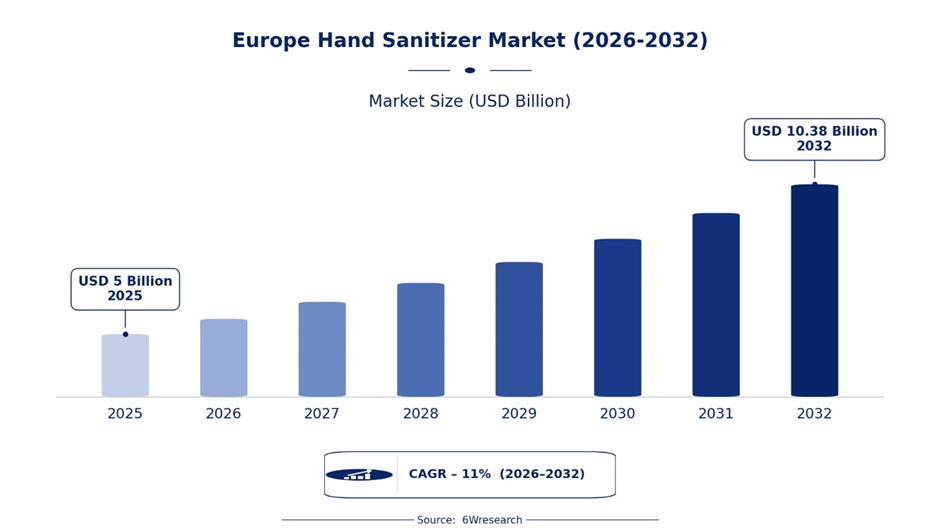
Europe Hand Sanitizer Market Highlights
|
Report Metric |
Details |
|
Report Name |
Europe Hand Sanitizer Market (2026-2032) |
|
Market Size 2025 |
USD 5 billion |
|
Market Size 2032 |
USD 10.38 billion |
|
Absolute Growth 2025–2032 |
USD 5.38 billion |
|
CAGR 2026–2032 |
11% |
|
Peak Annual Growth |
12.8% in 2028 |
|
Forecast Period |
2026–2032 |
|
Historical Data |
2022–2025 |
|
Base Year |
2025 |
|
Leading Product Type, 2025 |
Alcohol Based (76% share) |
|
Fastest-Growing Product Type |
Non-Alcohol Based (13.2% CAGR) |
|
Leading Product Form, 2025 |
Gel (51% share) |
|
Fastest-Growing Product Form |
Foam (12.9% CAGR) |
|
Leading Distribution Channel, 2025 |
Offline (73% share) |
|
Fastest-Growing Distribution Channel |
Online (14.1% CAGR) |
|
Leading End User, 2025 |
Healthcare (39% share) |
|
Fastest-Growing End User |
Hospitality & Others (13.4% CAGR) |
|
Leading Country, 2025 |
Germany (29% share) |
|
Fastest-Growing Country |
Rest of Europe (12.6% CAGR) |
|
Growing Sector |
Hospitality & Others (public and private offices, retail, transportation) |
|
Key End Users |
Hospitals and clinics, long-term care facilities, households, schools and universities, hotels and restaurants, offices, retailers and transport operators |
Europe Hand Sanitizer Market Year-wise Growth Rate and Key Drivers (2022–2032)
This graph illustrates the annual growth rates of the market from 2022 to 2032, highlighting a steady upward trajectory and projected market expansion over the forecast period.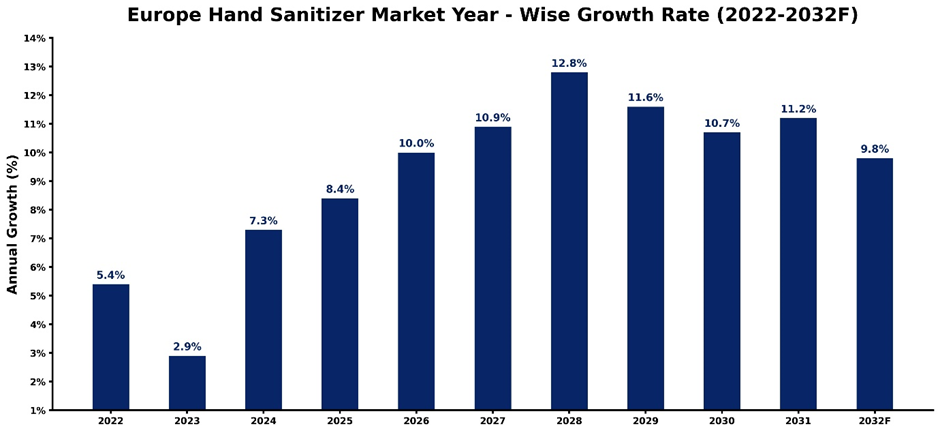 The following table presents the estimated annual growth rate for each year together with the principal factor influencing market performance. The values are intended to highlight year-specific drivers rather than to provide a direct comparison between individual years.
|
Year |
Estimated Annual Growth (%) |
Market Rationale |
|
2022 |
5.4% |
Omicron-driven infection waves in early 2022 sustained purchases. |
|
2023 |
2.9% |
The World Health Organization ended the COVID-19 emergency in May 2023, and consumers and employers sharply reduced routine sanitiser purchasing. |
|
2024 |
7.3% |
Mpox alerts declared by the World Health Organization in August 2024 and strong summer tourism revived public hygiene demand. |
|
2025 |
8.4% |
A strong 2024-25 influenza season across Europe renewed household and institutional stocking of hygiene products. |
|
2026 |
10.0% |
Rollout of upgraded infection-prevention protocols in hospitals is expected to lift institutional purchasing after two years of normalisation. |
|
2027 |
10.9% |
Expansion of refill and dispenser installations in schools, offices and transport hubs is expected to raise recurring consumption. |
|
2028 |
12.8% |
UEFA Euro 2028, hosted across the United Kingdom and Ireland, is scheduled to lift event, transport and hospitality hygiene purchasing. |
|
2029 |
11.6% |
Event-related demand is expected to unwind after the 2028 peak, moderating growth despite steady institutional replenishment. |
|
2030 |
10.7% |
Price competition from retailer private labels and bulk institutional tenders is expected to compress average selling prices. |
|
2031 |
11.2% |
Wider availability of skin-friendly non-alcohol and foam formats through e-commerce is expected to accelerate trial and repeat purchases. |
|
2032 |
9.8% |
Saturating household and workplace penetration is expected to slow volume growth as the market base approaches maturity. |
Note: Market size estimations and growth projections presented in this report are based on 6Wresearch’s proprietary forecasting methodology, utilizing the latest available industry data, government publications, and primary research inputs.
Europe Hand Sanitizer Market Synopsis
The Europe Hand Sanitizer Market is predicted to grow progressively through 2032. The market covers alcohol-based and non-alcohol-based gels, foams and sprays used for waterless hand disinfection across healthcare facilities, households, schools, hotels and workplaces in Germany, Italy, France, the United Kingdom and the rest of the continent. Market expansion is sustained by hospital infection-control routines, heightened post-pandemic hygiene habits, dense public transport and tourism flows, and the spread of pump dispensers in commercial buildings. Competition is shaped by healthcare specialists, global consumer brands and retailer private labels, with differentiation increasingly based on skin tolerance, refill formats and biocidal compliance.
Market Dynamics Impact Analysis (2026–2032)
|
Factor |
Type |
Impact |
Primary Segment Affected |
|
Hospital infection-control protocols |
Driver |
High |
Healthcare |
|
Dispenser installation in transport and public buildings |
Driver |
High |
Hospitality & Others |
|
Skin-friendly and virucidal-validated formulations |
Opportunity |
High |
Non-Alcohol Based |
|
Online pharmacy and subscription refills |
Opportunity |
Medium |
Online |
|
Volatile ethanol and isopropanol costs |
Restraint |
High |
Alcohol Based |
|
Post-pandemic demand normalisation |
Restraint |
Medium |
Domestic Household |
|
Biocidal authorisation across member states |
Challenge |
High |
Gel |
|
Tender price pressure in public procurement |
Challenge |
Medium |
Healthcare |
Evaluation of Drivers in the Europe Hand Sanitizer Market (2026–2032)
Below mentioned are some major drivers and their influence on the market dynamics:
|
Drivers |
Primary Segment Affected |
Why It Matters (Evidence) |
|
Hospital infection-control protocols |
Healthcare |
Point-of-care hand rub use is built into ward routines, so every bed and treatment area creates recurring consumption. An estimated 4 million patients acquire healthcare-associated infections each year across the EU and EEA, which keeps infection prevention a funded priority. |
|
Dispenser installation in transport and public buildings |
Hospitality & Others |
Each installed dispenser needs regular refills, which turns a one-time hardware placement into recurring demand. Major hubs such as Frankfurt and London Heathrow each handle more than 60 million passengers a year, which sustains continuous high-frequency use. |
|
Tourism and guest-facing hygiene expectations |
Spray & Others |
Hotels, resorts and attractions supply sanitiser at guest touchpoints, while travellers buy pocket-sized formats for journeys. Europe recorded roughly 747 million international tourist arrivals in 2024, which gives a very large pool of potential users. |
|
Retail private-label and drugstore shelf access |
Offline |
Drugstore chains list low-priced own-brand sanitisers beside branded products, which lowers the entry price for consumers and widens trial. The dm chain alone operates more than 2,000 stores in Germany, giving broad physical distribution. |
|
Seasonal respiratory and measles outbreaks |
Domestic Household |
Outbreak news and winter infection peaks prompt families to stock up, which creates predictable seasonal sales spikes. The European Region recorded roughly 127,000 measles cases in 2024, the highest since 1997, which renewed attention to everyday hygiene. |
Europe Hand Sanitizer Market Growth is underpinned by higher health awareness and stronger consumer willingness to pay for hygiene products after the pandemic years. Around 75 percent of Europeans live in urban areas, and dense commuting patterns sustain habitual on-the-go use. Manufacturers are investing in formulation science, including skin-conditioning agents, fragrance-free bases and recyclable packaging, which widens the user base and supports premium pricing. Private capital is expanding contract filling and bioethanol-based supply capacity within the region, shortening lead times and improving availability. Rising per-capita spending on personal care adds a steady base for repeat purchases across income groups.
Evaluation of Restraints in the Europe Hand Sanitizer Market
Below mentioned are some major restraints and their influence on the market dynamics:
|
Market Restraint |
Primary Segment Affected |
Why It Matters (Evidence) |
|
Volatile ethanol and isopropanol input costs |
Alcohol Based |
Alcohol is the largest cost item in most hand rubs, so price swings either squeeze manufacturer margins or force price increases. European energy and ethanol costs rose sharply in 2022 after Russia’s invasion of Ukraine, which pressured producers across the region. |
|
Normalisation of demand after the pandemic |
Domestic Household |
Consumers have reduced routine sanitiser purchasing since the emergency phase ended, which leaves inventory and promotional pressure on suppliers. The World Health Organization ended the COVID-19 public health emergency in May 2023. |
|
Flammable goods transport and storage rules |
Online |
High-alcohol rubs are classified as flammable liquids, which raises storage, insurance and carrier costs and limits some parcel and air freight options for e-commerce. Road transport of dangerous goods in Europe is governed by the ADR agreement. |
|
Plastic packaging regulation and recyclability requirements |
Gel |
Pump bottles and mixed-material dispensers face tighter recyclability expectations, which forces redesign and raises packaging cost per unit. The EU Packaging and Packaging Waste Regulation (EU) 2025/40 entered into force in February 2025 and applies from August 2026. |
|
Preference for soap and water |
Educational Institution |
Schools and public institutions often favour handwashing facilities, particularly where hands are visibly soiled, which limits sanitiser substitution. Official guidance sets handwashing at 40 to 60 seconds versus 20 to 30 seconds for hand rubbing, so sanitisers complement rather than replace washing. |
Europe Hand Sanitizer Market Challenges
The Europe Hand Sanitizer Industry goes through various constraints. Biocidal compliance is demanding as every product needs an approved active substance and authorisation routes across 27 member states, which delays launches and favours suppliers with regulatory teams. Staff behaviour is another constraint, since observed hand hygiene compliance among hospital workers is often reported near 40 percent, which leaves installed dispensers underused and limits replenishment volumes. Additionally, public hospital buyers award framework agreements of up to four years largely on price, which limits premium pricing and locks smaller brands out of volume contracts. Meanwhile, differing national labelling languages and pack requirements also raise inventory and packaging costs for suppliers expanding across borders.
Trends in the Europe Hand Sanitizer Market
Key trends shaping the Europe Hand Sanitizer Market are outlined below:
- Shift from High-Alcohol Rubs to Skin-Friendly Formulations: Buyers across Germany, France and the Nordic countries are moving away from high-alcohol rubs towards emollient-enriched and non-alcohol-based products as frequent use dries the skin. Suppliers are reformulating with glycerol, aloe and skin-conditioning agents while retaining proven germicidal performance. The shift rewards formulators with dermatological testing capability and gives suppliers a way to differentiate beyond price.
- Shift from Alcohol Content Claims to Virucidal Validation: Hospital and care-home buyers increasingly ask for virucidal test reports under EN 14476 in addition to stated alcohol concentration, after pandemic experience showed formulation, not just ethanol content, determines performance. Suppliers with documented efficacy data are winning shortlisting in tenders, while unvalidated products are filtered out. The trend raises testing costs but strengthens the position of established healthcare brands.
- Transition from Clinical Products to Personal-Care Accessories: Hand sanitiser is moving from a purely clinical product towards a personal-care accessory, with scented, moisturising and pocket-sized formats sold in beauty chains such as Douglas in Germany and Sephora in France. Brands are borrowing cosmetic design cues and gift-ready packaging. The shift supports higher price points and brings cosmetic brands into the category.
Investment Opportunities in the Europe Hand Sanitizer Market
Growth-oriented investment opportunities in the Europe Hand Sanitizer Market include the following:
- Long-Term Care and Outpatient Clinic Supply: Italy and Germany have some of the oldest populations in Europe, which is expanding residential care and outpatient clinic networks that need hand hygiene supplies. Investors can supply 500 ml to 1 litre pump bottles and wall dispensers with WHO-formulation rubs, plus refill contracts. Entry is through regional purchasing bodies and group-purchasing organisations, with a local distributor holding hospital-tender registrations.
- Refillable and Recycled-Content Packaging Lines: Retailers and institutional buyers are setting recycled-content and refill targets, creating demand for compliant packaging that few regional suppliers offer today. Capital can go into recycled-HDPE pump bottle lines, refill pouches and bag-in-box formats for dispensers. Entry is through partnerships with packaging converters in Germany or Poland, backed by recyclability certification.
- School and Childcare Foam Supply: Schools and childcare centres in the United Kingdom and France increasingly specify gentle formulations for young skin and routine hygiene stations. Investors can supply alcohol-free foam, child-safe dispensers and classroom refill packs. Entry is through local authority framework agreements and education-supply distributors, supported by dermatological testing and child-safety certification.
Leading Players in Europe Hand Sanitizer Market
A detailed compilation of major companies active in the Europe Hand Sanitizer Market is presented below:
1. Ecolab Inc.
| Company Name | Ecolab Inc. |
|---|---|
| Established Year | 1923 |
| Headquarters | Saint Paul, Minnesota, United States |
| Official Website | Click Here |
Ecolab Inc. is a global provider of hygiene, water and infection-prevention solutions. In Europe it supplies hand hygiene products and dispensing systems to healthcare, hospitality and food-service customers.
2. GOJO Industries, Inc.
| Company Name | GOJO Industries, Inc. |
|---|---|
| Established Year | 1946 |
| Headquarters | Akron, Ohio, United States |
| Official Website | Click Here |
GOJO Industries is the maker of the Purell brand of hand hygiene products. It supplies sanitiser and dispenser systems to healthcare and commercial facilities across European markets.
3. Reckitt Benckiser Group plc
| Company Name | Reckitt Benckiser Group plc |
|---|---|
| Established Year | 1999 |
| Headquarters | Slough, United Kingdom |
| Official Website | Click Here |
Reckitt is a multinational health, hygiene and home care group. Through brands such as Dettol, it supplies hand hygiene products to consumers and institutions across European markets.
4. Paul Hartmann AG
| Company Name | Paul Hartmann AG |
|---|---|
| Established Year | 1867 |
| Headquarters | Heidenheim an der Brenz, Germany |
| Official Website | Click Here |
Paul Hartmann AG is a German medical and hygiene products company. It supplies hand disinfection and infection-prevention products to hospitals, care providers and pharmacies across Europe.
5. Schülke & Mayr GmbH
| Company Name | Schülke & Mayr GmbH |
|---|---|
| Established Year | 1889 |
| Headquarters | Norderstedt, Germany |
| Official Website | Click Here |
Schülke & Mayr GmbH is a German specialist in disinfection and antisepsis. It supplies hand rubs and surface disinfectants to healthcare, laboratory and industrial customers across European markets.
Government Initiatives in the Europe Hand Sanitizer Market
The regulatory framework rests on the 2009 Council Recommendation on patient safety, which asks member states to adopt national infection-prevention strategies, and on Regulation (EU) 2022/2371 on serious cross-border health threats, in force since 2023, which strengthens preparedness planning. Hand rubs also fall under the Biocidal Products Regulation (EU) No 528/2012. The EU4Health Programme for 2021–2027, with a budget of about EUR 5.3 billion, finances prevention, surveillance and crisis-readiness measures across member states.
Implementation is led by the European Centre for Disease Prevention and Control, which runs point prevalence surveys across EU and EEA hospitals, and by national bodies such as the Robert Koch Institute in Germany and the UK Health Security Agency, established in 2021. Germany’s Aktion Saubere Hände campaign, launched in 2008, has enrolled well over 1,000 hospitals, while World Hand Hygiene Day on 5 May anchors annual awareness drives.
Future Insights of the Europe Hand Sanitizer Market
The Europe Hand Sanitizer Market is predicted to grow progressively through 2032. Future growth will be shaped by sensor-enabled dispensing systems that track usage and automate replenishment, giving facility operators reliable consumption data. Strategic stockpiling policies maintained by national authorities are expected to keep a baseline of institutional orders in place. Additionally, the EU’s commitments to cut net emissions by 55 percent by 2030 and reach climate neutrality by 2050 are supporting bio-based ethanol and recyclable packaging investment. Furthermore, advances in skin-conditioning and antimicrobial formulation science will widen acceptance among frequent users and support steadier repeat demand across the region.
Market Segmentation Analysis
The report offers a comprehensive study of the market across its key segments. The chart below highlights the leading segment by market share in 2025 and the fastest-growing segment by CAGR over 2026–2032, followed by a detailed analysis of each segment.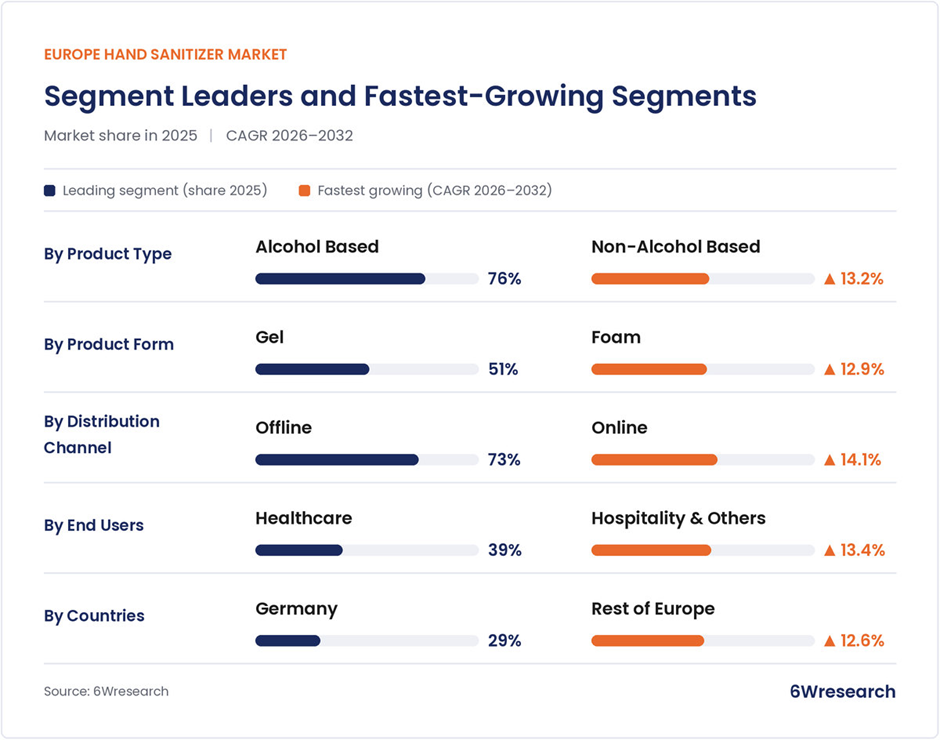
By Product Type – Alcohol Based Leads, Non-Alcohol Based Expected to Grow Fastest
According to Ravi Bhandari, Research Head at 6Wresearch, Alcohol Based products led with a 76% Europe Hand Sanitizer Market Share in 2025, as ethanol and isopropanol formulations follow the WHO-recommended composition used in European hospital protocols and offer proven germicidal performance at low unit cost. At the same time, Non-Alcohol Based products are expected to grow fastest at a CAGR of 13.2% over 2026–2032, driven by demand for gentler formulations among frequent users and for options acceptable in schools and care settings.
By Product Form – Gel Leads, Foam Expected to Grow Fastest
Gel formats accounted for the largest 2025 industry share at 51%, supported by a thicker consistency that stays on the hands during rubbing, long-standing use in hospital wall dispensers and the wide range of pack sizes stocked across European drugstores. In parallel, Foam is projected to record the fastest CAGR of 12.9% during 2026 - 2032, as its quick-spreading, less sticky feel suits frequent use and appeals to buyers seeking lighter, skin-friendly alternatives.
By Distribution Channel – Offline Leads, Online Expected to Grow Fastest
Offline channels held 73% of 2025 sales as pharmacies, drugstore chains, supermarkets and institutional distributors dominated the supply of both bulk and consumer packs across Europe. At the same time, Online is the fastest-growing route, with a CAGR of 14.1% during 2026–2032, as pharmacy platforms and marketplaces offer multipack subscriptions, home delivery and wider product choice.
By End Users – Healthcare Leads, Hospitality & Others Expected to Grow Fastest
Healthcare was the largest end user with a 39% industry share in 2025, as hospitals, clinics and long-term care facilities follow strict point-of-care hand hygiene protocols and procure sanitiser in bulk. Meanwhile, Hospitality & Others is expected to expand fastest at a CAGR of 13.4% during 2026-2032, supported by guest-facing hygiene stations in hotels and restaurants and by sanitiser provision in offices, retail outlets and transport networks.
By Countries – Germany Leads, Rest of Europe Expected to Grow Fastest
Germany accounted for the largest industry share at 29% in 2025, owing to its large hospital sector, strong drugstore retail network and established hygiene culture. In parallel, Rest of Europe is expected to record the fastest CAGR of 12.6% over 2026–2032, as Spain, Poland and the Nordic countries expand healthcare access, tourism flows and modern retail.
Key Attractiveness of the Report
- 10 Years of Market Numbers
- Historical Data Starting from 2022 to 2025
- Base Year 2025
- Forecast Data until 2032
- Key Performance Indicators Impacting the Market
- Major Upcoming Developments and Projects
Key Highlights of the Report:
- Europe Hand Sanitizer Market Overview
- Europe Hand Sanitizer Market Outlook 2025
- Europe Hand Sanitizer Market Forecast 2023
- Historical Data of Europe Hand Sanitizer Market Revenues & Volume for the Period 2022-2032
- Europe Hand Sanitizer Market Size and Europe Hand Sanitizer Market Forecast of Revenues & Volume, Until 2032
- Historical Data of Europe Hand Sanitizer Market Revenues & Volume, by Product Type, for the Period 2022-2032
- Market Size & Forecast of Europe Hand Sanitizer Market Revenues & Volume, by Product Type, Until 2032
- Historical Data of Europe Hand Sanitizer Market Revenues & Volumes, by Product Form, for the Period 2022-2032
- Market Size & Forecast of Europe Hand Sanitizer Market Revenues & Volumes, by Product Form, Until 2032
- Historical Data of Europe Hand Sanitizer Market Revenues & Volume, by Distribution Channels, for the Period 2022-2032
- Market Size & Forecast of Europe Hand Sanitizer Market Revenues & Volume, by Distribution Channels, Until 2032
- Historical Data of Europe Hand Sanitizer Market Revenues & Volume, by End Users, for the Period 2022-2032
- Market Size & Forecast of Europe Hand Sanitizer Market Revenues & Volume, by End Users, Until 2032
- Historical Data of Germany Hand Sanitizer Market Revenues and Volume, for the Period 2022-2032
- Market Size & Forecast of Germany Hand Sanitizer Market Revenues and Volume, Until 2032
- Historical Data of Italy Hand Sanitizer Market Revenues and Volume, for the Period 2022-2032
- Market Size & Forecast of Italy Hand Sanitizer Market Revenues and Volume, Until 2032
- Historical Data of France Hand Sanitizer Market Revenues and Volume, for the Period 2022-2032
- Market Size & Forecast of France Hand Sanitizer Market Revenues and Volume, Until 2032
- Historical Data of United Kingdom Hand Sanitizer Market Revenues and Volume, for the Period 2022-2032
- Market Size & Forecast of United Kingdom Hand Sanitizer Market Revenues and Volume, Until 2032
- Historical Data of Rest of Europe Hand Sanitizer Market Revenues and Volume, for the Period 2022-2032
- Market Size & Forecast of Rest of Europe Hand Sanitizer Market Revenues and Volume, Until 2032
- Market Drivers and Restraints
- Europe Hand Sanitizer Market Trends and Industry Life Cycle
- Porter’s Five Force Analysis
- Market Opportunity Assessment
- Europe Hand Sanitizer Market Share, By Players
- Europe Hand Sanitizer Market Share, By Regions
- Europe Hand Sanitizer Market Overview on Competitive Benchmarking
- Company Profiles
- Key Strategic Recommendations
Market Covered
The report subsequently covers the market by following segments and subsegments:
By Product Type
- Non Alcohol Based
- Alcohol Based
By Product Form
- Gel
- Foam
- Spray & Others
By Distribution Channel
- Online
- Offline
By End Users
- Healthcare
- Domestic Household
- Educational Institution
- Hospitality & Others (Public & Private offices, Retail, Transportation, etc.)
By Countries
- Germany
- Italy
- France
- United Kingdom
- Rest of Europe






































