China HCM Market Size & Growth Rate (2026-2032)
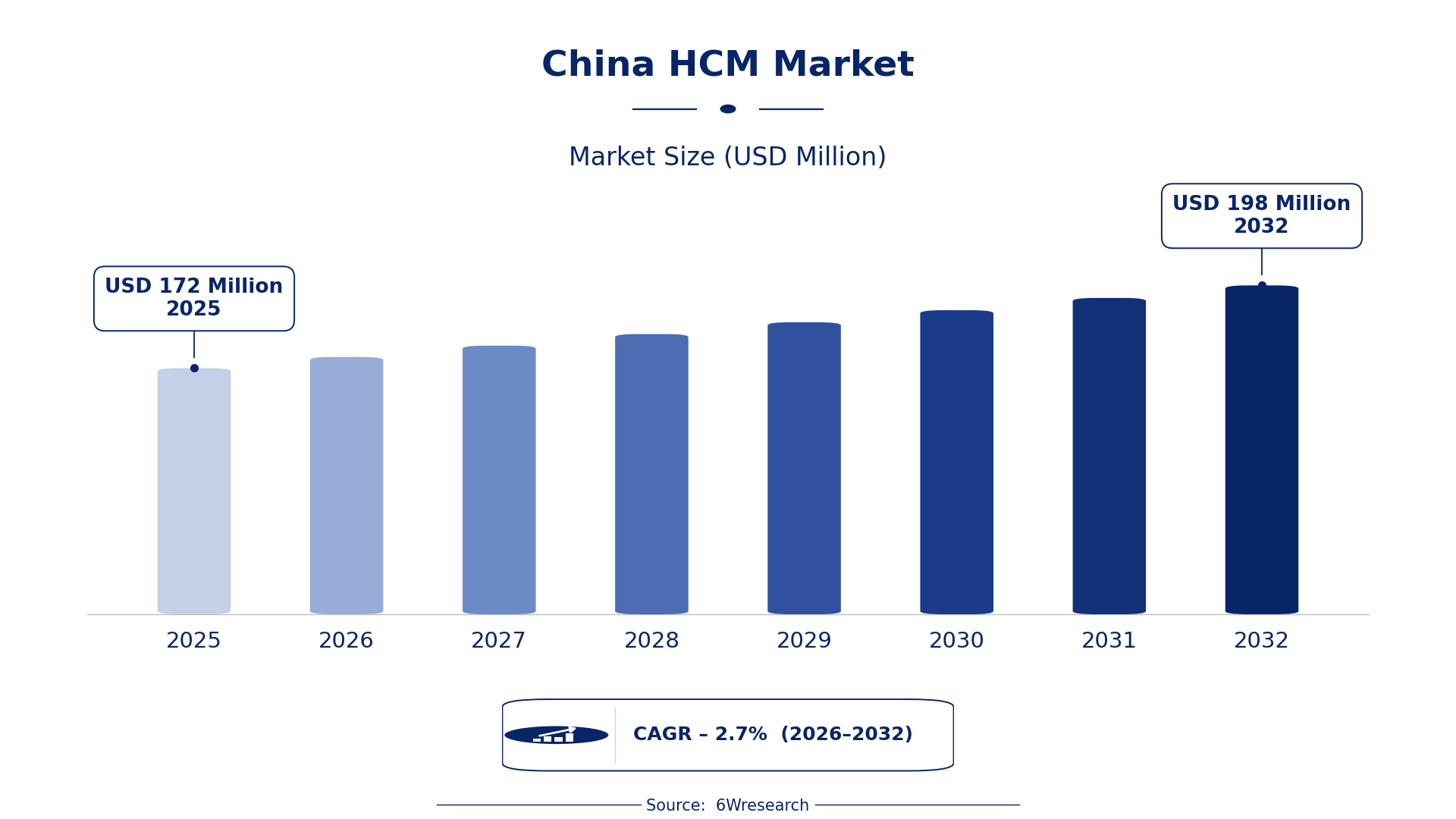
The China HCM Market was estimated at USD 172 Million in 2025 and is projected to reach USD 198 Million by 2032, growing at a CAGR of 2.7% from 2026 to 2032.
China HCM Market Synopsis
The accelerating adoption of technology in human resources is the primary force driving the China HCM market. Organizations are increasingly prioritizing talent management, workforce analytics, and payroll solutions to enhance their operational efficiency and employee engagement.
As companies in China shift towards cloud-based HCM software, the demand for scalable and cost-effective solutions is on the rise, particularly among small and medium-sized enterprises. This trend is reshaping the competitive landscape, as both domestic and international players strive to meet the unique needs of Chinese organizations.
China HCM Market Year-wise Growth Rate and Key Drivers
This graph illustrates the annual growth rates of the China HCM Market from 2021 to 2032, highlighting a steady upward trajectory and projected expansion over the forecast period.
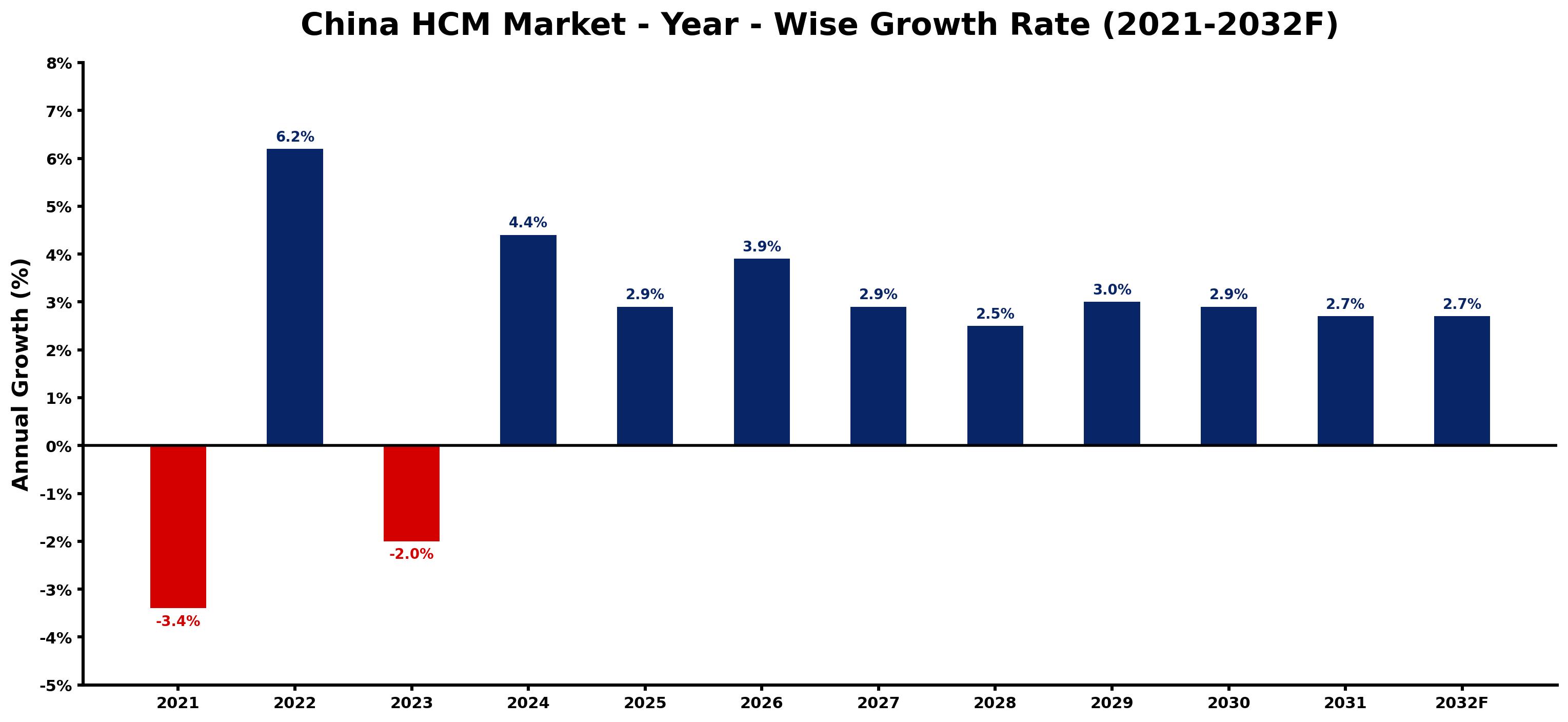
The table below presents the year‑wise growth rates along with the key drivers influencing the market
| Year | Growth Rate | Major Drivers |
| 2021 | -3.4% | China's Ministry of Human Resources raised employment regulations |
| 2022 | 6.2% | Government incentives for digital transformation in HR. |
| 2023 | -2.0% | Increased demand for AI-driven HR tools diverted investments |
| 2024 | 4.4% | Growth in HR tech startups boosting innovation and competition. |
| 2025 | 2.9% | Increased focus on employee engagement programs in firms. |
| 2026 | 3.9% | Supportive regulations for talent mobility in tech sectors. |
| 2027 | 2.9% | Emerging labor market trends driving customized HCM solutions. |
| 2028 | 2.5% | Rising need for compliance with new labor laws. |
| 2029 | 3.0% | Focus on enhancing employer branding for talent retention. |
| 2030 | 2.9% | Integration of wellness programs in corporate HCM strategies. |
| 2031 | 2.7% | Demand for upskilling initiatives in fast-evolving industries. |
| 2032 | 2.7% | Increased digital adoption in HR by large corporations. |
Note: Market size estimations and growth projections presented in this report are based on 6Wresearch's proprietary forecasting methodology, utilizing the latest available industry data, government publications, and primary research inputs.
China HCM Market Key Takeaways
Below are some of the specific key takeaways from the market, including:
- The shift to cloud-based HCM solutions is becoming a standard practice among businesses.
- AI and machine learning are being integrated into HCM systems for enhanced data-driven decision-making.
- Employee wellness and engagement tools are gaining traction as companies focus on improving workplace culture.
- The regulatory environment poses compliance challenges for organizations navigating labor laws.
- Investment opportunities in HR tech startups are expanding, driven by the demand for innovative solutions.
Evaluation of Restraints in China HCM Market
The China HCM market faces several restraints that can hinder its growth. The rapid evolution of labor regulations creates compliance headaches for companies, requiring them to invest significant resources to stay updated. Additionally, the cultural diversity within China complicates the implementation of standardized HCM practices across various regions. Companies are also grappling with the challenge of attracting and retaining top talent in a competitive labor market, which further complicates their human capital strategies.
China HCM Market Trends
A noticeable trend in the China HCM market is the increasing emphasis on cloud-based solutions, driven by digital transformation initiatives across industries. Businesses are focusing on enhancing employee experience and improving workforce management through advanced analytics and automation. Mobile applications for HR functions are becoming essential, catering to remote and field employees. on top of that, organizations are prioritizing employee well-being, investing in tools that support mental health and work-life balance.
China HCM Market Opportunities
Investment opportunities in the China HCM market are on the rise, particularly in the areas of cloud-based software and HR analytics. As digital transformation accelerates, there’s a significant demand for solutions that streamline HR processes and enhance productivity. Companies focusing on employee engagement, training, and wellness are also attracting attention from investors, reflecting a broader trend towards prioritizing human capital development.
Government Initiatives in the China HCM Market
The Chinese government plays a crucial role in shaping the HCM market through various policies aimed at enhancing workforce capabilities and compliance. Regulatory measures are being introduced to ensure fair labor practices while encouraging businesses to adopt digital technologies in their HR processes. These initiatives are designed to foster a more skilled, transparent, and equitable workforce, which aligns with China's economic goals.
- A national digital infrastructure upgrade programme was launched in early 2025 to enhance HR technology adoption.
- Current regulations focus on data protection and employee rights, making compliance a priority for businesses.
- Ongoing initiatives aim to promote skills development through vocational training partnerships with educational institutions.
- Future plans include a regulatory framework expected to be introduced by 2027 to standardize employee wellness programs across industries.
Future Insights of the China HCM Market
Looking ahead to 2026-2032, the China HCM market is set to expand significantly as organizations increasingly recognize the importance of human capital in driving business success. The integration of innovative technologies, such as AI-driven analytics and comprehensive HCM suites, will become more prevalent. As companies continue to prioritize employee engagement and development, the demand for sophisticated HCM solutions will only grow, reinforcing the need for firms to adapt their strategies accordingly.
China HCM Market Latest Developments
In the past year, the China HCM market has seen a surge in activities focusing on technology adoption and employee engagement strategies. Companies are prioritizing investments in innovative solutions to improve their HR processes and workforce management capabilities.
- A major technology vendor launched a new cloud-based HCM platform in Q2 2025, enhancing user experience and analytical capabilities.
- An initiative that began in early 2025 and remains underway aims to integrate AI tools into existing HCM solutions for better talent management.
- A leading regional operator is currently expanding its HR analytics offerings, expected to roll out updates by late 2025.
- Plans for an upcoming training program targeting HR professionals were announced, set to commence in early 2026.
China HCM Market - Key Attractiveness of the Report
- 10 Years of Market Numbers
- Historical Data Starting from 2022 to 2025
- Base Year: 2025
- Forecast Data until 2032
- Key Performance Indicators Impacting the Market
- Major Upcoming Developments and Projects
Key Highlights of the Report:
- China HCM Market Outlook
- Market Size of China HCM Market, 2025
- Forecast of China HCM Market, 2032
- Historical Data and Forecast of China HCM Revenues & Volume for the Period 2022-2032F
- China HCM Market Trend Evolution
- China HCM Market Drivers and Challenges
- China HCM Price Trends
- China HCM Porter's Five Forces
- China HCM Industry Life Cycle
- Historical Data and Forecast of China HCM Market Revenues & Volume By Component for the Period 2022-2032F
- Historical Data and Forecast of China HCM Market Revenues & Volume By Solution for the Period 2022-2032F
- Historical Data and Forecast of China HCM Market Revenues & Volume By Services for the Period 2022-2032F
- Historical Data and Forecast of China HCM Market Revenues & Volume By Deployment Type for the Period 2022-2032F
- Historical Data and Forecast of China HCM Market Revenues & Volume By Cloud for the Period 2022-2032F
- Historical Data and Forecast of China HCM Market Revenues & Volume By On-Premises for the Period 2022-2032F
- Historical Data and Forecast of China HCM Market Revenues & Volume By Organization Size for the Period 2022-2032F
- Historical Data and Forecast of China HCM Market Revenues & Volume By SMEs for the Period 2022-2032F
- Historical Data and Forecast of China HCM Market Revenues & Volume By Large Enterprises for the Period 2022-2032F
- China HCM Import Export Trade Statistics
- Market Opportunity Assessment By Component
- Market Opportunity Assessment By Deployment Type
- Market Opportunity Assessment By Organization Size
- China HCM Top Companies Market Share
- China HCM Competitive Benchmarking By Technical and Operational Parameters
- China HCM Company Profiles
- China HCM Key Strategic Recommendations






































