China Hdpe Market Top 5 Importing Countries and Market Competition (HHI) Analysis
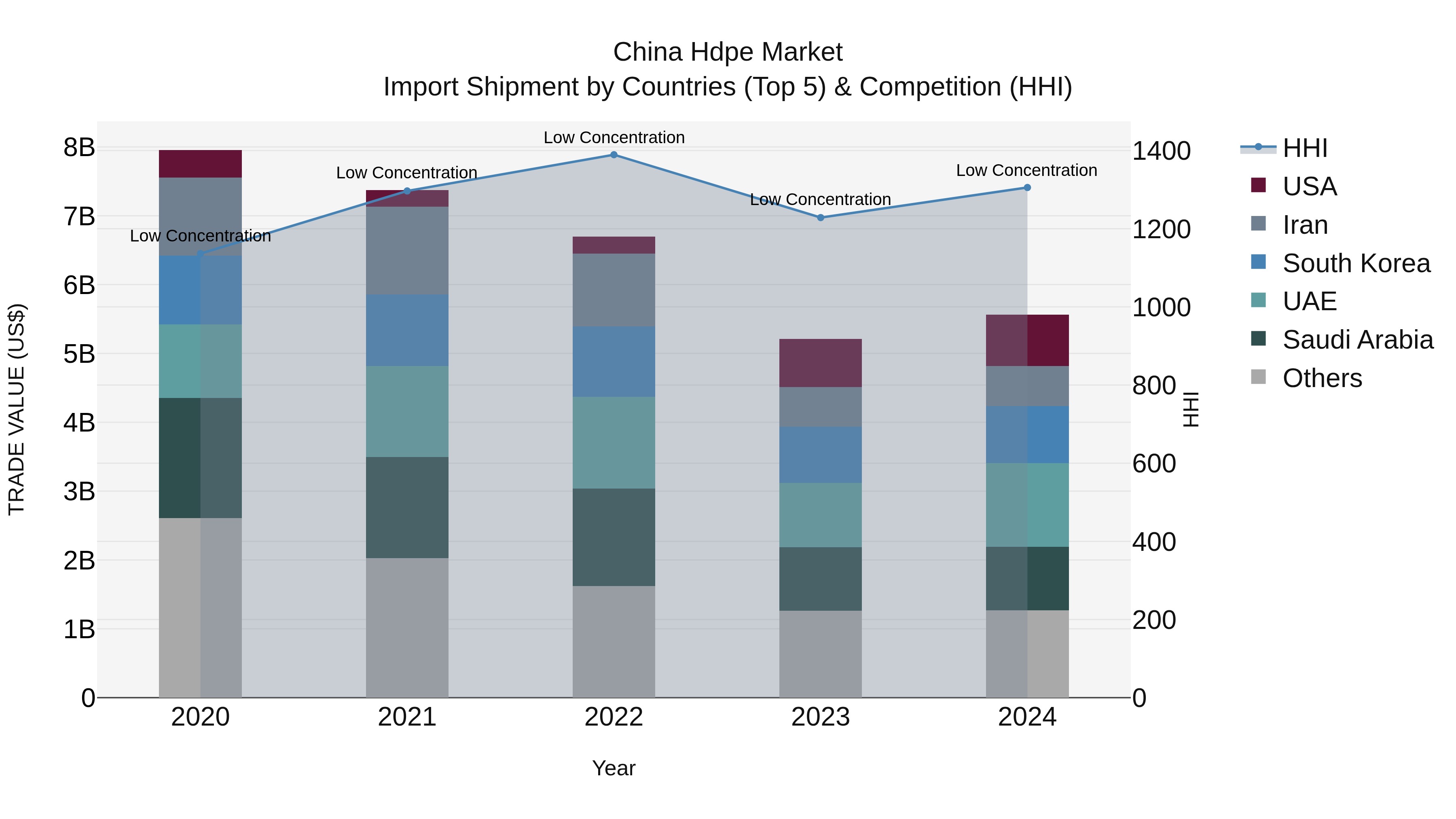
China HDPE import market in 2024 saw a diverse range of top exporting countries including the UAE, Saudi Arabia, South Korea, USA, and Iran. Despite the low concentration level indicated by the Herfindahl-Hirschman Index (HHI), the market experienced a negative compound annual growth rate (CAGR) of -8.54% from 2020 to 2024. However, there was a positive growth rate of 6.77% in 2024 compared to the previous year, suggesting potential opportunities for growth and development in the coming years.
China Hdpe Market Overview
The High-Density Polyethylene (HDPE) market in China is experiencing steady growth driven by its wide range of applications across various industries such as packaging, construction, and automotive. The increasing demand for HDPE in packaging materials due to its lightweight, durable, and recyclable nature is a key factor fueling market growth. Additionally, the construction sector in China is a significant consumer of HDPE for applications like pipes, fittings, and geomembranes. The government`s initiatives to promote sustainable practices and the growing awareness about environmental protection are further boosting the adoption of HDPE products in the country. With the ongoing technological advancements and investments in production capacities, the China HDPE market is expected to continue its upward trajectory in the coming years.
China Hdpe Market Trends
Currently, the HDPE market in China is experiencing several key trends. One major trend is the increasing demand for HDPE in packaging and construction industries due to its properties such as high strength, chemical resistance, and recyclability. Another trend is the rising focus on sustainability and environmental concerns, leading to a shift towards using recycled HDPE materials. Additionally, technological advancements in HDPE production processes are driving efficiency improvements and cost reductions. The market is also witnessing growing investments in research and development to develop innovative HDPE products for various applications, such as automotive, healthcare, and agriculture sectors. Overall, these trends indicate a positive outlook for the China HDPE market with opportunities for growth and innovation in the coming years.
China Hdpe Market Challenges
In the China HDPE market, some challenges include overcapacity leading to intense competition and price pressure, fluctuations in raw material prices and availability, stringent environmental regulations increasing production costs, and the need for continuous innovation to meet evolving customer demands. Additionally, the market is influenced by global economic conditions and trade policies, which can impact demand and supply dynamics. Companies operating in the China HDPE market must navigate these challenges by optimizing their production processes, managing cost efficiencies, investing in research and development for product innovation, and ensuring compliance with environmental regulations to remain competitive and sustainable in the long term.
China Hdpe Market Investment Opportunities
Investment opportunities in the China HDPE (High-Density Polyethylene) market are promising due to the country`s growing demand for packaging materials, infrastructure development, and consumer goods manufacturing. With the increasing focus on environmental sustainability, there is a rising demand for HDPE in industries such as construction, agriculture, and automotive for its recyclability and durability. Additionally, China`s government initiatives to promote the use of plastic recycling and reduce plastic waste create a favorable market environment for HDPE producers and recyclers. Potential investment opportunities include expanding production capacities, investing in recycling technologies, and exploring new applications for HDPE products in various industries. Overall, the China HDPE market presents opportunities for investors looking to capitalize on the growing demand for sustainable plastic solutions in a rapidly developing economy.
China Hdpe Market Government Policy
The Chinese government has implemented various policies to regulate the high-density polyethylene (HDPE) market. This includes measures to promote the recycling and sustainable use of HDPE materials, such as the "Plastic Pollution Control Action Plan" aimed at reducing plastic waste. Additionally, the government has imposed restrictions on the import of plastic waste to address environmental concerns. In terms of production and pricing, the government has implemented regulations to ensure fair competition and prevent monopolies in the HDPE market. Overall, government policies in China related to the HDPE market focus on environmental protection, sustainable development, and market stability.
China Hdpe Market Future Outlook
The future outlook for the China HDPE market appears promising with steady growth anticipated in the coming years. The increasing demand for HDPE in various industries such as packaging, construction, and automotive sectors, coupled with the government`s initiatives to promote sustainable practices, are expected to drive market expansion. Additionally, the rising awareness about the benefits of HDPE, such as its durability, flexibility, and recyclability, will further boost market growth. Technological advancements leading to the development of innovative HDPE products and the growing trend towards lightweight and eco-friendly materials are also likely to create opportunities for market players. Overall, the China HDPE market is projected to experience sustained growth driven by expanding applications and favorable government policies supporting the use of HDPE in different sectors.
Key Highlights of the Report:
- China HDPE Market Outlook
- Market Size of China HDPE Market,2024
- Forecast of China HDPE Market, 2031
- Historical Data and Forecast of China HDPE Revenues & Volume for the Period 2021-2031
- China HDPE Market Trend Evolution
- China HDPE Market Drivers and Challenges
- China HDPE Price Trends
- China HDPE Porter's Five Forces
- China HDPE Industry Life Cycle
- Historical Data and Forecast of China HDPE Market Revenues & Volume By Type for the Period 2021-2031
- Historical Data and Forecast of China HDPE Market Revenues & Volume By PE80 Pipe for the Period 2021-2031
- Historical Data and Forecast of China HDPE Market Revenues & Volume By PE100 Pipe for the Period 2021-2031
- Historical Data and Forecast of China HDPE Market Revenues & Volume By Sales Channel for the Period 2021-2031
- Historical Data and Forecast of China HDPE Market Revenues & Volume By Direct Sales for the Period 2021-2031
- Historical Data and Forecast of China HDPE Market Revenues & Volume By Distribution Sales for the Period 2021-2031
- Historical Data and Forecast of China HDPE Market Revenues & Volume By Application for the Period 2021-2031
- Historical Data and Forecast of China HDPE Market Revenues & Volume By Water Supply for the Period 2021-2031
- Historical Data and Forecast of China HDPE Market Revenues & Volume By Oil and Gas for the Period 2021-2031
- Historical Data and Forecast of China HDPE Market Revenues & Volume By Sewage Systems for the Period 2021-2031
- Historical Data and Forecast of China HDPE Market Revenues & Volume By Agricultural Applications for the Period 2021-2031
- China HDPE Import Export Trade Statistics
- Market Opportunity Assessment By Type
- Market Opportunity Assessment By Sales Channel
- Market Opportunity Assessment By Application
- China HDPE Top Companies Market Share
- China HDPE Competitive Benchmarking By Technical and Operational Parameters
- China HDPE Company Profiles
- China HDPE Key Strategic Recommendations






































