China High Strength Steel Market Size, Share & Growth Rate
The China High Strength Steel Market was estimated at USD 239 Million in 2025 and is projected to reach USD 274 Million by 2032, growing at a CAGR of 2.0% from 2026 to 2032. This upward trajectory is primarily fueled by a booming automotive sector that increasingly prioritizes lightweight materials to enhance fuel efficiency. Additionally, the ongoing expansion of infrastructure projects across the country significantly drives the demand for high strength steel in construction and manufacturing applications.
China High Strength Steel Market Year-wise Growth Rate and Key Drivers
This graph highlights how the China High Strength Steel Market has steadily grown over the years, supported by major growth factors.
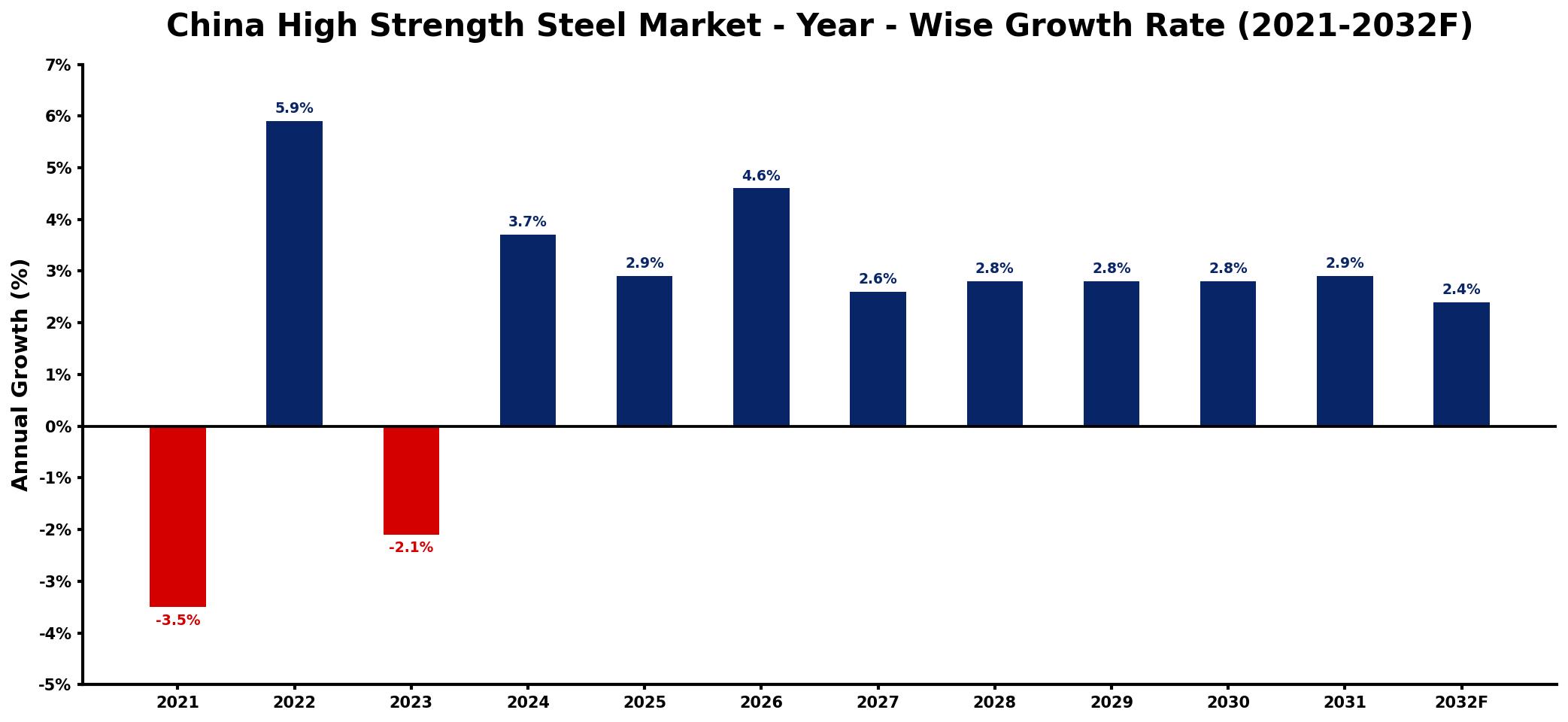
The table below presents the year‑wise growth rates along with the key drivers influencing the market
| Year | Growth Rate | Major Drivers |
| 2021 | -3.5% | decreased infrastructure investment projects |
| 2022 | 5.9% | rising construction sector activities |
| 2023 | -2.1% | slower automotive production rates |
| 2024 | 3.7% | expanding renewable energy initiatives |
| 2025 | 2.9% | increased demand from manufacturing |
| 2026 | 4.6% | growing urban development projects |
| 2027 | 2.6% | rising demand from transportation |
| 2028 | 2.8% | increased investment in construction |
| 2029 | 2.8% | growing industrial automation trends |
| 2030 | 2.8% | expanding electric vehicle production |
| 2031 | 2.9% | rising global energy demands |
| 2032 | 2.4% | increased focus on sustainability |
Note: Market size estimations and growth projections presented in this report are based on 6Wresearch's proprietary forecasting methodology, utilizing the latest available industry data, government publications, and primary research inputs.
China High Strength Steel Market Synopsis
In China, the high strength steel market is witnessing a remarkable surge, particularly within the automotive industry. As manufacturers focus on producing lighter vehicles, the need for advanced steel solutions that offer both strength and weight reduction is critical. Concurrently, infrastructure investments are amplifying the demand for durable materials capable of withstanding demanding environments.
The structural integrity and performance characteristics of high strength steel make it an indispensable resource for various sectors. With stringent regulations on emissions and safety, industries are shifting towards materials that not only meet performance standards but also comply with environmental considerations.
China High Strength Steel Market Key Takeaways
- The market is driven by increasing demand from the automotive and construction sectors.
- High strength steel's superior mechanical properties make it vital for modern applications.
- Infrastructure development initiatives continue to fuel market expansion.
- Government policies supporting innovation in steelmaking technologies enhance competitiveness.
- Challenges related to raw material costs and environmental regulations persist but can be managed strategically.
Evaluation of Restraints in China High Strength Steel Market
Despite the positive growth trajectory, the China High Strength Steel market faces notable restraints. Fluctuations in raw material prices create uncertainty, impacting production costs and profitability. Additionally, stringent environmental regulations may necessitate costly adjustments in manufacturing processes. These factors compel stakeholders to navigate a challenging landscape, balancing economic viability with compliance and sustainability efforts.
China High Strength Steel Market Trends
Emerging trends in the China High Strength Steel market indicate a shift towards sustainability and performance optimization. Manufacturers are increasingly investing in advanced steel processing technologies that enhance product characteristics while minimizing environmental impact. Furthermore, the advent of smart manufacturing practices is driving efficiency and precision in production, enabling quicker adaptation to market demands.
China High Strength Steel Market Opportunities
Significant growth opportunities lie within the electric vehicle (EV) sector, where the emphasis on lightweight materials presents a lucrative avenue for high strength steel applications. Additionally, the growing trend of urbanization and infrastructure development offers a sustained demand for high-performance materials in both residential and commercial projects. Engaging in R&D initiatives to innovate new alloys and processing techniques can also position stakeholders favorably in this competitive market.
Government Initiatives in the China High Strength Steel Market
The Chinese government is implementing various initiatives to bolster the high strength steel market, particularly through funding for infrastructure projects and research in advanced steelmaking technologies. Policies aimed at reducing carbon emissions and enhancing fuel efficiency in the automotive sector align well with the benefits of high strength steel, fostering an environment conducive to growth and innovation. Support for sustainable practices ensures that industry players remain competitive and compliant with future regulations.
Future Insights of the China High Strength Steel Market
Looking ahead to 2026-2032, the China High Strength Steel market is poised for steady growth driven by continued industrial advancements and rising consumer demand for energy-efficient products. As the automotive sector pivots towards electric vehicles, and construction projects emphasize sustainability, the role of high strength steel will only increase. Strategic investments in technology and process improvements will be essential for companies seeking to capitalize on emerging market trends.
China High Strength Steel Market Latest Developments (2025 - 2026)
Recent developments in the China High Strength Steel market reflect a notable shift towards innovation and sustainability. Industry participants are increasingly focused on enhancing production efficiency and developing new steel alloys to meet evolving demand. Collaboration between government agencies and private companies has also intensified, leading to joint initiatives aimed at improving environmental performance in steel manufacturing. These dynamics are shaping the landscape and setting the stage for future advancements.
China High Strength Steel Market - Key Attractiveness of the Report
- 10 Years of Market Numbers
- Historical Data Starting from 2022 to 2025
- Base Year: 2025
- Forecast Data until 2032
- Key Performance Indicators Impacting the Market
- Major Upcoming Developments and Projects
Key Highlights of the Report:
- China High Strength Steel Market Outlook
- Market Size of China High Strength Steel Market, 2025
- Forecast of China High Strength Steel Market, 2032
- Historical Data and Forecast of China High Strength Steel Revenues & Volume for the Period 2022-2032F
- China High Strength Steel Market Trend Evolution
- China High Strength Steel Market Drivers and Challenges
- China High Strength Steel Price Trends
- China High Strength Steel Porter's Five Forces
- China High Strength Steel Industry Life Cycle
- Historical Data and Forecast of China High Strength Steel Market Revenues & Volume By Product Type for the Period 2022-2032F
- Historical Data and Forecast of China High Strength Steel Market Revenues & Volume By Dual Phase Steel for the Period 2022-2032F
- Historical Data and Forecast of China High Strength Steel Market Revenues & Volume By Bake Hardenable Steel for the Period 2022-2032F
- Historical Data and Forecast of China High Strength Steel Market Revenues & Volume By Carbon Manganese Steel for the Period 2022-2032F
- Historical Data and Forecast of China High Strength Steel Market Revenues & Volume By Other Product Types for the Period 2022-2032F
- Historical Data and Forecast of China High Strength Steel Market Revenues & Volume By Application for the Period 2022-2032F
- Historical Data and Forecast of China High Strength Steel Market Revenues & Volume By Automotive for the Period 2022-2032F
- Historical Data and Forecast of China High Strength Steel Market Revenues & Volume By Construction for the Period 2022-2032F
- Historical Data and Forecast of China High Strength Steel Market Revenues & Volume By Yellow Goods and Mining Equipment for the Period 2022-2032F
- Historical Data and Forecast of China High Strength Steel Market Revenues & Volume By Aviation and Marine for the Period 2022-2032F
- Historical Data and Forecast of China High Strength Steel Market Revenues & Volume By Other Applications for the Period 2022-2032F
- China High Strength Steel Import Export Trade Statistics
- Market Opportunity Assessment By Product Type
- Market Opportunity Assessment By Application
- China High Strength Steel Top Companies Market Share
- China High Strength Steel Competitive Benchmarking By Technical and Operational Parameters
- China High Strength Steel Company Profiles
- China High Strength Steel Key Strategic Recommendations






































