China Higher Education Market Size & Growth Rate (2026-2032)
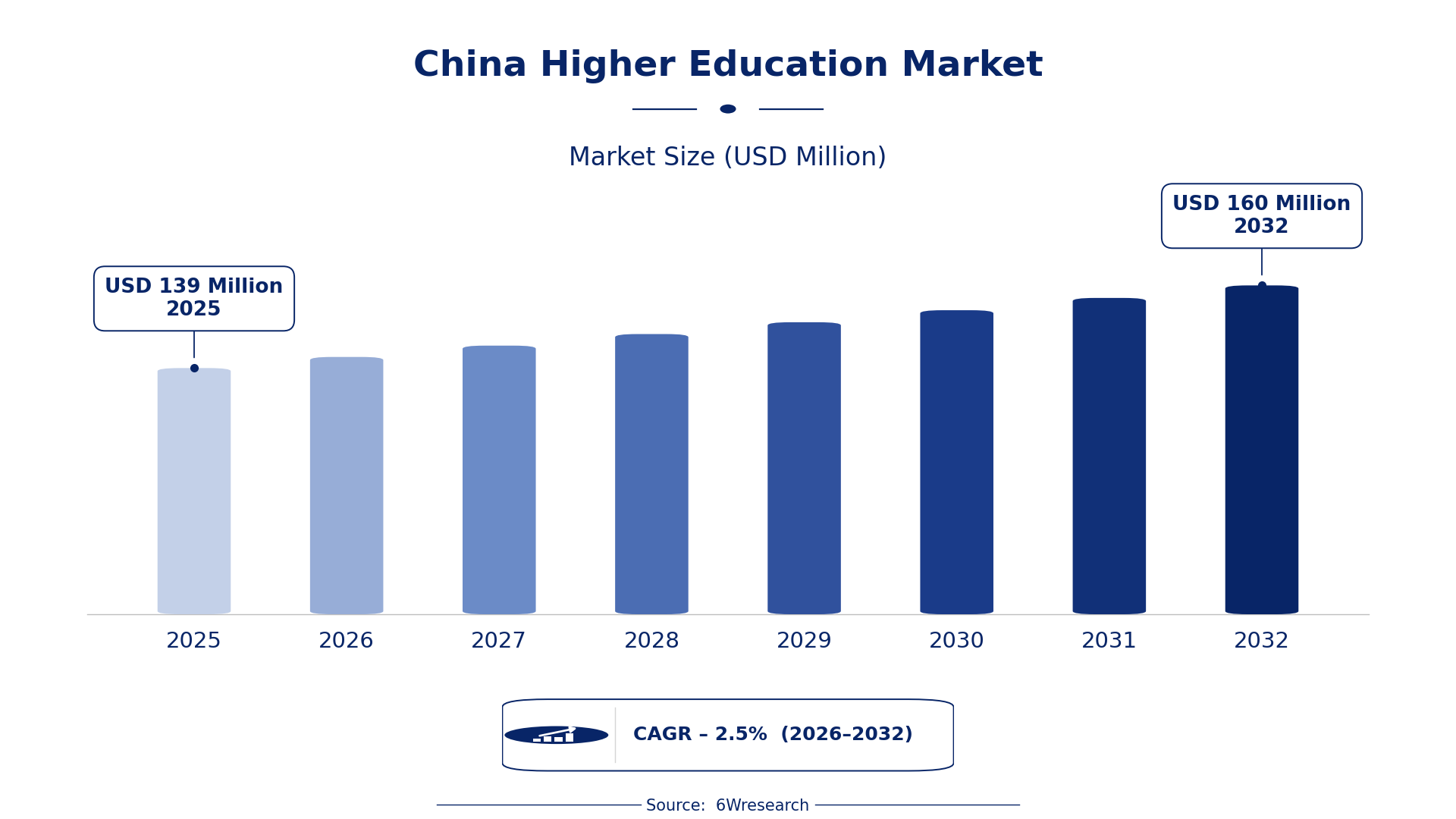
The China Higher Education Market was estimated at USD 139 Million in 2025 and is projected to reach USD 160 Million by 2032, growing at a CAGR of 2.5% from 2026 to 2032.
China Higher Education Market Synopsis
The China Higher Education Market has witnessed remarkable growth recently, fueled by an increasing number of students seeking advanced educational opportunities. However, as the market matures, a need for innovative educational models and institutional adaptability becomes apparent, paving the way for a shift in focus towards quality and sustainability.
Government investments in educational infrastructure and a growing emphasis on research and innovation are reshaping the sector. The burgeoning demand for skilled professionals in a knowledge-based economy further underlines the critical role that higher education institutions will play in meeting future labor market needs.
China Higher Education Market Year-wise Growth Rate and Key Drivers
This graph illustrates the annual growth rates of the China Higher Education Market from 2021 to 2032, highlighting a steady upward trajectory and projected expansion over the forecast period.
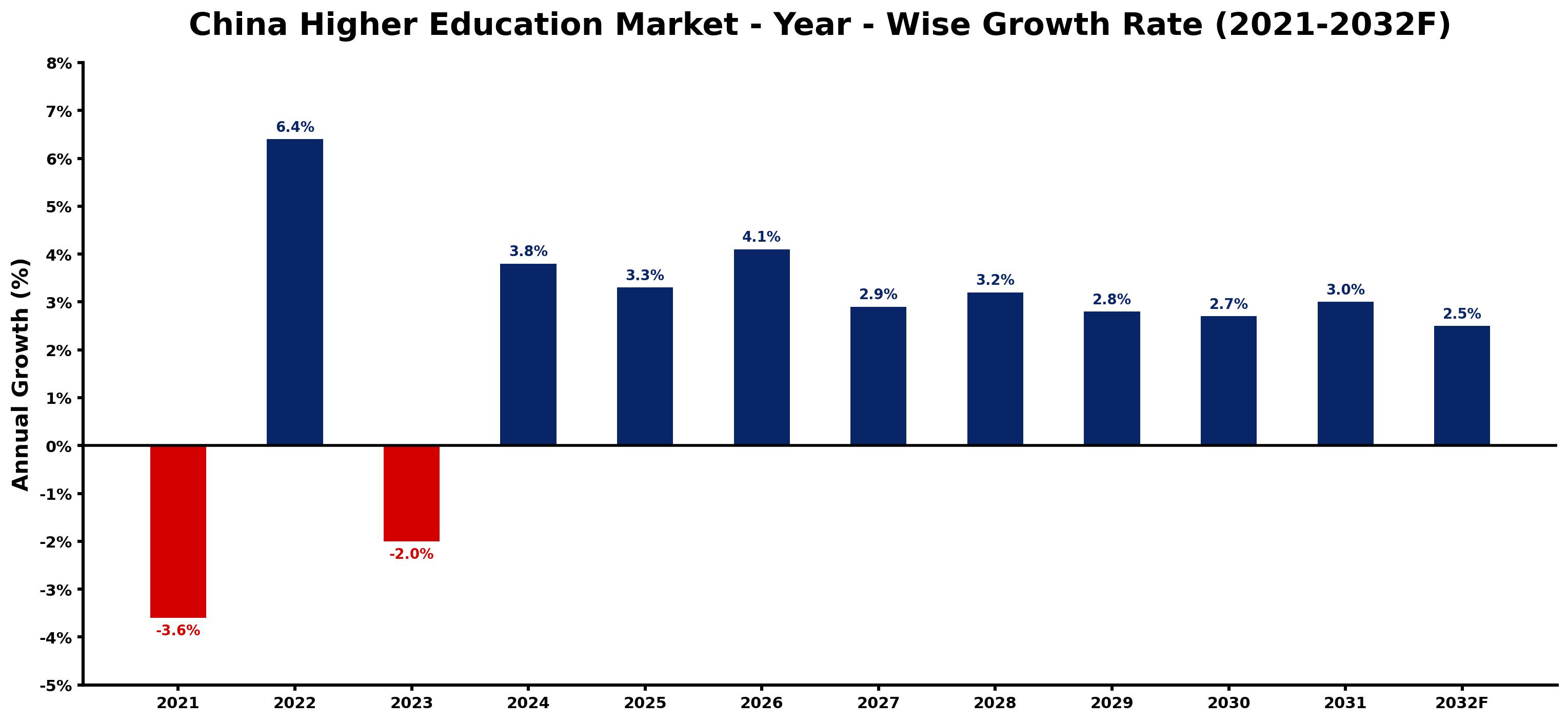
The table below presents the year‑wise growth rates along with the key drivers influencing the market
| Year | Growth Rate | Major Drivers |
| 2021 | -3.6% | Enrollment declines after Ministry of Education policy changes |
| 2022 | 6.4% | Increased government funding for vocational education initiatives. |
| 2023 | -2.0% | Economic pressures leading to reduced student enrollment |
| 2024 | 3.8% | Rising middle-class enrollment in private universities. |
| 2025 | 3.3% | Launch of online education platforms by local universities. |
| 2026 | 4.1% | Demand for skilled labor post-pandemic recovery efforts. |
| 2027 | 2.9% | Policies promoting STEM education in urban areas. |
| 2028 | 3.2% | International partnerships enhancing curriculum quality in colleges. |
| 2029 | 2.8% | Greater emphasis on lifelong learning programs by government. |
| 2030 | 2.7% | Regulatory support for blended learning models in education. |
| 2031 | 3.0% | Growth in adult education driven by aging workforce. |
| 2032 | 2.5% | Increased emphasis on digital skills in university programs. |
Note: Market size estimations and growth projections presented in this report are based on 6Wresearch's proprietary forecasting methodology, utilizing the latest available industry data, government publications, and primary research inputs.
China Higher Education Market Key Takeaways
Below are some of the specific key takeaways from the market, including:
- Significant growth driven by rising student enrollment and government investment.
- Increased emphasis on research and international collaborations among institutions.
- Expansion of online and distance learning programs to cater to diverse learners.
- Growing demand for vocational and skill development training aligned with market needs.
- Regulatory changes impacting funding and operational frameworks of higher education institutions.
Evaluation of Restraints in China Higher Education Market
Despite the growth trajectory, the China Higher Education Market faces substantial restraints. Rapid regulatory changes can create uncertainty for institutions, particularly regarding funding and compliance. Additionally, the challenge of meeting evolving student expectations requires ongoing innovation and resources that may be in short supply. The need to balance quality education with cost-effectiveness poses a significant challenge for many institutions.
China Higher Education Market Trends
A notable trend in the China Higher Education Market is the increasing integration of technology in learning environments. Digital tools and platforms are becoming essential for both teaching and administration, facilitating personalized learning experiences. on top of that, there is a shift towards international education, with more institutions fostering partnerships abroad to enhance educational offerings and global competitiveness.
China Higher Education Market Opportunities
The market offers genuine growth opportunities, especially in the area of online education. The demand for flexible learning solutions is growing, particularly among working professionals seeking skill upgrades. Additionally, collaborations between universities and industries can create pathways for innovative research and development, fostering a more skilled workforce aligned with market demands.
Government Initiatives in the China Higher Education Market
Government policies are crucial in shaping the China Higher Education Market, focusing on increasing access and enhancing educational quality. Recent initiatives demonstrate a commitment to modernizing the sector through infrastructure investments, curriculum reforms, and international partnerships. As the government prioritizes education, these policies will significantly influence the market dynamics.
- A recently launched national initiative aimed at expanding digital infrastructure in higher education institutions to enhance access to online learning resources.
- Ongoing reforms to curriculum standards that emphasize skill development and practical experience, responding to evolving labor market needs.
- A planned public-private partnership expected to increase funding for research institutions, enhancing their capabilities and competitiveness globally.
- A program introduced in 2025 focused on promoting international collaborations between Chinese universities and foreign institutions, aimed at improving educational quality.
- Investment in vocational training programs to address the skills gap in emerging sectors, set to be rolled out by mid-2026.
Future Insights of the China Higher Education Market
Looking ahead to 2026-2032, the China Higher Education Market is likely to see continued growth driven by an evolving economy that increasingly values knowledge and skills. Institutions will need to adapt their offerings to align with industry demands, focusing on interdisciplinary education and practical training. As competition intensifies, the ability to innovate and provide quality education will be critical for institutions aiming to thrive in this dynamic environment.
China Higher Education Market Latest Developments
Recent activity in the China Higher Education Market reflects a strong emphasis on innovation and collaboration. Institutions are increasingly investing in technology to enhance educational delivery and administrative efficiency. The focus on international partnerships is also gaining momentum as universities seek to expand their global reach.
- An initiative that began in early 2025 aimed at integrating artificial intelligence into educational management systems, currently in its implementation phase.
- A major technology vendor partnered with several leading universities in mid-2025 to develop advanced online learning platforms, enhancing remote education capabilities.
- A public announcement in late 2025 regarding a comprehensive review of higher education funding models to ensure sustainability and accessibility moving forward.
- Upcoming collaborations set to launch in Q3 2026 between local universities and foreign institutions focused on joint research initiatives.
- Ongoing upgrades to campus facilities to support hybrid learning environments, with a timeline for completion by late 2026.
China Higher Education Market - Key Attractiveness of the Report
- 10 Years of Market Numbers
- Historical Data Starting from 2022 to 2025
- Base Year: 2025
- Forecast Data until 2032
- Key Performance Indicators Impacting the Market
- Major Upcoming Developments and Projects
Key Highlights of the Report:
- China Higher Education Market Outlook
- Market Size of China Higher Education Market, 2025
- Forecast of China Higher Education Market, 2032
- Historical Data and Forecast of China Higher Education Revenues & Volume for the Period 2022-2032F
- China Higher Education Market Trend Evolution
- China Higher Education Market Drivers and Challenges
- China Higher Education Price Trends
- China Higher Education Porter's Five Forces
- China Higher Education Industry Life Cycle
- Historical Data and Forecast of China Higher Education Market Revenues & Volume By Component for the Period 2022-2032F
- Historical Data and Forecast of China Higher Education Market Revenues & Volume By Solutions for the Period 2022-2032F
- Historical Data and Forecast of China Higher Education Market Revenues & Volume By Services for the Period 2022-2032F
- Historical Data and Forecast of China Higher Education Market Revenues & Volume By Deployment Type for the Period 2022-2032F
- Historical Data and Forecast of China Higher Education Market Revenues & Volume By On-premises for the Period 2022-2032F
- Historical Data and Forecast of China Higher Education Market Revenues & Volume By Cloud for the Period 2022-2032F
- Historical Data and Forecast of China Higher Education Market Revenues & Volume By Vertical for the Period 2022-2032F
- Historical Data and Forecast of China Higher Education Market Revenues & Volume By State Universities for the Period 2022-2032F
- Historical Data and Forecast of China Higher Education Market Revenues & Volume By Community Colleges for the Period 2022-2032F
- Historical Data and Forecast of China Higher Education Market Revenues & Volume By Private Colleges for the Period 2022-2032F
- China Higher Education Import Export Trade Statistics
- Market Opportunity Assessment By Component
- Market Opportunity Assessment By Deployment Type
- Market Opportunity Assessment By Vertical
- China Higher Education Top Companies Market Share
- China Higher Education Competitive Benchmarking By Technical and Operational Parameters
- China Higher Education Company Profiles
- China Higher Education Key Strategic Recommendations






































