China Ilmenite Market Top 5 Importing Countries and Market Competition (HHI) Analysis
China ilmenite import shipments in 2024 continued to show strong growth, with top exporting countries being Mozambique, Australia, Norway, Nigeria, and Sierra Leone. The market remained highly concentrated, as indicated by the high Herfindahl-Hirschman Index (HHI). The compound annual growth rate (CAGR) for the period 2020-2024 was an impressive 23.98%, with a growth rate of 2.77% from 2023 to 2024. This data suggests a resilient and expanding market for ilmenite imports in China, driven by diverse sources and steady growth rates.
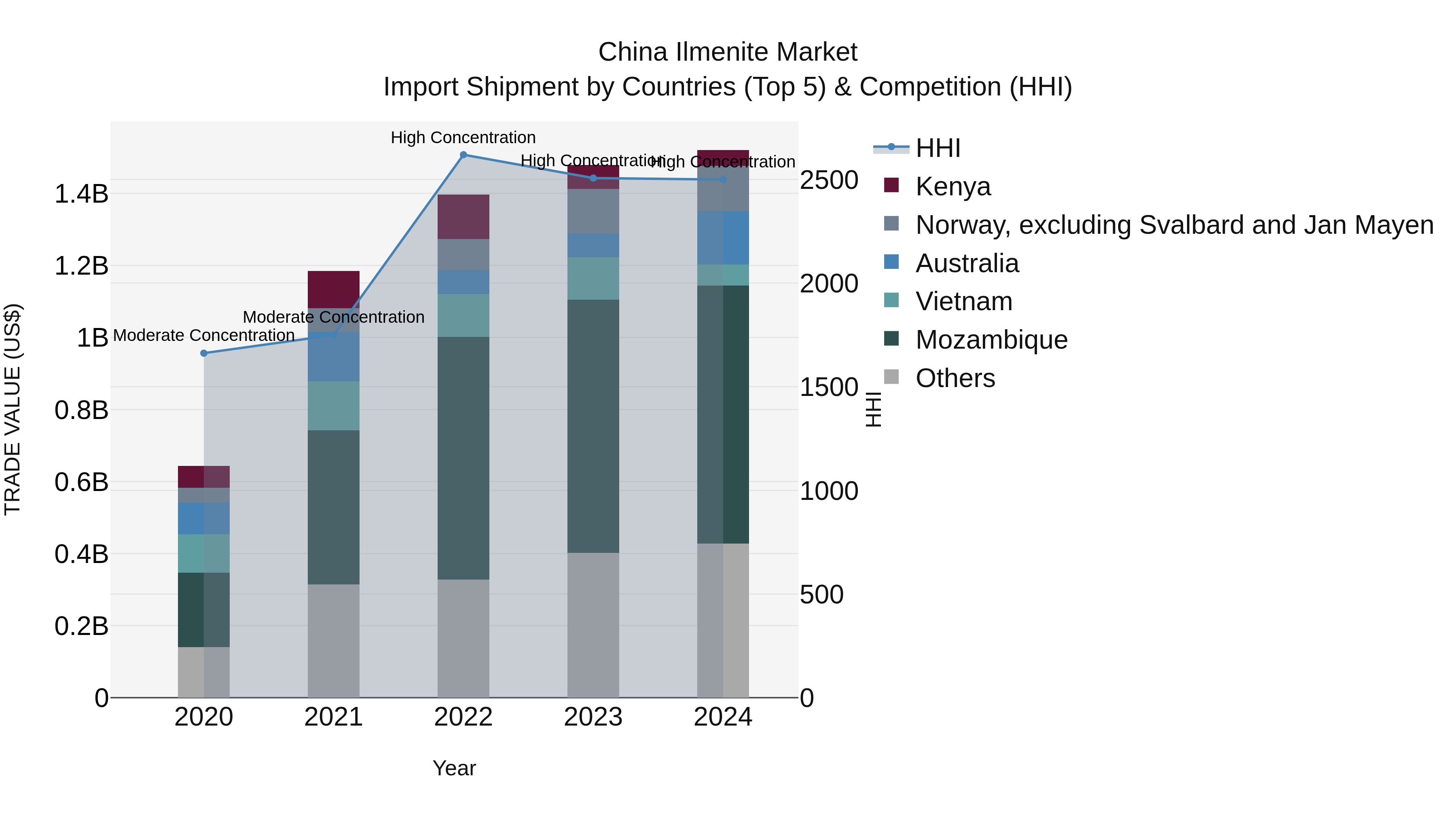
China Ilmenite Market Market Overview
The China ilmenite market is experiencing steady growth due to the increasing demand for titanium dioxide in various industries such as paints, coatings, plastics, and paper. Ilmenite is the primary source of titanium dioxide, which is a key ingredient in these sectors. China, as a major producer of ilmenite, benefits from its abundant reserves and growing industrial activities. The market is also influenced by factors such as government regulations, technological advancements in mining and processing techniques, and the global supply chain dynamics. With the continuous development of infrastructure and construction projects in China, the demand for ilmenite is expected to remain strong, driving further investments and expansions in the market.
China Ilmenite Market Trends
Currently, the China ilmenite market is experiencing several key trends. One major trend is the increasing demand for ilmenite in the production of titanium dioxide, which is used in various industries such as paints, plastics, and cosmetics. This growing demand is driven by the expanding construction and automotive sectors in China. Another trend is the shift towards sustainable sourcing practices, with companies increasingly looking for ethically and environmentally responsible suppliers. Additionally, there is a focus on technological advancements in ilmenite processing to improve efficiency and reduce costs. Overall, the China ilmenite market is poised for growth as the country continues to industrialize and invest in infrastructure, driving demand for key minerals like ilmenite.
China Ilmenite Market Challenges
In the China ilmenite market, some challenges include oversupply leading to downward pressure on prices, environmental regulations impacting production processes, and competition from other mineral resources. The oversupply issue has been exacerbated by increased production capacity in recent years, causing a surplus in the market and driving prices down. Additionally, environmental regulations in China have become stricter, leading to increased compliance costs for ilmenite producers. This can hinder the overall profitability of the industry. Furthermore, competition from alternative mineral resources such as rutile and zircon can also pose a challenge for the ilmenite market in China, as buyers may opt for these alternatives based on price or specific application requirements. Overall, these challenges require market participants to adapt their strategies to remain competitive in the dynamic environment of the China ilmenite market.
China Ilmenite Market Investment Opportunities
The China ilmenite market presents several investment opportunities due to its significant demand in various industries such as pigment production, titanium dioxide manufacturing, and aerospace applications. Investing in ilmenite mining companies in China can be lucrative as the country is one of the largest producers of titanium minerals globally. Additionally, with the increasing focus on sustainable practices and the growing demand for environmentally friendly products, investing in companies that are exploring innovative technologies for ilmenite extraction and processing could also be a promising opportunity in the market. Furthermore, considering the potential for growth in the construction and automotive sectors in China, investing in companies that supply ilmenite for use in these industries could yield favorable returns for investors looking to capitalize on the country`s expanding market opportunities.
China Ilmenite Market Government Policy
The Chinese government has implemented various policies to regulate the ilmenite market. These policies include restrictions on ilmenite mining to protect the environment and ensure sustainable resource use. Additionally, the government has imposed export quotas and tariffs on ilmenite to control its supply and stabilize prices. Moreover, there are regulations in place to promote domestic processing of ilmenite to add value to the raw material before export. The government also encourages investment in research and development to enhance technological capabilities in the ilmenite industry. Overall, these policies aim to balance the exploitation of ilmenite resources with environmental protection, ensure stable market conditions, and support the growth of the domestic ilmenite sector.
China Ilmenite Market Future Outlook
The China ilmenite market is expected to see steady growth in the coming years due to increasing demand from various industries such as paints, plastics, and paper. The growing construction sector in China is also driving the demand for ilmenite as a key component in the production of titanium dioxide, which is widely used in construction materials. Additionally, the rise in infrastructure projects and urbanization in the country further contribute to the positive outlook for the ilmenite market. However, challenges such as fluctuating prices of ilmenite and environmental regulations may impact the market dynamics. Overall, with the continued industrial development in China, the ilmenite market is anticipated to expand, presenting opportunities for both domestic producers and international suppliers to capitalize on the growing demand.
Key Highlights of the Report:
- China Ilmenite Market Outlook
- Market Size of China Ilmenite Market,2024
- Forecast of China Ilmenite Market, 2031
- Historical Data and Forecast of China Ilmenite Revenues & Volume for the Period 2021-2031
- China Ilmenite Market Trend Evolution
- China Ilmenite Market Drivers and Challenges
- China Ilmenite Price Trends
- China Ilmenite Porter's Five Forces
- China Ilmenite Industry Life Cycle
- Historical Data and Forecast of China Ilmenite Market Revenues & Volume By Product Type for the Period 2021-2031
- Historical Data and Forecast of China Ilmenite Market Revenues & Volume By Rutile Ilmenite for the Period 2021-2031
- Historical Data and Forecast of China Ilmenite Market Revenues & Volume By Leucoxene Ilmenite for the Period 2021-2031
- Historical Data and Forecast of China Ilmenite Market Revenues & Volume By High-Ti Ilmenite for the Period 2021-2031
- Historical Data and Forecast of China Ilmenite Market Revenues & Volume By Low-Ti Ilmenite for the Period 2021-2031
- Historical Data and Forecast of China Ilmenite Market Revenues & Volume By Upgraded Ilmenite for the Period 2021 - 2029
- Historical Data and Forecast of China Ilmenite Market Revenues & Volume By Application for the Period 2021-2031
- Historical Data and Forecast of China Ilmenite Market Revenues & Volume By Titanium Dioxide Pigments for the Period 2021-2031
- Historical Data and Forecast of China Ilmenite Market Revenues & Volume By Welding Electrodes for the Period 2021-2031
- Historical Data and Forecast of China Ilmenite Market Revenues & Volume By Ceramics Production for the Period 2021-2031
- Historical Data and Forecast of China Ilmenite Market Revenues & Volume By Steel & Alloy Manufacturing for the Period 2021-2031
- Historical Data and Forecast of China Ilmenite Market Revenues & Volume By Water Purification for the Period 2021 - 2029
- Historical Data and Forecast of China Ilmenite Market Revenues & Volume By End User for the Period 2021-2031
- Historical Data and Forecast of China Ilmenite Market Revenues & Volume By Paints & Coatings Industry for the Period 2021-2031
- Historical Data and Forecast of China Ilmenite Market Revenues & Volume By Aerospace & Defense for the Period 2021-2031
- Historical Data and Forecast of China Ilmenite Market Revenues & Volume By Automotive Industry for the Period 2021-2031
- Historical Data and Forecast of China Ilmenite Market Revenues & Volume By Chemical Industry for the Period 2021-2031
- Historical Data and Forecast of China Ilmenite Market Revenues & Volume By Electronics & Semiconductors for the Period 2021 - 2029
- Historical Data and Forecast of China Ilmenite Market Revenues & Volume By Sales Channel for the Period 2021-2031
- Historical Data and Forecast of China Ilmenite Market Revenues & Volume By Direct Procurement for the Period 2021-2031
- Historical Data and Forecast of China Ilmenite Market Revenues & Volume By Distributors for the Period 2021-2031
- Historical Data and Forecast of China Ilmenite Market Revenues & Volume By Online Sales for the Period 2021-2031
- Historical Data and Forecast of China Ilmenite Market Revenues & Volume By Bulk Buyers for the Period 2021-2031
- Historical Data and Forecast of China Ilmenite Market Revenues & Volume By Retailers for the Period 2021 - 2029
- Historical Data and Forecast of China Ilmenite Market Revenues & Volume By Processing Method for the Period 2021-2031
- Historical Data and Forecast of China Ilmenite Market Revenues & Volume By Chloride Process for the Period 2021-2031
- Historical Data and Forecast of China Ilmenite Market Revenues & Volume By Sulfate Process for the Period 2021-2031
- Historical Data and Forecast of China Ilmenite Market Revenues & Volume By Synthetic Rutile Process for the Period 2021-2031
- Historical Data and Forecast of China Ilmenite Market Revenues & Volume By Smelting Process for the Period 2021 - 2029
- Historical Data and Forecast of China Ilmenite Market Revenues & Volume By Thermal Upgrading for the Period 2021 - 2029
- China Ilmenite Import Export Trade Statistics
- Market Opportunity Assessment By Product Type
- Market Opportunity Assessment By Application
- Market Opportunity Assessment By End User
- Market Opportunity Assessment By Sales Channel
- Market Opportunity Assessment By Processing Method
- China Ilmenite Top Companies Market Share
- China Ilmenite Competitive Benchmarking By Technical and Operational Parameters
- China Ilmenite Company Profiles
- China Ilmenite Key Strategic Recommendations






































