China Insulated Glass Market Size, Share & Growth Rate
The China Insulated Glass Market was estimated at USD 90 Million in 2025 and is projected to reach USD 103 Million by 2032, growing at a CAGR of 1.9% from 2026 to 2032. This growth trajectory is largely driven by surging construction activities alongside a heightened demand for energy-efficient building materials. With urbanization pushing the limits of infrastructure and increasing governmental focus on sustainability, the market for insulated glass products is set to expand robustly in the coming years.
China Insulated Glass Market Year-wise Growth Rate and Key Drivers
This graph highlights how the China Insulated Glass Market has steadily grown over the years, supported by major growth factors.
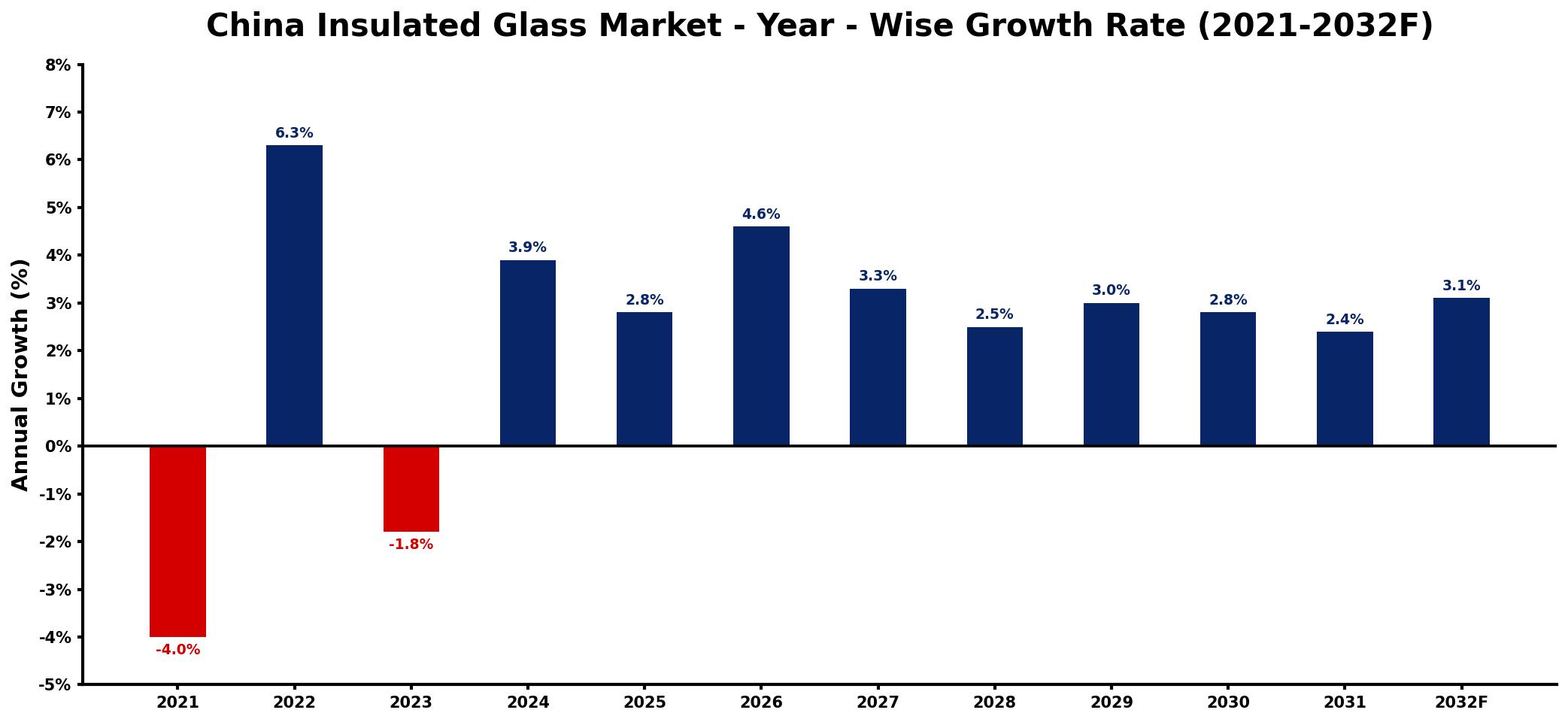
The table below presents the year‑wise growth rates along with the key drivers influencing the market
| Year | Growth Rate | Major Drivers |
| 2021 | -4.0% | Construction activities slowed significantly |
| 2022 | 6.3% | Renewable energy projects increased investments |
| 2023 | -1.8% | Real estate market faced downturn |
| 2024 | 3.9% | Sustainable building practices gained traction |
| 2025 | 2.8% | Urbanization trends continued accelerating |
| 2026 | 4.6% | Technological advancements enhanced production |
| 2027 | 3.3% | Government incentives promoted energy efficiency |
| 2028 | 2.5% | Residential renovations spurred market growth |
| 2029 | 3.0% | Architectural designs emphasized energy conservation |
| 2030 | 2.8% | Export opportunities expanded internationally |
| 2031 | 2.4% | Infrastructure projects received increased funding |
| 2032 | 3.1% | Green building certifications encouraged adoption |
Note: Market size estimations and growth projections presented in this report are based on 6Wresearch's proprietary forecasting methodology, utilizing the latest available industry data, government publications, and primary research inputs.
China Insulated Glass Market Synopsis
The demand for insulated glass in China is rapidly escalating, primarily due to a transition towards energy-efficient and sustainable building practices. As residential and commercial construction accelerates, insulated glass emerges as a key component in meeting the growing energy performance standards set by regulatory bodies.
Furthermore, innovations in insulated glass technology, such as enhanced thermal insulation and noise reduction properties, are increasingly appealing to architects and builders. This shift not only supports compliance with stringent energy regulations but also caters to the modern architectural aesthetic that emphasizes both functionality and design.
China Insulated Glass Market Key Takeaways
- The market is experiencing consistent growth fueled by urbanization and a shift towards sustainable construction.
- Technological advancements are enhancing the thermal insulation and energy efficiency of insulated glass products.
- Government policies are actively promoting the adoption of energy-efficient materials in building construction.
- Customization options in insulated glass products are gaining traction to cater to unique architectural designs.
- Investment opportunities are emerging in manufacturing and distribution sectors, particularly for innovative glass technologies.
Evaluation of Restraints in China Insulated Glass Market
Despite its promising growth potential, the China Insulated Glass Market faces several restraints that could hinder its progress. Intense competition from both domestic and international manufacturers complicates market dynamics, forcing companies to differentiate their offerings continually. Additionally, fluctuating raw material prices pose a challenge to maintaining competitive pricing structures. Moreover, compliance with evolving regulations regarding energy efficiency and safety standards adds another layer of complexity, necessitating ongoing investment in quality assurance and innovation.
China Insulated Glass Market Trends
Current trends in the China Insulated Glass Market indicate a strong movement towards advanced technologies. The rise of double and triple glazed units reflects a clear consumer preference for superior energy performance. Smart glass solutions are also making significant inroads, providing not only enhanced comfort but also the capability to control indoor environments effectively. Furthermore, as aesthetic demands grow, custom-designed insulated glass products are becoming increasingly popular among architects and builders who aim to merge style with sustainability.
China Insulated Glass Market Opportunities
The China Insulated Glass Market holds numerous investment opportunities fueled by rapid urbanization and ongoing construction activities. Companies focusing on innovative technologies aimed at improving thermal insulation and soundproofing can particularly benefit from this upward trend. Additionally, as energy efficiency becomes a focal point in building design, manufacturers offering sustainable insulated glass solutions are positioned for success. Engaging in the distribution and installation of these products also presents a promising avenue for growth, given the rising demand in the construction sector.
Government Initiatives in the China Insulated Glass Market
The Chinese government has launched several initiatives aimed at bolstering the Insulated Glass Market through the promotion of energy-efficient building materials. Financial incentives, subsidies, and regulatory frameworks have been implemented to encourage the adoption of insulated glass in both new and retrofitted buildings. These policies not only support manufacturers but also enhance consumer awareness regarding the benefits of using energy-efficient products, which ultimately contributes to reduced energy consumption and lower carbon emissions across the nation.
Future Insights of the China Insulated Glass Market
Looking ahead to 2026-2032, the China Insulated Glass Market is expected to thrive under the influence of accelerating urbanization and a persistent focus on energy efficiency. As the construction sector continues to expand, the demand for insulated glass products will grow, fueled by advancements in technology and an increasing consumer preference for sustainability. Moreover, as government policies increasingly favor green building practices, manufacturers that prioritize innovation will be well-positioned to capitalize on emerging market opportunities and drive future growth.
China Insulated Glass Market Latest Developments (2025 - 2026)
In the recent months leading up to mid-2026, the China Insulated Glass Market has seen a surge in developments geared towards enhancing product offerings and addressing consumer needs. Innovations in glass technology, including the introduction of new insulating materials, have begun to reshape market dynamics. Additionally, collaborations among manufacturers to improve supply chain efficiency and distribution channels have been observed, indicating a strategic move to meet rising demand in the construction sector.
China Insulated Glass Market - Key Attractiveness of the Report
- 10 Years of Market Numbers
- Historical Data Starting from 2022 to 2025
- Base Year: 2025
- Forecast Data until 2032
- Key Performance Indicators Impacting the Market
- Major Upcoming Developments and Projects
Key Highlights of the Report:
- China Insulated Glass Market Outlook
- Market Size of China Insulated Glass Market, 2025
- Forecast of China Insulated Glass Market, 2032
- Historical Data and Forecast of China Insulated Glass Revenues & Volume for the Period 2022-2032F
- China Insulated Glass Market Trend Evolution
- China Insulated Glass Market Drivers and Challenges
- China Insulated Glass Price Trends
- China Insulated Glass Porter's Five Forces
- China Insulated Glass Industry Life Cycle
- Historical Data and Forecast of China Insulated Glass Market Revenues & Volume By Type for the Period 2022-2032F
- Historical Data and Forecast of China Insulated Glass Market Revenues & Volume By Heated Insulating Glass for the Period 2022-2032F
- Historical Data and Forecast of China Insulated Glass Market Revenues & Volume By Tempering Insulating Glass for the Period 2022-2032F
- Historical Data and Forecast of China Insulated Glass Market Revenues & Volume By Custom Insulated Glass for the Period 2022-2032F
- Historical Data and Forecast of China Insulated Glass Market Revenues & Volume By Other Glasses for the Period 2022-2032F
- Historical Data and Forecast of China Insulated Glass Market Revenues & Volume By Application for the Period 2022-2032F
- Historical Data and Forecast of China Insulated Glass Market Revenues & Volume By Doors & Partitions for the Period 2022-2032F
- Historical Data and Forecast of China Insulated Glass Market Revenues & Volume By Kitchen Appliances & Cabinets for the Period 2022-2032F
- Historical Data and Forecast of China Insulated Glass Market Revenues & Volume By Floors & Ceilings for the Period 2022-2032F
- Historical Data and Forecast of China Insulated Glass Market Revenues & Volume By Furniture & Curtain Walls for the Period 2022-2032F
- Historical Data and Forecast of China Insulated Glass Market Revenues & Volume By Railings & Bolted Structures for the Period 2022-2032F
- Historical Data and Forecast of China Insulated Glass Market Revenues & Volume By Automotive Glasses for the Period 2022-2032F
- Historical Data and Forecast of China Insulated Glass Market Revenues & Volume By End User for the Period 2022-2032F
- Historical Data and Forecast of China Insulated Glass Market Revenues & Volume By Residential Buildings for the Period 2022-2032F
- Historical Data and Forecast of China Insulated Glass Market Revenues & Volume By Commercial & Institutional Buildings for the Period 2022-2032F
- Historical Data and Forecast of China Insulated Glass Market Revenues & Volume By Industrial Users for the Period 2022-2032F
- China Insulated Glass Import Export Trade Statistics
- Market Opportunity Assessment By Type
- Market Opportunity Assessment By Application
- Market Opportunity Assessment By End User
- China Insulated Glass Top Companies Market Share
- China Insulated Glass Competitive Benchmarking By Technical and Operational Parameters
- China Insulated Glass Company Profiles
- China Insulated Glass Key Strategic Recommendations






































