China LED Professional Lighting Market Summary
The china led professional lighting market was estimated at USD 115 Million in 2025 and is projected to reach USD 132 Million by 2032, growing at a CAGR of 4.4% from 2026 to 2032.
China LED Professional Lighting Market Year-wise Growth Rate and Key Drivers
This graph highlights how the China LED Professional Lighting Market has steadily grown over the past five years, supported by major growth factors.
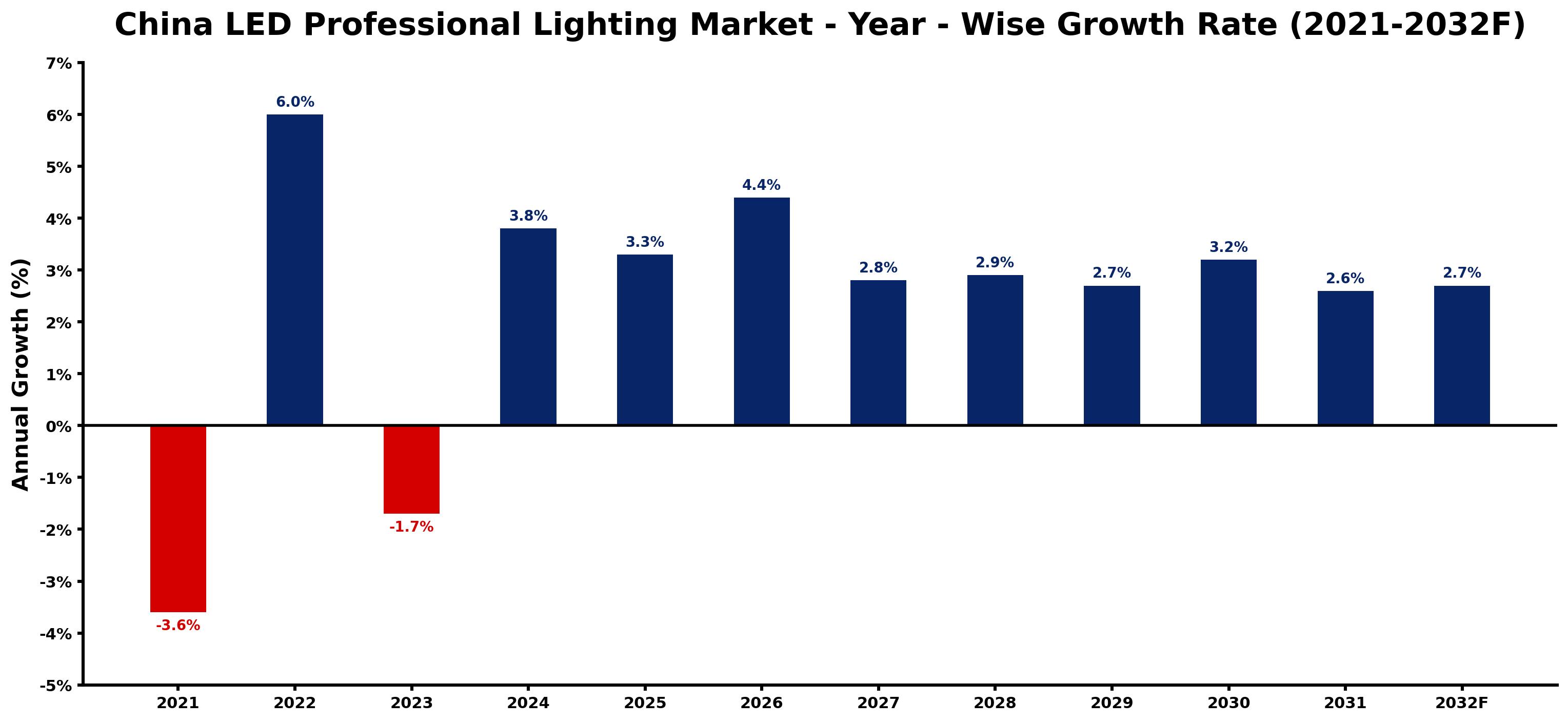
The table below presents the year wise growth rates along with the key drivers influencing the market
| Year | Growth Rate | Major Drivers |
| 2021 | -3.6% | Increased energy costs diminished investment in new LED lighting projects, stifling market expansion. |
| 2022 | 6.0% | Technological innovations in LED fixtures enhance energy efficiency, attracting commercial investors. |
| 2023 | -1.7% | Intensified competition from alternative energy solutions diminished demand for traditional LED lighting products. |
| 2024 | 3.8% | Smart city initiatives incorporate LED solutions, integrating IoT for better energy management. |
| 2025 | 3.3% | Increased awareness of environmental sustainability creates market opportunities in green technologies. |
| 2026 | 4.4% | Retail sector reinvestment in ambiance lighting enhances customer experiences and drives sales. |
| 2027 | 2.8% | Construction expansion in tier-two cities necessitates advanced lighting solutions for new developments. |
| 2028 | 2.9% | Integration of smart home technologies increases consumer interest in premium LED lighting products. |
| 2029 | 2.7% | Policy changes incentivize energy-efficient technologies, encouraging broader adoption across industries. |
| 2030 | 3.2% | Aging infrastructure prompts the replacement of outdated systems with modern LED alternatives. |
| 2031 | 2.6% | Corporate sustainability targets push organizations to invest heavily in energy-efficient solutions. |
| 2032 | 2.7% | Competitive pricing from local manufacturers enhances market accessibility for diverse consumer segments. |
Note - Market size estimations and growth projections presented in this report are based on 6Wresearch's advanced forecasting approach, validated with industry datasets as of June 2026.
Key Highlights of the Report:
- China LED Professional Lighting Market Outlook
- Market Size of China LED Professional Lighting Market, 2025
- Forecast of China LED Professional Lighting Market, 2032F
- Historical Data and Forecast of China LED Professional Lighting Revenues & Volume for the Period 2022-2032F
- China LED Professional Lighting Market Trend Evolution
- China LED Professional Lighting Market Drivers and Challenges
- China LED Professional Lighting Price Trends
- China LED Professional Lighting Porter's Five Forces
- China LED Professional Lighting Industry Life Cycle
- Historical Data and Forecast of China LED Professional Lighting Market Revenues & Volume By Product Type for the Period 2022-2032F
- Historical Data and Forecast of China LED Professional Lighting Market Revenues & Volume By LED Bulbs for the Period 2022-2032F
- Historical Data and Forecast of China LED Professional Lighting Market Revenues & Volume By LED Fixtures for the Period 2022-2032F
- Historical Data and Forecast of China LED Professional Lighting Market Revenues & Volume By Bare LED Tubes for the Period 2022-2032F
- Historical Data and Forecast of China LED Professional Lighting Market Revenues & Volume By LED Down lights for the Period 2022-2032F
- Historical Data and Forecast of China LED Professional Lighting Market Revenues & Volume By Applications for the Period 2022-2032F
- Historical Data and Forecast of China LED Professional Lighting Market Revenues & Volume By Indoor for the Period 2022-2032F
- Historical Data and Forecast of China LED Professional Lighting Market Revenues & Volume By Outdoor for the Period 2022-2032F
- Historical Data and Forecast of China LED Professional Lighting Market Revenues & Volume By Automotive for the Period 2022-2032F
- Historical Data and Forecast of China LED Professional Lighting Market Revenues & Volume By Backlighting for the Period 2022-2032F
- China LED Professional Lighting Import Export Trade Statistics
- Market Opportunity Assessment By Product Type
- Market Opportunity Assessment By Applications
- China LED Professional Lighting Top Companies Market Share
- China LED Professional Lighting Competitive Benchmarking By Technical and Operational Parameters
- China LED Professional Lighting Company Profiles
- China LED Professional Lighting Key Strategic Recommendations






































