China Low Power Wide Area Network Market Size & Growth Rate (2026-2032)
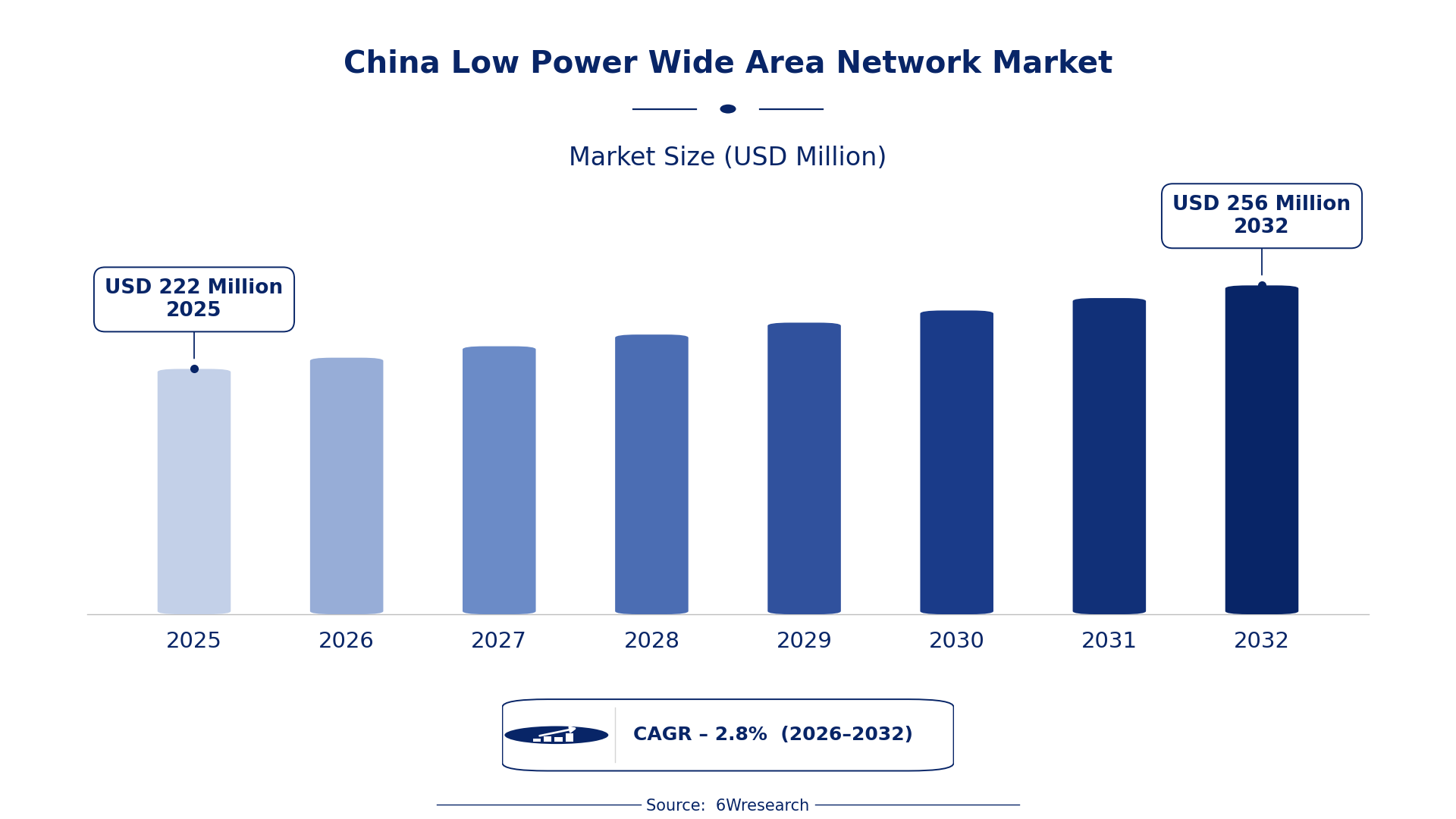
The China Low Power Wide Area Network Market was estimated at USD 222 Million in 2025 and is projected to reach USD 256 Million by 2032, growing at a CAGR of 2.8% from 2026 to 2032.
China Low Power Wide Area Network Market Synopsis
The demand for Low Power Wide Area Network (LPWAN) technology in China is driven primarily by the rapid proliferation of IoT devices across multiple sectors. Industries like agriculture, logistics, and smart cities are increasingly relying on cost-effective and energy-efficient solutions to connect various devices over expansive areas.
LPWAN technologies such as NB-IoT and LoRaWAN are not just buzzwords; they represent a transformative shift in connectivity. With the government backing smart city initiatives and industrial automation, we are witnessing a surge in infrastructure development aimed at enhancing network performance and coverage.
China Low Power Wide Area Network Market Year-wise Growth Rate and Key Drivers
This graph illustrates the annual growth rates of the China Low Power Wide Area Network Market from 2021 to 2032, highlighting a steady upward trajectory and projected expansion over the forecast period.
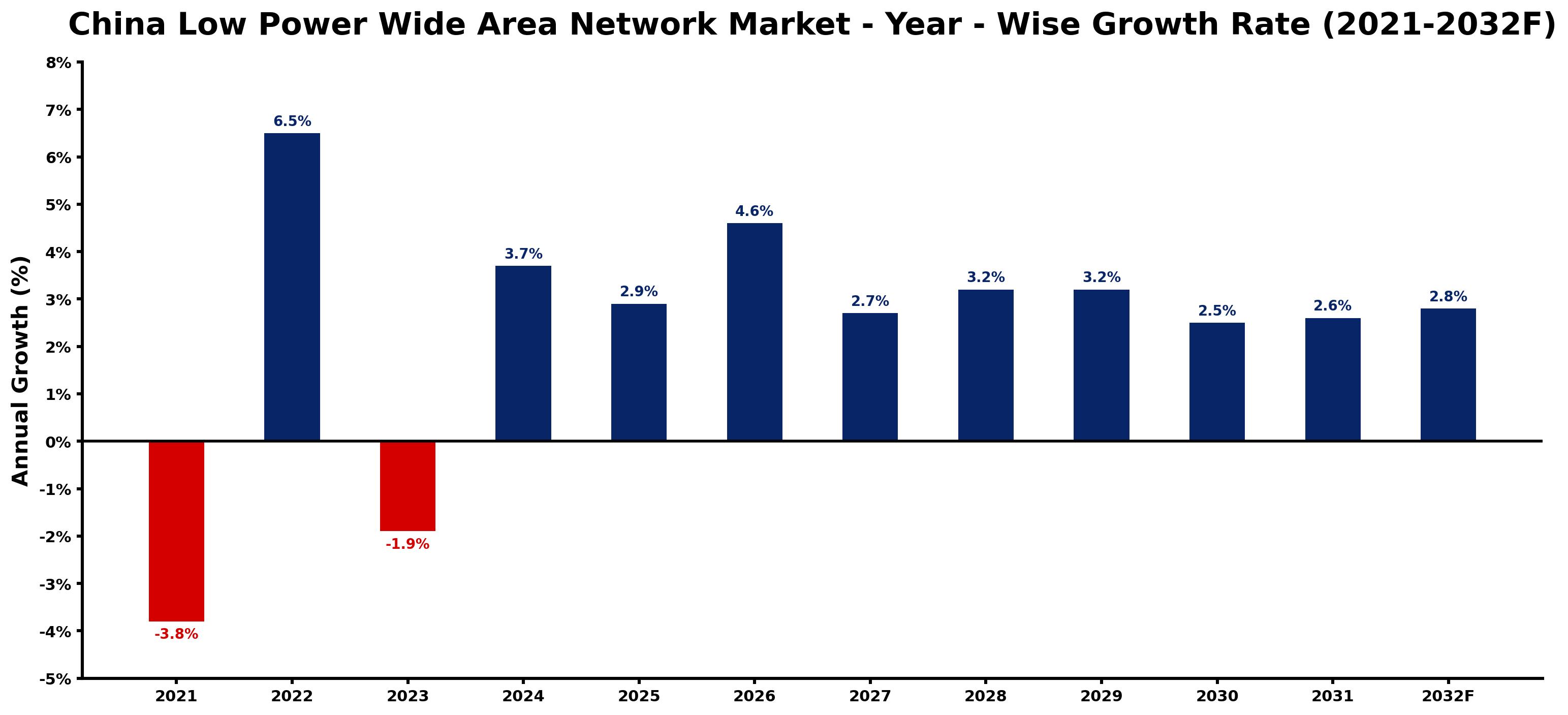
The table below presents the year‑wise growth rates along with the key drivers influencing the market
| Year | Growth Rate | Major Drivers |
| 2021 | -3.8% | China's State Council prioritized 5G over LPWAN development. |
| 2022 | 6.5% | Adoption of smart city initiatives by local governments. |
| 2023 | -1.9% | Huawei faced increased competition from domestic IoT providers. |
| 2024 | 3.7% | Increased IoT device deployments across major industries. |
| 2025 | 2.9% | Government incentives for LPWAN technology in urban planning. |
| 2026 | 4.6% | Growing investments in smart metering by utility companies. |
| 2027 | 2.7% | Enhanced rural connectivity programs by the Ministry of Industry. |
| 2028 | 3.2% | Expanding 5G infrastructure supporting LPWAN applications. |
| 2029 | 3.2% | Rising focus on environmental monitoring and smart agriculture. |
| 2030 | 2.5% | Increased demand for smart transportation solutions in cities. |
| 2031 | 2.6% | Eco-friendly initiatives boosting demand for wireless connectivity. |
| 2032 | 2.8% | Implementation of national standards for LPWAN interoperability. |
Note: Market size estimations and growth projections presented in this report are based on 6Wresearch's proprietary forecasting methodology, utilizing the latest available industry data, government publications, and primary research inputs.
China Low Power Wide Area Network Market Key Takeaways
Below are some of the specific key takeaways from the market, including:
- Growing adoption of LPWAN technologies is directly correlated with the rise in IoT applications.
- The market is benefitting from substantial government investment in digital infrastructure and smart cities.
- Cost-effective and energy-efficient characteristics of LPWAN make it ideal for various sectors, including agriculture and logistics.
- Intense competition among technologies like NB-IoT and LoRa poses challenges but drives innovation.
- Significant opportunities exist for infrastructure development and service providers in the LPWAN segment.
Evaluation of Restraints in China Low Power Wide Area Network Market
The growth of the LPWAN market in China is not without its challenges. Intense competition among differing LPWAN technologies creates a fragmented landscape, causing confusion for potential users. Regulatory uncertainties concerning spectrum allocation can also hinder market entry for new players. Additionally, concerns over data security and the scalability of existing solutions can deter adoption rates, limiting market potential.
China Low Power Wide Area Network Market Trends
A noticeable trend in the China Low Power Wide Area Network market is the increasing integration of LPWAN technology with artificial intelligence and big data analytics. This combination is enhancing the functionality of IoT applications across industries. Moreover, the emphasis on environmental sustainability is driving innovation in energy-efficient LPWAN devices, aligning with government goals for green technology.
As businesses focus on operational efficiency, LPWAN technology is evolving to support advanced applications like real-time tracking and remote monitoring, further solidifying its position in the market. This evolution showcases the adaptability of LPWAN in meeting the varied needs of different sectors.
China Low Power Wide Area Network Market Opportunities
Investment opportunities are flourishing within the LPWAN sector as organizations seek reliable connectivity solutions for their IoT devices. Companies focused on infrastructure development, as well as those producing innovative LPWAN devices and applications, stand to gain from the expanding market. With China's robust push towards digital transformation and smart city initiatives, stakeholders can expect significant returns on investments aimed at enhancing LPWAN capabilities.
Government Initiatives in the China Low Power Wide Area Network Market
The Chinese government's commitment to promoting LPWAN technologies is reshaping the market. With numerous policies aimed at fostering innovation and deploying IoT infrastructure, the regulatory environment is becoming increasingly favorable for LPWAN adoption. This focus on public sector initiatives is critical as the nation strives to boost its global competitiveness in the IoT arena.
- A national smart city initiative launched in 2024 emphasizes the deployment of LPWAN technologies to enhance urban connectivity.
- Current regulatory frameworks are being reviewed to streamline spectrum allocation for LPWAN providers, enhancing market access.
- A planned funding programme aims to support research and innovation in LPWAN solutions, expected to roll out by 2025.
- Ongoing government workshops are promoting collaboration between tech companies and public entities to improve LPWAN standards.
- Recently completed policies include financial incentives for businesses that invest in LPWAN technologies and applications.
Future Insights of the China Low Power Wide Area Network Market
From 2026 to 2032, the China Low Power Wide Area Network market is projected to experience steady growth, fueled by the increasing integration of IoT technologies in everyday applications. As businesses demand more efficient and expansive connectivity, LPWAN solutions will likely evolve to meet those needs. The ongoing digital transformation initiatives led by the government will continue to pave the way for LPWAN adoption, solidifying its role in the IoT ecosystem.
China Low Power Wide Area Network Market Latest Developments
In the past year, the China Low Power Wide Area Network market has seen significant advancements, with increased focus on enhancing network capabilities. Key stakeholders are actively engaged in projects aimed at expanding infrastructure and improving the user experience. As market dynamics shift, recent activities reflect a strong push towards innovation and integration of new technologies.
- A leading technology vendor announced an ongoing rollout of a nationwide LPWAN network that began in early 2025 and is set to be completed by late 2026.
- A major regional operator has launched a new LPWAN service designed for smart agriculture applications, currently underway since mid-2025.
- Plans for a new LPWAN infrastructure upgrade initiative were revealed in late 2025, targeting underserved rural areas.
- In early 2026, a prominent research institution is expected to publish findings on the effectiveness of LPWAN in energy management systems.
- A collaboration between public and private sectors has been initiated to enhance LPWAN coverage, which began in Q1 2025 and remains ongoing.
China Low Power Wide Area Network Market - Key Attractiveness of the Report
- 10 Years of Market Numbers
- Historical Data Starting from 2022 to 2025
- Base Year: 2025
- Forecast Data until 2032
- Key Performance Indicators Impacting the Market
- Major Upcoming Developments and Projects
Key Highlights of the Report:
- China Low Power Wide Area Network Market Outlook
- Market Size of China Low Power Wide Area Network Market, 2025
- Forecast of China Low Power Wide Area Network Market, 2032
- Historical Data and Forecast of China Low Power Wide Area Network Revenues & Volume for the Period 2022-2032F
- China Low Power Wide Area Network Market Trend Evolution
- China Low Power Wide Area Network Market Drivers and Challenges
- China Low Power Wide Area Network Price Trends
- China Low Power Wide Area Network Porter's Five Forces
- China Low Power Wide Area Network Industry Life Cycle
- Historical Data and Forecast of China Low Power Wide Area Network Market Revenues & Volume By Connectivity Technology for the Period 2022-2032F
- Historical Data and Forecast of China Low Power Wide Area Network Market Revenues & Volume By SIGFOX for the Period 2022-2032F
- Historical Data and Forecast of China Low Power Wide Area Network Market Revenues & Volume By LoRaWAN for the Period 2022-2032F
- Historical Data and Forecast of China Low Power Wide Area Network Market Revenues & Volume By Weigthless for the Period 2022-2032F
- Historical Data and Forecast of China Low Power Wide Area Network Market Revenues & Volume By Others for the Period 2022-2032F
- Historical Data and Forecast of China Low Power Wide Area Network Market Revenues & Volume By Verticals for the Period 2022-2032F
- Historical Data and Forecast of China Low Power Wide Area Network Market Revenues & Volume By Agriculture for the Period 2022-2032F
- Historical Data and Forecast of China Low Power Wide Area Network Market Revenues & Volume By Smart Logistic and Transportation for the Period 2022-2032F
- Historical Data and Forecast of China Low Power Wide Area Network Market Revenues & Volume By Healthcare for the Period 2022-2032F
- Historical Data and Forecast of China Low Power Wide Area Network Market Revenues & Volume By Industrial Manufacturing for the Period 2022-2032F
- Historical Data and Forecast of China Low Power Wide Area Network Market Revenues & Volume By Oil and Gas for the Period 2022-2032F
- Historical Data and Forecast of China Low Power Wide Area Network Market Revenues & Volume By Consumer Electronics for the Period 2022-2032F
- Historical Data and Forecast of China Low Power Wide Area Network Market Revenues & Volume By Others for the Period 2022-2032F
- Historical Data and Forecast of China Low Power Wide Area Network Market Revenues & Volume By Application for the Period 2022-2032F
- Historical Data and Forecast of China Low Power Wide Area Network Market Revenues & Volume By Smart Waste Management for the Period 2022-2032F
- Historical Data and Forecast of China Low Power Wide Area Network Market Revenues & Volume By Smart Buildings for the Period 2022-2032F
- Historical Data and Forecast of China Low Power Wide Area Network Market Revenues & Volume By Smart Gas and Water Metering for the Period 2022-2032F
- Historical Data and Forecast of China Low Power Wide Area Network Market Revenues & Volume By Smart Streetlights for the Period 2022-2032F
- Historical Data and Forecast of China Low Power Wide Area Network Market Revenues & Volume By Smart Parking for the Period 2022-2032F
- Historical Data and Forecast of China Low Power Wide Area Network Market Revenues & Volume By Livestock Monitoring for the Period 2022-2032F
- Historical Data and Forecast of China Low Power Wide Area Network Market Revenues & Volume By Others for the Period 2022-2032F
- Historical Data and Forecast of China Low Power Wide Area Network Market Revenues & Volume By Network Deployment for the Period 2022-2032F
- Historical Data and Forecast of China Low Power Wide Area Network Market Revenues & Volume By Public Sector for the Period 2022-2032F
- Historical Data and Forecast of China Low Power Wide Area Network Market Revenues & Volume By Private Sector for the Period 2022-2032F
- Historical Data and Forecast of China Low Power Wide Area Network Market Revenues & Volume By Technology Service for the Period 2022-2032F
- Historical Data and Forecast of China Low Power Wide Area Network Market Revenues & Volume By Managed Services for the Period 2022-2032F
- Historical Data and Forecast of China Low Power Wide Area Network Market Revenues & Volume By Professional Services for the Period 2022-2032F
- China Low Power Wide Area Network Import Export Trade Statistics
- Market Opportunity Assessment By Connectivity Technology
- Market Opportunity Assessment By Verticals
- Market Opportunity Assessment By Application
- Market Opportunity Assessment By Network Deployment
- Market Opportunity Assessment By Technology Service
- China Low Power Wide Area Network Top Companies Market Share
- China Low Power Wide Area Network Competitive Benchmarking By Technical and Operational Parameters
- China Low Power Wide Area Network Company Profiles
- China Low Power Wide Area Network Key Strategic Recommendations






































