China LTE IoT Market Size & Growth Rate (2026-2032)
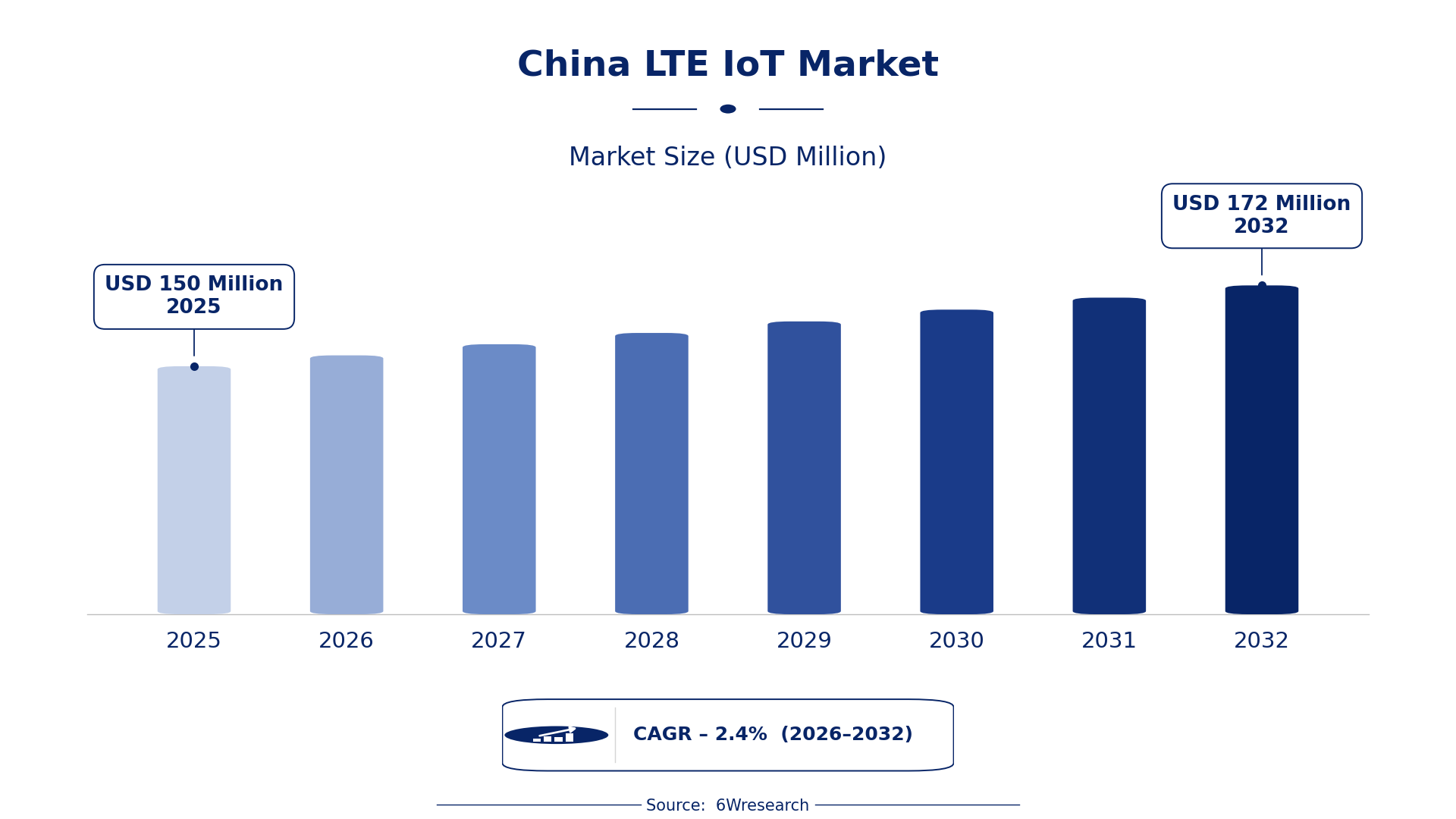
The China LTE IoT Market was estimated at USD 150 Million in 2025 and is projected to reach USD 172 Million by 2032, growing at a CAGR of 2.4% from 2026 to 2032.
China LTE IoT Market Synopsis
The accelerating adoption of IoT devices across multiple sectors is the driving force behind the China LTE IoT market's expansion. Industries such as manufacturing, healthcare, and smart cities are integrating LTE-M and NB-IoT technologies to enhance operational efficiency and connectivity.
Key telecom operators are actively investing in infrastructure development to support this growth, bolstered by government initiatives aimed at promoting IoT solutions. These factors create a fertile environment for innovation and investment in the LTE IoT space.
China LTE IoT Market Year-wise Growth Rate and Key Drivers
This graph illustrates the annual growth rates of the China LTE IoT Market from 2021 to 2032, highlighting a steady upward trajectory and projected expansion over the forecast period.
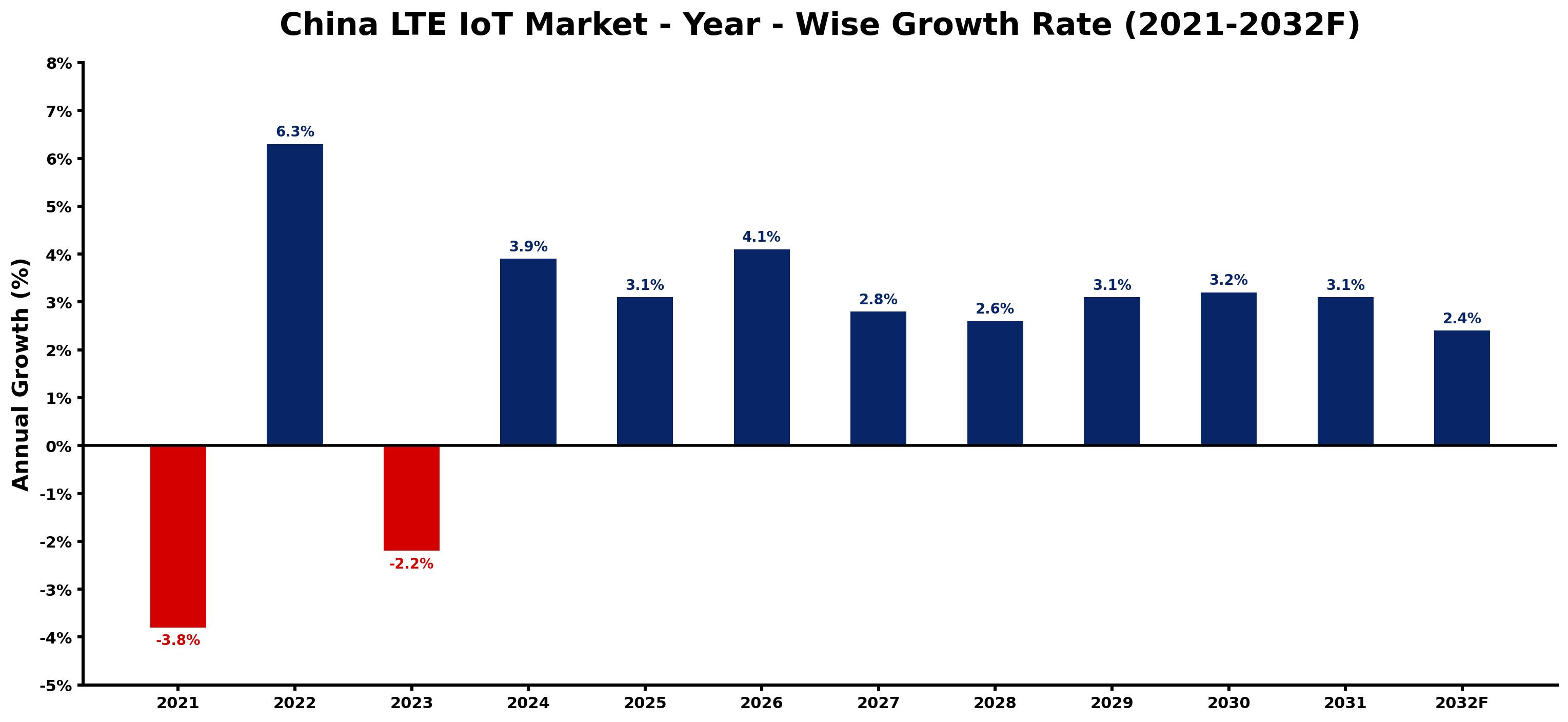
The table below presents the year‑wise growth rates along with the key drivers influencing the market
| Year | Growth Rate | Major Drivers |
| 2021 | -3.8% | Economic deceleration due to US-China trade tensions |
| 2022 | 6.3% | 5G deployment boosting IoT device connectivity in China. |
| 2023 | -2.2% | Subsidy cuts by Chinese government impacting IoT adoption |
| 2024 | 3.9% | Government support for smart city initiatives enhancing LTE adoption. |
| 2025 | 3.1% | Increased demand for connected devices in manufacturing sector. |
| 2026 | 4.1% | IoT applications growing in agricultural monitoring technologies. |
| 2027 | 2.8% | Rise in urbanization driving smart transportation solutions. |
| 2028 | 2.6% | Supportive regulatory framework for IoT applications in healthcare. |
| 2029 | 3.1% | Expanding logistics networks enhancing supply chain IoT solutions. |
| 2030 | 3.2% | Growing consumer interest in smart home automation technologies. |
| 2031 | 3.1% | Increased investment in secure LTE networks for enterprises. |
| 2032 | 2.4% | Adoption of smart metering solutions in energy management. |
Note: Market size estimations and growth projections presented in this report are based on 6Wresearch's proprietary forecasting methodology, utilizing the latest available industry data, government publications, and primary research inputs.
China LTE IoT Market Key Takeaways
Below are some of the specific key takeaways from the market, including:
- Deployment of LTE-M and NB-IoT technologies is enhancing low-power, wide-area connectivity.
- Telecom operators are forming partnerships to develop end-to-end IoT solutions tailored for various sectors.
- Government initiatives are streamlining the regulatory environment to support IoT technology adoption.
- Growing demand for real-time data analytics is driving integration with AI and edge computing.
- Investment opportunities abound in areas such as industrial automation, smart cities, and healthcare.
Evaluation of Restraints in China LTE IoT Market
Despite a robust growth trajectory, the China LTE IoT market faces several challenges. Rural areas often lack adequate network coverage, hindering the expansion of IoT services. Interoperability issues among devices can complicate integration, while security concerns related to data privacy continue to be a major hurdle. Furthermore, high deployment costs and a shortage of skilled professionals add pressure to industry players, making it essential to address these issues collaboratively.
China LTE IoT Market Trends
Several trends are shaping the China LTE IoT market. The push for low-power connectivity is catalyzing the deployment of NB-IoT and LTE-M technologies, which facilitate energy-efficient communication. Furthermore, the integration of LTE IoT with AI and edge computing is gaining traction, enabling faster data processing and real-time decision-making. Collaborations among telecom operators, manufacturers, and software providers are also rising to meet the specific needs of the Chinese market.
China LTE IoT Market Opportunities
The potential for growth within the China LTE IoT market is immense. Sectors such as smart cities and industrial automation are ripe for investment, driven by the increasing number of connected devices. Opportunities exist in IoT device manufacturing, infrastructure development, and data analytics solutions tailored to local needs. Additionally, forming strategic partnerships with telecom operators can further enhance market penetration for investors.
Government Initiatives in the China LTE IoT Market
The Chinese government is significantly influencing the growth of the LTE IoT market through targeted policies and initiatives. With a focus on elevating the country’s manufacturing capabilities and integrating IoT technologies, these efforts are vital for fostering a supportive environment for LTE IoT deployment.
- A national digital infrastructure upgrade programme, now in its rollout phase, aims to improve connectivity in urban and rural areas.
- Financial incentives are currently available for companies deploying IoT solutions in healthcare and agriculture sectors.
- The "Made in China 2025" initiative seeks to integrate IoT technologies across various industries.
- Regulatory reforms initiated in 2025 are aimed at streamlining approvals for IoT devices.
- A planned public-private initiative is expected to expand telecom infrastructure access by 2028.
Future Insights of the China LTE IoT Market
Looking ahead to 2026-2032, the China LTE IoT market is anticipated to flourish, fueled by the increasing deployment of IoT devices across diverse industries. Advances in technology, particularly the ongoing rollout of 5G networks, will bolster the capabilities of IoT applications, leading to heightened efficiency and productivity. Continued government backing for IoT initiatives will further propel market expansion, as China solidifies its position as a leader in IoT innovation.
China LTE IoT Market Latest Developments
In the past year, activity in the China LTE IoT market has intensified, reflecting a collective effort by industry stakeholders to accelerate deployment and integration of IoT technologies. Companies are focusing on enhancing operational capabilities while aligning with government initiatives.
- A major telecom operator announced an initiative in Q3 2023 to expand NB-IoT coverage across underserved regions, aimed at increasing accessibility.
- A new partnership was formed in early 2024 between a leading technology vendor and a regional operator to develop smart agriculture solutions.
- In Q1 2024, a technology company launched an IoT platform designed to facilitate real-time data analytics for healthcare applications.
- Ongoing efforts are focused on the establishment of IoT innovation hubs in several provinces, set to foster development in 2025.
- Upcoming initiatives are planned for late 2024 to address regulatory challenges and streamline the approval process for new IoT devices.
China LTE IoT Market - Key Attractiveness of the Report
- 10 Years of Market Numbers
- Historical Data Starting from 2022 to 2025
- Base Year: 2025
- Forecast Data until 2032
- Key Performance Indicators Impacting the Market
- Major Upcoming Developments and Projects
Key Highlights of the Report:
- China LTE IoT Market Outlook
- Market Size of China LTE IoT Market, 2025
- Forecast of China LTE IoT Market, 2032
- Historical Data and Forecast of China LTE IoT Revenues & Volume for the Period 2022-2032F
- China LTE IoT Market Trend Evolution
- China LTE IoT Market Drivers and Challenges
- China LTE IoT Price Trends
- China LTE IoT Porter's Five Forces
- China LTE IoT Industry Life Cycle
- Historical Data and Forecast of China LTE IoT Market Revenues & Volume By Technology for the Period 2022-2032F
- Historical Data and Forecast of China LTE IoT Market Revenues & Volume By NB-IoT for the Period 2022-2032F
- Historical Data and Forecast of China LTE IoT Market Revenues & Volume By LTE-M for the Period 2022-2032F
- Historical Data and Forecast of China LTE IoT Market Revenues & Volume By Service for the Period 2022-2032F
- Historical Data and Forecast of China LTE IoT Market Revenues & Volume By Professional Services for the Period 2022-2032F
- Historical Data and Forecast of China LTE IoT Market Revenues & Volume By Managed Services for the Period 2022-2032F
- Historical Data and Forecast of China LTE IoT Market Revenues & Volume By Industry for the Period 2022-2032F
- Historical Data and Forecast of China LTE IoT Market Revenues & Volume By Manufacturing for the Period 2022-2032F
- Historical Data and Forecast of China LTE IoT Market Revenues & Volume By Energy and utilities for the Period 2022-2032F
- Historical Data and Forecast of China LTE IoT Market Revenues & Volume By Transportation and logistics for the Period 2022-2032F
- Historical Data and Forecast of China LTE IoT Market Revenues & Volume By Healthcare for the Period 2022-2032F
- Historical Data and Forecast of China LTE IoT Market Revenues & Volume By Agriculture for the Period 2022-2032F
- China LTE IoT Import Export Trade Statistics
- Market Opportunity Assessment By Technology
- Market Opportunity Assessment By Service
- Market Opportunity Assessment By Industry
- China LTE IoT Top Companies Market Share
- China LTE IoT Competitive Benchmarking By Technical and Operational Parameters
- China LTE IoT Company Profiles
- China LTE IoT Key Strategic Recommendations






































