China Medical Gases Market Top 5 Importing Countries and Market Competition (HHI) Analysis
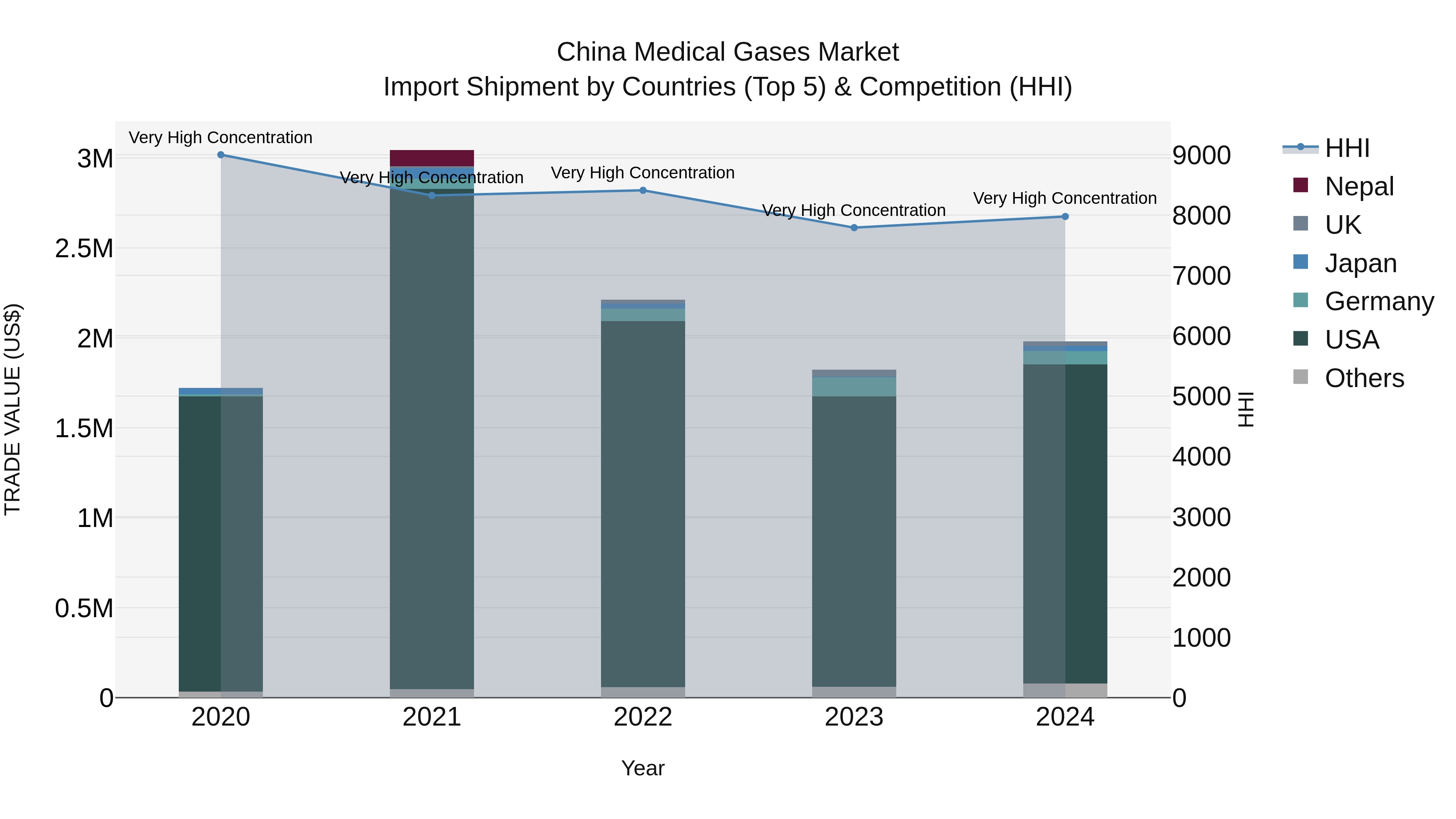
China medical gases import market continued to witness strong growth in 2024, with key exporting countries including the USA, Germany, South Korea, Japan, and the UK dominating the market. The high Herfindahl-Hirschman Index (HHI) indicates a concentrated market structure, fostering competition and innovation. The compound annual growth rate (CAGR) of 3.57% from 2020 to 2024 highlights steady expansion, while the impressive growth rate of 8.6% in 2024 suggests increasing demand and potential opportunities for market players in the medical gases sector.
China Medical Gases Market Overview
The China medical gases market is experiencing steady growth, driven by factors such as the increasing prevalence of chronic diseases, rising geriatric population, and expanding healthcare infrastructure. The market is characterized by the growing adoption of medical gases in various healthcare settings, including hospitals, clinics, and home healthcare. Key players in the market are focusing on expanding their product portfolios and investing in research and development to introduce advanced medical gas products. Moreover, the government initiatives aimed at improving healthcare facilities and the growing awareness about the benefits of medical gases are further propelling market growth. Overall, the China medical gases market is poised for significant expansion in the coming years, with opportunities for both domestic and international companies to capitalize on the growing demand for high-quality medical gases in the country.
China Medical Gases Market Trends
The China medical gases market is witnessing several key trends. One prominent trend is the increasing adoption of home healthcare services, driving the demand for medical gases for in-home treatments. Another important trend is the growing focus on improving healthcare infrastructure, leading to the expansion of hospitals and healthcare facilities that require medical gases for various applications. Additionally, the market is experiencing a shift towards more eco-friendly and sustainable practices, driving the demand for green medical gases production and distribution solutions. Moreover, advancements in technology and regulations aimed at ensuring the quality and safety of medical gases are shaping the market landscape in China. Overall, these trends indicate a promising outlook for the growth and development of the medical gases market in China.
China Medical Gases Market Challenges
In the China medical gases market, several challenges are being faced, including regulatory complexities, intense competition, and quality control issues. The stringent regulations and compliance requirements set by the Chinese government create barriers to entry for new players and can impact the pricing and availability of medical gases. Additionally, the market is highly competitive with both domestic and international companies vying for market share, leading to pricing pressures and the need for innovative product offerings. Quality control is another significant challenge, as ensuring the purity and safety of medical gases is crucial for patient health and safety. Companies operating in the China medical gases market need to navigate these challenges effectively to succeed in this dynamic and demanding industry.
China Medical Gases Market Investment Opportunities
The China medical gases market presents promising investment opportunities due to the increasing demand for medical gases in the healthcare industry. With the growing aging population and rising prevalence of chronic diseases, there is a greater need for medical gases such as oxygen, nitrogen, and nitrous oxide for therapeutic and diagnostic purposes. Additionally, the expansion of healthcare infrastructure and the rise in healthcare expenditure in China further support the market growth. Investors could consider opportunities in medical gas production and distribution companies, as well as manufacturers of medical gas equipment and accessories. Furthermore, advancements in technology and the adoption of innovative gas delivery systems in the healthcare sector provide avenues for investment in research and development to stay competitive in this rapidly evolving market.
China Medical Gases Market Government Policy
The Chinese government has implemented several key policies related to the medical gases market. In recent years, there has been a focus on improving the quality and safety of medical gases, with regulations in place to ensure proper production, storage, and transportation standards are met. Additionally, the government has encouraged domestic production of medical gases to reduce reliance on imports and promote self-sufficiency. In terms of market access, the government has also taken steps to streamline the approval process for medical gas products, aiming to facilitate faster entry of new products into the market. Overall, these policies indicate a commitment to enhancing the quality, safety, and accessibility of medical gases in China, while also supporting the growth of the domestic industry.
China Medical Gases Market Future Outlook
The China medical gases market is poised for significant growth in the coming years, driven by factors such as the increasing prevalence of respiratory diseases, burgeoning geriatric population, and rising healthcare infrastructure development. The demand for medical gases, including oxygen, nitrous oxide, carbon dioxide, and helium, is expected to surge as these gases play a crucial role in various medical applications such as anesthesia, respiratory therapy, and emergency care. Additionally, the ongoing advancements in healthcare technology and the growing awareness regarding the benefits of medical gases are anticipated to further boost market growth. With key players expanding their product portfolios and investing in research and development activities, the China medical gases market is likely to witness steady expansion and innovation, presenting lucrative opportunities for market participants in the foreseeable future.
Key Highlights of the Report:
- China Medical Gases Market Outlook
- Market Size of China Medical Gases Market,2024
- Forecast of China Medical Gases Market, 2031
- Historical Data and Forecast of China Medical Gases Revenues & Volume for the Period 2021-2031
- China Medical Gases Market Trend Evolution
- China Medical Gases Market Drivers and Challenges
- China Medical Gases Price Trends
- China Medical Gases Porter's Five Forces
- China Medical Gases Industry Life Cycle
- Historical Data and Forecast of China Medical Gases Market Revenues & Volume By Technology Type for the Period 2021-2031
- Historical Data and Forecast of China Medical Gases Market Revenues & Volume By Fractional Distillation for the Period 2021-2031
- Historical Data and Forecast of China Medical Gases Market Revenues & Volume By Molecular Sieve for the Period 2021-2031
- Historical Data and Forecast of China Medical Gases Market Revenues & Volume By Semipermeable Membrane for the Period 2021-2031
- Historical Data and Forecast of China Medical Gases Market Revenues & Volume By Physical Separators for the Period 2021-2031
- Historical Data and Forecast of China Medical Gases Market Revenues & Volume By Application Area for the Period 2021-2031
- Historical Data and Forecast of China Medical Gases Market Revenues & Volume By Therapeutic Applications for the Period 2021-2031
- Historical Data and Forecast of China Medical Gases Market Revenues & Volume By Pharmaceutical Manufacturing for the Period 2021-2031
- Historical Data and Forecast of China Medical Gases Market Revenues & Volume By Diagnostic Applications for the Period 2021-2031
- Historical Data and Forecast of China Medical Gases Market Revenues & Volume By Drug Discovery for the Period 2021-2031
- Historical Data and Forecast of China Medical Gases Market Revenues & Volume By Quality Control for the Period 2021 - 2029
- Historical Data and Forecast of China Medical Gases Market Revenues & Volume By End User for the Period 2021-2031
- Historical Data and Forecast of China Medical Gases Market Revenues & Volume By Hospitals for the Period 2021-2031
- Historical Data and Forecast of China Medical Gases Market Revenues & Volume By Home Healthcare for the Period 2021-2031
- Historical Data and Forecast of China Medical Gases Market Revenues & Volume By Pharmaceutical Companies for the Period 2021-2031
- Historical Data and Forecast of China Medical Gases Market Revenues & Volume By Academic Institutions for the Period 2021-2031
- Historical Data and Forecast of China Medical Gases Market Revenues & Volume By Emergency Service Providers for the Period 2021 - 2029
- Historical Data and Forecast of China Medical Gases Market Revenues & Volume By Product Type for the Period 2021-2031
- Historical Data and Forecast of China Medical Gases Market Revenues & Volume By Oxygen Gases for the Period 2021-2031
- Historical Data and Forecast of China Medical Gases Market Revenues & Volume By Carbon Dioxide Gases for the Period 2021-2031
- Historical Data and Forecast of China Medical Gases Market Revenues & Volume By Nitrogen Gases for the Period 2021-2031
- Historical Data and Forecast of China Medical Gases Market Revenues & Volume By Helium Gases for the Period 2021-2031
- Historical Data and Forecast of China Medical Gases Market Revenues & Volume By Gas Mixtures for the Period 2021 - 2029
- China Medical Gases Import Export Trade Statistics
- Market Opportunity Assessment By Technology Type
- Market Opportunity Assessment By Application Area
- Market Opportunity Assessment By End User
- Market Opportunity Assessment By Product Type
- China Medical Gases Top Companies Market Share
- China Medical Gases Competitive Benchmarking By Technical and Operational Parameters
- China Medical Gases Company Profiles
- China Medical Gases Key Strategic Recommendations






































