China Microbial Products Market Size, Share & Growth Rate
The China Microbial Products Market was estimated at USD 130 Million in 2025 and is projected to reach USD 150 Million by 2032, growing at a CAGR of 2.1% from 2026 to 2032. This growth trajectory is primarily fueled by an increasing focus on sustainable agricultural practices, coupled with a significant push from the government to adopt eco-friendly solutions in farming. As Chinese farmers embrace these microbial products, the market is set to expand, driven by rising awareness of their benefits in enhancing crop yields and improving soil health.
China Microbial Products Market Year-wise Growth Rate and Key Drivers
This graph highlights how the China Microbial Products Market has steadily grown over the years, supported by major growth factors.
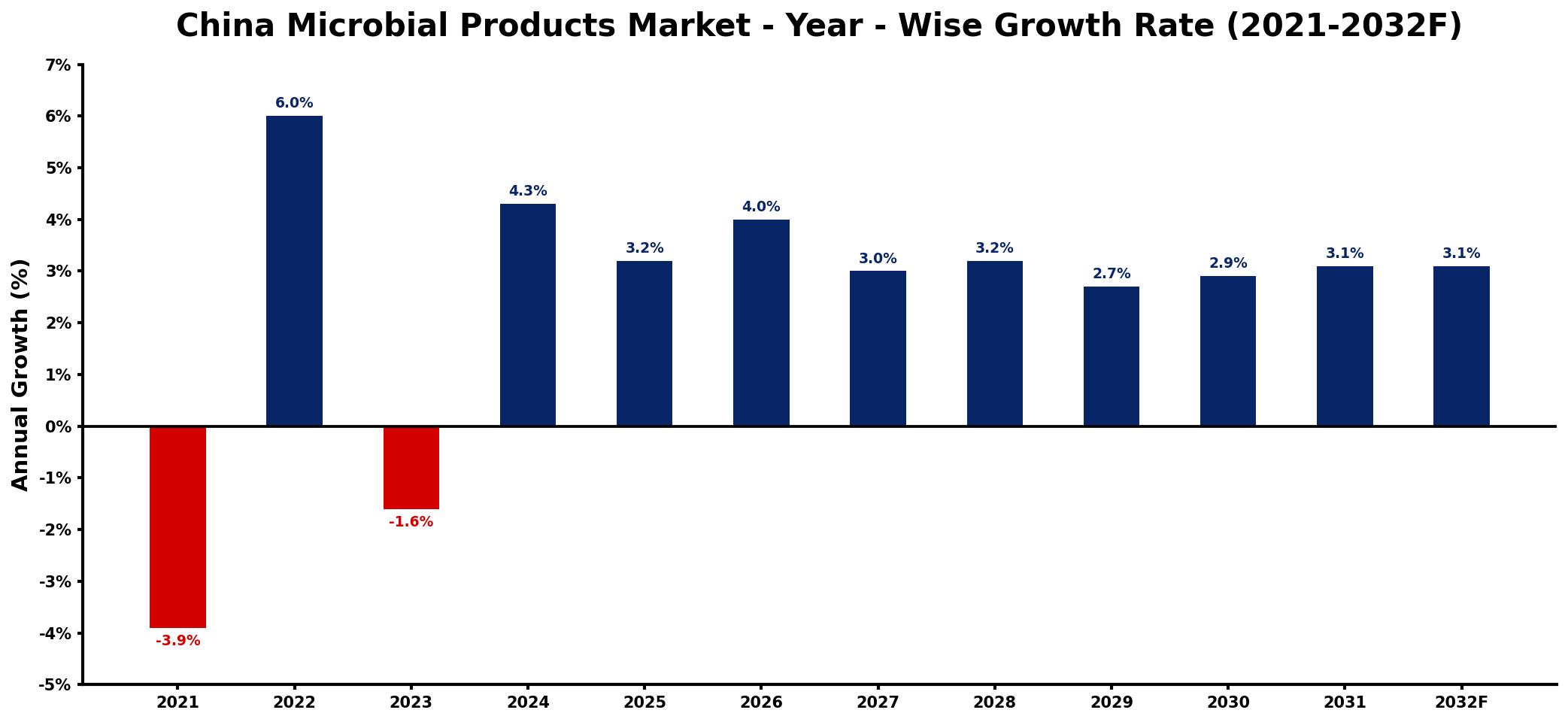
The table below presents the year‑wise growth rates along with the key drivers influencing the market
| Year | Growth Rate | Major Drivers |
| 2021 | -3.9% | Decrease in industrial investments |
| 2022 | 6.0% | Rising demand in agriculture sector |
| 2023 | -1.6% | Lower consumer spending patterns |
| 2024 | 4.3% | Expansion of biotechnology research |
| 2025 | 3.2% | Increased regulatory support initiatives |
| 2026 | 4.0% | Growth in environmental applications |
| 2027 | 3.0% | Surge in healthcare innovations |
| 2028 | 3.2% | Emergence of new market players |
| 2029 | 2.7% | Development of sustainable practices |
| 2030 | 2.9% | Advancements in fermentation technology |
| 2031 | 3.1% | Strengthening of supply chain networks |
| 2032 | 3.1% | Growing awareness of ecological benefits |
Note: Market size estimations and growth projections presented in this report are based on 6Wresearch's proprietary forecasting methodology, utilizing the latest available industry data, government publications, and primary research inputs.
China Microbial Products Market Synopsis
The China Microbial Products Market has recently witnessed robust momentum, fueled by heightened consumer awareness and favorable government policies. Looking ahead, the market is poised for further expansion, as more agricultural stakeholders seek sustainable solutions to meet the increasing demand for organic produce.
As traditional agricultural methods face scrutiny due to their environmental impact, the shift toward microbial products represents a critical evolution in Chinas agricultural landscape. The synergy of innovation in microbial technologies and supportive regulatory frameworks is expected to accelerate market growth in the coming years.
China Microbial Products Market Key Takeaways
- The market is transitioning towards environmentally friendly solutions, driven by sustainable agricultural practices.
- Government initiatives are playing a vital role in promoting microbial products over conventional chemical alternatives.
- High demand for probiotics and biofertilizers is reflective of the increasing focus on soil health and crop productivity.
- The animal feed industry is expanding, leading to a rising requirement for microbial additives to boost livestock health.
- Product innovation and strategic partnerships are key to staying competitive in the rapidly evolving market landscape.
Evaluation of Restraints in China Microbial Products Market
Despite the promising growth outlook for the China Microbial Products Market, several restraints could hinder its full potential. The complex regulatory landscape poses challenges for companies aiming to navigate product registration and market access effectively. Additionally, the fierce competition among domestic and international players may exert pressure on pricing strategies, compelling firms to invest continuously in research and development. Ensuring quality control and production consistency is crucial to maintaining consumer trust in these innovative solutions, and overcoming skepticism regarding microbial products remains a significant hurdle. As such, companies must remain adaptable and vigilant in addressing these challenges to secure their position in the market.
China Microbial Products Market Trends
The China Microbial Products Market is currently shaped by several key trends that are likely to define its future trajectory. Increasing consumer awareness of health and environmental issues is driving demand for biofertilizers and biopesticides, which offer sustainable alternatives to chemical fertilizers. Furthermore, the ongoing expansion of the animal feed sector is propelling the market for microbial additives, enhancing livestock health and productivity. Additionally, strategic partnerships between companies and research institutions are fostering innovation, resulting in new product offerings tailored to specific agricultural challenges. Overall, these trends highlight a significant shift toward sustainable practices that prioritize eco-friendliness.
China Microbial Products Market Opportunities
Investment opportunities within the China Microbial Products Market are ripe across various sectors. In agriculture, the increasing adoption of microbial fertilizers and biopesticides offers a substantial growth potential for companies focused on sustainable farming solutions. Additionally, the healthcare sector is witnessing rising demand for probiotics, catering to a health-conscious consumer base. Moreover, environmental applications related to waste treatment and pollution control are emerging fields that present investment avenues for microbial solutions. As China increasingly prioritizes sustainable practices, the microbial products market is set to attract significant interest from investors.
Government Initiatives in the China Microbial Products Market
The Chinese government has implemented a series of policies aimed at regulating and promoting the microbial products market. These include the issuance of guidelines for the development and application of microbial technologies, along with establishing standards for production, testing, and distribution. Financial support and incentives for research and development in this sector further encourage innovation. Regulatory measures are also in place to ensure the safety and efficacy of microbial products, promoting sustainable practices in their manufacturing and usage. These initiatives create a conducive environment for growth, ensuring adherence to regulatory standards while fostering industry best practices.
Future Insights of the China Microbial Products Market
Looking ahead to 2026-2032, the China Microbial Products Market is expected to maintain its growth trajectory, driven by an increasing awareness of the benefits offered by microbial products across various sectors, particularly agriculture and healthcare. The market will likely continue to flourish as advancements in biotechnology lead to innovative microbial solutions tailored to emerging challenges in farming and health. Additionally, the governments continued focus on sustainability and reducing chemical usage will further bolster the demand for these products, paving the way for a prosperous future in the microbial products market.
China Microbial Products Market Latest Developments (2025 - 2026)
Recent developments in the China Microbial Products Market indicate a robust shift towards innovation and sustainability. Companies have been actively enhancing their product lines with advanced microbial solutions that address specific agricultural needs. Collaborations between technology firms and agricultural producers have also emerged, aiming to improve the efficiency and effectiveness of microbial applications. Furthermore, educational campaigns targeting farmers are being initiated to promote the understanding and adoption of microbial products, contributing to the overall market growth.
China Microbial Products Market - Key Attractiveness of the Report
- 10 Years of Market Numbers
- Historical Data Starting from 2022 to 2025
- Base Year: 2025
- Forecast Data until 2032
- Key Performance Indicators Impacting the Market
- Major Upcoming Developments and Projects
Key Highlights of the Report:
- China Microbial Products Market Outlook
- Market Size of China Microbial Products Market, 2025
- Forecast of China Microbial Products Market, 2032
- Historical Data and Forecast of China Microbial Products Revenues & Volume for the Period 2022-2032F
- China Microbial Products Market Trend Evolution
- China Microbial Products Market Drivers and Challenges
- China Microbial Products Price Trends
- China Microbial Products Porter's Five Forces
- China Microbial Products Industry Life Cycle
- Historical Data and Forecast of China Microbial Products Market Revenues & Volume By Types for the Period 2022-2032F
- Historical Data and Forecast of China Microbial Products Market Revenues & Volume By Enzymes for the Period 2022-2032F
- Historical Data and Forecast of China Microbial Products Market Revenues & Volume By Polysaccharides for the Period 2022-2032F
- Historical Data and Forecast of China Microbial Products Market Revenues & Volume By Nutrients for the Period 2022-2032F
- Historical Data and Forecast of China Microbial Products Market Revenues & Volume By Chemotherapeutic Agents for the Period 2022-2032F
- Historical Data and Forecast of China Microbial Products Market Revenues & Volume By Antibiotics for the Period 2022-2032F
- Historical Data and Forecast of China Microbial Products Market Revenues & Volume By Vaccines for the Period 2022-2032F
- Historical Data and Forecast of China Microbial Products Market Revenues & Volume By Source for the Period 2022-2032F
- Historical Data and Forecast of China Microbial Products Market Revenues & Volume By Bacterial for the Period 2022-2032F
- Historical Data and Forecast of China Microbial Products Market Revenues & Volume By Viral for the Period 2022-2032F
- Historical Data and Forecast of China Microbial Products Market Revenues & Volume By Fungi for the Period 2022-2032F
- Historical Data and Forecast of China Microbial Products Market Revenues & Volume By Applications for the Period 2022-2032F
- Historical Data and Forecast of China Microbial Products Market Revenues & Volume By Pharmaceutical for the Period 2022-2032F
- Historical Data and Forecast of China Microbial Products Market Revenues & Volume By Diagnostic for the Period 2022-2032F
- Historical Data and Forecast of China Microbial Products Market Revenues & Volume By Biotechnology for the Period 2022-2032F
- Historical Data and Forecast of China Microbial Products Market Revenues & Volume By End Users for the Period 2022-2032F
- Historical Data and Forecast of China Microbial Products Market Revenues & Volume By Pharmaceutical And Biotechnological Industries for the Period 2022-2032F
- Historical Data and Forecast of China Microbial Products Market Revenues & Volume By Hospitals And Clinics for the Period 2022-2032F
- Historical Data and Forecast of China Microbial Products Market Revenues & Volume By Diagnostic Labs for the Period 2022-2032F
- Historical Data and Forecast of China Microbial Products Market Revenues & Volume By Research And Academics for the Period 2022-2032F
- China Microbial Products Import Export Trade Statistics
- Market Opportunity Assessment By Types
- Market Opportunity Assessment By Source
- Market Opportunity Assessment By Applications
- Market Opportunity Assessment By End Users
- China Microbial Products Top Companies Market Share
- China Microbial Products Competitive Benchmarking By Technical and Operational Parameters
- China Microbial Products Company Profiles
- China Microbial Products Key Strategic Recommendations






































