China Planting Equipment Market Size, Share & Growth Rate
The China Planting Equipment Market was estimated at USD 135 Million in 2025 and is projected to reach USD 156 Million by 2032, growing at a CAGR of 2.1% from 2026 to 2032. This growth trajectory is primarily driven by the increasing mechanization of agricultural practices, as well as government initiatives that foster the adoption of advanced planting technologies. As farmers strive to enhance productivity and efficiency, the market is expected to witness a robust demand for innovative planting solutions.
China Planting Equipment Market Year-wise Growth Rate and Key Drivers
This graph highlights how the China Planting Equipment Market has steadily grown over the years, supported by major growth factors.
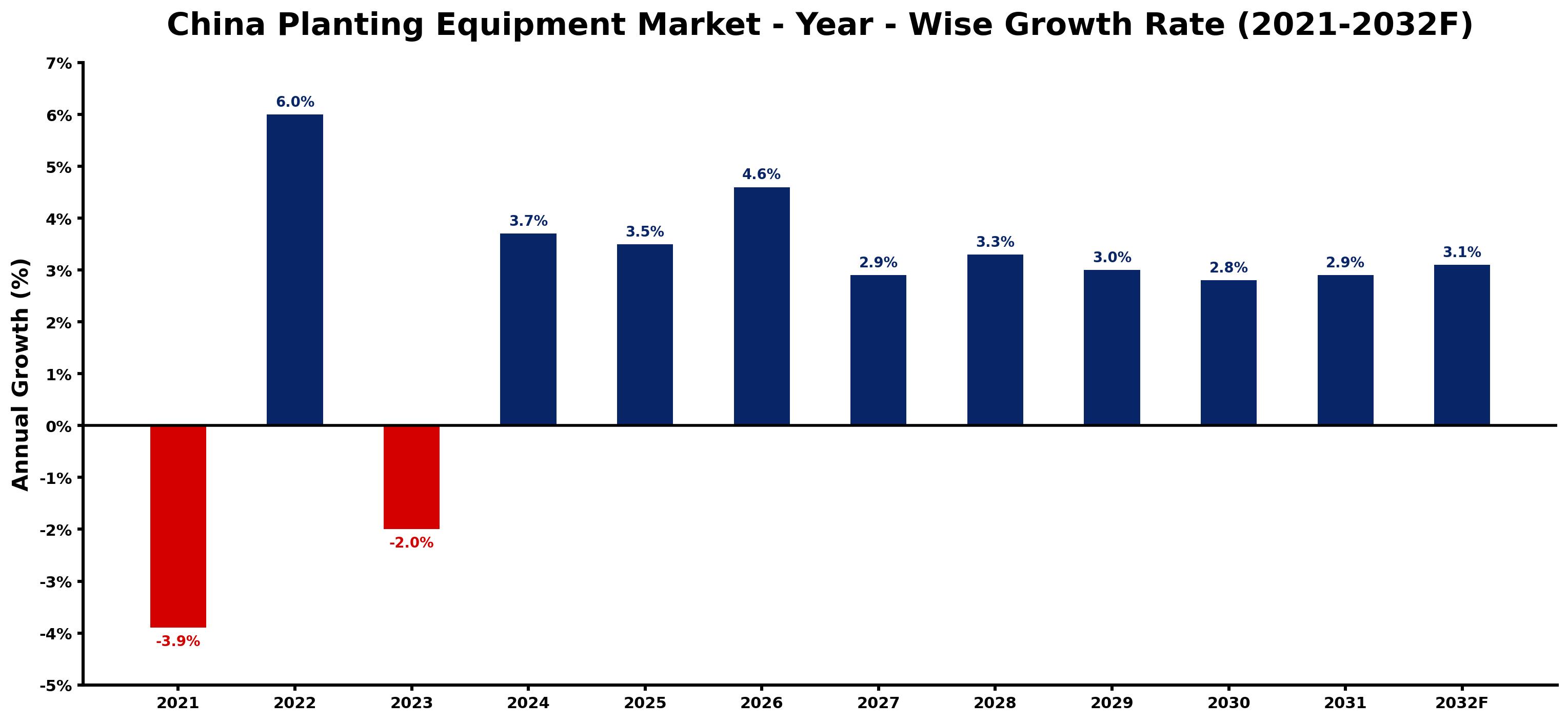
The table below presents the year‑wise growth rates along with the key drivers influencing the market
| Year | Growth Rate | Major Drivers |
| 2021 | -3.9% | Rapid growth in telecom and data center sectors |
| 2022 | 6.0% | Rising electricity demand across industries |
| 2023 | -2.0% | Rapid growth in telecom and data center sectors |
| 2024 | 3.7% | Government infrastructure modernization initiatives |
| 2025 | 3.5% | Increasing industrial infrastructure investments |
| 2026 | 4.6% | Rapid growth in telecom and data center sectors |
| 2027 | 2.9% | Expansion of transportation and logistics networks |
| 2028 | 3.3% | Expansion of commercial construction activities |
| 2029 | 3.0% | Expansion of commercial construction activities |
| 2030 | 2.8% | Expansion of commercial construction activities |
| 2031 | 2.9% | Government infrastructure modernization initiatives |
| 2032 | 3.1% | Rapid growth in telecom and data center sectors |
Note - Market size estimations and growth projections presented in this report are based on 6Wresearch’s advanced forecasting approach, validated with industry datasets as of June 2026.
China Planting Equipment Market Synopsis
In China, the rising trend of precision agriculture is shaping the demand for advanced planting equipment. Farmers are increasingly adopting smart seeding solutions that utilize GPS technology for optimal seed placement and crop yield enhancement. This shift is complemented by the need for multi-functional machinery capable of adapting to various crops and soil types, which is becoming essential for modern agricultural practices.
Moreover, the focus on sustainability is influencing equipment selection in the market. As environmental concerns rise, there is a growing interest in planting equipment designed to minimize chemical usage and mitigate soil erosion. This trend towards eco-friendly technologies aligns with the broader goal of achieving sustainable agricultural practices across the nation.
China Planting Equipment Market Key Takeaways
- The market is poised for steady growth due to increasing mechanization and government support.
- Precision planting technologies are becoming mainstream as farmers seek efficiency.
- There is a notable trend towards multi-functional equipment that accommodates diverse agricultural needs.
- Investments in sustainable planting technologies are gaining momentum in response to environmental challenges.
- Intense competition from both domestic and international players is shaping market dynamics.
Evaluation of Restraints in China Planting Equipment Market
Despite the promising growth prospects, the China Planting Equipment Market faces several constraints. The competitive landscape is marked by fierce rivalry, which can lead to price wars and reduced profit margins. Additionally, rapid technological advancements necessitate continuous innovation, posing challenges for manufacturers to keep pace. Fluctuating agricultural policies, changing weather patterns, and labor shortages also impact market dynamics, compelling companies to adapt swiftly to the evolving environment. The fragmentation of product offerings with varied quality standards adds complexity for buyers, making decision-making challenging.
China Planting Equipment Market Trends
A notable trend in the China Planting Equipment Market is the increased integration of automation and artificial intelligence in machinery. This advancement not only enhances operational efficiency but also improves data analytics capabilities, allowing farmers to make informed decisions. Furthermore, the rise of smart farming practices, including IoT-connected devices, is paving the way for real-time monitoring and adjustment of planting activities. As these technologies mature, they will further reshape the planting landscape.
China Planting Equipment Market Opportunities
Investment opportunities in the China Planting Equipment Market are ripe, particularly in precision planting solutions that utilize cutting-edge technologies. The mechanization of farming, driven by labor shortages, underscores the need for innovative planting machinery. Collaborating with local manufacturers to develop tailored solutions can create significant value for investors. Additionally, there's potential in creating equipment that emphasizes sustainability, aligning with the growing demand for environmentally responsible agricultural practices.
Government Initiatives in the China Planting Equipment Market
The Chinese government plays a pivotal role in shaping the planting equipment landscape through various policies aimed at modernizing agriculture. Initiatives include subsidies for purchasing advanced machinery and incentives promoting precision farming technologies. Furthermore, the government supports research and development efforts within the sector, encouraging innovations that lead to environmentally friendly practices. These policies are designed to bolster domestic manufacturing while reducing dependency on imports, fostering a competitive and efficient planting equipment market.
Future Insights of the China Planting Equipment Market
Looking ahead to 2026-2032, the China Planting Equipment Market is set to thrive, driven by continued mechanization and government support. The increasing awareness of sustainable farming practices and the adoption of advanced agricultural technologies will enhance demand for innovative planting solutions. Furthermore, as smart farming technologies gain traction, the industry is expected to witness groundbreaking developments that will redefine agricultural efficiency and productivity, positioning it for a bright future.
China Planting Equipment Market Latest Developments (May 2025 - June 2026)
Recent developments in the China Planting Equipment Market indicate a strong push towards automation and digitalization. Companies are increasingly investing in research to integrate AI and IoT technologies into planting solutions. This shift is driven by the need for efficiency amid labor shortages and the desire to optimize crop yields through data analytics. Additionally, there is an uptick in partnerships aimed at enhancing product offerings and addressing farmer-specific challenges with innovative machinery.
China Planting Equipment Market - Key Attractiveness of the Report
- 10 Years of Market Numbers
- Historical Data Starting from 2022 to 2025
- Base Year: 2025
- Forecast Data until 2032
- Key Performance Indicators Impacting the Market
- Major Upcoming Developments and Projects
Key Highlights of the Report:
- China Planting Equipment Market Outlook
- Market Size of China Planting Equipment Market, 2025
- Forecast of China Planting Equipment Market, 2032
- Historical Data and Forecast of China Planting Equipment Revenues & Volume for the Period 2022-2032F
- China Planting Equipment Market Trend Evolution
- China Planting Equipment Market Drivers and Challenges
- China Planting Equipment Price Trends
- China Planting Equipment Porter's Five Forces
- China Planting Equipment Industry Life Cycle
- Historical Data and Forecast of China Planting Equipment Market Revenues & Volume By Type for the Period 2022-2032F
- Historical Data and Forecast of China Planting Equipment Market Revenues & Volume By Air seeders for the Period 2022-2032F
- Historical Data and Forecast of China Planting Equipment Market Revenues & Volume By Seed drills for the Period 2022-2032F
- Historical Data and Forecast of China Planting Equipment Market Revenues & Volume By Planters for the Period 2022-2032F
- Historical Data and Forecast of China Planting Equipment Market Revenues & Volume By Others for the Period 2022-2032F
- Historical Data and Forecast of China Planting Equipment Market Revenues & Volume By Design for the Period 2022-2032F
- Historical Data and Forecast of China Planting Equipment Market Revenues & Volume By Mechanical for the Period 2022-2032F
- Historical Data and Forecast of China Planting Equipment Market Revenues & Volume By Automatic for the Period 2022-2032F
- Historical Data and Forecast of China Planting Equipment Market Revenues & Volume By Crop Type for the Period 2022-2032F
- Historical Data and Forecast of China Planting Equipment Market Revenues & Volume By Cereals & grains for the Period 2022-2032F
- Historical Data and Forecast of China Planting Equipment Market Revenues & Volume By Oilseeds & pulses for the Period 2022-2032F
- Historical Data and Forecast of China Planting Equipment Market Revenues & Volume By Fruits & vegetables for the Period 2022-2032F
- Historical Data and Forecast of China Planting Equipment Market Revenues & Volume By Others for the Period 2022-2032F
- China Planting Equipment Import Export Trade Statistics
- Market Opportunity Assessment By Type
- Market Opportunity Assessment By Design
- Market Opportunity Assessment By Crop Type
- China Planting Equipment Top Companies Market Share
- China Planting Equipment Competitive Benchmarking By Technical and Operational Parameters
- China Planting Equipment Company Profiles
- China Planting Equipment Key Strategic Recommendations






































