China Railway Maintenance Machinery Market Size, Share & Growth Rate
The China Railway Maintenance Machinery Market was estimated at USD 492 Million in 2025 and is projected to reach USD 657 Million by 2032, growing at a CAGR of 4.2% from 2026 to 2032. This growth trajectory is driven by China's expansive railway network and the government's commitment to modernizing infrastructure. With a growing emphasis on high-speed rail systems and urban metro projects, the demand for advanced maintenance machinery is expected to rise significantly in the coming years.
China Railway Maintenance Machinery Market Year-wise Growth Rate and Key Drivers
This graph highlights how the China Railway Maintenance Machinery Market has steadily grown over the years, supported by major growth factors.
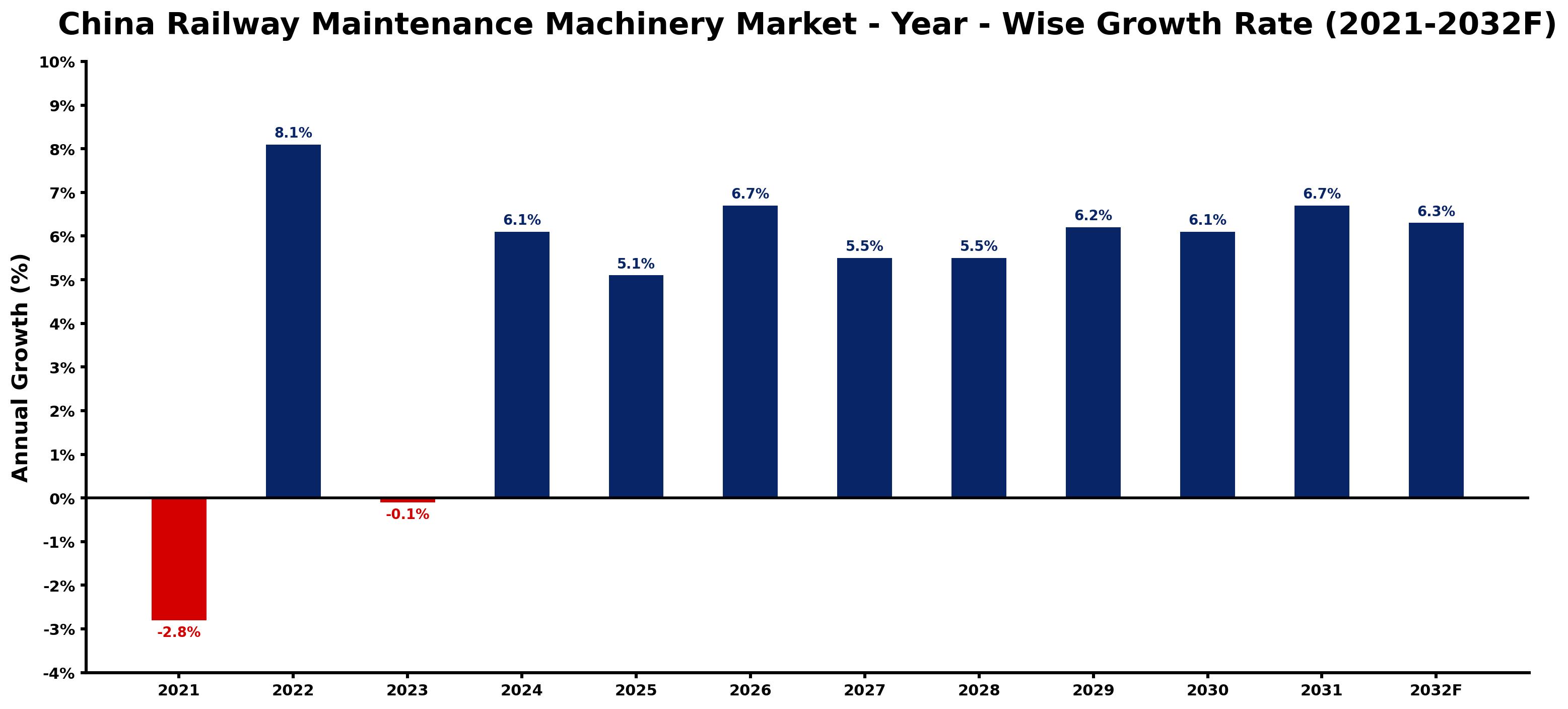
The table below presents the year‑wise growth rates along with the key drivers influencing the market
| Year | Growth Rate | Major Drivers |
| 2021 | -2.8% | Growing urbanization and commercial development |
| 2022 | 8.1% | Growing urbanization and commercial development |
| 2023 | -0.1% | Expansion of commercial construction activities |
| 2024 | 6.1% | Rapid growth in telecom and data center sectors |
| 2025 | 5.1% | Rapid growth in telecom and data center sectors |
| 2026 | 6.7% | Increasing industrial infrastructure investments |
| 2027 | 5.5% | Increasing industrial infrastructure investments |
| 2028 | 5.5% | Expansion of transportation and logistics networks |
| 2029 | 6.2% | Expansion of transportation and logistics networks |
| 2030 | 6.1% | Increasing industrial infrastructure investments |
| 2031 | 6.7% | Rising electricity demand across industries |
| 2032 | 6.3% | Increasing smart city development projects |
Note - Market size estimations and growth projections presented in this report are based on 6Wresearch's advanced forecasting approach, validated with industry datasets as of June 2026.
China Railway Maintenance Machinery Market Synopsis
As the largest rail network globally, China requires extensive maintenance machinery to ensure safety and efficiency. This demand is underscored by ongoing government initiatives aimed at upgrading railway operations and introducing cutting-edge technologies into maintenance practices.
The market features a diverse array of machinery, including track laying and ballast cleaning equipment, tailored to address the unique challenges presented by China's vast railway infrastructure. Such specialized machinery plays a critical role in maintaining the operational integrity and safety of the railway system.
China Railway Maintenance Machinery Market Key Takeaways
- The market is bolstered by government investment in infrastructure and modernization initiatives.
- Technological advancements in AI and IoT are revolutionizing maintenance operations.
- There is an increasing demand for environmentally friendly and energy-efficient machinery.
- Market players are expanding product portfolios to meet the needs of high-speed rail networks.
- Competitive pressures are shaping pricing strategies and innovation cycles within the industry.
Evaluation of Restraints in China Railway Maintenance Machinery Market
Despite promising growth, the market faces significant constraints, particularly concerning intense competition among domestic and international firms. This environment creates price wars that can compress profit margins and impact investment in innovation. Moreover, companies must continuously adapt to rapid technological changes, necessitating significant R&D investments. Additionally, the regulatory landscape can be complex, posing challenges in compliance and operational efficiency. Lastly, the sheer scale of China's railway system requires sophisticated logistical solutions that can complicate maintenance operations.
China Railway Maintenance Machinery Market Trends
One of the most notable trends in the China Railway Maintenance Machinery Market is the integration of advanced technologies such as artificial intelligence and big data analytics. These innovations are being employed to enhance maintenance operations by predicting equipment failures and optimizing service schedules. Furthermore, there's a pronounced shift toward sustainable practices, with manufacturers focusing on creating environmentally friendly machinery that minimizes carbon footprints while maximizing operational efficiency.
China Railway Maintenance Machinery Market Opportunities
The ongoing infrastructure development in China presents lucrative investment opportunities within the railway maintenance machinery sector. Investors can capitalize on the demand for cutting-edge maintenance equipment designed for high-speed railways and urban transit systems. Additionally, the transition towards automation and digitalization fosters a fertile ground for innovations that improve efficiency and safety in railway operations, providing avenues for both new entrants and established players alike to grow their market presence.
Government Initiatives in the China Railway Maintenance Machinery Market
The Chinese government is actively promoting policies aimed at enhancing railway infrastructure and maintenance efficiency. These include increased public spending on rail construction, particularly for high-speed and urban rail systems. Furthermore, regulatory measures are in place to ensure the safety and quality of railway maintenance machinery, and there are incentives to encourage domestic manufacturing and innovation within the sector. This supportive environment is designed to stimulate growth and modernization in the railway maintenance machinery market.
Future Insights of the China Railway Maintenance Machinery Market
Looking ahead to the period between 2026 and 2032, the China Railway Maintenance Machinery Market is poised for steady growth fueled by continuous investment in railway infrastructure. The expansion of high-speed rail networks and increased urbanization will continue to necessitate advanced maintenance solutions. Furthermore, technological innovations will likely play a significant role in redefining operational practices, leading to smarter, safer, and more efficient railway maintenance systems that align with China's broader transportation goals.
China Railway Maintenance Machinery Market Latest Developments (May 2025 - June 2026)
Recently, the industry has seen a focus on incorporating digital technologies into maintenance operations, with an emphasis on predictive maintenance solutions. Furthermore, ongoing collaborations between manufacturers and tech companies are expected to result in the development of highly efficient machinery that meets the evolving needs of the railway sector. Public sector investments in rail projects have also intensified, signaling a robust pipeline of infrastructure enhancement plans that will drive demand for maintenance machinery.
China Railway Maintenance Machinery Market - Key Attractiveness of the Report
- 10 Years of Market Numbers
- Historical Data Starting from 2022 to 2025
- Base Year: 2025
- Forecast Data until 2032
- Key Performance Indicators Impacting the Market
- Major Upcoming Developments and Projects
Key Highlights of the Report:
- China Railway Maintenance Machinery Market Outlook
- Market Size of China Railway Maintenance Machinery Market, 2025
- Forecast of China Railway Maintenance Machinery Market, 2032
- Historical Data and Forecast of China Railway Maintenance Machinery Revenues & Volume for the Period 2022-2032F
- China Railway Maintenance Machinery Market Trend Evolution
- China Railway Maintenance Machinery Market Drivers and Challenges
- China Railway Maintenance Machinery Price Trends
- China Railway Maintenance Machinery Porter's Five Forces
- China Railway Maintenance Machinery Industry Life Cycle
- Historical Data and Forecast of China Railway Maintenance Machinery Market Revenues & Volume By Type for the Period 2022-2032F
- Historical Data and Forecast of China Railway Maintenance Machinery Market Revenues & Volume By Tamping Machine for the Period 2022-2032F
- Historical Data and Forecast of China Railway Maintenance Machinery Market Revenues & Volume By Stabilizing Machinery for the Period 2022-2032F
- Historical Data and Forecast of China Railway Maintenance Machinery Market Revenues & Volume By Rail Handling Machinery for the Period 2022-2032F
- Historical Data and Forecast of China Railway Maintenance Machinery Market Revenues & Volume By Ballast Cleaning Machine for the Period 2022-2032F
- Historical Data and Forecast of China Railway Maintenance Machinery Market Revenues & Volume By Other for the Period 2022-2032F
- Historical Data and Forecast of China Railway Maintenance Machinery Market Revenues & Volume By Applications for the Period 2022-2032F
- Historical Data and Forecast of China Railway Maintenance Machinery Market Revenues & Volume By Ballast Track for the Period 2022-2032F
- Historical Data and Forecast of China Railway Maintenance Machinery Market Revenues & Volume By Ballastless Track for the Period 2022-2032F
- China Railway Maintenance Machinery Import Export Trade Statistics
- Market Opportunity Assessment By Type
- Market Opportunity Assessment By Applications
- China Railway Maintenance Machinery Top Companies Market Share
- China Railway Maintenance Machinery Competitive Benchmarking By Technical and Operational Parameters
- China Railway Maintenance Machinery Company Profiles
- China Railway Maintenance Machinery Key Strategic Recommendations






































