China Refined Petroleum Products Market Size, Share & Growth Rate
The China Refined Petroleum Products Market was estimated at USD 165 Million in 2025 and is projected to reach USD 190 Million by 2032, growing at a CAGR of 2.0% from 2026 to 2032. This growth trajectory is propelled by an ever-increasing demand for refined products driven by industrial expansion and a burgeoning vehicle ownership rate. Additionally, the ongoing investment in cleaner technologies aligns with governmental initiatives aimed at reducing pollution and enhancing energy efficiency.
China Refined Petroleum Products Market Year-wise Growth Rate and Key Drivers
This graph highlights how the China Refined Petroleum Products Market has steadily grown over the years, supported by major growth factors.
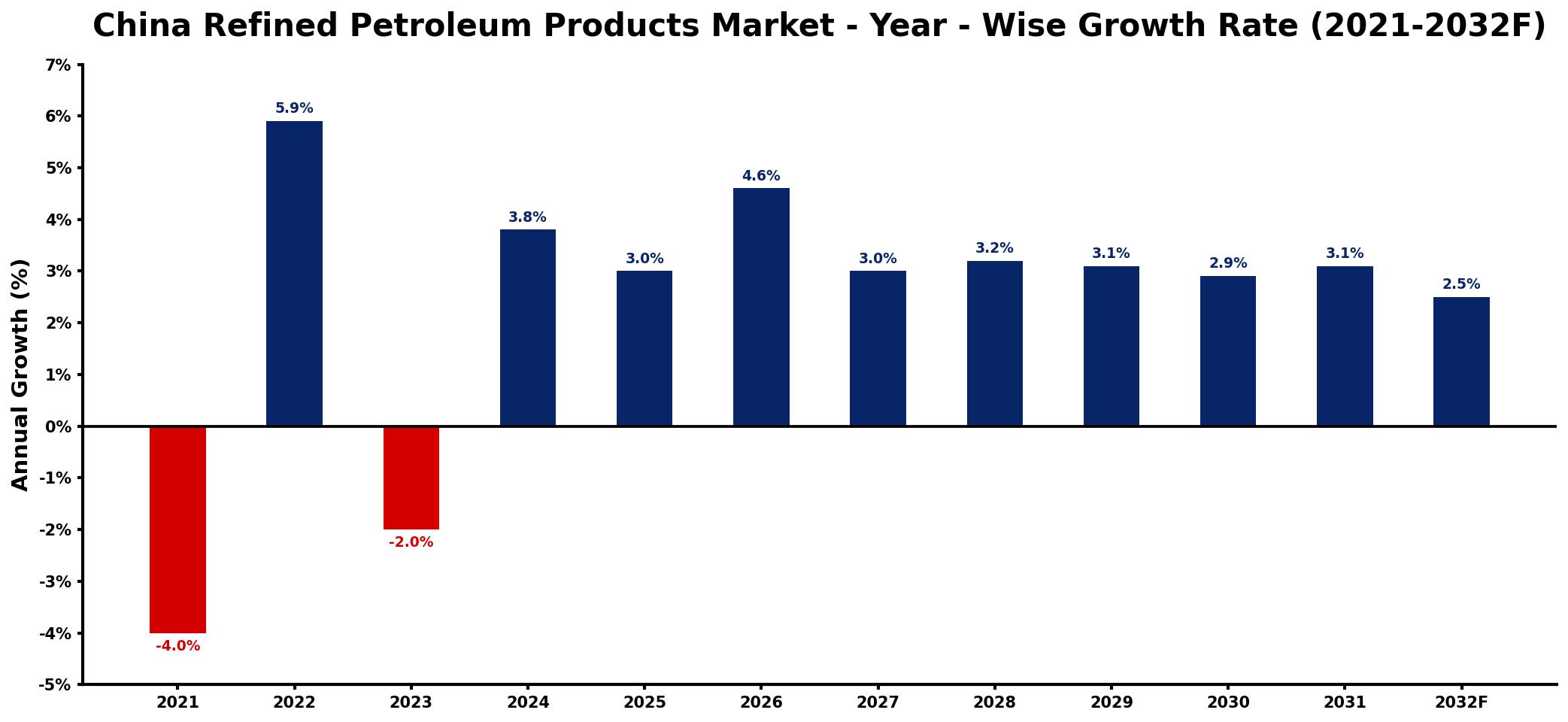
The table below presents the year‑wise growth rates along with the key drivers influencing the market
| Year | Growth Rate | Major Drivers |
| 2021 | -4.0% | decrease in transportation activity |
| 2022 | 5.9% | growing industrial energy consumption |
| 2023 | -2.0% | lowered global crude prices |
| 2024 | 3.8% | rising demand for logistics services |
| 2025 | 3.0% | expansion in urban infrastructure projects |
| 2026 | 4.6% | increased investments in energy sector |
| 2027 | 3.0% | growth in automotive manufacturing output |
| 2028 | 3.2% | enhanced supply chain efficiencies |
| 2029 | 3.1% | increased consumer travel activities |
| 2030 | 2.9% | growing demand for commercial fleets |
| 2031 | 3.1% | advancements in alternative fuel technologies |
| 2032 | 2.5% | expansion of regional trade agreements |
Note: Market size estimations and growth projections presented in this report are based on 6Wresearch's proprietary forecasting methodology, utilizing the latest available industry data, government publications, and primary research inputs.
China Refined Petroleum Products Market Synopsis
In the context of a rapidly transforming energy landscape, the China Refined Petroleum Products Market stands out as a pivotal component of the country's economic engine. The persistent demand for gasoline, diesel, jet fuel, and other refined products underscores the significance of this sector in supporting both industrial activities and daily transportation needs.
As the world's largest crude oil importer, Chinas refining sector is dominated by state-owned enterprises that are actively investing in expanding their capacities. These efforts are complemented by a strong focus on adopting cleaner technologies to meet increasingly stringent environmental regulations, setting the stage for a more sustainable future.
China Refined Petroleum Products Market Key Takeaways
- The market is projected to grow steadily due to rising industrial and transportation demands.
- Government policies are driving the transition towards cleaner fuels and sustainable practices.
- Increased vehicle ownership and urbanization continue to boost petroleum consumption.
- Investment in refining capacity expansion and technology adoption is crucial for future growth.
- Market dynamics are shaped by global oil prices and emerging alternative energy sources.
Evaluation of Restraints in China Refined Petroleum Products Market
Despite its robust growth potential, the China Refined Petroleum Products Market faces notable restraints. Volatility in global oil prices presents a significant risk, impacting profitability and operational planning for refiners. Additionally, the sector must contend with increasingly stringent government regulations aimed at mitigating environmental impacts, which necessitate constant adaptation and investment. Competition from alternative energy sources is escalating, pressuring traditional petroleum product demand while creating challenges in maintaining market share. Moreover, overcapacity within refining facilities calls for strategic reevaluation to optimize operations and align with fluctuating demand influenced by economic conditions.
China Refined Petroleum Products Market Trends
Several transformative trends are emerging within the China Refined Petroleum Products Market. A pivotal shift towards sustainability is evident, with a marked increase in demand for cleaner petroleum products such as low-sulfur diesel and gasoline. Concurrently, the refining processes are evolving, embracing higher quality standards and efficiency to comply with stringent environmental regulations. The adoption of electric vehicles is also reshaping the demand landscape, as consumers increasingly consider alternatives to traditional petroleum products. These trends collectively highlight a market moving towards a more environmentally conscious future.
China Refined Petroleum Products Market Opportunities
Investment opportunities abound in the China Refined Petroleum Products Market, particularly in the domain of cleaner fuel technologies. Government initiatives targeting pollution reduction are likely to elevate the demand for low-sulfur fuels, thus opening avenues for innovative refining solutions. Additionally, given Chinas substantial consumption of oil, investment in storage and distribution infrastructure is essential to support rising demands effectively. As the nation embraces a diversified energy mix, integrating renewable sources like solar and wind power presents a lucrative long-term opportunity for stakeholders looking to reduce dependency on fossil fuels.
Government Initiatives in the China Refined Petroleum Products Market
The Chinese government plays a crucial role in regulating the Refined Petroleum Products Market through various initiatives aimed at promoting energy conservation and environmental sustainability. Policies including stringent fuel quality standards aim to mitigate pollution levels, while pricing mechanisms are implemented to stabilize market fluctuations. Furthermore, the government actively encourages investments in renewable energy sources, thereby diversifying the overall energy mix and promoting a shift away from heavy reliance on fossil fuels. These comprehensive policy frameworks reflect Chinas commitment to achieving energy security and fostering a sustainable energy future.
Future Insights of the China Refined Petroleum Products Market
Looking ahead to 2026-2032, the future of the China Refined Petroleum Products Market appears optimistic. Factors such as increasing industrialization, urbanization, and a growing middle-class population will sustain the demand for refined products. Concurrently, the Chinese government's focus on promoting cleaner energy solutions is likely to catalyze investment in innovative refining technologies. Additionally, initiatives like the Belt and Road Initiative could stimulate further demand for refined products, driven by infrastructure development projects across various regions. However, market players must remain vigilant of fluctuations in global oil prices and the evolving competitive landscape influenced by alternative energy sources.
China Refined Petroleum Products Market Latest Developments (2025 - 2026)
Recent industry developments indicate a heightened focus on environmental compliance as companies strive to align with new governmental regulations on emissions. Initiatives promoting the adoption of cleaner fuels are gaining traction, prompting refiners to upgrade their operations. Moreover, fluctuating global oil prices have led to strategic partnerships within the supply chain aimed at securing stability and reducing vulnerability to market shocks. Stakeholders are increasingly exploring technological innovations to enhance operational efficiency and sustainability.
China Refined Petroleum Products Market - Key Attractiveness of the Report
- 10 Years of Market Numbers
- Historical Data Starting from 2022 to 2025
- Base Year: 2025
- Forecast Data until 2032
- Key Performance Indicators Impacting the Market
- Major Upcoming Developments and Projects
Key Highlights of the Report:
- China Refined Petroleum Products Market Outlook
- Market Size of China Refined Petroleum Products Market, 2025
- Forecast of China Refined Petroleum Products Market, 2032
- Historical Data and Forecast of China Refined Petroleum Products Revenues & Volume for the Period 2022-2032F
- China Refined Petroleum Products Market Trend Evolution
- China Refined Petroleum Products Market Drivers and Challenges
- China Refined Petroleum Products Price Trends
- China Refined Petroleum Products Porter's Five Forces
- China Refined Petroleum Products Industry Life Cycle
- Historical Data and Forecast of China Refined Petroleum Products Market Revenues & Volume By Product Type for the Period 2022-2032F
- Historical Data and Forecast of China Refined Petroleum Products Market Revenues & Volume By Diesel for the Period 2022-2032F
- Historical Data and Forecast of China Refined Petroleum Products Market Revenues & Volume By Gasoline for the Period 2022-2032F
- Historical Data and Forecast of China Refined Petroleum Products Market Revenues & Volume By Fuel Oils for the Period 2022-2032F
- Historical Data and Forecast of China Refined Petroleum Products Market Revenues & Volume By Kerosene for the Period 2022-2032F
- Historical Data and Forecast of China Refined Petroleum Products Market Revenues & Volume By Others for the Period 2022-2032F
- Historical Data and Forecast of China Refined Petroleum Products Market Revenues & Volume By Application for the Period 2022-2032F
- Historical Data and Forecast of China Refined Petroleum Products Market Revenues & Volume By Fuel for the Period 2022-2032F
- Historical Data and Forecast of China Refined Petroleum Products Market Revenues & Volume By Chemical for the Period 2022-2032F
- Historical Data and Forecast of China Refined Petroleum Products Market Revenues & Volume By Others for the Period 2022-2032F
- Historical Data and Forecast of China Refined Petroleum Products Market Revenues & Volume By Fraction for the Period 2022-2032F
- Historical Data and Forecast of China Refined Petroleum Products Market Revenues & Volume By Light Distillates for the Period 2022-2032F
- Historical Data and Forecast of China Refined Petroleum Products Market Revenues & Volume By Middle Distillates for the Period 2022-2032F
- Historical Data and Forecast of China Refined Petroleum Products Market Revenues & Volume By Heavy Oils for the Period 2022-2032F
- China Refined Petroleum Products Import Export Trade Statistics
- Market Opportunity Assessment By Product Type
- Market Opportunity Assessment By Application
- Market Opportunity Assessment By Fraction
- China Refined Petroleum Products Top Companies Market Share
- China Refined Petroleum Products Competitive Benchmarking By Technical and Operational Parameters
- China Refined Petroleum Products Company Profiles
- China Refined Petroleum Products Key Strategic Recommendations






































