China Risk Analytics Market Size & Growth Rate (2026-2032)
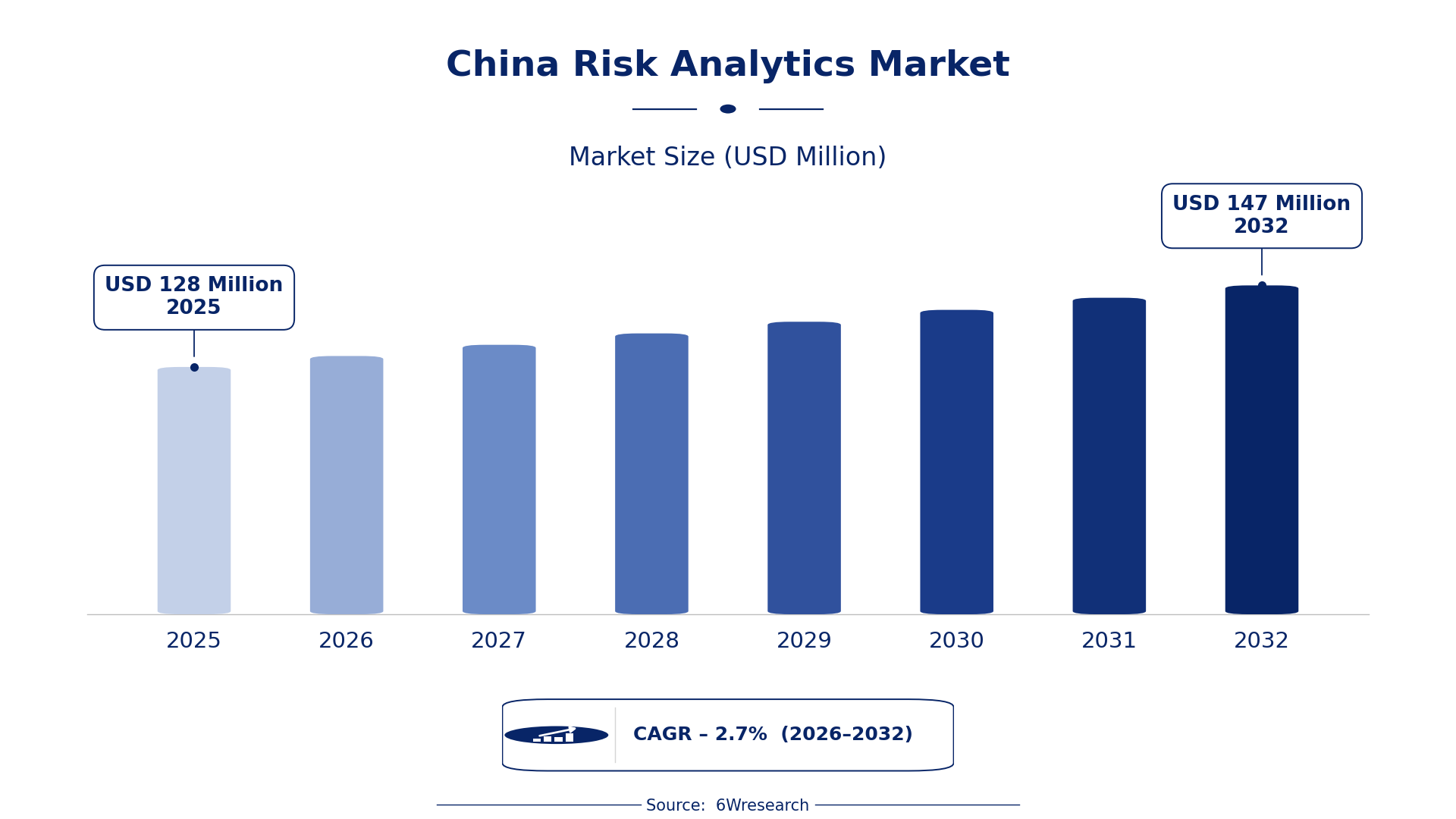
The China Risk Analytics Market was estimated at USD 128 Million in 2025 and is projected to reach USD 147 Million by 2032, growing at a CAGR of 2.7% from 2026 to 2032.
China Risk Analytics Market Synopsis
The China Risk Analytics Market has seen a surge in demand as businesses increasingly recognize the necessity of robust risk management strategies. This momentum stems from the growing complexities in regulatory environments and the increasing frequency of cyber threats that organizations face. As we look ahead, the market is poised for further expansion, driven by technological advancements and an intensifying focus on compliance and security.
Businesses across sectors such as finance, healthcare, and manufacturing are investing in advanced risk analytics solutions to navigate uncertainties. These solutions not only enhance operational efficiency but also provide a competitive edge in a volatile market. The integration of artificial intelligence and machine learning into risk management practices is transforming how risks are assessed and mitigated.
China Risk Analytics Market Year-wise Growth Rate and Key Drivers
This graph illustrates the annual growth rates of the China Risk Analytics Market from 2021 to 2032, highlighting a steady upward trajectory and projected expansion over the forecast period.
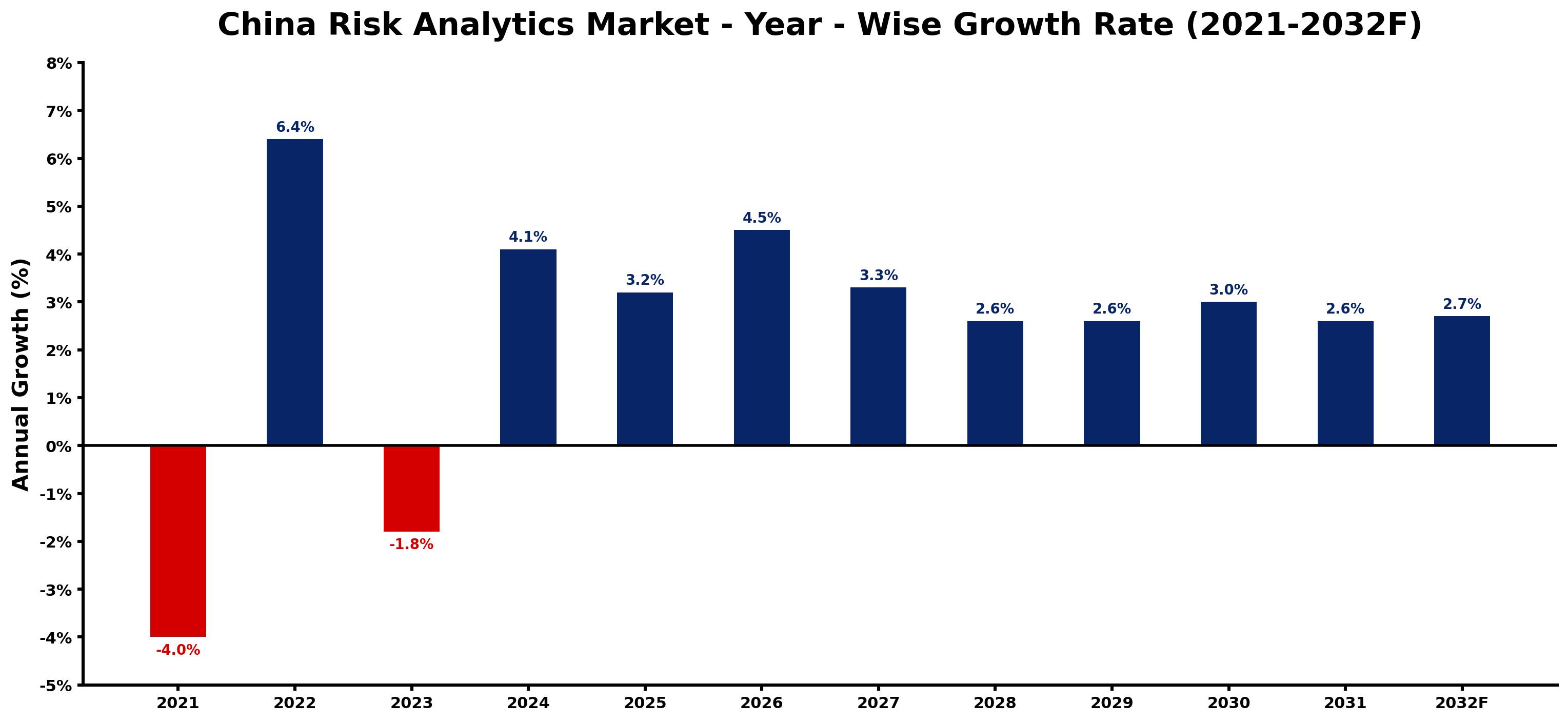
The table below presents the year‑wise growth rates along with the key drivers influencing the market
| Year | Growth Rate | Major Drivers |
| 2021 | -4.0% | Increased restrictions by China’s Cybersecurity Administration |
| 2022 | 6.4% | China's regulatory push for stronger financial risk management. |
| 2023 | -1.8% | Decline in demand due to economic uncertainties from COVID-19 |
| 2024 | 4.1% | Increase in cybersecurity regulations for financial institutions. |
| 2025 | 3.2% | Growing urbanization leading to heightened risk assessment needs. |
| 2026 | 4.5% | Government policies promoting data transparency in finance sectors. |
| 2027 | 3.3% | Emergence of fintech driving demand for risk analytics solutions. |
| 2028 | 2.6% | Rising climate change impacts necessitating tailored risk strategies. |
| 2029 | 2.6% | Increased focus on anti-money laundering regulations in banking. |
| 2030 | 3.0% | Digital yuan implementation boosting financial transaction risk management. |
| 2031 | 2.6% | Local enterprises seeking advanced risk mitigation technologies. |
| 2032 | 2.7% | Growing importance of data privacy laws enhancing risk compliance. |
Note: Market size estimations and growth projections presented in this report are based on 6Wresearch's proprietary forecasting methodology, utilizing the latest available industry data, government publications, and primary research inputs.
China Risk Analytics Market Key Takeaways
Below are some of the specific key takeaways from the market, including:
- The market is driven by increasing regulatory compliance requirements across various industries.
- Adoption of AI and machine learning technologies is reshaping risk assessment methodologies.
- Cybersecurity risk analytics is becoming a top priority for organizations.
- Cloud-based risk analytics solutions are gaining traction due to their flexibility and scalability.
- Investment opportunities are emerging in consulting services focused on regulatory navigation.
Evaluation of Restraints in China Risk Analytics Market
Despite the growth potential, the China Risk Analytics Market is hindered by several challenges. Regulatory complexities present a significant barrier, as companies struggle to keep pace with an evolving landscape of compliance requirements. Additionally, data quality issues arise from the vast amounts of information generated, which are often inconsistent or poorly standardized. Cultural barriers within some organizations may also impede the adoption of innovative risk analytics solutions. These factors necessitate a tailored approach, requiring deep local market understanding and partnerships to effectively address the unique challenges faced by Chinese businesses.
China Risk Analytics Market Trends
Several key trends are currently shaping the China Risk Analytics Market. The first is the accelerated integration of AI and machine learning technologies, which enable real-time risk assessment and decision-making. Organizations are increasingly utilizing predictive analytics to forecast potential risks and respond proactively. Another notable trend is the heightened focus on cybersecurity analytics, reflecting the growing concerns surrounding data breaches and cyber threats. Additionally, the shift towards cloud-based solutions is becoming apparent, as companies seek more agile and scalable options to manage risks effectively.
China Risk Analytics Market Opportunities
Investment opportunities in the China Risk Analytics Market are plentiful, particularly as businesses prioritize advanced risk management solutions. With the increasing complexity of operations and geopolitical risks, organizations require sophisticated analytics tools to navigate challenges. Investors can focus on companies that offer innovative software solutions, particularly those that incorporate predictive modeling and real-time monitoring capabilities. The consulting sector also presents lucrative opportunities, aiding businesses in compliance and risk management amidst evolving regulations.
Government Initiatives in the China Risk Analytics Market
Government policy plays a crucial role in shaping the China Risk Analytics Market, as regulators implement measures to enhance data security and compliance. The emphasis on safeguarding national interests influences how companies manage risk analytics, creating both challenges and opportunities. As organizations align with government mandates, those offering secure and compliant analytics solutions are well-positioned for growth.
- A regulatory framework introduced in 2021 mandating enhanced data protection measures for companies handling sensitive information.
- Current initiatives focus on establishing regional cybersecurity centers to bolster defense against cyber threats, underway since early 2023.
- A planned public-private partnership aimed at developing a national risk management framework is expected to launch in 2026.
- Ongoing reviews of the Cybersecurity Law to align with international standards, initiated in late 2022.
- A recent program to promote AI in risk analytics launched in mid-2023 to support innovation and adoption in the industry.
Future Insights of the China Risk Analytics Market
Looking towards 2026-2032, the China Risk Analytics Market is likely to experience substantial growth as businesses become increasingly aware of risk management's importance. The digitalization of operations and ongoing globalization will necessitate advanced analytics solutions to address diverse risks. Government initiatives promoting technology-driven risk management practices will further stimulate market expansion. As organizations confront rising cyber threats and regulatory complexities, the demand for sophisticated risk analytics services will continue to grow.
China Risk Analytics Market Latest Developments
Over the past year, the China Risk Analytics Market has seen notable developments, reflecting the industry's dynamic nature. Organizations are rapidly adopting innovative technologies to enhance their risk management capabilities, with a clear trend towards integrating AI and machine learning into their analytics processes. Companies are also increasingly prioritizing partnerships that facilitate data sharing and compliance with regulatory standards.
- A leading technology vendor launched a comprehensive risk analytics platform in early 2023, focusing on real-time threat monitoring.
- An initiative to enhance data interoperability standards among financial institutions began in Q2 2023 and is currently ongoing.
- A major regional player is expected to roll out an upgraded risk assessment tool in late 2024, aimed at improving decision-making efficiency.
- In mid-2023, a collaborative project between government and private sectors was announced, focusing on cybersecurity threat intelligence sharing.
- A pilot program to test AI-driven risk prediction models is set to launch in early 2025, with anticipated insights to influence industry practices.
China Risk Analytics Market - Key Attractiveness of the Report
- 10 Years of Market Numbers
- Historical Data Starting from 2022 to 2025
- Base Year: 2025
- Forecast Data until 2032
- Key Performance Indicators Impacting the Market
- Major Upcoming Developments and Projects
Key Highlights of the Report:
- China Risk Analytics Market Outlook
- Market Size of China Risk Analytics Market, 2025
- Forecast of China Risk Analytics Market, 2032
- Historical Data and Forecast of China Risk Analytics Revenues & Volume for the Period 2022-2032F
- China Risk Analytics Market Trend Evolution
- China Risk Analytics Market Drivers and Challenges
- China Risk Analytics Price Trends
- China Risk Analytics Porter's Five Forces
- China Risk Analytics Industry Life Cycle
- Historical Data and Forecast of China Risk Analytics Market Revenues & Volume By Component for the Period 2022-2032F
- Historical Data and Forecast of China Risk Analytics Market Revenues & Volume By Software (ETL Tools, Risk Calculation Engines, GRC Software) for the Period 2022-2032F
- Historical Data and Forecast of China Risk Analytics Market Revenues & Volume By Services for the Period 2022-2032F
- Historical Data and Forecast of China Risk Analytics Market Revenues & Volume By Risk Type for the Period 2022-2032F
- Historical Data and Forecast of China Risk Analytics Market Revenues & Volume By Strategic Risk for the Period 2022-2032F
- Historical Data and Forecast of China Risk Analytics Market Revenues & Volume By Operational Risk for the Period 2022-2032F
- Historical Data and Forecast of China Risk Analytics Market Revenues & Volume By Financial Risk for the Period 2022-2032F
- Historical Data and Forecast of China Risk Analytics Market Revenues & Volume By Deployment Mode for the Period 2022-2032F
- Historical Data and Forecast of China Risk Analytics Market Revenues & Volume By Cloud for the Period 2022-2032F
- Historical Data and Forecast of China Risk Analytics Market Revenues & Volume By On-premises for the Period 2022-2032F
- Historical Data and Forecast of China Risk Analytics Market Revenues & Volume By Organization Size for the Period 2022-2032F
- Historical Data and Forecast of China Risk Analytics Market Revenues & Volume By Large enterprises for the Period 2022-2032F
- Historical Data and Forecast of China Risk Analytics Market Revenues & Volume By Small and medium-sized enterprises (SMEs) for the Period 2022-2032F
- Historical Data and Forecast of China Risk Analytics Market Revenues & Volume By Vertical for the Period 2022-2032F
- Historical Data and Forecast of China Risk Analytics Market Revenues & Volume By Banking and Financial Services for the Period 2022-2032F
- Historical Data and Forecast of China Risk Analytics Market Revenues & Volume By Insurance for the Period 2022-2032F
- Historical Data and Forecast of China Risk Analytics Market Revenues & Volume By Manufacturing for the Period 2022-2032F
- Historical Data and Forecast of China Risk Analytics Market Revenues & Volume By Transportation and Logistics for the Period 2022-2032F
- Historical Data and Forecast of China Risk Analytics Market Revenues & Volume By Retail and Consumer Goods for the Period 2022-2032F
- Historical Data and Forecast of China Risk Analytics Market Revenues & Volume By IT and Telecom for the Period 2022-2032F
- Historical Data and Forecast of China Risk Analytics Market Revenues & Volume By Government and Defense for the Period 2022-2032F
- Historical Data and Forecast of China Risk Analytics Market Revenues & Volume By Healthcare and Life Sciences for the Period 2022-2032F
- China Risk Analytics Import Export Trade Statistics
- Market Opportunity Assessment By Component
- Market Opportunity Assessment By Risk Type
- Market Opportunity Assessment By Deployment Mode
- Market Opportunity Assessment By Organization Size
- Market Opportunity Assessment By Vertical
- China Risk Analytics Top Companies Market Share
- China Risk Analytics Competitive Benchmarking By Technical and Operational Parameters
- China Risk Analytics Company Profiles
- China Risk Analytics Key Strategic Recommendations






































