China Sports Flooring Market Summary
The china sports flooring market was estimated at USD 147 Million in 2025 and is projected to reach USD 170 Million by 2032, growing at a CAGR of 4.4% from 2026 to 2032.
China Sports Flooring Market Year-wise Growth Rate and Key Drivers
This graph highlights how the China Sports Flooring Market has steadily grown over the past five years, supported by major growth factors.
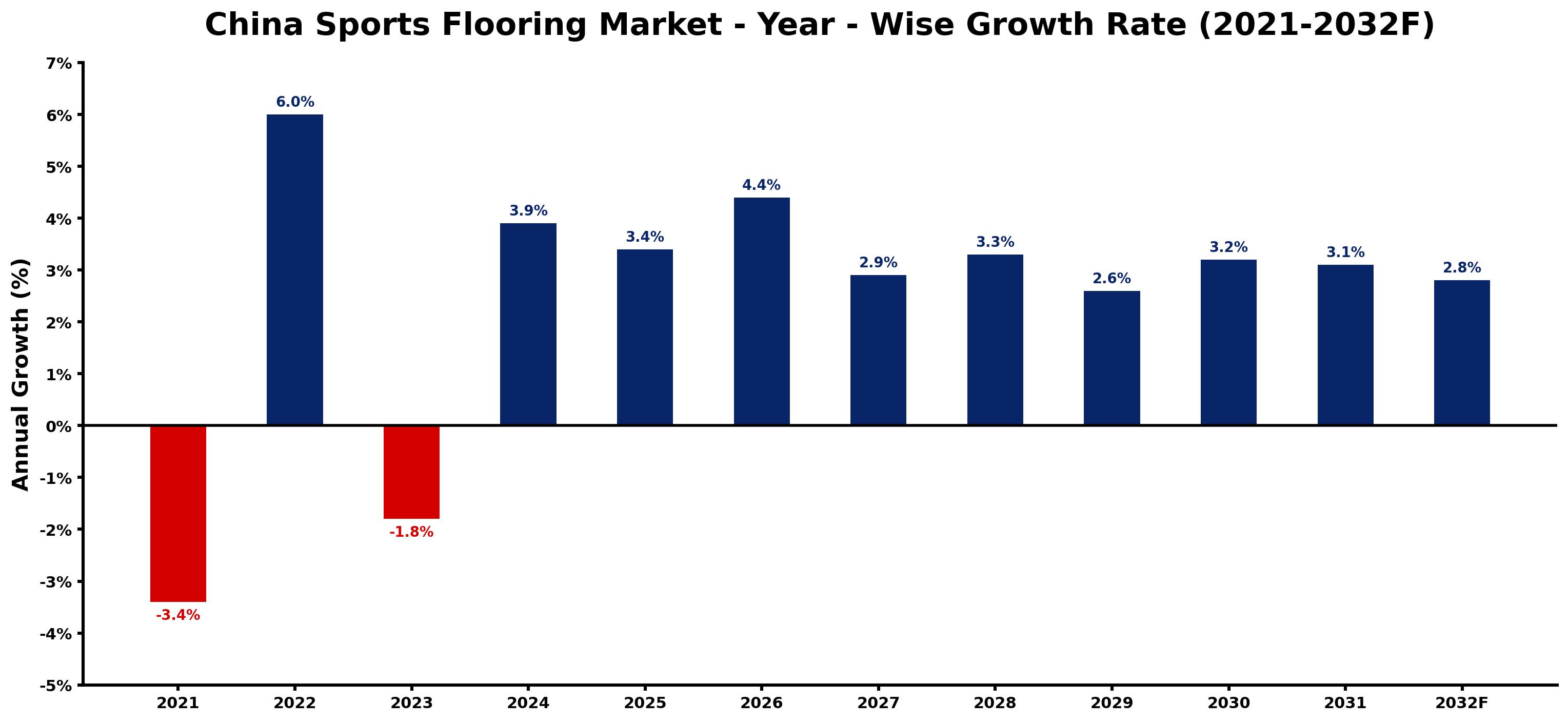
The table below presents the year wise growth rates along with the key drivers influencing the market
| Year | Growth Rate | Major Drivers |
| 2021 | -3.4% | Increased competition from imported flooring options led to a decline in local market share and sales. |
| 2022 | 6.0% | Increased participation in fitness activities influenced preferences for high-quality flooring options. |
| 2023 | -1.8% | Increased competition from lowcost alternatives diminished market share for premium sports flooring brands. |
| 2024 | 3.9% | Developments in eco-friendly materials began attracting environmentally conscious consumers. |
| 2025 | 3.4% | Corporate sponsorships in sports events propelled investments in athletic infrastructure upgrades. |
| 2026 | 4.4% | Growing health awareness among the population drove interest in multi-functional sports spaces. |
| 2027 | 2.9% | Emerging technologies in flooring materials enhanced performance, gaining market traction. |
| 2028 | 3.3% | Government-backed initiatives for community sports facilities created new opportunities for suppliers. |
| 2029 | 2.6% | Increased collaborations between sports organizations and flooring manufacturers strengthened market ties. |
| 2030 | 3.2% | Investment in smart sports complexes highlighted the importance of specialized flooring solutions. |
| 2031 | 3.1% | Development of regional sports leagues escalated demand for innovative flooring systems. |
| 2032 | 2.8% | Focus on international sporting events significantly boosted the overall market's growth potential. |
Note - Market size estimations and growth projections presented in this report are based on 6Wresearch's advanced forecasting approach, validated with industry datasets as of June 2026.
China Sports Flooring Market Synopsis
The China Sports Flooring Market is projected to reach 4.4% and witness significant growth during the forecast period (2026-2032). The escalating focus on sports and fitness activities across the nation has catalyzed the demand for diverse flooring solutions tailored to various facilities including gyms, stadiums, and fitness centers. This market encompasses a variety of flooring options, such as synthetic, wooden, and rubber materials, designed to enhance performance and safety in sporting environments.
China Sports Flooring Market Growth Drivers
Several factors are propelling the growth of the China Sports Flooring Market. First, the increasing participation in sports and fitness among the Chinese population has heightened the demand for high-quality flooring materials that ensure safety and performance. Second, the growing awareness regarding sports safety has led to a surge in requirements for flooring that meets stringent safety standards. Additionally, the expansion of sports facilities and infrastructure investment, particularly in light of significant international events, acts as a robust catalyst for market growth.
- The rise in fitness consciousness and sports participation across various demographics is driving the demand for specialized flooring.
- Government initiatives to promote sports and recreational activities have contributed to the increase in sports facilities and venues needing advanced flooring solutions.
- Technological advancements in flooring materials, including enhanced durability and performance features, are attracting investment and innovation.
- Rising disposable incomes have led consumers to prioritize quality in sports facilities, thus creating a demand for premium flooring options.
- The growing trend toward eco-friendly flooring solutions, such as recycled materials, aligns with consumer preferences for sustainability.
China Sports Flooring Market Trends and Opportunities
The China Sports Flooring Market is undergoing noteworthy trends that indicate a paradigm shift in product offerings and consumer preferences. Increased environmental awareness has led to a notable trend towards adopting sustainable materials like recycled rubber and bamboo, catering to environmentally conscious consumers. Moreover, an emerging demand for multifunctional flooring that accommodates diverse sports activities within a single space is driving product development.
- Integration of smart technologies in flooring materials is gaining traction, with features designed for shock absorption and anti-slip properties.
- Customization options that allow consumers to select flooring designs for aesthetic appeal alongside functionality are becoming more prevalent.
- The shift towards urbanization and increased real estate development is resulting in new fitness centers and sports facilities requiring advanced flooring solutions.
- Growing competition among manufacturers is fostering innovation, leading to the introduction of high-performance flooring materials.
- Investment in technological advancements that enhance product lifespan and user safety is likely to shape new market dynamics.
China Sports Flooring Market Challenges and Restraints
Although the China Sports Flooring Market shows promising growth prospects, it faces several challenges that may impede market expansion. Intense competition from both domestic and international manufacturers is leading to price sensitivity among consumers, pressuring margins. Fluctuations in raw material prices create unpredictability in production costs, which can affect market stability. Furthermore, stringent regulatory compliance related to safety and environmental standards necessitates continuous adaptation by manufacturers.
- Challenges surrounding the sourcing of sustainable materials can hinder the production of eco-friendly flooring options.
- Increasing consumer expectations regarding quality and versatility of flooring solutions can pressure manufacturers to innovate continually.
- Regulatory constraints related to environmental impact can pose challenges in product development and market entry strategies.
- Economic factors, including trade tensions and currency fluctuations, could influence market dynamics and competitive positioning.
- The need for constant research and development investments can strain resources, particularly for smaller players in the market.
China Sports Flooring Market Government Investment and Initiatives
The Chinese government plays a crucial role in the development of the sports flooring market through various policies and initiatives aimed at promoting sports infrastructure. Significant public investments are directed towards the construction and renovation of sports venues across urban and rural areas to enhance community fitness and well-being. Additionally, government regulations focus on ensuring that sports flooring materials meet safety and performance standards, fostering trust among users.
- Government-backed programs to construct modern sports facilities are contributing to an increase in demand for high-quality flooring solutions.
- Incentives for manufacturers investing in eco-friendly production practices align with national sustainability goals.
- The promotion of grassroots sports initiatives is leading to increased construction of community sports centers that require specialized flooring.
- Government funding for major sporting events, including the Olympics, is elevating the standards for sports facilities and associated flooring.
- Policies encouraging public-private partnerships in sports facility development are likely to enhance market opportunities for flooring manufacturers.
China Sports Flooring Market Latest Developments (May 2025 - June 2026)
In the period from May 2025 to June 2026, the China Sports Flooring Market has witnessed several developments that signal evolving trends and emerging opportunities. Industry players are increasingly focusing on technological innovations, particularly in smart flooring solutions that incorporate shock absorption and anti-slip features. The growing emphasis on sustainability has led to a wider adoption of recycled and eco-friendly materials in sports flooring products. Moreover, manufacturers are enhancing their research and development efforts to cater to the expanding need for multifunctional flooring that meets the requirements of various sports.
- Collaboration between industry stakeholders is increasing, focusing on creating sustainable flooring solutions and enhancing market competitiveness.
- Market players are engaging in product launches that feature advanced performance characteristics tailored to specific sports environments.
- The trend of digitalization within the flooring industry is promoting innovative customer engagement strategies and enhanced product offerings.
- Participation in trade exhibitions and industry forums has allowed manufacturers to showcase new flooring technologies and innovations.
- Analyses of consumer feedback have been leveraged to drive product development and enhance user satisfaction.
China Sports Flooring Market - Key Attractiveness of the Report
- 10 Years of Market Numbers
- Historical Data Starting from 2022 to 2025
- Base Year: 2025
- Forecast Data until 2032
- Key Performance Indicators Impacting the Market
- Major Upcoming Developments and Projects
Key Highlights of the Report:
- China Sports Flooring Market Outlook
- Market Size of China Sports Flooring Market, 2025
- Forecast of China Sports Flooring Market, 2032F
- Historical Data and Forecast of China Sports Flooring Revenues & Volume for the Period 2022-2032F
- China Sports Flooring Market Trend Evolution
- China Sports Flooring Market Drivers and Challenges
- China Sports Flooring Price Trends
- China Sports Flooring Porter's Five Forces
- China Sports Flooring Industry Life Cycle
- Historical Data and Forecast of China Sports Flooring Market Revenues & Volume By Product Type for the Period 2022-2032F
- Historical Data and Forecast of China Sports Flooring Market Revenues & Volume By Outdoor for the Period 2022-2032F
- Historical Data and Forecast of China Sports Flooring Market Revenues & Volume By Indoor for the Period 2022-2032F
- Historical Data and Forecast of China Sports Flooring Market Revenues & Volume By Material Type for the Period 2022-2032F
- Historical Data and Forecast of China Sports Flooring Market Revenues & Volume By Wood for the Period 2022-2032F
- Historical Data and Forecast of China Sports Flooring Market Revenues & Volume By Rubber for the Period 2022-2032F
- Historical Data and Forecast of China Sports Flooring Market Revenues & Volume By Polymeric for the Period 2022-2032F
- Historical Data and Forecast of China Sports Flooring Market Revenues & Volume By Sales Channel for the Period 2022-2032F
- Historical Data and Forecast of China Sports Flooring Market Revenues & Volume By Direct Sales for the Period 2022-2032F
- Historical Data and Forecast of China Sports Flooring Market Revenues & Volume By Independent Sports Outlet for the Period 2022-2032F
- Historical Data and Forecast of China Sports Flooring Market Revenues & Volume By Mass Merchandiser for the Period 2022-2032F
- Historical Data and Forecast of China Sports Flooring Market Revenues & Volume By Value Added Resellers for the Period 2022-2032F
- Historical Data and Forecast of China Sports Flooring Market Revenues & Volume By End-users for the Period 2022-2032F
- Historical Data and Forecast of China Sports Flooring Market Revenues & Volume By Commercial for the Period 2022-2032F
- Historical Data and Forecast of China Sports Flooring Market Revenues & Volume By Residential for the Period 2022-2032F
- China Sports Flooring Import Export Trade Statistics
- Market Opportunity Assessment By Product Type
- Market Opportunity Assessment By Material Type
- Market Opportunity Assessment By Sales Channel
- Market Opportunity Assessment By End-users
- China Sports Flooring Top Companies Market Share
- China Sports Flooring Competitive Benchmarking By Technical and Operational Parameters
- China Sports Flooring Company Profiles
- China Sports Flooring Key Strategic Recommendations






































