China Sports Nutrition Market Size, Share & Growth Rate
The China Sports Nutrition Market was estimated at USD 134 Million in 2025 and is projected to reach USD 155 Million by 2032, growing at a CAGR of 2.1% from 2026 to 2032. This growth trajectory is primarily driven by an increasing awareness of health and fitness, particularly among the younger demographic. The transition to active lifestyles, coupled with a burgeoning interest in maintaining optimal physical performance, has significantly amplified demand for sports nutrition products.
China Sports Nutrition Market Year-wise Growth Rate and Key Drivers
This graph highlights how the China Sports Nutrition Market has steadily grown over the years, supported by major growth factors.
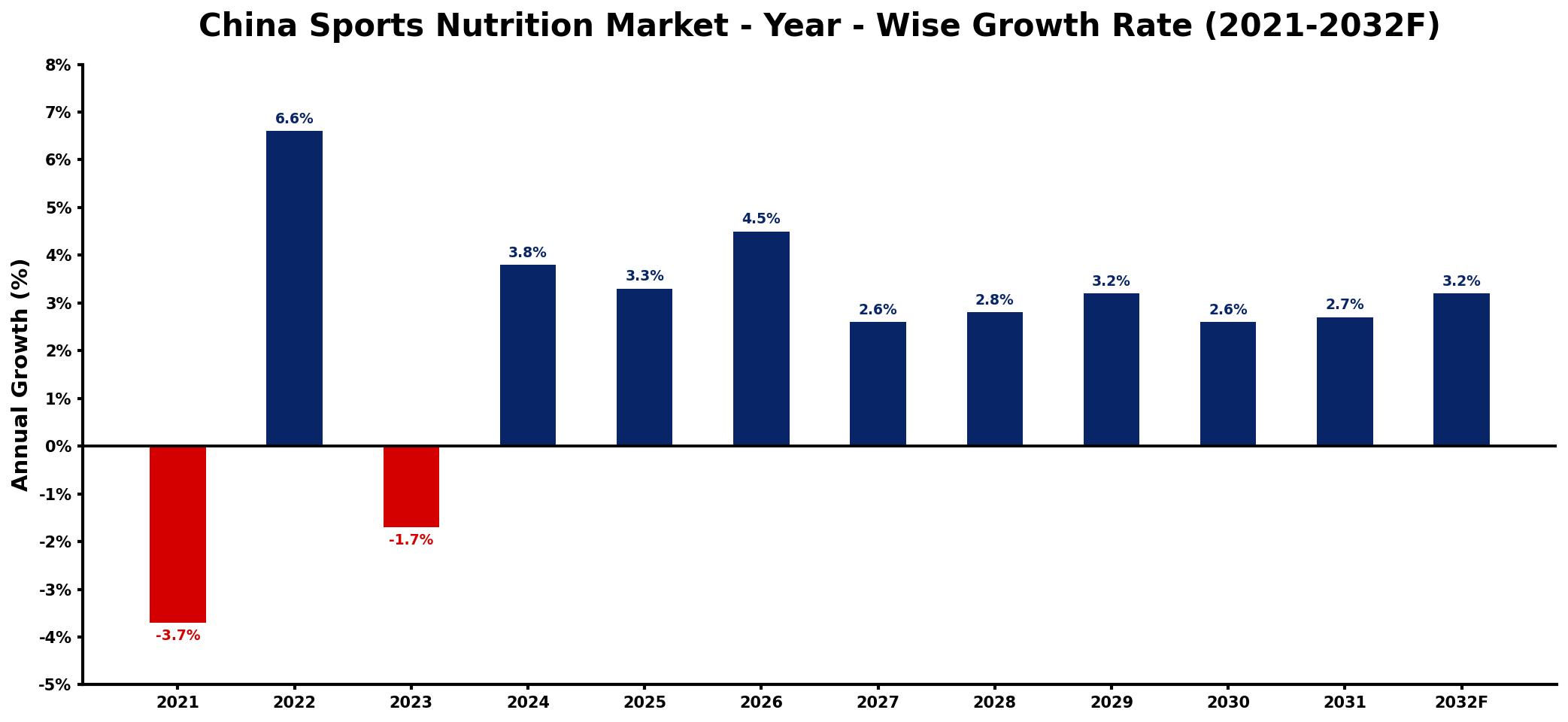
The table below presents the year‑wise growth rates along with the key drivers influencing the market
| Year | Growth Rate | Major Drivers |
| 2021 | -3.7% | Shift towards online retail platforms |
| 2022 | 6.6% | Rising consumer health consciousness |
| 2023 | -1.7% | Decline in disposable income levels |
| 2024 | 3.8% | Expansion of fitness facilities |
| 2025 | 3.3% | Increase in influencer marketing strategies |
| 2026 | 4.5% | Growth in e-commerce sales channels |
| 2027 | 2.6% | Emergence of new consumer segments |
| 2028 | 2.8% | Development of innovative product formulations |
| 2029 | 3.2% | Increased participation in recreational activities |
| 2030 | 2.6% | Wider acceptance of lifestyle changes |
| 2031 | 2.7% | Enhanced distribution network capabilities |
| 2032 | 3.2% | Boost in collaborative marketing efforts |
Note: Market size estimations and growth projections presented in this report are based on 6Wresearch's proprietary forecasting methodology, utilizing the latest available industry data, government publications, and primary research inputs.
China Sports Nutrition Market Synopsis
The demand for protein supplements, energy bars, and dietary aids in China is witnessing an unprecedented surge, driven by a population increasingly conscious of health and wellness. With diverse product offerings tailored to meet varying dietary needs, the market caters not only to athletes but also to fitness enthusiasts and health-conscious individuals.
A notable trend in the China Sports Nutrition Market is the rising preference for natural and organic ingredients. Consumers are gravitating toward products that provide transparency regarding their content, reflecting a deeper concern for overall health and sustainability in food choices.
China Sports Nutrition Market Key Takeaways
- The market is benefiting from a significant shift towards healthier lifestyles and increased fitness awareness.
- E-commerce channels are essential in enhancing product accessibility, driving higher consumer engagement.
- There is a strong demand for clean label products, as consumers prioritize natural ingredients.
- Collaborations with fitness influencers are becoming vital for brands looking to establish credibility and reach their target audience.
- Regulatory standards are shaping product offerings, necessitating adherence to safety and quality guidelines.
Evaluation of Restraints in China Sports Nutrition Market
Despite its promising outlook, the China Sports Nutrition Market is not without challenges. Regulatory hurdles pose significant restraints, as the existing framework lacks comprehensive guidelines on product safety and labeling. This ambiguity can foster consumer skepticism regarding product efficacy and safety. Moreover, the proliferation of counterfeit products has compounded these issues, eroding trust within the market. Companies aiming to penetrate this landscape must navigate a complex distribution network, which further complicates market entry and expansion efforts.
China Sports Nutrition Market Trends
The current landscape of the China Sports Nutrition Market is characterized by several noteworthy trends. A notable shift towards digital channels for marketing and sales has emerged, spurred by the widespread use of social media and online platforms. Furthermore, consumers are increasingly informed and discerning, driving demand for innovative, high-quality products. Brands are responding by prioritizing research and development, focusing on enhancing product performance and user experience.
China Sports Nutrition Market Opportunities
Opportunities abound within the China Sports Nutrition Market, particularly for brands looking to expand their reach. The growing middle class is eager for products that align with their health goals, presenting a ripe environment for innovation in product offerings. By leveraging e-commerce platforms, brands can optimize distribution and marketing strategies, enhancing consumer access to sports nutrition solutions. The rise of health-focused lifestyle initiatives from the government also creates an enabling environment for investment in this sector.
Government Initiatives in the China Sports Nutrition Market
Government regulations in China are pivotal to the sports nutrition landscape, aiming to ensure consumer safety and product integrity. The China Food and Drug Administration (CFDA) is actively involved in overseeing the registration and approval process for sports nutrition products, enforcing stringent quality standards. Additionally, the State Administration for Market Regulation (SAMR) monitors advertising practices to prevent misleading claims, thereby fostering a reliable market environment conducive to growth and innovation.
Future Insights of the China Sports Nutrition Market
Looking ahead to 2026-2032, the China Sports Nutrition Market is poised for significant advancements, propelled by urbanization and an expanding middle class. The trend of rising health consciousness, combined with an increasing participation in sports activities, will be essential in shaping future demand. Influences from Western fitness trends and endorsements from sports personalities are likely to drive further consumer engagement, enhancing market dynamics. The e-commerce sector will continue to evolve, providing consumers with broader access to diverse product offerings.
China Sports Nutrition Market Latest Developments (2025 - 2026)
Recent developments in the China Sports Nutrition Market showcase a dynamic shift toward innovative product offerings and enhanced marketing strategies. There has been an increase in collaborations between brands and fitness influencers, aimed at driving consumer interest and brand loyalty. Furthermore, companies are prioritizing research and development to meet the growing demand for health-oriented products, particularly those featuring natural and organic ingredients.
China Sports Nutrition Market - Key Attractiveness of the Report
- 10 Years of Market Numbers
- Historical Data Starting from 2022 to 2025
- Base Year: 2025
- Forecast Data until 2032
- Key Performance Indicators Impacting the Market
- Major Upcoming Developments and Projects
Key Highlights of the Report:
- China Sports Nutrition Market Outlook
- Market Size of China Sports Nutrition Market, 2025
- Forecast of China Sports Nutrition Market, 2032
- Historical Data and Forecast of China Sports Nutrition Revenues & Volume for the Period 2022-2032F
- China Sports Nutrition Market Trend Evolution
- China Sports Nutrition Market Drivers and Challenges
- China Sports Nutrition Price Trends
- China Sports Nutrition Porter's Five Forces
- China Sports Nutrition Industry Life Cycle
- Historical Data and Forecast of China Sports Nutrition Market Revenues & Volume By Type for the Period 2022-2032F
- Historical Data and Forecast of China Sports Nutrition Market Revenues & Volume By Sports Food for the Period 2022-2032F
- Historical Data and Forecast of China Sports Nutrition Market Revenues & Volume By Sports Drinks for the Period 2022-2032F
- Historical Data and Forecast of China Sports Nutrition Market Revenues & Volume By Sports Supplements for the Period 2022-2032F
- Historical Data and Forecast of China Sports Nutrition Market Revenues & Volume By Distribution Channel for the Period 2022-2032F
- Historical Data and Forecast of China Sports Nutrition Market Revenues & Volume By Supermarkets/Hypermarkets for the Period 2022-2032F
- Historical Data and Forecast of China Sports Nutrition Market Revenues & Volume By Specialty Stores for the Period 2022-2032F
- Historical Data and Forecast of China Sports Nutrition Market Revenues & Volume By Convenience Stores for the Period 2022-2032F
- Historical Data and Forecast of China Sports Nutrition Market Revenues & Volume By Online Stores for the Period 2022-2032F
- Historical Data and Forecast of China Sports Nutrition Market Revenues & Volume By Other Distribution Channels for the Period 2022-2032F
- China Sports Nutrition Import Export Trade Statistics
- Market Opportunity Assessment By Type
- Market Opportunity Assessment By Distribution Channel
- China Sports Nutrition Top Companies Market Share
- China Sports Nutrition Competitive Benchmarking By Technical and Operational Parameters
- China Sports Nutrition Company Profiles
- China Sports Nutrition Key Strategic Recommendations






































