China Stockings Market (2026-2032) | Value, Trends, Share, Size, Growth, Industry, Analysis, Revenue, Outlook, Companies, Forecast
Market Forecast By Product Types (Compression Stockings, Luxury or Regular Stockings), By Distribution Channel (Online Stores, Multi-Brand Stores, Departmental Stores, Mass-Retailers, Others) And Competitive Landscape
| Product Code: ETC030161 | Publication Date: Oct 2020 | Updated Date: Jun 2026 | Product Type: Report | |
| Publisher: 6Wresearch | Author: Vasudha | No. of Pages: 70 | No. of Figures: 35 | No. of Tables: 5 |
China Stockings Market Summary
The china stockings market was estimated at USD 196 Million in 2025 and is projected to reach USD 226 Million by 2032, growing at a CAGR of 4.2% from 2026 to 2032.
China Stockings Market Growth Rate Analysis (2021-2032)
The China stockings market has experienced notable fluctuations in recent years, reflecting broader economic trends and consumer behavior shifts. Following a decline of 3.6% in 2021, the market saw a recovery with a robust growth of 6.4% in 2022, driven by renewed consumer demand and increasing disposable income. However, a slight downturn of 1.5% was recorded in 2023, influenced by a slowdown in retail and heightened competition from emerging technologies and alternative legwear options. Looking ahead, the market is poised for a gradual rebound, with growth rates projected at 4.2% in 2024 and stabilizing around 2.8% through 2032, underpinned by investments in digital marketing and innovative product lines that cater to evolving consumer preferences.
China Stockings Market Year-wise Growth Rate and Key Drivers
This graph highlights how the China Stockings Market has steadily grown over the past five years, supported by major growth factors.
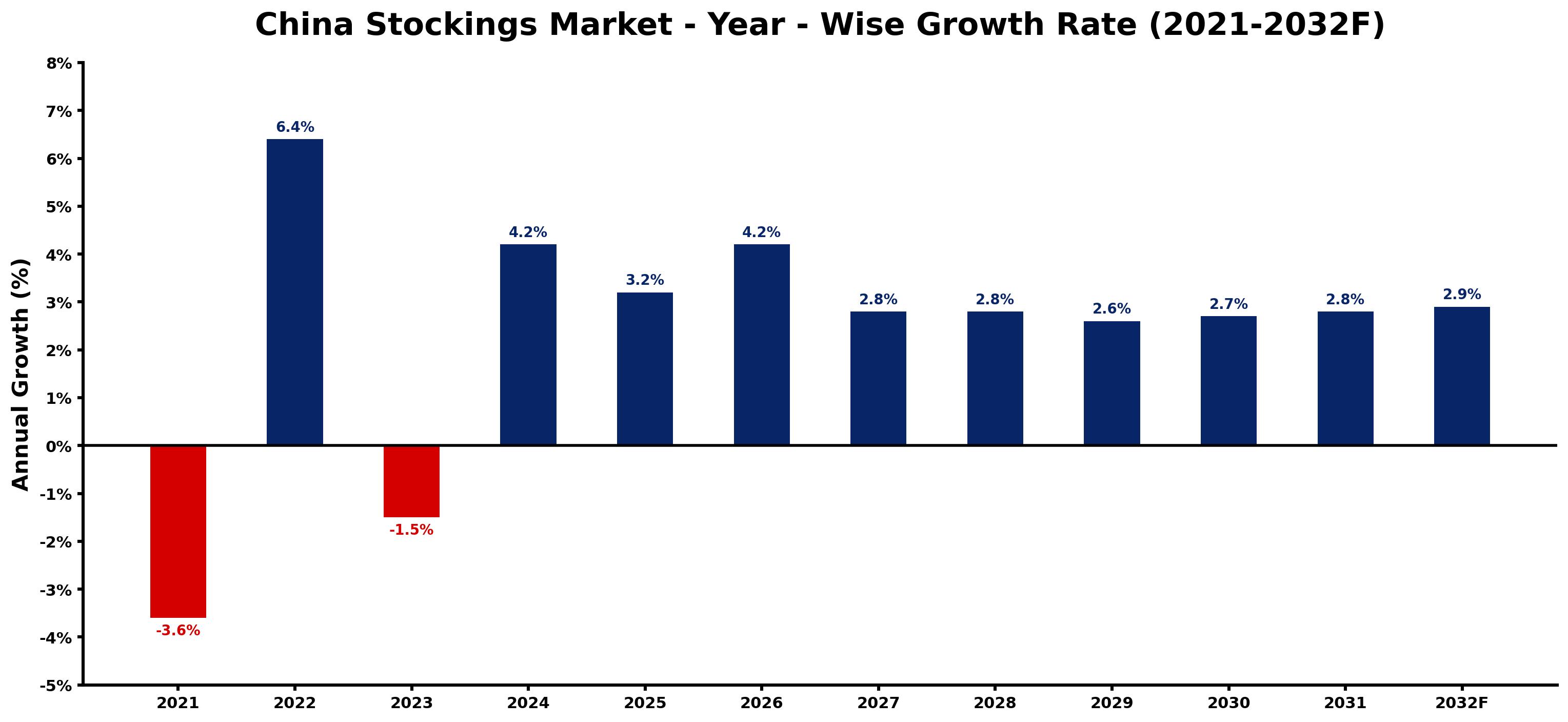
The table below presents the year wise growth rates along with the key drivers influencing the market
| Year | Growth Rate | Major Drivers |
| 2021 | -3.6% | Heightened competition from imported hosiery brands eroded local manufacturers' market share, undermining sales growth. |
| 2022 | 6.4% | Increased online shopping trends contributed significantly to sales in the stockings market. |
| 2023 | -1.5% | Increased competition from synthetic alternatives diminished demand for traditional nylon stockings among younger consumers. |
| 2024 | 4.2% | Innovative fabric technologies improved durability and comfort, enhancing product appeal. |
| 2025 | 3.2% | The fashion industry's focus on sustainability attracted eco-conscious consumers to stockings. |
| 2026 | 4.2% | Luxury brands entry into the stockings market shifted consumer expectations toward quality. |
| 2027 | 2.8% | Localized marketing strategies resonated with diverse regional demographics across China. |
| 2028 | 2.8% | Collaborations between fashion influencers and brands boosted visibility and consumer engagement. |
| 2029 | 2.6% | Shifts in workplace attire trends led to increased demand for formal stockings. |
| 2030 | 2.7% | Technological advancements in manufacturing processes reduced production costs significantly. |
| 2031 | 2.8% | Heightened awareness of personal grooming and fashion trends influenced purchase decisions. |
| 2032 | 2.9% | Integration of smart textiles in stockings created new market niches and opportunities. |
Note - Market size estimations and growth projections presented in this report are based on 6Wresearch's advanced forecasting approach, validated with industry datasets as of June 2026.
China Stockings Market Synopsis
The China Stockings Market is projected to reach 4.2% and witness significant growth during the forecast period (2026-2032). This dynamic sector within the apparel industry is characterized by a diverse product offering, which includes sheer, opaque, patterned, and compression stockings. With a substantial population and rising disposable income, consumer demand for stockings in China is rapidly increasing. This growth is further fueled by the competitive landscape that features both domestic and international players striving to provide innovative designs and materials. The market is also notably influenced by e-commerce platforms, which have transformed consumer purchasing habits by providing a convenient avenue to explore an extensive range of stocking products.
China Stockings Market Trends
A number of trends are shaping the China Stockings Market as it continues to evolve. Among these trends, the increasing consumer preference for sustainable and eco-friendly materials stands out. This shift is largely driven by heightened environmental awareness among consumers. Concurrently, innovative designs and unique patterns are gaining traction, appealing to a fashion-conscious audience. The transition towards online retail channels is also notable, as e-commerce platforms offer convenience and a wider selection, becoming the preferred channels for stocking purchases.
- The growing focus on inclusive sizing is another significant trend. More brands are recognizing the need to cater to various body types, thus expanding their size offerings to attract a broader consumer base.
- Technological advancements in textile production are enhancing the comfort and durability of stockings, further driving consumer interest.
- Seasonal variations continue to impact consumer buying patterns, creating demand for specific types of stockings throughout the year.
- Fashion trends are continuously influencing the designs and styles offered in the market, with brands launching limited edition collections to attract trend-savvy consumers.
- Additionally, the market's dynamics are shifting towards health-conscious consumers, who increasingly seek compression stockings for their therapeutic benefits.
China Stockings Market Challenges and Restraints
Despite its promising potential, the China Stockings Market faces several challenges. The intense competition among domestic and international brands can lead to price wars, impacting profitability. Additionally, the prevalence of counterfeit products poses a significant threat to consumer trust and brand integrity. There is also a noticeable shift in consumer preferences towards casual and comfortable clothing options, which may reduce the demand for traditional stockings.
- Market saturation is becoming a growing concern, making it essential for brands to differentiate themselves through unique value propositions.
- Fluctuating raw material prices can affect production costs, subsequently impacting pricing strategies and overall market stability.
- Regulatory changes and trade tensions may introduce uncertainties that challenge both operational and financial strategies for businesses involved in the stocking sector.
- Rapidly evolving fashion trends necessitate that companies remain agile and innovative, continuously adapting their marketing strategies to maintain relevance.
- Moreover, ensuring product quality while maintaining competitive pricing remains a critical challenge for market participants.
China Stockings Market Investment Opportunities
The growth trajectory of the China Stockings Market presents a plethora of investment opportunities for stakeholders. With rising disposable income and a shift towards premium products, the demand for high-quality and fashion-forward stockings is evident. Investors might consider backing established manufacturers and retailers that demonstrate resilience and adaptability to market trends.
- Emerging brands that emphasize sustainable and eco-friendly production processes are also attractive investment prospects, tapping into a growing trend of conscious consumerism.
- The expanding e-commerce sector offers substantial opportunities for companies aiming to reach a broader audience through online platforms.
- Investing in innovative technologies for stocking production can enhance product offerings and drive consumer interest.
- Additionally, partnerships with technology firms can yield advancements in marketing and distribution strategies, maximizing market reach.
- Overall, the demand for diverse stocking products indicates a strong potential for sustained investment returns in the evolving fashion landscape of China.
China Stockings Market Government Investment and Initiatives
The Chinese government has initiated several policies aimed at regulating and supporting the Stockings Market. These policies encompass quality control regulations designed to ensure the safety and durability of stockings produced domestically. Import restrictions have been established to protect local manufacturers from foreign competition, thus fostering a nurturing environment for domestic production. The government also emphasizes sustainable manufacturing practices by promoting reductions in environmental impact and advocating for fair labor standards in the industry.
- Government spending initiatives aimed at infrastructure development are designed to enhance logistics and distribution channels, facilitating more efficient market operations.
- Regulatory measures to curb counterfeit products help to strengthen consumer trust and maintain a stable market environment.
- Policies encouraging research and development in textile technologies aim to spur innovation within the domestic market.
- The government closely monitors the market for fraudulent activities to ensure a level playing field among market participants.
- Overall, these initiatives are designed to foster a competitive and transparent China Stockings Market that benefits both consumers and manufacturers.
China Stockings Market Latest Developments (May 2025 - June 2026)
The period from May 2025 to June 2026 has seen significant developments within the China Stockings Market. The momentum for sustainable and eco-friendly practices continues to build, with many manufacturers adopting greener production methods. There has also been an uptick in collaboration between brands and technology firms, aiming to leverage advancements in textile technology for improved product offerings. E-commerce growth remains robust, with consumers increasingly favoring online shopping channels for stocking purchases due to their convenience and variety. Moreover, fashion trends have showcased a shift towards bolder patterns and innovative designs, reflecting a more adventurous consumer base. Overall, these developments suggest a proactive approach from the industry to adapt to shifting consumer demands and market dynamics.
China Stockings Market - Key Attractiveness of the Report
- 10 Years of Market Numbers
- Historical Data Starting from 2022 to 2025
- Base Year: 2025
- Forecast Data until 2032
- Key Performance Indicators Impacting the Market
- Major Upcoming Developments and Projects
Key Highlights of the Report:
- China Stockings Market Outlook
- Market Size of China Stockings Market, 2025
- Forecast of China Stockings Market, 2032F
- Historical Data and Forecast of China Stockings Revenues & Volume for the Period 2022-2032F
- China Stockings Market Trend Evolution
- China Stockings Market Drivers and Challenges
- China Stockings Price Trends
- China Stockings Porter's Five Forces
- China Stockings Industry Life Cycle
- Historical Data and Forecast of China Stockings Market Revenues & Volume By Product Types for the Period 2022-2032F
- Historical Data and Forecast of China Stockings Market Revenues & Volume By Compression Stockings for the Period 2022-2032F
- Historical Data and Forecast of China Stockings Market Revenues & Volume By Luxury or Regular Stockings for the Period 2022-2032F
- Historical Data and Forecast of China Stockings Market Revenues & Volume By Distribution Channel for the Period 2022-2032F
- Historical Data and Forecast of China Stockings Market Revenues & Volume By Online Stores for the Period 2022-2032F
- Historical Data and Forecast of China Stockings Market Revenues & Volume By Multi-Brand Stores for the Period 2022-2032F
- Historical Data and Forecast of China Stockings Market Revenues & Volume By Departmental Stores for the Period 2022-2032F
- Historical Data and Forecast of China Stockings Market Revenues & Volume By Mass-Retailers for the Period 2022-2032F
- Historical Data and Forecast of China Stockings Market Revenues & Volume By Others for the Period 2022-2032F
- China Stockings Import Export Trade Statistics
- Market Opportunity Assessment By Product Types
- Market Opportunity Assessment By Distribution Channel
- China Stockings Top Companies Market Share
- China Stockings Competitive Benchmarking By Technical and Operational Parameters
- China Stockings Company Profiles
- China Stockings Key Strategic Recommendations
Frequently Asked Questions About the Market Study (FAQs):
The growth is primarily driven by increasing disposable income, evolving consumer preferences towards fashion, and the rise of e-commerce platforms facilitating easier access to products.
Key challenges include intense competition, the prevalence of counterfeit products affecting consumer trust, and shifting preferences towards more casual attire.
The government is implementing policies aimed at quality control, promoting sustainable practices, and protecting domestic manufacturers through import restrictions and regulatory measures.
Opportunities lie in supporting established manufacturers, investing in emerging brands focusing on sustainability, and leveraging technological advancements to improve product quality and market reach.
6Wresearch actively monitors the China Stockings Market and publishes its comprehensive annual report, highlighting emerging trends, growth drivers, revenue analysis, and forecast outlook. Our insights help businesses to make data-backed strategic decisions with ongoing market dynamics. Our analysts track relevent industries related to the China Stockings Market, allowing our clients with actionable intelligence and reliable forecasts tailored to emerging regional needs.
Yes, we provide customisation as per your requirements. To learn more, feel free to contact us on sales@6wresearch.com
1 Executive Summary |
2 Introduction |
2.1 Key Highlights of the Report |
2.2 Report Description |
2.3 Market Scope & Segmentation |
2.4 Research Methodology |
2.5 Assumptions |
3 China Stockings Market Overview |
3.1 China Country Macro Economic Indicators |
3.2 China Stockings Market Revenues & Volume, 2022 & 2032F |
3.3 China Stockings Market - Industry Life Cycle |
3.4 China Stockings Market - Porter's Five Forces |
3.5 China Stockings Market Revenues & Volume Share, By Product Types, 2022 & 2032F |
3.6 China Stockings Market Revenues & Volume Share, By Distribution Channel, 2022 & 2032F |
4 China Stockings Market Dynamics |
4.1 Impact Analysis |
4.2 Market Drivers |
4.2.1 Increasing fashion consciousness and changing consumer preferences towards trendy and fashionable stockings. |
4.2.2 Growing disposable income and purchasing power of consumers in China. |
4.2.3 Rising popularity of e-commerce platforms for purchasing stockings, leading to increased accessibility and convenience for consumers. |
4.3 Market Restraints |
4.3.1 Intense competition in the market leading to price wars and margin pressures. |
4.3.2 Fluctuating raw material prices impacting production costs and profitability. |
4.3.3 Counterfeit products and intellectual property issues affecting brand reputation and consumer trust. |
5 China Stockings Market Trends |
6 China Stockings Market, By Types |
6.1 China Stockings Market, By Product Types |
6.1.1 Overview and Analysis |
6.1.2 China Stockings Market Revenues & Volume, By Product Types, 2022-2032F |
6.1.3 China Stockings Market Revenues & Volume, By Compression Stockings, 2022-2032F |
6.1.4 China Stockings Market Revenues & Volume, By Luxury or Regular Stockings, 2022-2032F |
6.2 China Stockings Market, By Distribution Channel |
6.2.1 Overview and Analysis |
6.2.2 China Stockings Market Revenues & Volume, By Online Stores, 2022-2032F |
6.2.3 China Stockings Market Revenues & Volume, By Multi-Brand Stores, 2022-2032F |
6.2.4 China Stockings Market Revenues & Volume, By Departmental Stores, 2022-2032F |
6.2.5 China Stockings Market Revenues & Volume, By Mass-Retailers, 2022-2032F |
6.2.6 China Stockings Market Revenues & Volume, By Others, 2022-2032F |
7 China Stockings Market Import-Export Trade Statistics |
7.1 China Stockings Market Export to Major Countries |
7.2 China Stockings Market Imports from Major Countries |
8 China Stockings Market Key Performance Indicators |
8.1 Online engagement metrics such as website traffic, social media followers, and online reviews indicating brand visibility and consumer interest. |
8.2 Customer retention rate and repeat purchase frequency showcasing brand loyalty and product satisfaction. |
8.3 Trend analysis of fashion shows and influencer collaborations to track alignment with market trends and consumer preferences. |
9 China Stockings Market - Opportunity Assessment |
9.1 China Stockings Market Opportunity Assessment, By Product Types, 2022 & 2032F |
9.2 China Stockings Market Opportunity Assessment, By Distribution Channel, 2022 & 2032F |
10 China Stockings Market - Competitive Landscape |
10.1 China Stockings Market Revenue Share, By Companies, 2025 |
10.2 China Stockings Market Competitive Benchmarking, By Operating and Technical Parameters |
11 Company Profiles |
12 Recommendations |
13 Disclaimer |
Global Go To Market Strategy - 2030
Export potential enables firms to identify high-growth global markets with greater confidence by combining advanced trade intelligence with a structured quantitative methodology. The framework analyzes emerging demand trends and country-level import patterns while integrating macroeconomic and trade datasets such as GDP and population forecasts, bilateral import–export flows, tariff structures, elasticity differentials between developed and developing economies, geographic distance, and import demand projections. Using weighted trade values from 2020–2024 as the base period to project country-to-country export potential for 2030, these inputs are operationalized through calculated drivers such as gravity model parameters, tariff impact factors, and projected GDP per-capita growth. Through an analysis of hidden potentials, demand hotspots, and market conditions that are most favorable to success, this method enables firms to focus on target countries, maximize returns, and global expansion with data, backed by accuracy.
By factoring in the projected importer demand gap that is currently unmet and could be potential opportunity, it identifies the potential for the Exporter (Country) among 190 countries, against the general trade analysis, which identifies the biggest importer or exporter.
To discover high-growth global markets and optimize your business strategy:
Click Here
Pricing
- Single User License$ 1,995
- Department License$ 2,400
- Site License$ 3,120
- Global License$ 3,795

Leadership Perspectives from Industry Events
Search
Thought Leadership and Analyst Meet





Our Clients








6WResearch In News
- India Air Conditioner Market Set for Strong Rebound in 2026 After Weather-Led Correction and GST-Driven Recovery: 6Wresearch
- ADAS in India: How Automatic Emergency Braking, Blind Spot Detection & Driver Monitoring are Transforming Road Safety
- Doha a strategic location for EV manufacturing hub: IPA Qatar
- Demand for luxury TVs surging in the GCC, says Samsung
- Empowering Growth: The Thriving Journey of Bangladesh’s Cable Industry
- Demand for luxury TVs surging in the GCC, says Samsung
Latest Reports
- Nicaragua RPG Gaming Market (2026-2032)
- New Zealand RPG Gaming Market (2026-2032)
- Netherlands RPG Gaming Market (2026-2032)
- Nauru RPG Gaming Market (2026-2032)
- Namibia RPG Gaming Market (2026-2032)
- Mozambique RPG Gaming Market (2026-2032)
- Montenegro RPG Gaming Market (2026-2032)
- Mongolia RPG Gaming Market (2026-2032)
- Monaco RPG Gaming Market (2026-2032)
- Micronesia RPG Gaming Market (2026-2032)
Industry Events and Analyst Meet

HIMTEX 2026

India Refining Summit 2026

India EV Show 2026

EV tech India Expo 2026

Auto Tech Asia 2026
Whitepaper
- Middle East & Africa Commercial Security Market Click here to view more.
- Middle East & Africa Fire Safety Systems & Equipment Market Click here to view more.
- GCC Drone Market Click here to view more.
- Middle East Lighting Fixture Market Click here to view more.
- GCC Physical & Perimeter Security Market Click here to view more.


