China Threat Intelligence Market Size & Growth Rate (2026-2032)
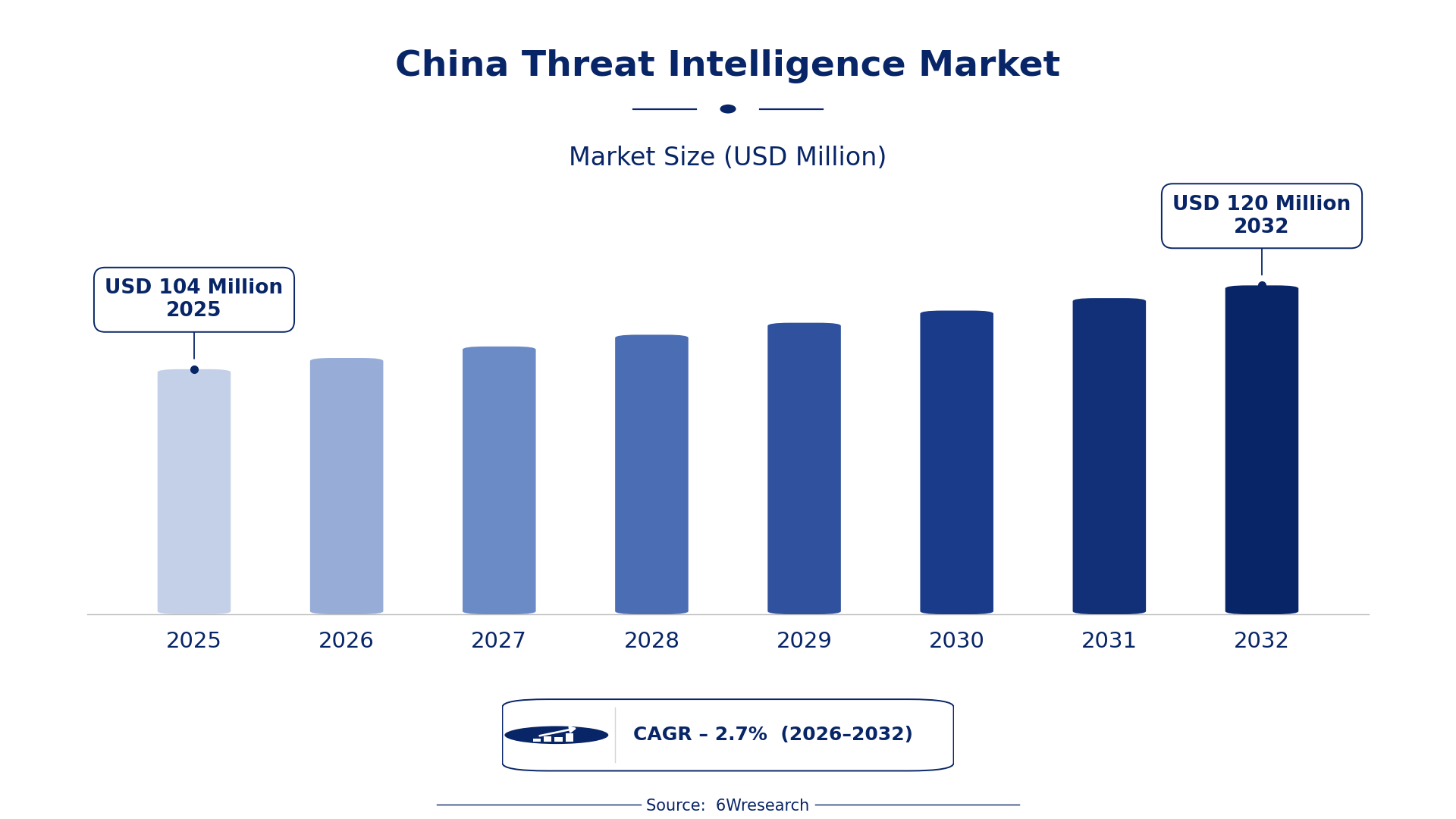
The China Threat Intelligence Market was estimated at USD 104 Million in 2025 and is projected to reach USD 120 Million by 2032, growing at a CAGR of 2.7% from 2026 to 2032.
China Threat Intelligence Market Synopsis
The China Threat Intelligence Market is currently experiencing an unprecedented surge as businesses confront an increasing number of cyber threats. Organizations are now more aware of the critical need for robust threat detection and response tools to safeguard their assets. As we look forward, the emphasis on cutting-edge technologies and collaboration will reshape the way companies approach cybersecurity in the coming years.
The market's expansion is being propelled by both technological advancements and growing regulatory pressure. In response to the increasingly sophisticated nature of cyber threats, companies are investing heavily in artificial intelligence and machine learning for proactive threat management. This investment trajectory suggests that the market is not only growing but transforming fundamentally.
China Threat Intelligence Market Year-wise Growth Rate and Key Drivers
This graph illustrates the annual growth rates of the China Threat Intelligence Market from 2021 to 2032, highlighting a steady upward trajectory and projected expansion over the forecast period.
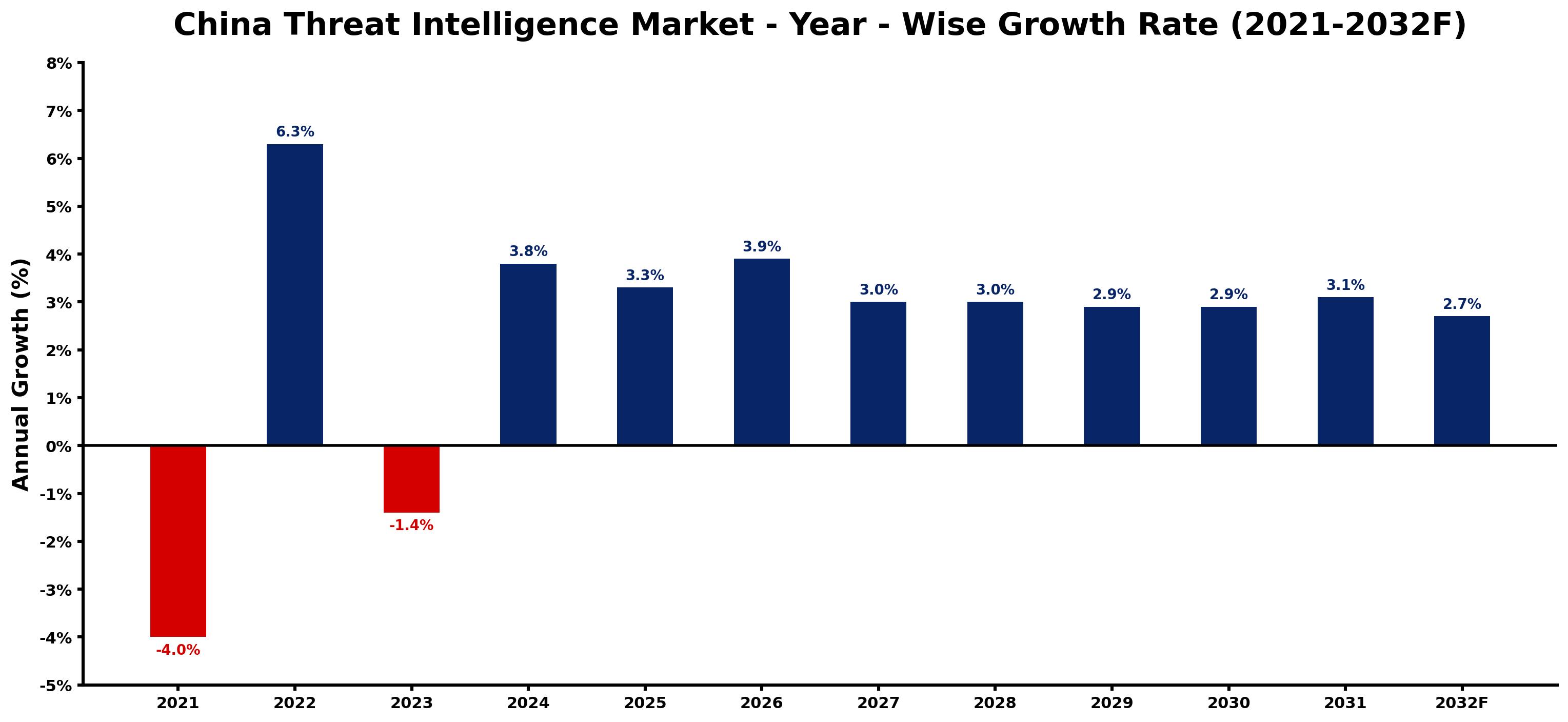
The table below presents the year‑wise growth rates along with the key drivers influencing the market
| Year | Growth Rate | Major Drivers |
| 2021 | -4.0% | Cybersecurity law revisions slowed investment in threat intelligence. |
| 2022 | 6.3% | Heightened cybersecurity regulations by the Cyberspace Administration. |
| 2023 | -1.4% | Major tech firms shifted focus to AI-driven solutions. |
| 2024 | 3.8% | Increased demand for data protection from state-owned enterprises. |
| 2025 | 3.3% | Rising incidences of cyberattacks targeting critical infrastructure. |
| 2026 | 3.9% | Growing focus on AI-driven threat detection technologies. |
| 2027 | 3.0% | Enhanced international collaboration on cybersecurity intelligence sharing. |
| 2028 | 3.0% | Development of national standards for cybersecurity resilience. |
| 2029 | 2.9% | Increased investment in military cyber defense capabilities. |
| 2030 | 2.9% | Implementation of stricter cloud security compliance mandates. |
| 2031 | 3.1% | Emergence of new cybersecurity startups attracting venture capital. |
| 2032 | 2.7% | Ongoing digital transformation initiatives across state-owned enterprises. |
Note: Market size estimations and growth projections presented in this report are based on 6Wresearch's proprietary forecasting methodology, utilizing the latest available industry data, government publications, and primary research inputs.
China Threat Intelligence Market Key Takeaways
Below are some of the specific key takeaways from the market, including:
- The shift towards advanced threat detection technologies is a priority for businesses across sectors.
- Collaboration among organizations is becoming vital for effective threat mitigation strategies.
- Government initiatives are increasingly influencing cybersecurity practices, mandating compliance and innovation.
- AI and machine learning are driving the development of more sophisticated threat intelligence solutions.
- Investment opportunities are emerging in consulting services focused on tailored solutions for Chinese cyber threats.
Evaluation of Restraints in China Threat Intelligence Market
Despite the market's promising trajectory, several critical restraints hinder its full potential. Regulatory restrictions limit standardized threat intelligence sharing, complicating collaborative efforts among organizations. Additionally, the presence of state-sponsored cyber threats poses an ongoing challenge that complicates detection and response. Smaller enterprises often lack awareness of threat intelligence's importance, which slows overall market growth. Navigating these complexities requires a nuanced understanding of the local regulatory environment and strong partnerships with local stakeholders.
China Threat Intelligence Market Trends
Several trends are shaping the China Threat Intelligence Market. First, there's a clear push for real-time threat detection systems that can respond swiftly to emerging threats. The adoption of threat intelligence platforms utilizing AI and machine learning is also accelerating, enabling organizations to proactively hunt for threats rather than just react to them. Furthermore, an increased focus on information sharing and collaboration is evident as companies realize that collective intelligence can significantly enhance threat mitigation efforts.
China Threat Intelligence Market Opportunities
Investment opportunities abound in this sector, particularly for organizations that specialize in advanced threat intelligence technologies. With the increasing frequency and sophistication of cyber threats, there is heightened demand for proactive threat hunting services and analytics tools. Companies can benefit from partnering with startups focused on innovative threat detection methodologies tailored specifically for the Chinese context. Training programs designed to bolster organizational resilience against cyber threats also present a substantial opportunity for growth.
Government Initiatives in the China Threat Intelligence Market
Government policies are instrumental in shaping the China Threat Intelligence Market, as they focus on enhancing cybersecurity protocols to tackle the surge in cyber threats. Regulatory frameworks are increasingly stringent, prioritizing information sharing and encouraging the development of advanced threat intelligence technologies. These initiatives are crucial not just for bolstering cybersecurity, but also for fostering a culture of innovation within the industry.
- A national cybersecurity strategy launched in 2025 focused on improving data protection measures and encouraging information sharing among organizations.
- Current initiatives are underway to establish regional cybersecurity response teams to enhance collaborative defenses against cyber threats.
- Upcoming regulations planned for 2026 aim to mandate enhanced transparency in threat reporting across sectors.
- The government is investing in cybersecurity research and development projects to keep pace with evolving threats.
- Public-private partnerships expected to launch in late 2025 will focus on enhancing digital infrastructure capabilities.
Future Insights of the China Threat Intelligence Market
As we look ahead to 2026-2032, the China Threat Intelligence Market is set for sustained growth, driven by a confluence of digital adoption and heightened cyber threats. Organizations will increasingly prioritize cybersecurity, recognizing it as an essential component of business continuity. The integration of advanced technologies like AI and machine learning will further redefine threat intelligence, allowing for quicker and more effective threat responses. This trajectory indicates that as threats evolve, so too will the strategies employed to combat them, ensuring that the market remains dynamic and responsive.
China Threat Intelligence Market Latest Developments
In the past year, activity within the China Threat Intelligence Market has intensified, marked by numerous developments aimed at enhancing cybersecurity measures. Companies are increasingly focused on innovating their offerings to meet the rising demand for sophisticated threat intelligence solutions. This dynamic environment suggests that the push for better cybersecurity is not just a trend but a sustained movement.
- A major technology vendor announced an update to its threat intelligence platform in Q3 2025, incorporating machine learning algorithms to enhance threat detection capabilities.
- A leading cybersecurity firm launched a new service focused on threat hunting specifically targeting state-sponsored actors, beginning in early 2025 and remaining in active deployment.
- Research initiatives aimed at identifying emerging cyber threats were rolled out in mid-2025, marking a significant step in proactive threat management.
- A public-private collaboration focused on improving industry-wide cybersecurity standards is expected to begin in late 2026.
- A regional operator is expected to complete its rollout of advanced threat intelligence tools for small businesses by mid-2026, enhancing their cybersecurity posture.
China Threat Intelligence Market - Key Attractiveness of the Report
- 10 Years of Market Numbers
- Historical Data Starting from 2022 to 2025
- Base Year: 2025
- Forecast Data until 2032
- Key Performance Indicators Impacting the Market
- Major Upcoming Developments and Projects
Key Highlights of the Report:
- China Threat Intelligence Market Outlook
- Market Size of China Threat Intelligence Market, 2025
- Forecast of China Threat Intelligence Market, 2032
- Historical Data and Forecast of China Threat Intelligence Revenues & Volume for the Period 2022-2032F
- China Threat Intelligence Market Trend Evolution
- China Threat Intelligence Market Drivers and Challenges
- China Threat Intelligence Price Trends
- China Threat Intelligence Porter's Five Forces
- China Threat Intelligence Industry Life Cycle
- Historical Data and Forecast of China Threat Intelligence Market Revenues & Volume By Component for the Period 2022-2032F
- Historical Data and Forecast of China Threat Intelligence Market Revenues & Volume By Solutions for the Period 2022-2032F
- Historical Data and Forecast of China Threat Intelligence Market Revenues & Volume By Services for the Period 2022-2032F
- Historical Data and Forecast of China Threat Intelligence Market Revenues & Volume By Vertical for the Period 2022-2032F
- Historical Data and Forecast of China Threat Intelligence Market Revenues & Volume By BFSI for the Period 2022-2032F
- Historical Data and Forecast of China Threat Intelligence Market Revenues & Volume By IT for the Period 2022-2032F
- Historical Data and Forecast of China Threat Intelligence Market Revenues & Volume By ITeS for the Period 2022-2032F
- Historical Data and Forecast of China Threat Intelligence Market Revenues & Volume By Retail for the Period 2022-2032F
- Historical Data and Forecast of China Threat Intelligence Market Revenues & Volume By Healthcare for the Period 2022-2032F
- Historical Data and Forecast of China Threat Intelligence Market Revenues & Volume By Life Sciences for the Period 2022-2032F
- Historical Data and Forecast of China Threat Intelligence Market Revenues & Volume By Organization Size for the Period 2022-2032F
- Historical Data and Forecast of China Threat Intelligence Market Revenues & Volume By Large Enterprises for the Period 2022-2032F
- Historical Data and Forecast of China Threat Intelligence Market Revenues & Volume By SMEs for the Period 2022-2032F
- Historical Data and Forecast of China Threat Intelligence Market Revenues & Volume By Application for the Period 2022-2032F
- Historical Data and Forecast of China Threat Intelligence Market Revenues & Volume By Security Information and Event Management for the Period 2022-2032F
- Historical Data and Forecast of China Threat Intelligence Market Revenues & Volume By Government, Risk, and Compliance for the Period 2022-2032F
- Historical Data and Forecast of China Threat Intelligence Market Revenues & Volume By Business Continuity Planning and Management for the Period 2022-2032F
- Historical Data and Forecast of China Threat Intelligence Market Revenues & Volume By Deployment Mode for the Period 2022-2032F
- Historical Data and Forecast of China Threat Intelligence Market Revenues & Volume By Cloud for the Period 2022-2032F
- Historical Data and Forecast of China Threat Intelligence Market Revenues & Volume By On-premises for the Period 2022-2032F
- China Threat Intelligence Import Export Trade Statistics
- Market Opportunity Assessment By Component
- Market Opportunity Assessment By Vertical
- Market Opportunity Assessment By Organization Size
- Market Opportunity Assessment By Application
- Market Opportunity Assessment By Deployment Mode
- China Threat Intelligence Top Companies Market Share
- China Threat Intelligence Competitive Benchmarking By Technical and Operational Parameters
- China Threat Intelligence Company Profiles
- China Threat Intelligence Key Strategic Recommendations






































