China Web Application Firewall Market Size & Growth Rate (2026-2032)
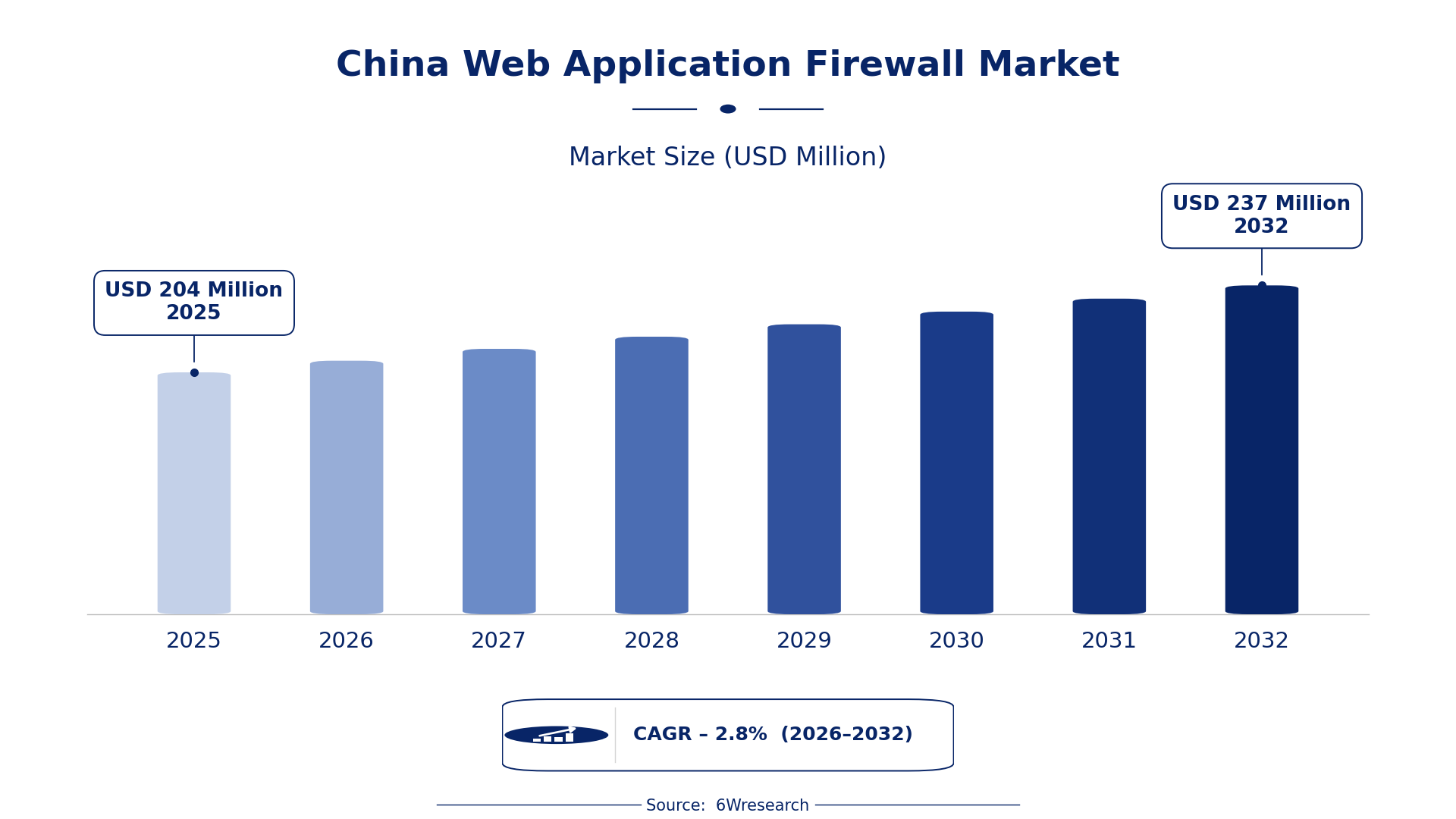
The China Web Application Firewall Market was estimated at USD 204 Million in 2025 and is projected to reach USD 237 Million by 2032, growing at a CAGR of 2.8% from 2026 to 2032.
China Web Application Firewall Market Synopsis
The pressing threat of cyberattacks is the primary force shaping the China Web Application Firewall Market today. As organizations increasingly digitalize their operations, the demand for reliable security measures has surged, prompting businesses to invest heavily in WAF solutions.
Regulatory pressure also plays a critical role in the market dynamics. The Chinese government's stringent data protection regulations are pushing companies to ensure robust cybersecurity practices, which includes the implementation of WAFs to safeguard online assets against evolving threats.
China Web Application Firewall Market Year-wise Growth Rate and Key Drivers
This graph illustrates the annual growth rates of the China Web Application Firewall Market from 2021 to 2032, highlighting a steady upward trajectory and projected expansion over the forecast period.
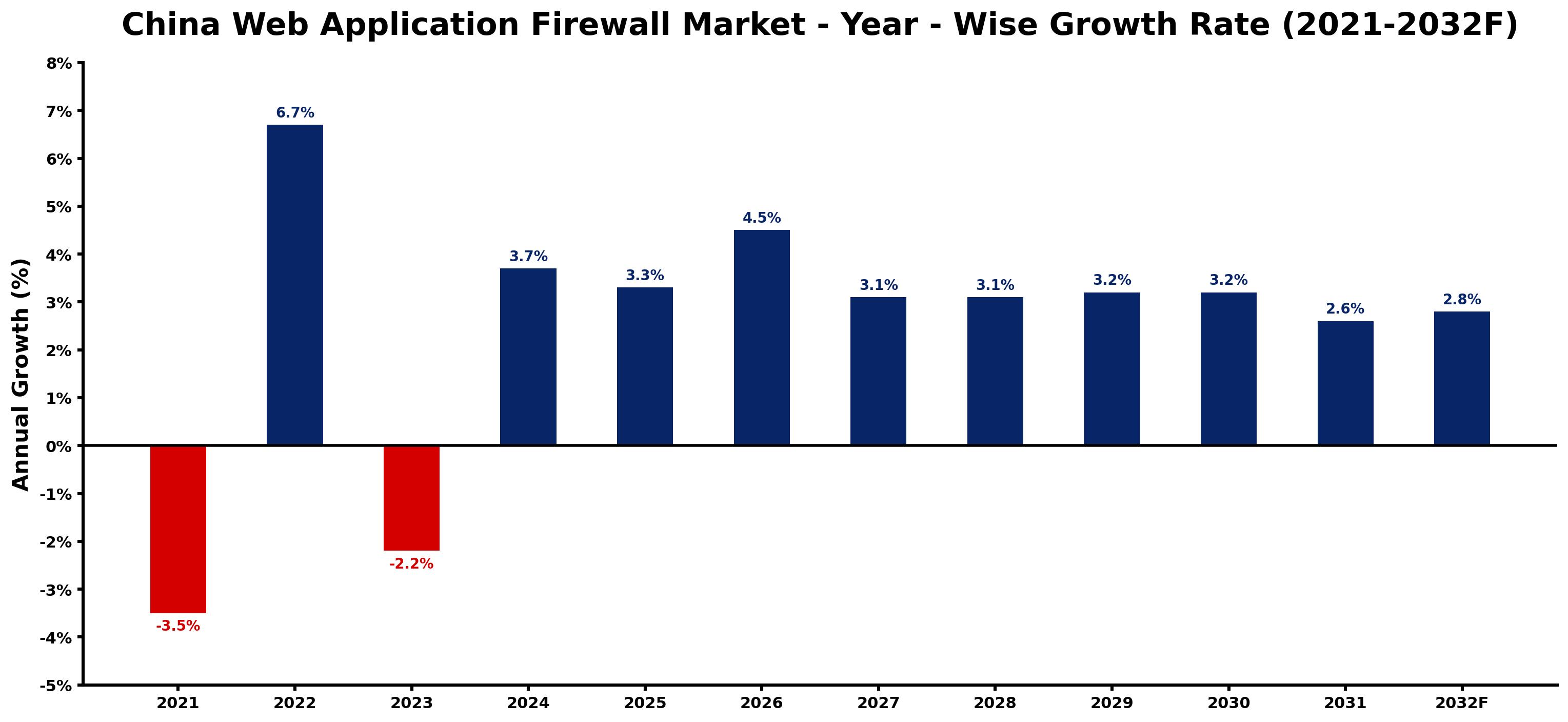
The table below presents the year‑wise growth rates along with the key drivers influencing the market
| Year | Growth Rate | Major Drivers |
| 2021 | -3.5% | Tougher regulations from Cyberspace Administration of China |
| 2022 | 6.7% | Increase in data breach incidents prompting stronger cybersecurity measures. |
| 2023 | -2.2% | Rising competition from domestic cybersecurity startups in China |
| 2024 | 3.7% | Regulatory push from Cyberspace Administration for enhanced data security. |
| 2025 | 3.3% | Surge in remote work promoting cloud-based application security needs. |
| 2026 | 4.5% | Growing adoption of IoT devices increasing web application vulnerabilities. |
| 2027 | 3.1% | Rising awareness of personal data security among consumers. |
| 2028 | 3.1% | Implementation of new GDPR-like privacy laws spurring firewall investments. |
| 2029 | 3.2% | Cloud computing growth driving demand for advanced WAF solutions. |
| 2030 | 3.2% | Development of 5G networks necessitating fortified web application security. |
| 2031 | 2.6% | Emergence of local cybersecurity firms enhancing competition and innovation. |
| 2032 | 2.8% | Digital transformation initiatives boosting web security solution adoption. |
Note: Market size estimations and growth projections presented in this report are based on 6Wresearch's proprietary forecasting methodology, utilizing the latest available industry data, government publications, and primary research inputs.
China Web Application Firewall Market Key Takeaways
Below are some of the specific key takeaways from the market, including:
- The rising frequency of sophisticated cyberattacks is a key driver for the WAF market in China.
- Cloud-based solutions are increasingly prioritized as businesses adopt digital transformations.
- Data protection regulations are influencing organizations to enhance their cybersecurity measures.
- Continued updates and improvements in WAF technologies are essential to counter evolving threats.
- Scalability remains a top requirement for WAF solutions as traffic and complexity grow.
Evaluation of Restraints in China Web Application Firewall Market
Despite strong growth potential, several factors are restraining the progress of the WAF market in China. The high costs associated with implementation can deter small and medium-sized enterprises from adopting these solutions. Additionally, the complexity involved in configuring WAFs poses a barrier to effective deployment. Continuous advancements in cyber threats require firms to invest in regular updates, making it challenging for businesses to maintain cutting-edge security measures.
China Web Application Firewall Market Trends
Several trends are shaping the WAF market's future in China. There's a significant shift towards integrating artificial intelligence and machine learning capabilities into WAFs, providing enhanced threat detection and automated responses. Organizations are also showing a preference for managed security services, as they seek to outsource their cybersecurity needs to specialized providers. Additionally, the growth of remote work is leading to increased focus on securing web applications accessed outside traditional corporate networks.
China Web Application Firewall Market Opportunities
The opportunities for growth in the WAF market are promising. With the expanding adoption of IoT devices and the increasing complexity of cyber threats, organizations require more sophisticated security solutions. Furthermore, investment in public and private sector infrastructure projects is set to amplify the need for advanced web application protection measures. Businesses also have a chance to innovate and develop tailored WAF solutions that meet specific industry needs.
Government Initiatives in the China Web Application Firewall Market
Government policy is significantly influencing the WAF market in China, with a range of initiatives aimed at bolstering cybersecurity across various sectors. These regulations and programs emphasize the importance of protecting sensitive data and enhancing digital infrastructure against cyber threats, creating a supportive environment for WAF adoption.
- A recently completed initiative focused on updating cybersecurity regulations, mandating stricter measures for web application security.
- A currently ongoing national cybersecurity enhancement program, which encourages businesses to integrate advanced security technologies like WAFs.
- A planned regulatory framework aimed at establishing standards for WAF effectiveness, expected to launch in 2026.
- An initiative introduced in 2024 promoting public-private partnerships to enhance cybersecurity infrastructure nationwide.
- A new government-backed funding program to support SMEs in implementing robust cybersecurity measures, including WAF solutions.
Future Insights of the China Web Application Firewall Market
Looking ahead to 2026-2032, the China Web Application Firewall Market is anticipated to continue its upward trajectory driven by escalating cyber threats and increasing regulatory scrutiny. As organizations increasingly adopt cloud solutions and digital platforms, the demand for reliable WAF technologies will likely escalate. The emphasis on integrating AI and automation will not only enhance security measures but also drive innovations within the market.
China Web Application Firewall Market Latest Developments
Recent activity within the China Web Application Firewall Market has reflected a clear trend towards strengthening cybersecurity measures amidst rising threats. As businesses respond to regulatory pressures and evolving attack methods, notable developments are emerging in WAF technologies and services.
- A major technology vendor launched a new AI-driven WAF solution in early 2025, aimed at enhancing threat detection capabilities.
- An initiative focused on enhancing cybersecurity training for businesses was introduced in Q2 2025 and remains underway.
- A regional operator is planning to roll out a cloud-based WAF service designed for small enterprises by late 2026.
- A partnership was formed between cybersecurity firms in mid-2025 to develop integrated WAF solutions tailored for financial institutions.
- A pilot project to test advanced DDoS protection features in WAFs was completed in late 2024, showing promising results for future implementation.
China Web Application Firewall Market - Key Attractiveness of the Report
- 10 Years of Market Numbers
- Historical Data Starting from 2022 to 2025
- Base Year: 2025
- Forecast Data until 2032
- Key Performance Indicators Impacting the Market
- Major Upcoming Developments and Projects
Key Highlights of the Report:
- China Web Application Firewall Market Outlook
- Market Size of China Web Application Firewall Market, 2025
- Forecast of China Web Application Firewall Market, 2032
- Historical Data and Forecast of China Web Application Firewall Revenues & Volume for the Period 2022-2032F
- China Web Application Firewall Market Trend Evolution
- China Web Application Firewall Market Drivers and Challenges
- China Web Application Firewall Price Trends
- China Web Application Firewall Porter's Five Forces
- China Web Application Firewall Industry Life Cycle
- Historical Data and Forecast of China Web Application Firewall Market Revenues & Volume By Component for the Period 2022-2032F
- Historical Data and Forecast of China Web Application Firewall Market Revenues & Volume By Solutions (Hardware Appliances, Virtual Appliances, Cloud-Based) for the Period 2022-2032F
- Historical Data and Forecast of China Web Application Firewall Market Revenues & Volume By Services (Professional and Managed) for the Period 2022-2032F
- Historical Data and Forecast of China Web Application Firewall Market Revenues & Volume By Organization Size for the Period 2022-2032F
- Historical Data and Forecast of China Web Application Firewall Market Revenues & Volume By SMEs for the Period 2022-2032F
- Historical Data and Forecast of China Web Application Firewall Market Revenues & Volume By Large Enterprises for the Period 2022-2032F
- Historical Data and Forecast of China Web Application Firewall Market Revenues & Volume By Vertical for the Period 2022-2032F
- Historical Data and Forecast of China Web Application Firewall Market Revenues & Volume By Banking, Financial Services & Insurance for the Period 2022-2032F
- Historical Data and Forecast of China Web Application Firewall Market Revenues & Volume By Retail for the Period 2022-2032F
- Historical Data and Forecast of China Web Application Firewall Market Revenues & Volume By IT & Telecommunications for the Period 2022-2032F
- Historical Data and Forecast of China Web Application Firewall Market Revenues & Volume By Government & Defense for the Period 2022-2032F
- Historical Data and Forecast of China Web Application Firewall Market Revenues & Volume By Healthcare for the Period 2022-2032F
- Historical Data and Forecast of China Web Application Firewall Market Revenues & Volume By Energy & Utilities for the Period 2022-2032F
- Historical Data and Forecast of China Web Application Firewall Market Revenues & Volume By Education for the Period 2022-2032F
- Historical Data and Forecast of China Web Application Firewall Market Revenues & Volume By Other Verticals for the Period 2022-2032F
- China Web Application Firewall Import Export Trade Statistics
- Market Opportunity Assessment By Component
- Market Opportunity Assessment By Organization Size
- Market Opportunity Assessment By Vertical
- China Web Application Firewall Top Companies Market Share
- China Web Application Firewall Competitive Benchmarking By Technical and Operational Parameters
- China Web Application Firewall Company Profiles
- China Web Application Firewall Key Strategic Recommendations






































