Colombia Artificial Intelligence in Accounting Market Size & Growth Rate (2026-2032)
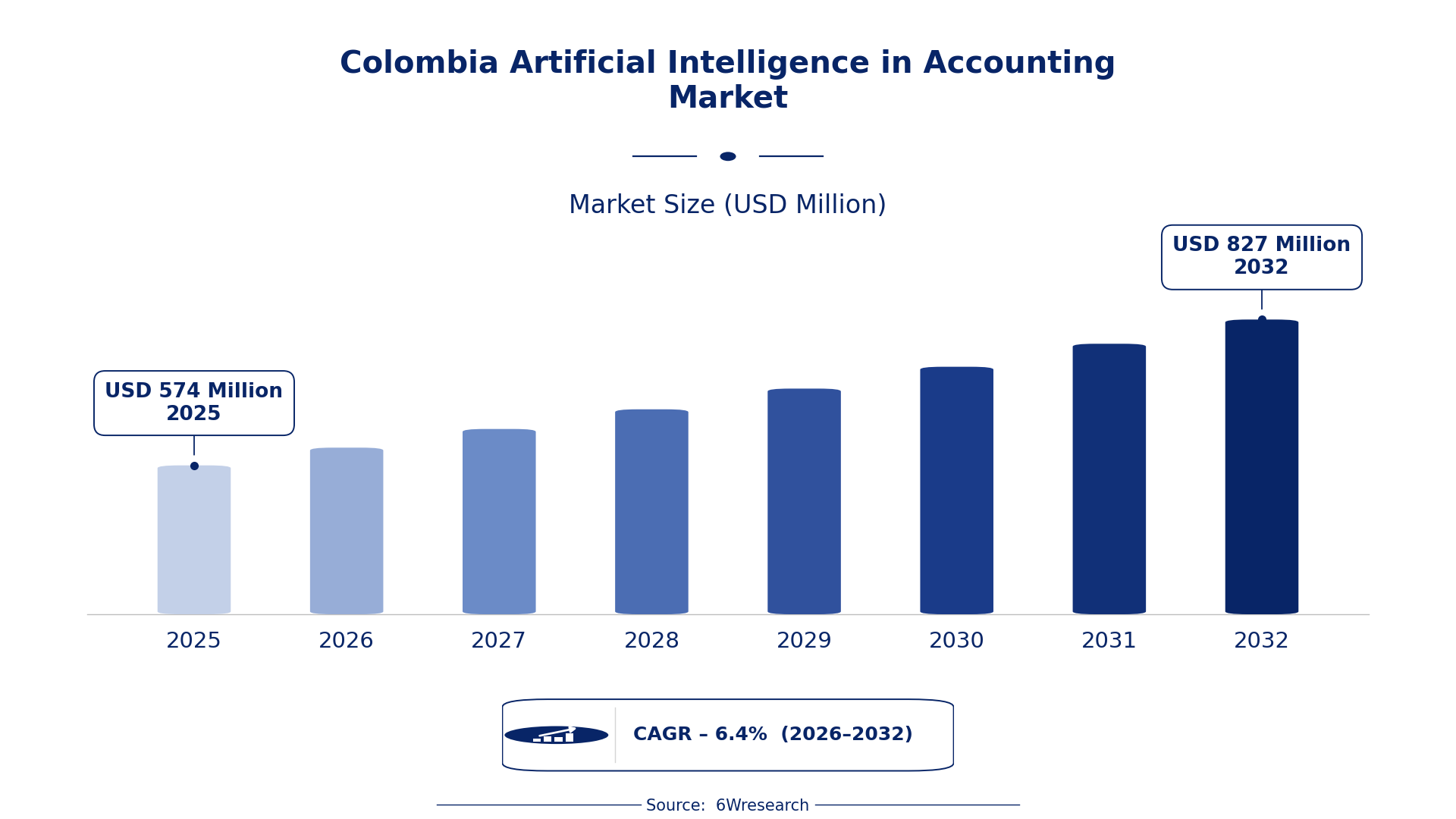
The Colombia Artificial Intelligence in Accounting Market was estimated at USD 574 Million in 2025 and is projected to reach USD 827 Million by 2032, growing at a CAGR of 6.4% from 2026 to 2032.
Colombia Artificial Intelligence in Accounting Market Synopsis
The integration of artificial intelligence into accounting practices in Colombia is not just a trend; it’s a necessary evolution. Businesses across the country are increasingly turning to AI-driven tools to enhance their financial operations, focusing on areas like data entry and fraud detection. The demand for greater accuracy and efficiency is pushing firms to adopt these technologies at an accelerated pace.
As digital transformation sweeps through Colombia’s financial sector, AI solutions are becoming indispensable. Organizations are leveraging machine learning and automation to streamline processes, ultimately leading to better decision-making and productivity. The appetite for AI-powered accounting software is growing, reflecting a broader shift towards technological advancement in the industry.
Colombia Artificial Intelligence in Accounting Market Year-wise Growth Rate and Key Drivers
This graph illustrates the annual growth rates of the Colombia Artificial Intelligence in Accounting Market from 2021 to 2032, highlighting a steady upward trajectory and projected expansion over the forecast period.
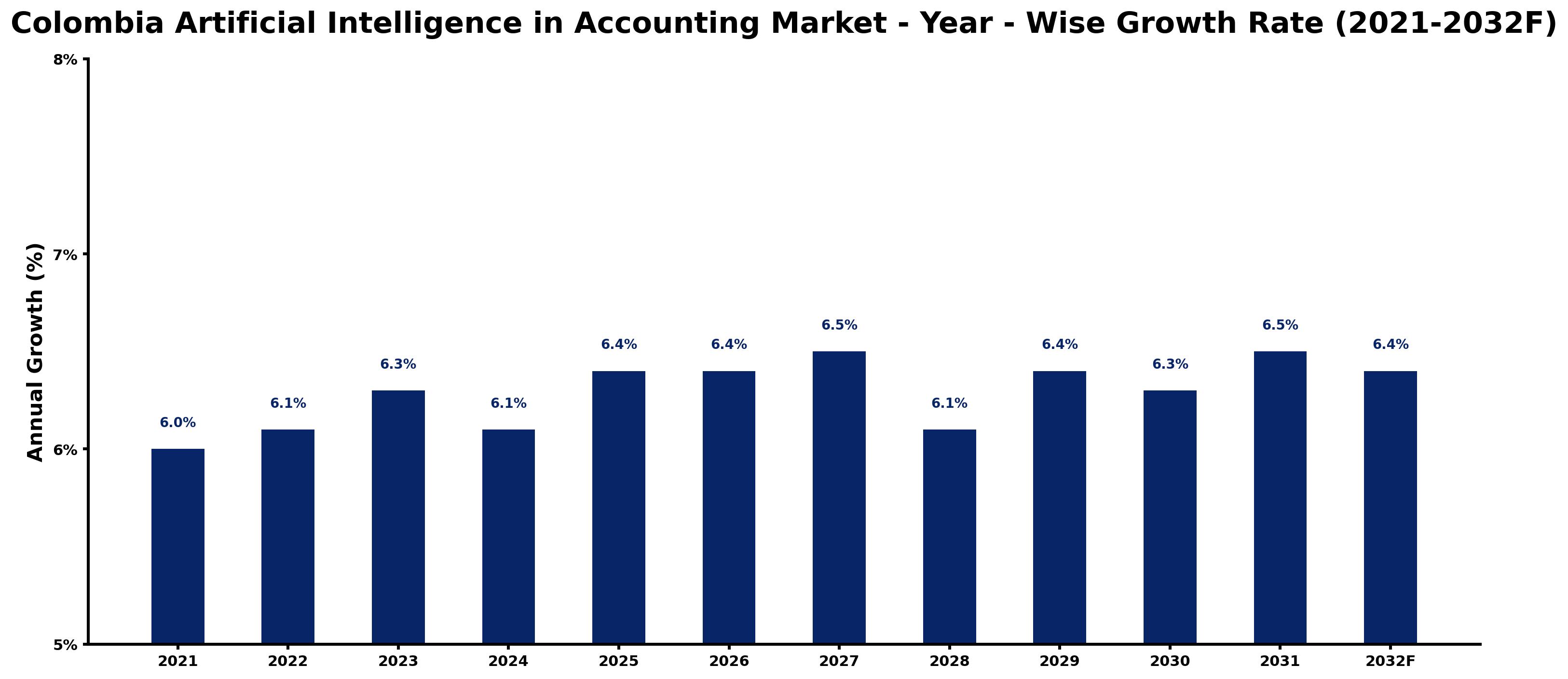
The table below presents the year‑wise growth rates along with the key drivers influencing the market
| Year | Growth Rate | Major Drivers |
| 2021 | 6.0% | Colombian tax reforms encouraging digital accounting solutions |
| 2022 | 6.1% | Growth in remote work boosting AI adoption in accounting |
| 2023 | 6.3% | Increased government funding for tech startups in finance |
| 2024 | 6.1% | Rise in SMEs adopting AI for financial management |
| 2025 | 6.4% | Regulatory incentives for AI integration in tax compliance |
| 2026 | 6.4% | Educational programs enhancing local AI accounting skills |
| 2027 | 6.5% | Strengthening of accounting standards requiring AI tools |
| 2028 | 6.1% | Launch of AI audit frameworks by financial authorities |
| 2029 | 6.4% | Demand for fraud detection driving AI usage in accounting |
| 2030 | 6.3% | BPO sector's growth spurring AI demand in accounting |
| 2031 | 6.5% | Partnerships fostering AI solutions in Colombian finance sector |
| 2032 | 6.4% | Tax incentives for adopting AI technologies in businesses |
Note: Market size estimations and growth projections presented in this report are based on 6Wresearch's proprietary forecasting methodology, utilizing the latest available industry data, government publications, and primary research inputs.
Colombia Artificial Intelligence in Accounting Market Key Takeaways
Below are some of the specific key takeaways from the market, including:
- The growing necessity for automation in accounting tasks is driving AI adoption.
- There is a rising demand for AI tools that enhance data accuracy and efficiency.
- AI-driven predictive analytics is becoming crucial for accurate financial forecasting.
- Colombian businesses are increasingly focused on integrating AI with existing accounting systems.
- The government’s support for digital initiatives is creating a favorable environment for AI growth.
Evaluation of Restraints in Colombia Artificial Intelligence in Accounting Market
Despite the promising outlook, the market faces several restraints that could hinder its potential. A notable challenge is the lack of awareness among accounting professionals regarding AI technologies. This gap in understanding makes it difficult for firms to fully embrace the benefits of AI. Concerns surrounding data privacy and security also loom large, as businesses navigate the complexities of regulatory compliance.
on top of that, the costs associated with implementing AI solutions can be prohibitive, particularly for smaller firms. The need for specialized skills to effectively integrate these technologies further complicates the landscape. These factors combined create a barrier to entry that may slow the pace of AI adoption in accounting.
Colombia Artificial Intelligence in Accounting Market Trends
Current trends in the Colombia Artificial Intelligence in Accounting market are marked by a strong emphasis on automation. Firms are increasingly automating repetitive tasks, such as data reconciliation and financial reporting, which are traditionally labor-intensive. This shift is significantly enhancing operational efficiency and reducing human error.
Another emerging trend is the utilization of AI for real-time analytics, enabling businesses to make informed decisions based on current data rather than historical records alone. The incorporation of AI into existing accounting software is also gaining traction, as companies seek to enhance their capabilities without overhauling their entire systems.
Colombia Artificial Intelligence in Accounting Market Opportunities
The market is ripe with opportunities for growth and investment. One of the most promising areas is the development of AI-powered predictive analytics tools that can provide deeper financial insights. These tools can help organizations forecast trends and make strategic decisions more effectively.
Additionally, there is a significant opportunity for collaboration between technology providers and accounting firms to create tailored AI solutions that address specific industry challenges. As the demand for advanced financial insights continues to rise, businesses are likely to seek out partnerships that can facilitate this integration.
Government Initiatives in the Colombia Artificial Intelligence in Accounting Market
The Colombian government is actively promoting technological innovation and digital transformation across various sectors, including accounting. Although specific policies targeting AI in accounting are still developing, the general push towards digital solutions provides a favorable backdrop for market growth. Initiatives aimed at improving data security and privacy are also gaining traction, helping to build trust in AI applications.
- A national digital infrastructure upgrade programme launched in early 2023 aims to enhance technological capabilities across sectors.
- Ongoing efforts to revise data protection regulations are currently underway, focusing on compliance with international standards.
- A public-private partnership initiative expected to be announced in late 2024 will support AI integration in small and medium-sized enterprises.
- Recent training programs initiated in early 2025 aim to improve awareness and understanding of AI among accounting professionals.
- Plans for a national AI strategy, expected to be released by 2026, will include frameworks for ethical AI use in accounting.
Future Insights of the Colombia Artificial Intelligence in Accounting Market
Looking ahead to 2026-2032, the Colombia Artificial Intelligence in Accounting market is set to experience substantial growth. The increasing integration of AI technologies in financial processes will be fueled by advancements in machine learning and data analytics. Businesses will continue to seek efficiency, accuracy, and real-time insights, driving the demand for AI solutions.
on top of that, the government's commitment to fostering a digital economy will likely create more opportunities for innovation. As regulatory frameworks evolve to support AI integration, firms that proactively embrace these technologies will position themselves for success in a competitive market.
Colombia Artificial Intelligence in Accounting Market Latest Developments
Recent developments in the Colombia Artificial Intelligence in Accounting market reflect a growing enthusiasm for technological solutions. Companies are increasingly investing in AI capabilities to enhance their accounting functions, recognizing the strategic advantages these tools offer. The past year has seen a flurry of activity as organizations seek to stay ahead in this dynamic environment.
- A major technology vendor announced a rollout of a new AI-driven accounting platform in Q2 2025, aimed at streamlining financial reporting processes.
- In early 2025, a leading regional operator launched a training initiative focused on AI applications in accounting, targeting professionals across various sectors.
- An ongoing collaboration between academic institutions and industry players started in late 2024 to develop AI algorithms tailored for financial analysis.
- Plans for an upcoming software upgrade, set to commence in mid-2026, will enhance existing AI functionalities in popular accounting systems.
- A recently completed pilot project in early 2025 demonstrated the effectiveness of AI tools in fraud detection, garnering interest from multiple firms.
Colombia Artificial Intelligence in Accounting Market - Key Attractiveness of the Report
- 10 Years of Market Numbers
- Historical Data Starting from 2022 to 2025
- Base Year: 2025
- Forecast Data until 2032
- Key Performance Indicators Impacting the Market
- Major Upcoming Developments and Projects
Key Highlights of the Report:
- Colombia Artificial Intelligence in Accounting Market Outlook
- Market Size of Colombia Artificial Intelligence in Accounting Market, 2025
- Forecast of Colombia Artificial Intelligence in Accounting Market, 2032
- Historical Data and Forecast of Colombia Artificial Intelligence in Accounting Revenues & Volume for the Period 2022-2032F
- Colombia Artificial Intelligence in Accounting Market Trend Evolution
- Colombia Artificial Intelligence in Accounting Market Drivers and Challenges
- Colombia Artificial Intelligence in Accounting Price Trends
- Colombia Artificial Intelligence in Accounting Porter's Five Forces
- Colombia Artificial Intelligence in Accounting Industry Life Cycle
- Historical Data and Forecast of Colombia Artificial Intelligence in Accounting Market Revenues & Volume By Application for the Period 2022-2032F
- Historical Data and Forecast of Colombia Artificial Intelligence in Accounting Market Revenues & Volume By Automated Bookkeeping for the Period 2022-2032F
- Historical Data and Forecast of Colombia Artificial Intelligence in Accounting Market Revenues & Volume By Invoice Classification and Approvals for the Period 2022-2032F
- Historical Data and Forecast of Colombia Artificial Intelligence in Accounting Market Revenues & Volume By Fraud and Risk Management for the Period 2022-2032F
- Historical Data and Forecast of Colombia Artificial Intelligence in Accounting Market Revenues & Volume By Reporting for the Period 2022-2032F
- Historical Data and Forecast of Colombia Artificial Intelligence in Accounting Market Revenues & Volume By Others for the Period 2022-2032F
- Historical Data and Forecast of Colombia Artificial Intelligence in Accounting Market Revenues & Volume By Component for the Period 2022-2032F
- Historical Data and Forecast of Colombia Artificial Intelligence in Accounting Market Revenues & Volume By Solutions for the Period 2022-2032F
- Historical Data and Forecast of Colombia Artificial Intelligence in Accounting Market Revenues & Volume By Services for the Period 2022-2032F
- Historical Data and Forecast of Colombia Artificial Intelligence in Accounting Market Revenues & Volume By Technology for the Period 2022-2032F
- Historical Data and Forecast of Colombia Artificial Intelligence in Accounting Market Revenues & Volume By Machine Learning (ML) and Deep Learning for the Period 2022-2032F
- Historical Data and Forecast of Colombia Artificial Intelligence in Accounting Market Revenues & Volume By NLP for the Period 2022-2032F
- Historical Data and Forecast of Colombia Artificial Intelligence in Accounting Market Revenues & Volume By Deployment Mode for the Period 2022-2032F
- Historical Data and Forecast of Colombia Artificial Intelligence in Accounting Market Revenues & Volume By On-premises for the Period 2022-2032F
- Historical Data and Forecast of Colombia Artificial Intelligence in Accounting Market Revenues & Volume By Cloud for the Period 2022-2032F
- Historical Data and Forecast of Colombia Artificial Intelligence in Accounting Market Revenues & Volume By Enterprise Size for the Period 2022-2032F
- Historical Data and Forecast of Colombia Artificial Intelligence in Accounting Market Revenues & Volume By Large Enterprises for the Period 2022-2032F
- Historical Data and Forecast of Colombia Artificial Intelligence in Accounting Market Revenues & Volume By Small and Medium-Sized Enterprises (SMEs) for the Period 2022-2032F
- Colombia Artificial Intelligence in Accounting Import Export Trade Statistics
- Market Opportunity Assessment By Application
- Market Opportunity Assessment By Component
- Market Opportunity Assessment By Technology
- Market Opportunity Assessment By Deployment Mode
- Market Opportunity Assessment By Enterprise Size
- Colombia Artificial Intelligence in Accounting Top Companies Market Share
- Colombia Artificial Intelligence in Accounting Competitive Benchmarking By Technical and Operational Parameters
- Colombia Artificial Intelligence in Accounting Company Profiles
- Colombia Artificial Intelligence in Accounting Key Strategic Recommendations






































