Colombia Food Colors Market: Top 5 Importing Countries and Market Competition (HHI) Analysis
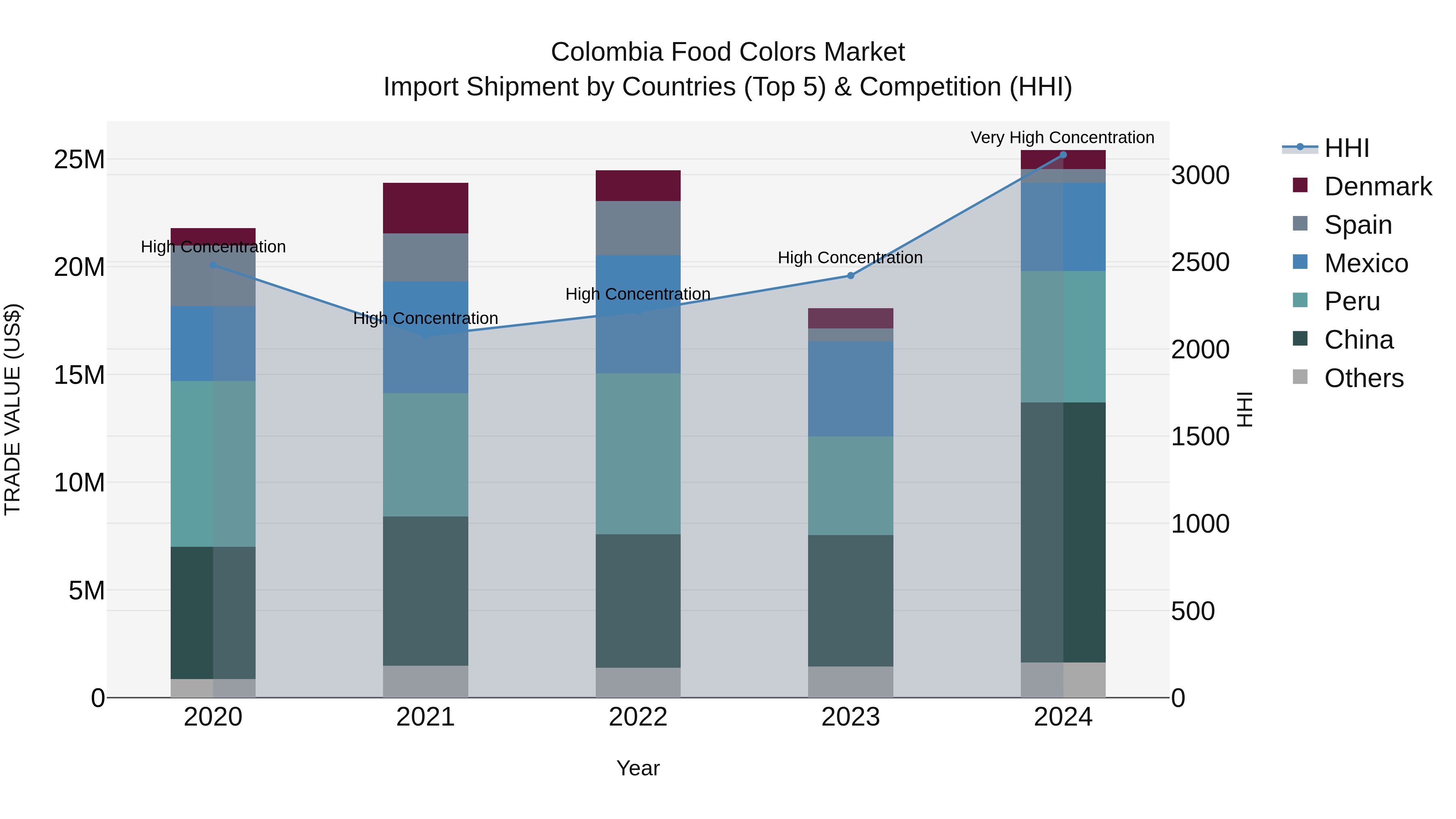
The Colombia food colors import market saw a significant increase in concentration in 2024, with top exporters being China, Peru, Mexico, Denmark, and Spain. The high Herfindahl-Hirschman Index (HHI) indicates a very competitive landscape. The compound annual growth rate (CAGR) from 2020 to 2024 stood at a steady 3.92%, while the exceptional growth rate of 40.53% from 2023 to 2024 suggests a rapid expansion in the import market. This data highlights the growing demand for food colors in Colombia and the importance of these key exporting countries in meeting that demand.
Colombia Food Colors Market Overview
Food colors play a vital role in enhancing the visual appeal of food products and influencing consumer preferences. In Colombia, the food colors market is experiencing growth, driven by the food processing industry`s demand for natural and synthetic colors to meet diverse consumer expectations and regulatory standards.
Drivers of the market
The Colombia Food Colors Market faces significant challenges, including regulatory constraints on the use of synthetic food colors due to health concerns and consumer preferences for natural alternatives. Additionally, the limited availability of locally sourced natural food colorants and the high cost of extraction processes hinder market growth. Moreover, the complexity of achieving stable and vibrant colors in various food formulations presents technical challenges for manufacturers.
Challenges of the market
Challenges in the food colors market include ensuring regulatory compliance with food additive regulations and labeling requirements. Additionally, addressing concerns about natural versus synthetic colorants and consumer perceptions poses challenges. Moreover, overcoming technical limitations in color stability and application versatility is crucial for market competitiveness.
Government Policy of the market
Colombia government policies governing the food colors market may include food additives regulations, labeling requirements, and safety standards. Regulatory frameworks aim to ensure the safety, efficacy, and consumer acceptance of food colors used to enhance the visual appeal of food products while protecting public health and promoting food safety.
Key Highlights of the Report:
- Colombia Food Colors Market Outlook
- Market Size of Colombia Food Colors Market, 2024
- Forecast of Colombia Food Colors Market, 2031
- Historical Data and Forecast of Colombia Food Colors Revenues & Volume for the Period 2021-2031
- Colombia Food Colors Market Trend Evolution
- Colombia Food Colors Market Drivers and Challenges
- Colombia Food Colors Price Trends
- Colombia Food Colors Porter's Five Forces
- Colombia Food Colors Industry Life Cycle
- Historical Data and Forecast of Colombia Food Colors Market Revenues & Volume By Type for the Period 2021-2031
- Historical Data and Forecast of Colombia Food Colors Market Revenues & Volume By Natural for the Period 2021-2031
- Historical Data and Forecast of Colombia Food Colors Market Revenues & Volume By Synthetic for the Period 2021-2031
- Historical Data and Forecast of Colombia Food Colors Market Revenues & Volume By Nature Identical for the Period 2021-2031
- Historical Data and Forecast of Colombia Food Colors Market Revenues & Volume By Application for the Period 2021-2031
- Historical Data and Forecast of Colombia Food Colors Market Revenues & Volume By Food Products for the Period 2021-2031
- Historical Data and Forecast of Colombia Food Colors Market Revenues & Volume By Beverages for the Period 2021-2031
- Historical Data and Forecast of Colombia Food Colors Market Revenues & Volume By Form for the Period 2021-2031
- Historical Data and Forecast of Colombia Food Colors Market Revenues & Volume By Liquid for the Period 2021-2031
- Historical Data and Forecast of Colombia Food Colors Market Revenues & Volume By Powder for the Period 2021-2031
- Historical Data and Forecast of Colombia Food Colors Market Revenues & Volume By Gel for the Period 2021-2031
- Historical Data and Forecast of Colombia Food Colors Market Revenues & Volume By Solubility for the Period 2021-2031
- Historical Data and Forecast of Colombia Food Colors Market Revenues & Volume By Dyes for the Period 2021-2031
- Historical Data and Forecast of Colombia Food Colors Market Revenues & Volume By Lakes for the Period 2021-2031
- Colombia Food Colors Import Export Trade Statistics
- Market Opportunity Assessment By Type
- Market Opportunity Assessment By Application
- Market Opportunity Assessment By Form
- Market Opportunity Assessment By Solubility
- Colombia Food Colors Top Companies Market Share
- Colombia Food Colors Competitive Benchmarking By Technical and Operational Parameters
- Colombia Food Colors Company Profiles
- Colombia Food Colors Key Strategic Recommendations






































