Colombia IoT Connectivity Market Size & Growth Rate (2026-2032)
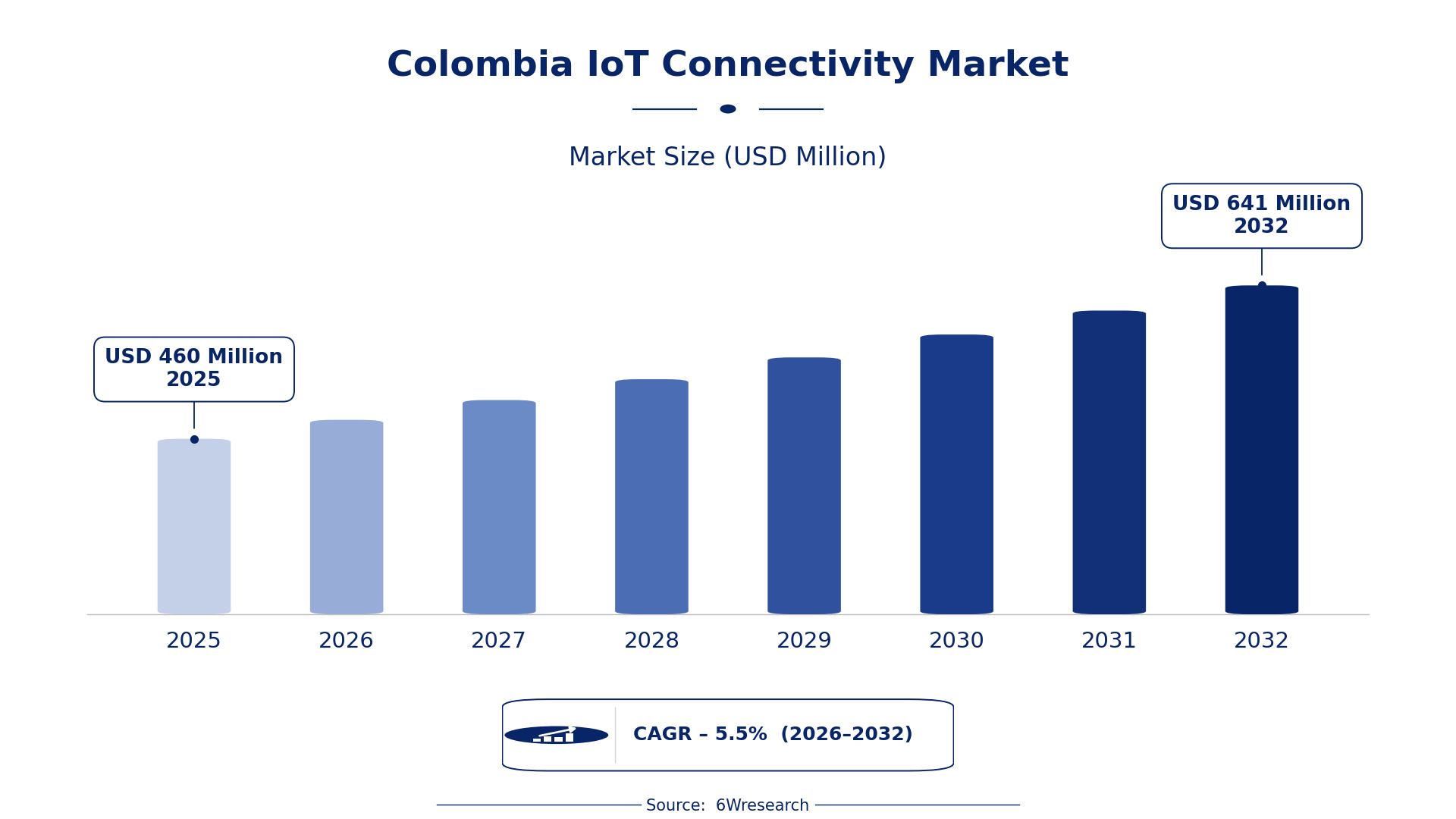
The Colombia IoT Connectivity Market was estimated at USD 460 Million in 2025 and is projected to reach USD 641 Million by 2032, growing at a CAGR of 5.5% from 2026 to 2032.
Colombia IoT Connectivity Market Synopsis
The Colombia IoT Connectivity Market is evolving rapidly, driven by a growing demand for reliable communication solutions across various sectors. As industries increasingly adopt IoT technologies, the need for dependable connectivity becomes paramount, particularly in urban and remote areas where traditional infrastructure often falls short.
With a diverse array of connectivity options, including cellular networks, LPWAN, and satellite solutions, the market is poised for growth. However, challenges related to infrastructure limitations and spectrum allocation persist, necessitating strategic initiatives from both public and private sectors to foster innovation and expansion.
Colombia IoT Connectivity Market Year-wise Growth Rate and Key Drivers
This graph illustrates the annual growth rates of the Colombia IoT Connectivity Market from 2021 to 2032, highlighting a steady upward trajectory and projected expansion over the forecast period.
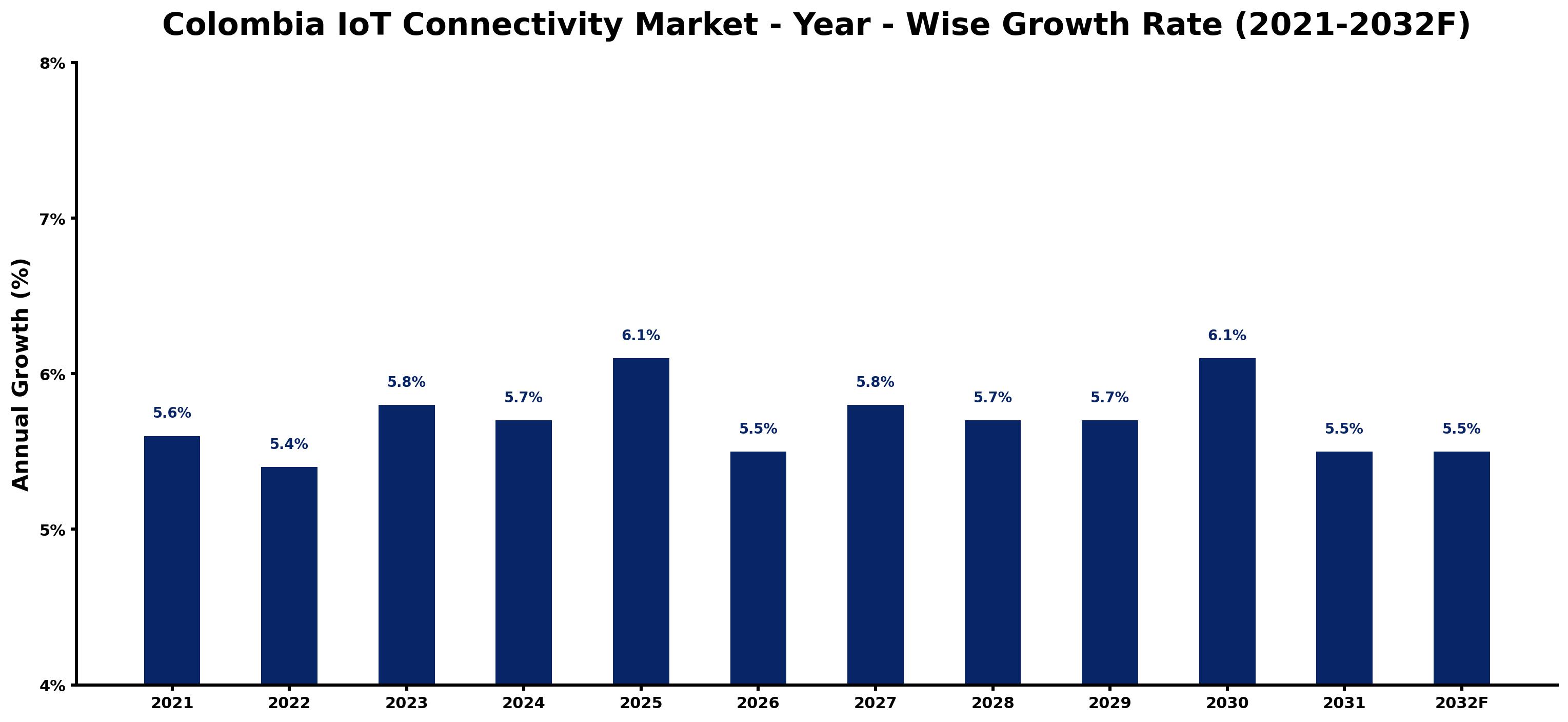
The table below presents the year‑wise growth rates along with the key drivers influencing the market
| Year | Growth Rate | Major Drivers |
| 2021 | 5.6% | Colombian government promotes 5G deployment for IoT applications. |
| 2022 | 5.4% | Increase in agritech solutions driving IoT connectivity adoption. |
| 2023 | 5.8% | Emergence of IoT startups enhancing smart agriculture technologies. |
| 2024 | 5.7% | Government incentives for IoT in environmental monitoring initiatives. |
| 2025 | 6.1% | Growth of logistics sector demanding advanced IoT tracking systems. |
| 2026 | 5.5% | Smart cities initiatives stimulating urban IoT project investments. |
| 2027 | 5.8% | Rise in population density fueling smart urban solutions demand. |
| 2028 | 5.7% | Increased cyber security regulations spurring IoT security solutions. |
| 2029 | 5.7% | Education sector's push for IoT in remote learning tools. |
| 2030 | 6.1% | Aging infrastructure drives IoT solutions for modernization. |
| 2031 | 5.5% | Local fintech innovations promoting IoT in supply chain management. |
| 2032 | 5.5% | Telecom companies accelerating IoT device integration for customers. |
Note: Market size estimations and growth projections presented in this report are based on 6Wresearch's proprietary forecasting methodology, utilizing the latest available industry data, government publications, and primary research inputs.
Colombia IoT Connectivity Market Key Takeaways
Below are some of the specific key takeaways from the market, including:
- The market is on track for a steady growth trajectory, projected to reach USD 641 Million by 2032.
- Infrastructure challenges, particularly in rural areas, remain a critical barrier to widespread IoT deployment.
- Emerging technologies like LPWAN and satellite communication are gaining traction as viable connectivity solutions.
- Government policies aimed at enhancing telecommunications infrastructure are expected to stimulate market growth.
- Increased investment in IoT applications across various industries is driving the demand for connectivity solutions.
Evaluation of Restraints in Colombia IoT Connectivity Market
The Colombia IoT Connectivity Market faces notable restraints, primarily stemming from inadequate infrastructure, especially in rural regions. Limited broadband penetration and gaps in cellular coverage hinder the deployment of consistent connectivity solutions necessary for effective IoT integration. on top of that, regulatory hurdles and spectrum allocation challenges complicate the landscape, restricting the ability of service providers to innovate and expand their offerings. Without addressing these fundamental issues, the market's potential remains compromised.
Colombia IoT Connectivity Market Trends
A notable trend in the Colombia IoT Connectivity Market is the increasing adoption of LPWAN technologies, which offer low-power, long-range communication capabilities ideal for various applications. Businesses are gravitating towards these solutions to enhance efficiency and reduce operational costs. on top of that, the rollout of 5G networks is expected to revolutionize connectivity standards, providing faster data transmission and improved device management.
Sustainability is also becoming a focal point, with companies seeking energy-efficient connectivity solutions that align with environmental goals. This trend is prompting investments in innovative technologies that reduce energy consumption while maintaining reliable connectivity.
Colombia IoT Connectivity Market Opportunities
Opportunities abound in the Colombia IoT Connectivity Market as various sectors seek to capitalize on IoT applications. The agriculture sector, in particular, presents a fertile ground for growth through precision farming technologies that rely on IoT for real-time monitoring. on top of that, urban development initiatives are pushing for smart city solutions that integrate IoT for improved resource management.
As the government invests in telecommunications infrastructure, private enterprises are encouraged to participate in partnerships that enhance connectivity offerings. This collaborative approach can unlock new avenues for innovation and broaden access to IoT solutions across the nation.
Government Initiatives in the Colombia IoT Connectivity Market
Government policies are increasingly focused on enhancing IoT connectivity within Colombia. By prioritizing investments in telecommunications infrastructure, the administration is laying the groundwork for more reliable connectivity solutions essential for IoT adoption. Regulatory frameworks are being developed to ensure spectrum availability and support emerging technologies, which are crucial for attracting investment and fostering innovation.
- A national digital infrastructure upgrade programme has been launched to improve connectivity in underserved regions.
- Currently ongoing is a regulatory initiative aimed at facilitating spectrum allocation for IoT networks, enhancing communication capabilities.
- Plans for an upcoming public-private partnership initiative focus on expanding telecom infrastructure access by 2028.
- New policies introduced in 2025 mandate investment in research and development of IoT connectivity technologies.
- The government is promoting collaborative projects with technology vendors to pilot innovative IoT solutions in urban areas.
Future Insights of the Colombia IoT Connectivity Market
Looking ahead to 2026-2032, the Colombia IoT Connectivity Market is set for transformative growth. As infrastructure gaps are addressed through governmental support and private sector investment, connectivity solutions will become more reliable and widespread. The integration of advanced technologies, such as 5G, will significantly enhance data transmission capabilities and device management.
Market players will likely focus on developing cost-effective and energy-efficient solutions, aligning with global sustainability trends. With the rise of smart cities and precision agriculture, the demand for IoT connectivity will surge, positioning Colombia as a key player in the regional IoT ecosystem.
Colombia IoT Connectivity Market Latest Developments
Over the past year, the Colombia IoT Connectivity Market has seen considerable activity as stakeholders respond to the increasing demand for efficient connectivity solutions. Initiatives are being launched to enhance infrastructure and promote innovative technologies, reflecting a strong commitment to advancing the market.
- A leading regional operator announced an expansion of its LPWAN network in early 2025, aiming to cover more rural areas.
- An initiative that began in mid-2025 and remains underway focuses on deploying smart sensors in urban settings for real-time data collection.
- Plans are in place for a rollout of 5G connectivity expected to begin in the second half of 2026, promising enhanced speeds and reliability.
- A recent partnership was formed between government and technology vendors to develop IoT applications for agriculture, launched in late 2025.
- A major telecom provider is currently upgrading its satellite communication services to cater to remote areas, an initiative that started in early 2025.
Colombia IoT Connectivity Market - Key Attractiveness of the Report
- 10 Years of Market Numbers
- Historical Data Starting from 2022 to 2025
- Base Year: 2025
- Forecast Data until 2032
- Key Performance Indicators Impacting the Market
- Major Upcoming Developments and Projects
Key Highlights of the Report:
- Colombia IoT Connectivity Market Outlook
- Market Size of Colombia IoT Connectivity Market, 2025
- Forecast of Colombia IoT Connectivity Market, 2032
- Historical Data and Forecast of Colombia IoT Connectivity Revenues & Volume for the Period 2022-2032F
- Colombia IoT Connectivity Market Trend Evolution
- Colombia IoT Connectivity Market Drivers and Challenges
- Colombia IoT Connectivity Price Trends
- Colombia IoT Connectivity Porter's Five Forces
- Colombia IoT Connectivity Industry Life Cycle
- Historical Data and Forecast of Colombia IoT Connectivity Market Revenues & Volume By Component for the Period 2022-2032F
- Historical Data and Forecast of Colombia IoT Connectivity Market Revenues & Volume By Platform for the Period 2022-2032F
- Historical Data and Forecast of Colombia IoT Connectivity Market Revenues & Volume By Services for the Period 2022-2032F
- Historical Data and Forecast of Colombia IoT Connectivity Market Revenues & Volume By Application Areas for the Period 2022-2032F
- Historical Data and Forecast of Colombia IoT Connectivity Market Revenues & Volume By Building & Home Automation for the Period 2022-2032F
- Historical Data and Forecast of Colombia IoT Connectivity Market Revenues & Volume By Smart Energy & Utility for the Period 2022-2032F
- Historical Data and Forecast of Colombia IoT Connectivity Market Revenues & Volume By Smart Manufacturing for the Period 2022-2032F
- Historical Data and Forecast of Colombia IoT Connectivity Market Revenues & Volume By Connected Health for the Period 2022-2032F
- Historical Data and Forecast of Colombia IoT Connectivity Market Revenues & Volume By Smart Retail for the Period 2022-2032F
- Historical Data and Forecast of Colombia IoT Connectivity Market Revenues & Volume By Smart Transportation for the Period 2022-2032F
- Historical Data and Forecast of Colombia IoT Connectivity Market Revenues & Volume By Others (Education and Agriculture) for the Period 2022-2032F
- Historical Data and Forecast of Colombia IoT Connectivity Market Revenues & Volume By Organization Size for the Period 2022-2032F
- Historical Data and Forecast of Colombia IoT Connectivity Market Revenues & Volume By Large Enterprises for the Period 2022-2032F
- Historical Data and Forecast of Colombia IoT Connectivity Market Revenues & Volume By SMEs for the Period 2022-2032F
- Colombia IoT Connectivity Import Export Trade Statistics
- Market Opportunity Assessment By Component
- Market Opportunity Assessment By Application Areas
- Market Opportunity Assessment By Organization Size
- Colombia IoT Connectivity Top Companies Market Share
- Colombia IoT Connectivity Competitive Benchmarking By Technical and Operational Parameters
- Colombia IoT Connectivity Company Profiles
- Colombia IoT Connectivity Key Strategic Recommendations






































