Mexico IoT Connectivity Market Size & Growth Rate (2026-2032)
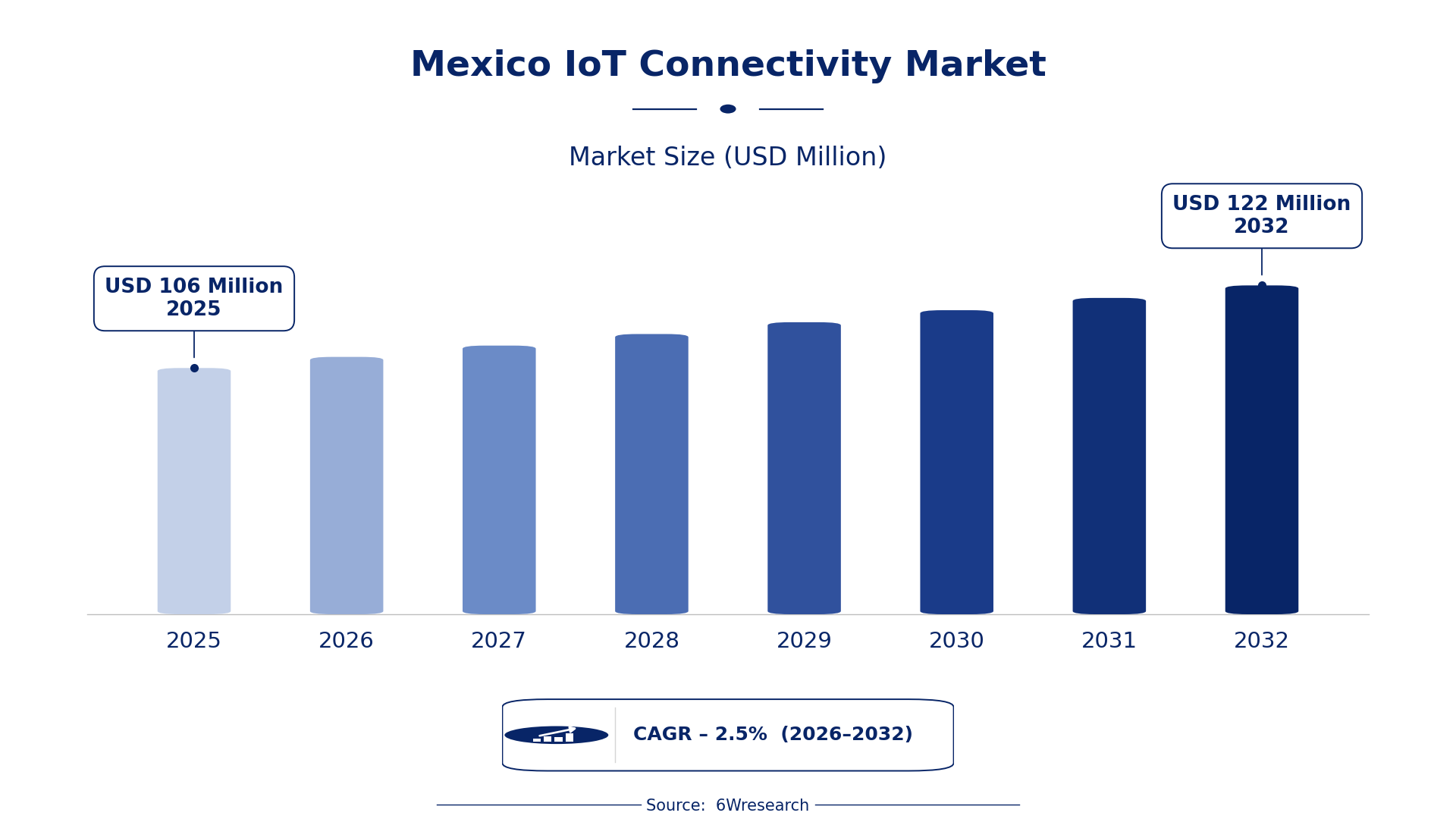
The Mexico IoT Connectivity Market was estimated at USD 106 Million in 2025 and is projected to reach USD 122 Million by 2032, growing at a CAGR of 2.5% from 2026 to 2032.
Mexico IoT Connectivity Market Synopsis
The expansion of 5G networks is the most influential factor driving the Mexico IoT Connectivity Market today. This advancement not only enhances the speed and reliability of data transmission but also enables a wider range of applications across various sectors, from agriculture to smart cities.
As the demand for connected devices surges, the need for dependable communication networks becomes increasingly pressing. Various connectivity solutions, including cellular, Wi-Fi, Bluetooth, and LPWAN, are vital in facilitating this communication, thereby pushing the market towards significant growth.
Mexico IoT Connectivity Market Year-wise Growth Rate and Key Drivers
This graph illustrates the annual growth rates of the Mexico IoT Connectivity Market from 2021 to 2032, highlighting a steady upward trajectory and projected expansion over the forecast period.
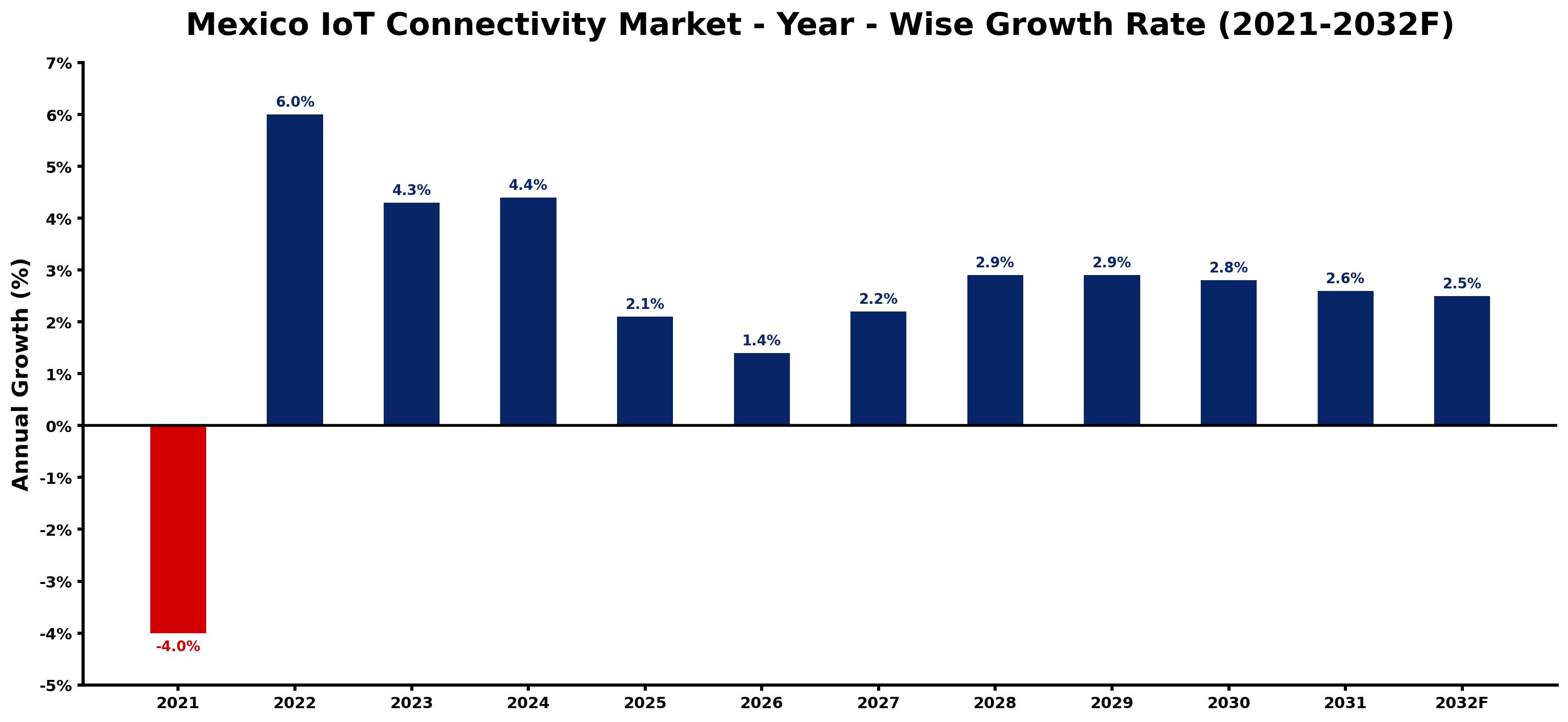
The table below presents the year‑wise growth rates along with the key drivers influencing the market
| Year | Growth Rate | Major Drivers |
| 2021 | -4.0% | Slow adoption due to inconsistent regulatory framework by IFT. |
| 2022 | 6.0% | Implementation of national broadband strategy by IFT |
| 2023 | 4.3% | Increased adoption of connected devices in logistics sector |
| 2024 | 4.4% | Government incentives for smart city development projects |
| 2025 | 2.1% | Growing interest in telemedicine applications across healthcare |
| 2026 | 1.4% | Accelerated deployment of LPWAN networks across cities |
| 2027 | 2.2% | Collaboration between telecoms for IoT network expansion |
| 2028 | 2.9% | Rising investments in agricultural IoT solutions |
| 2029 | 2.9% | Demand for real-time data analytics in manufacturing |
| 2030 | 2.8% | Boost from automotive industry focusing on connected vehicles |
| 2031 | 2.6% | Local startups promoting innovative IoT applications |
| 2032 | 2.5% | Increased focus on smart utilities for sustainability |
Note: Market size estimations and growth projections presented in this report are based on 6Wresearch's proprietary forecasting methodology, utilizing the latest available industry data, government publications, and primary research inputs.
Mexico IoT Connectivity Market Key Takeaways
Below are some of the specific key takeaways from the market, including:
- 5G network deployment is accelerating the adoption of IoT solutions across industries.
- Investment in telecom infrastructure is critical for supporting IoT device proliferation.
- Rural connectivity remains a challenge, creating a digital divide that affects IoT implementation.
- LPWAN and NB-IoT technologies are gaining traction for low-power applications.
- Government initiatives are focused on expanding broadband access and enhancing connectivity in underserved areas.
Evaluation of Restraints in Mexico IoT Connectivity Market
The Mexico IoT Connectivity Market faces notable limitations, primarily stemming from infrastructural challenges. Many areas, particularly rural regions, still lack adequate connectivity, hampering effective IoT deployment. The costs associated with establishing and maintaining this infrastructure can be a barrier for many stakeholders. on top of that, regulatory hurdles related to spectrum allocation can delay the rollout of necessary technologies, creating additional friction in market growth.
Mexico IoT Connectivity Market Trends
A growing trend in the Mexico IoT Connectivity Market is the increasing emphasis on energy-efficient IoT solutions. As sustainability becomes a priority, businesses are looking for ways to minimize power consumption in their connected devices. Additionally, advancements in artificial intelligence are facilitating smarter data processing, allowing for more efficient device management and predictive analytics.
on top of that, partnerships between public and private sectors are becoming essential to enhance connectivity infrastructure, particularly in remote areas. These collaborations aim to bridge the existing digital divide, ensuring wider access to IoT technologies.
Mexico IoT Connectivity Market Opportunities
The potential for growth in the Mexico IoT Connectivity Market lies primarily in the expansion of 5G infrastructure, which offers opportunities for new applications in smart cities, healthcare, and agriculture. Companies that invest in innovative solutions catering to these sectors are likely to gain a competitive edge. on top of that, there is a distinct opening for local players to partner with international firms to enhance service offerings, particularly in rural and underserved areas.
Government Initiatives in the Mexico IoT Connectivity Market
The Mexican government is actively working to bolster the connectivity infrastructure necessary for IoT growth. With a focus on both urban and rural areas, policies are being implemented to enhance broadband access and facilitate the rollout of 5G networks. This proactive stance is crucial for addressing existing gaps in connectivity and ensuring that IoT applications can thrive across the nation.
- A national digital infrastructure upgrade programme is currently in its rollout phase, aimed at expanding broadband access in underserved regions.
- The government has launched initiatives to promote partnerships between public and private sectors for telecom infrastructure development.
- A recent policy was introduced mandating the expansion of 5G networks to improve connectivity reliability across the country.
- Current efforts include workshops and funding opportunities to encourage IoT technology adoption in rural sectors.
- A planned initiative expects to address regulatory frameworks surrounding spectrum allocation for IoT applications by 2028.
Future Insights of the Mexico IoT Connectivity Market
Looking ahead to 2026-2032, the Mexico IoT Connectivity Market is expected to witness substantial transformation, driven by advancements in technology and infrastructure improvements. The ongoing push for digitalization across sectors will likely accelerate IoT adoption, paving the way for innovative applications that enhance efficiency and productivity. As the market matures, competition will intensify, prompting companies to focus on tailored solutions that meet the diverse needs of various industries.
Mexico IoT Connectivity Market Latest Developments
In the past year, the Mexico IoT Connectivity Market has seen noteworthy developments, particularly in the deployment of new technologies and infrastructure enhancements. As companies adapt to increasing demands for connectivity, significant initiatives have emerged to facilitate growth and broaden access to IoT solutions.
- A major technology vendor launched an innovative IoT platform in early 2025, aimed at streamlining device management and enhancing data analytics capabilities.
- In mid-2025, a leading regional operator began upgrading its existing network infrastructure to support the integration of 5G and LPWAN technologies.
- A public-private partnership is currently underway, focused on expanding connectivity services to remote communities, enhancing IoT access.
- A new regulatory framework was introduced in Q3 2025, aimed at simplifying spectrum allocation for IoT applications.
- A rollout expected to begin in late 2026 aims to implement smart city solutions in major urban centers across Mexico.
Mexico IoT Connectivity Market - Key Attractiveness of the Report
- 10 Years of Market Numbers
- Historical Data Starting from 2022 to 2025
- Base Year: 2025
- Forecast Data until 2032
- Key Performance Indicators Impacting the Market
- Major Upcoming Developments and Projects
Key Highlights of the Report:
- Mexico IoT Connectivity Market Outlook
- Market Size of Mexico IoT Connectivity Market, 2025
- Forecast of Mexico IoT Connectivity Market, 2032
- Historical Data and Forecast of Mexico IoT Connectivity Revenues & Volume for the Period 2022-2032F
- Mexico IoT Connectivity Market Trend Evolution
- Mexico IoT Connectivity Market Drivers and Challenges
- Mexico IoT Connectivity Price Trends
- Mexico IoT Connectivity Porter's Five Forces
- Mexico IoT Connectivity Industry Life Cycle
- Historical Data and Forecast of Mexico IoT Connectivity Market Revenues & Volume By Component for the Period 2022-2032F
- Historical Data and Forecast of Mexico IoT Connectivity Market Revenues & Volume By Platform for the Period 2022-2032F
- Historical Data and Forecast of Mexico IoT Connectivity Market Revenues & Volume By Services for the Period 2022-2032F
- Historical Data and Forecast of Mexico IoT Connectivity Market Revenues & Volume By Application Areas for the Period 2022-2032F
- Historical Data and Forecast of Mexico IoT Connectivity Market Revenues & Volume By Building & Home Automation for the Period 2022-2032F
- Historical Data and Forecast of Mexico IoT Connectivity Market Revenues & Volume By Smart Energy & Utility for the Period 2022-2032F
- Historical Data and Forecast of Mexico IoT Connectivity Market Revenues & Volume By Smart Manufacturing for the Period 2022-2032F
- Historical Data and Forecast of Mexico IoT Connectivity Market Revenues & Volume By Connected Health for the Period 2022-2032F
- Historical Data and Forecast of Mexico IoT Connectivity Market Revenues & Volume By Smart Retail for the Period 2022-2032F
- Historical Data and Forecast of Mexico IoT Connectivity Market Revenues & Volume By Smart Transportation for the Period 2022-2032F
- Historical Data and Forecast of Mexico IoT Connectivity Market Revenues & Volume By Others (Education and Agriculture) for the Period 2022-2032F
- Historical Data and Forecast of Mexico IoT Connectivity Market Revenues & Volume By Organization Size for the Period 2022-2032F
- Historical Data and Forecast of Mexico IoT Connectivity Market Revenues & Volume By Large Enterprises for the Period 2022-2032F
- Historical Data and Forecast of Mexico IoT Connectivity Market Revenues & Volume By SMEs for the Period 2022-2032F
- Mexico IoT Connectivity Import Export Trade Statistics
- Market Opportunity Assessment By Component
- Market Opportunity Assessment By Application Areas
- Market Opportunity Assessment By Organization Size
- Mexico IoT Connectivity Top Companies Market Share
- Mexico IoT Connectivity Competitive Benchmarking By Technical and Operational Parameters
- Mexico IoT Connectivity Company Profiles
- Mexico IoT Connectivity Key Strategic Recommendations






































