Peru IoT Connectivity Market Size & Growth Rate (2026-2032)
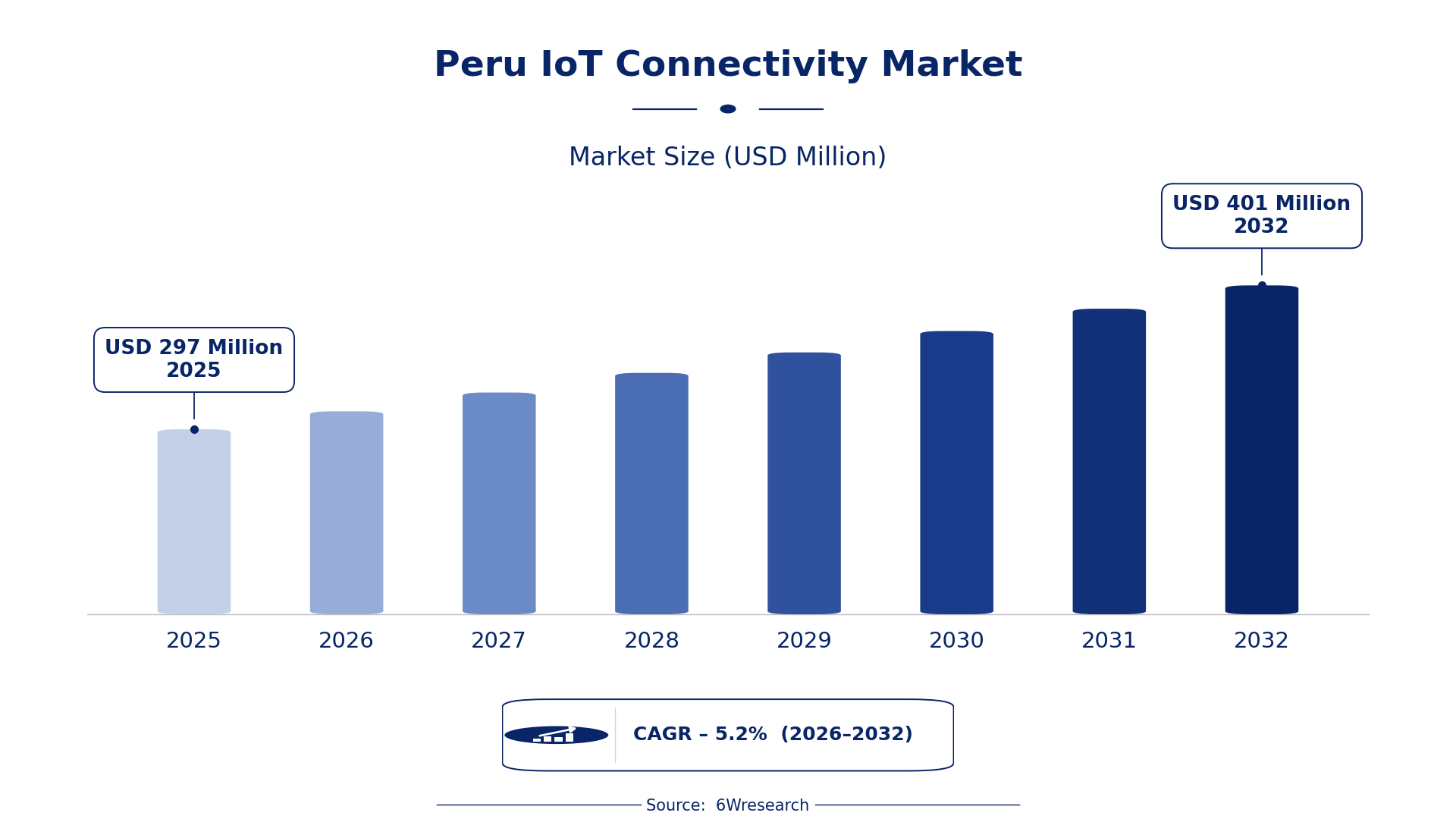
The Peru IoT Connectivity Market was estimated at USD 297 Million in 2025 and is projected to reach USD 401 Million by 2032, growing at a CAGR of 5.2% from 2026 to 2032.
Peru IoT Connectivity Market Synopsis
In recent years, the Peru IoT connectivity market has gained momentum, spurred by a surge in IoT device adoption across key sectors. This growth reflects a broader shift toward data-driven decision-making in industries such as agriculture and healthcare. As we look ahead, the market is set to expand further, driven by technological advancements and increased investment in infrastructure.
The future of the Peru IoT connectivity market is characterized by the emergence of innovative technologies, particularly the rollout of 5G networks. This will enhance connectivity, enabling real-time data monitoring and analytics. Businesses are recognizing the value of IoT solutions to optimize operations, resulting in a more competitive environment.
Peru IoT Connectivity Market Year-wise Growth Rate and Key Drivers
This graph illustrates the annual growth rates of the Peru IoT Connectivity Market from 2021 to 2032, highlighting a steady upward trajectory and projected expansion over the forecast period.
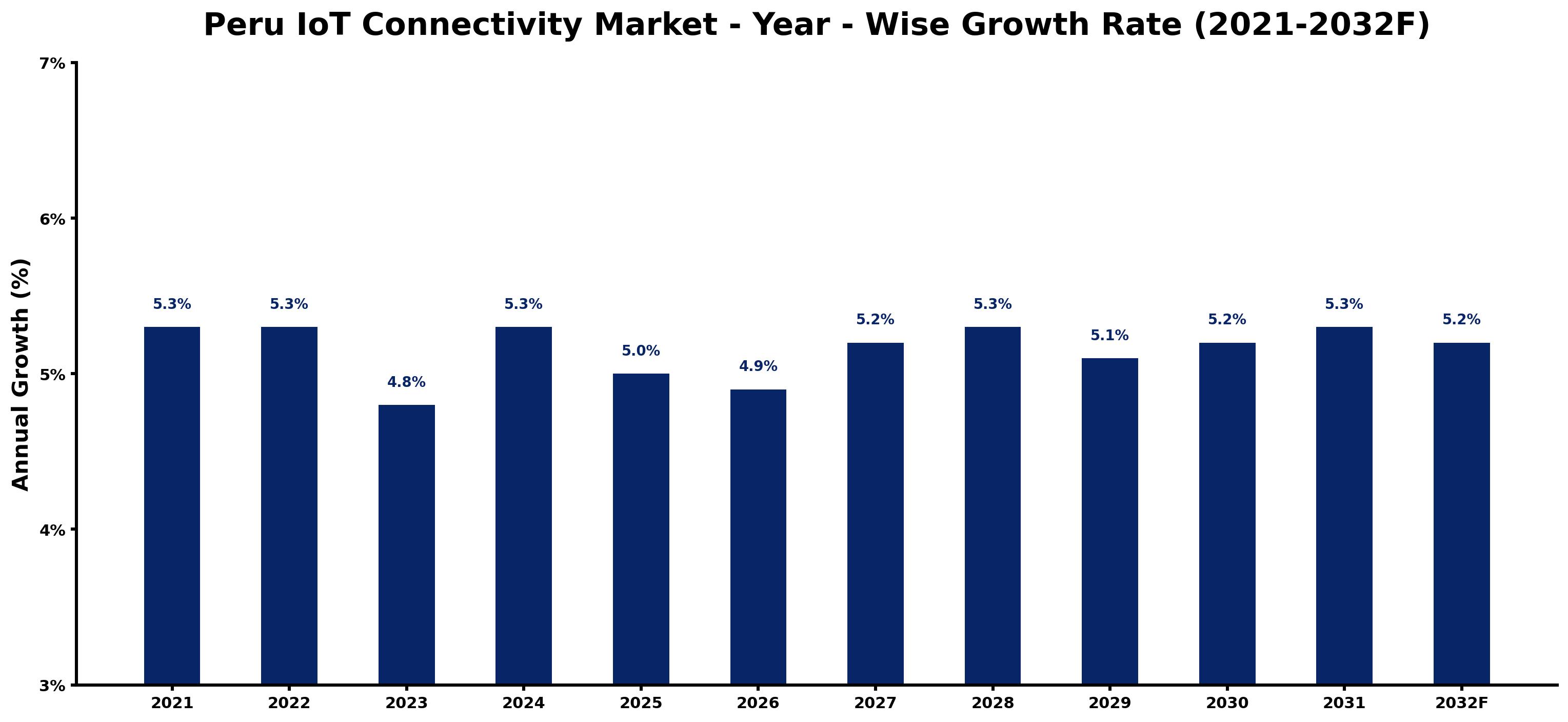
The table below presents the year‑wise growth rates along with the key drivers influencing the market
| Year | Growth Rate | Major Drivers |
| 2021 | 5.3% | Government backing for smart agriculture initiatives boosts connectivity. |
| 2022 | 5.3% | Launch of national IoT strategy by Ministerio de Transportes. |
| 2023 | 4.8% | Increased smartphone penetration enhances IoT device connectivity. |
| 2024 | 5.3% | Investment in broadband expansion supports IoT adoption. |
| 2025 | 5.0% | Growing retail sector demands enhanced customer experience via IoT. |
| 2026 | 4.9% | Telecom operators enhance 5G networks for IoT service provision. |
| 2027 | 5.2% | Rising urban population drives smart city IoT implementations. |
| 2028 | 5.3% | Surge in wearable technology fueling health monitoring IoT. |
| 2029 | 5.1% | Mining companies adopt IoT for operational optimization. |
| 2030 | 5.2% | Government incentives for smart energy solutions facilitate IoT growth. |
| 2031 | 5.3% | Increased focus on cybersecurity promotes IoT technology investments. |
| 2032 | 5.2% | E-commerce growth drives demand for IoT-enabled logistics solutions. |
Note: Market size estimations and growth projections presented in this report are based on 6Wresearch's proprietary forecasting methodology, utilizing the latest available industry data, government publications, and primary research inputs.
Peru IoT Connectivity Market Key Takeaways
Below are some of the specific key takeaways from the market, including:
- The increasing demand for real-time data analytics is driving IoT connectivity investments.
- Deployment of LPWAN technologies, such as LoRa and Sigfox, is gaining traction.
- Government initiatives are crucial in promoting digital transformation across sectors.
- 5G network implementation will significantly enhance IoT device performance.
- Interoperability challenges remain a focus for industry stakeholders as the market evolves.
Evaluation of Restraints in Peru IoT Connectivity Market
While the Peru IoT connectivity market shows promise, several real constraints limit its potential. One major issue is the uneven development of network infrastructure across various regions. Inadequate coverage can hinder IoT device connectivity, especially in rural areas where reliable data transmission is essential. on top of that, regulatory frameworks addressing data privacy and security are still in flux, leaving businesses uncertain about compliance. This lack of clarity can stifle innovation and slow down the adoption of IoT solutions.
Peru IoT Connectivity Market Trends
Several trends are shaping the Peru IoT connectivity market. Firstly, the rise of edge computing is fostering quicker data processing and reducing latency, which is vital for real-time applications. Additionally, as industries become more aware of the efficiency gains from IoT, there's a notable shift towards integrated solutions that combine hardware and software. This convergence is further supported by advancements in AI and machine learning, which enhance data analysis capabilities.
Peru IoT Connectivity Market Opportunities
The market presents several genuine growth opportunities, particularly for stakeholders willing to invest in infrastructure development. With the upcoming rollout of 5G networks, businesses can capitalize on enhanced connectivity to launch innovative IoT applications. on top of that, as the demand for smart agricultural solutions rises, there’s an avenue for companies to develop tailored IoT solutions that address local needs. The healthcare sector, too, offers substantial growth potential with increased demand for connected medical devices.
Government Initiatives in the Peru IoT Connectivity Market
The Peruvian government is actively shaping the IoT connectivity market through various initiatives aimed at fostering digital transformation. These efforts reflect a commitment to modernizing infrastructure and promoting the adoption of IoT solutions across different sectors. As regulatory frameworks evolve, they will play a critical role in ensuring secure and efficient IoT operations in the country.
- A National IoT Plan was launched in late 2023 to accelerate IoT technology adoption across agriculture, health, and transportation.
- The National IoT Observatory is currently operational, monitoring the development of IoT applications and services.
- Initiatives for smart city projects are underway, focusing on integrating IoT solutions to enhance urban management.
- A planned regulatory framework aimed at establishing IoT data privacy standards is expected to be introduced in 2026.
- Current efforts to improve internet infrastructure are focused on expanding connectivity in underserved regions.
Future Insights of the Peru IoT Connectivity Market
Looking ahead to 2026-2032, the Peru IoT connectivity market is expected to continue its upward trajectory, fueled by increasing awareness of IoT's benefits. As businesses increasingly recognize the need for efficient data management and operational improvements, the market will likely see a surge in investment. The government’s continued focus on digital infrastructure and strategic initiatives will further facilitate market growth, making it an attractive space for stakeholders.
Peru IoT Connectivity Market Latest Developments
Recent developments in the Peru IoT connectivity market indicate a strong push towards innovation and growth. Over the past year, various initiatives have emerged, reflecting the commitment of both the public and private sectors to enhance IoT capabilities in the country.
- A major telecom operator began rolling out LPWAN technology in Q1 2024 to improve connectivity for agricultural IoT applications.
- A technology vendor is currently developing a new IoT platform designed to streamline data analytics for healthcare providers.
- Smart city initiatives are gaining traction, with projects launched in early 2024 to enhance urban infrastructure using IoT solutions.
- A partnership was established in mid-2024 between industry players to promote standards for IoT device interoperability, addressing existing challenges.
- Upcoming investments in satellite-based IoT connectivity are expected to commence in late 2025 to enhance coverage in remote areas.
Peru IoT Connectivity Market - Key Attractiveness of the Report
- 10 Years of Market Numbers
- Historical Data Starting from 2022 to 2025
- Base Year: 2025
- Forecast Data until 2032
- Key Performance Indicators Impacting the Market
- Major Upcoming Developments and Projects
Key Highlights of the Report:
- Peru IoT Connectivity Market Outlook
- Market Size of Peru IoT Connectivity Market, 2025
- Forecast of Peru IoT Connectivity Market, 2032
- Historical Data and Forecast of Peru IoT Connectivity Revenues & Volume for the Period 2022-2032F
- Peru IoT Connectivity Market Trend Evolution
- Peru IoT Connectivity Market Drivers and Challenges
- Peru IoT Connectivity Price Trends
- Peru IoT Connectivity Porter's Five Forces
- Peru IoT Connectivity Industry Life Cycle
- Historical Data and Forecast of Peru IoT Connectivity Market Revenues & Volume By Component for the Period 2022-2032F
- Historical Data and Forecast of Peru IoT Connectivity Market Revenues & Volume By Platform for the Period 2022-2032F
- Historical Data and Forecast of Peru IoT Connectivity Market Revenues & Volume By Services for the Period 2022-2032F
- Historical Data and Forecast of Peru IoT Connectivity Market Revenues & Volume By Application Areas for the Period 2022-2032F
- Historical Data and Forecast of Peru IoT Connectivity Market Revenues & Volume By Building & Home Automation for the Period 2022-2032F
- Historical Data and Forecast of Peru IoT Connectivity Market Revenues & Volume By Smart Energy & Utility for the Period 2022-2032F
- Historical Data and Forecast of Peru IoT Connectivity Market Revenues & Volume By Smart Manufacturing for the Period 2022-2032F
- Historical Data and Forecast of Peru IoT Connectivity Market Revenues & Volume By Connected Health for the Period 2022-2032F
- Historical Data and Forecast of Peru IoT Connectivity Market Revenues & Volume By Smart Retail for the Period 2022-2032F
- Historical Data and Forecast of Peru IoT Connectivity Market Revenues & Volume By Smart Transportation for the Period 2022-2032F
- Historical Data and Forecast of Peru IoT Connectivity Market Revenues & Volume By Others (Education and Agriculture) for the Period 2022-2032F
- Historical Data and Forecast of Peru IoT Connectivity Market Revenues & Volume By Organization Size for the Period 2022-2032F
- Historical Data and Forecast of Peru IoT Connectivity Market Revenues & Volume By Large Enterprises for the Period 2022-2032F
- Historical Data and Forecast of Peru IoT Connectivity Market Revenues & Volume By SMEs for the Period 2022-2032F
- Peru IoT Connectivity Import Export Trade Statistics
- Market Opportunity Assessment By Component
- Market Opportunity Assessment By Application Areas
- Market Opportunity Assessment By Organization Size
- Peru IoT Connectivity Top Companies Market Share
- Peru IoT Connectivity Competitive Benchmarking By Technical and Operational Parameters
- Peru IoT Connectivity Company Profiles
- Peru IoT Connectivity Key Strategic Recommendations






































