Colombia Mass Spectrometry Market Size, Share & Growth Rate
The Colombia Mass Spectrometry Market was estimated at USD 369 Million in 2025 and is projected to reach USD 492 Million by 2032, growing at a CAGR of 4.2% from 2026 to 2032. This growth trajectory is primarily fueled by a surge in research and development activities across the pharmaceutical and biotechnology sectors. In addition, the increasing application of mass spectrometry in environmental testing and food safety is significantly boosting market demand, indicating a robust outlook for future investments.
Colombia Mass Spectrometry Market Year-wise Growth Rate and Key Drivers
This graph highlights how the Colombia Mass Spectrometry Market has steadily grown over the years, supported by major growth factors.
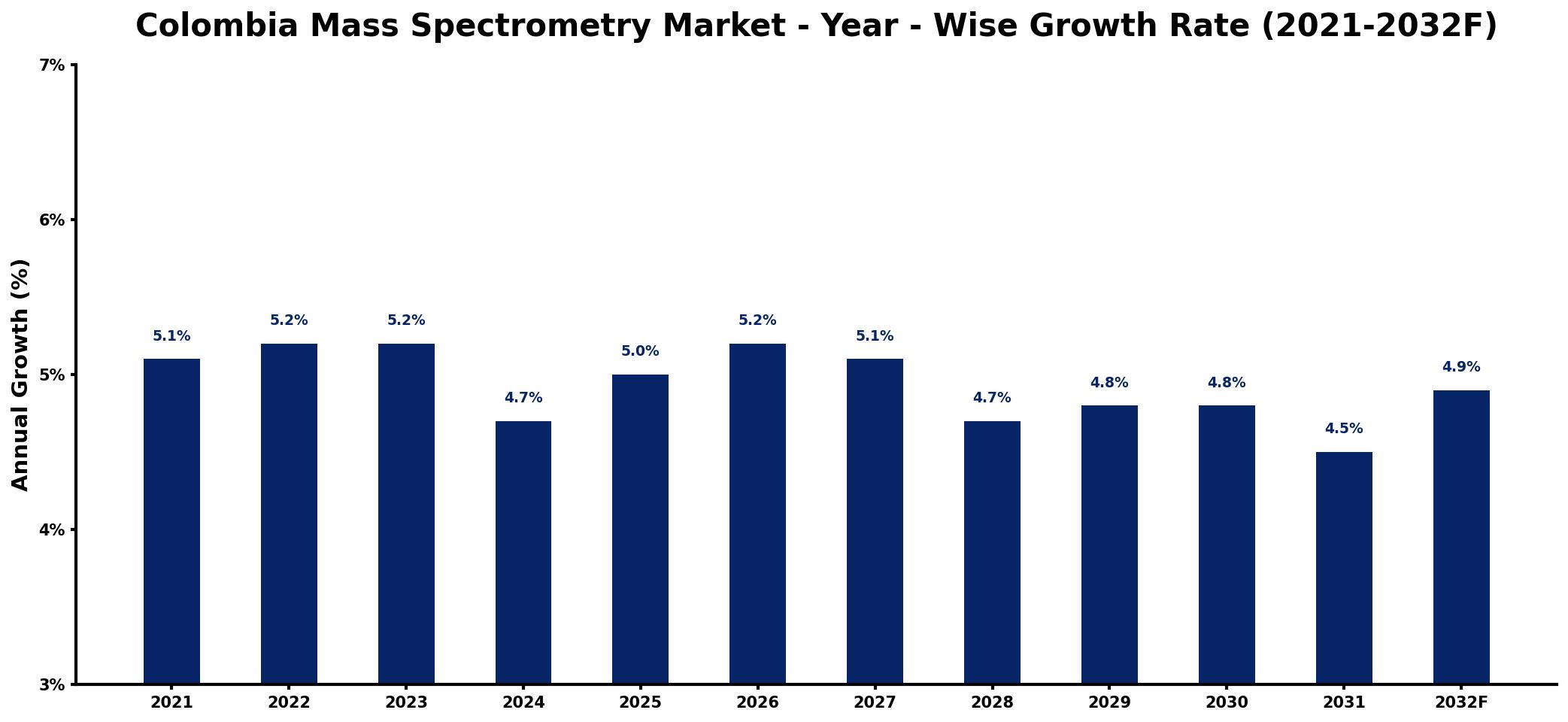
The table below presents the year‑wise growth rates along with the key drivers influencing the market
| Year | Growth Rate | Major Drivers |
| 2021 | 5.1% | Increased research funding initiatives |
| 2022 | 5.2% | Growing pharmaceutical development activities |
| 2023 | 5.2% | Expansion in clinical testing services |
| 2024 | 4.7% | Rising environmental monitoring needs |
| 2025 | 5.0% | Surge in food safety regulations |
| 2026 | 5.2% | Advancements in analytical technologies |
| 2027 | 5.1% | Growth in academic research collaborations |
| 2028 | 4.7% | Increased investments in biotechnology |
| 2029 | 4.8% | Emerging applications in proteomics |
| 2030 | 4.8% | Enhanced quality control standards |
| 2031 | 4.5% | Rising awareness of health diagnostics |
| 2032 | 4.9% | Strengthened regulatory compliance requirements |
Note: Market size estimations and growth projections presented in this report are based on 6Wresearch's proprietary forecasting methodology, utilizing the latest available industry data, government publications, and primary research inputs.
Colombia Mass Spectrometry Market Synopsis
In recent years, the Colombia Mass Spectrometry Market has gained momentum, propelled by technological advancements and heightened awareness regarding the importance of precise analytical tools. As we move forward, the market is poised for sustained expansion, with emerging sectors such as personalized healthcare and clinical diagnostics driving demand.
With governmental support for technological development, the landscape is becoming increasingly competitive, characterized by a push for innovation and improved instrumentation. As pharmaceutical and biotechnology research continues to thrive, mass spectrometry's role in ensuring quality and efficiency will become ever more critical.
Colombia Mass Spectrometry Market Key Takeaways
- Strong growth driven by pharmaceutical and biotechnology R&D investments.
- Increased adoption in environmental testing and food safety applications.
- Emerging trends toward portable mass spectrometry systems for point-of-care testing.
- Government initiatives are fostering innovation and collaboration in the sector.
- Potential for expansion in clinical diagnostics and proteomics research.
Evaluation of Restraints in Colombia Mass Spectrometry Market
Despite promising growth prospects, several factors are inhibiting the mass spectrometry market in Colombia. High initial costs associated with purchasing and maintaining sophisticated mass spectrometry equipment remain a significant barrier for many potential users. Furthermore, the complexity of the technology necessitates skilled personnel for operation and data interpretation, which is in short supply in the region. Regulatory challenges concerning the importation of certain mass spectrometry technologies add another layer of complexity that could stymie growth if not addressed properly. As the market evolves, addressing these constraints will be crucial for unlocking its full potential.
Colombia Mass Spectrometry Market Trends
A notable trend within the Colombia Mass Spectrometry Market is the increasing adoption of high-resolution and tandem mass spectrometry technologies. These advancements allow for the precise analysis of intricate biological samples, which is essential for drug discovery and metabolomics. Moreover, there is a growing shift towards compact and portable systems that enable on-site testing, catering to the need for more accessible analytical tools. The emphasis on product innovation and strategic partnerships among market players is further shaping the competitive landscape.
Colombia Mass Spectrometry Market Opportunities
The Colombia Mass Spectrometry Market is ripe with investment opportunities, especially in sectors like pharmaceuticals, biotechnology, and environmental testing. The rising need for advanced analytical solutions in food safety and clinical diagnostics positions investors favorably to capitalize on this momentum. Additionally, the governments push for research and development funding offers promising avenues for collaboration and growth, making this an attractive market for those in the industry.
Government Initiatives in the Colombia Mass Spectrometry Market
The Colombian government plays a pivotal role in fostering the growth of the mass spectrometry market. Initiatives include funding for research and development, tax incentives for companies embracing innovative technologies, and encouragement for partnerships between academia and industry. These policies are designed to enhance the capabilities and competitiveness of the market, ultimately driving technological adoption and facilitating advancements in analytical instrumentation.
Future Insights of the Colombia Mass Spectrometry Market
Looking ahead to 2026-2032, the Colombia Mass Spectrometry Market is set for notable advancements. With increasing investments in research initiatives and the exploration of new applications, the demand for advanced analytical technologies is expected to rise significantly. Moreover, advancements in mass spectrometry capabilities—such as improved sensitivity, resolution, and automation—will likely provide substantial growth opportunities. The overall regulatory environment is favorable, further paving the way for market players to explore emerging opportunities in this vital sector.
Colombia Mass Spectrometry Market Latest Developments (2025 - 2026)
In the recent months leading up to mid-2026, there has been a noticeable increase in collaborations between research institutions and technology providers aimed at enhancing mass spectrometry applications. This period has also seen innovative product launches focused on improving the accuracy and efficiency of analytical processes. Moreover, ongoing discussions regarding regulatory frameworks are likely to streamline the introduction of new technologies, further enriching the market landscape.
Colombia Mass Spectrometry Market - Key Attractiveness of the Report
- 10 Years of Market Numbers
- Historical Data Starting from 2022 to 2025
- Base Year: 2025
- Forecast Data until 2032
- Key Performance Indicators Impacting the Market
- Major Upcoming Developments and Projects
Key Highlights of the Report:
- Colombia Mass Spectrometry Market Outlook
- Market Size of Colombia Mass Spectrometry Market, 2025
- Forecast of Colombia Mass Spectrometry Market, 2032
- Historical Data and Forecast of Colombia Mass Spectrometry Revenues & Volume for the Period 2022-2032F
- Colombia Mass Spectrometry Market Trend Evolution
- Colombia Mass Spectrometry Market Drivers and Challenges
- Colombia Mass Spectrometry Price Trends
- Colombia Mass Spectrometry Porter's Five Forces
- Colombia Mass Spectrometry Industry Life Cycle
- Historical Data and Forecast of Colombia Mass Spectrometry Market Revenues & Volume By Technology for the Period 2022-2032F
- Historical Data and Forecast of Colombia Mass Spectrometry Market Revenues & Volume By Hybrid Mass Spectrometry for the Period 2022-2032F
- Historical Data and Forecast of Colombia Mass Spectrometry Market Revenues & Volume By Single Mass Spectrometry for the Period 2022-2032F
- Historical Data and Forecast of Colombia Mass Spectrometry Market Revenues & Volume By Application for the Period 2022-2032F
- Historical Data and Forecast of Colombia Mass Spectrometry Market Revenues & Volume By Pharmaceutical for the Period 2022-2032F
- Historical Data and Forecast of Colombia Mass Spectrometry Market Revenues & Volume By Biotechnology for the Period 2022-2032F
- Historical Data and Forecast of Colombia Mass Spectrometry Market Revenues & Volume By Security for the Period 2022-2032F
- Historical Data and Forecast of Colombia Mass Spectrometry Market Revenues & Volume By Industrial chemistry for the Period 2022-2032F
- Historical Data and Forecast of Colombia Mass Spectrometry Market Revenues & Volume By Environmental testing for the Period 2022-2032F
- Historical Data and Forecast of Colombia Mass Spectrometry Market Revenues & Volume By Food & beverage testing for the Period 2022-2032F
- Historical Data and Forecast of Colombia Mass Spectrometry Market Revenues & Volume By Forensic for the Period 2022-2032F
- Historical Data and Forecast of Colombia Mass Spectrometry Market Revenues & Volume By Clinical for the Period 2022-2032F
- Colombia Mass Spectrometry Import Export Trade Statistics
- Market Opportunity Assessment By Technology
- Market Opportunity Assessment By Application
- Colombia Mass Spectrometry Top Companies Market Share
- Colombia Mass Spectrometry Competitive Benchmarking By Technical and Operational Parameters
- Colombia Mass Spectrometry Company Profiles
- Colombia Mass Spectrometry Key Strategic Recommendations






































