Colombia Medicinal Herbs Market: Top 5 Importing Countries and Market Competition (HHI) Analysis
Colombia continues to see a steady rise in the import of medicinal herbs, with key suppliers in 2024 being Peru, Egypt, Paraguay, USA, and Spain. The market shows moderate concentration, fostering healthy competition among suppliers. The compound annual growth rate (CAGR) from 2020 to 2024 stands at an impressive 10.43%, indicating a robust market expansion. Notably, the growth rate spiked to 41.23% from 2023 to 2024, further illustrating the increasing demand for medicinal herbs in Colombia. This trend suggests a promising outlook for the medicinal herbs import market in the country.
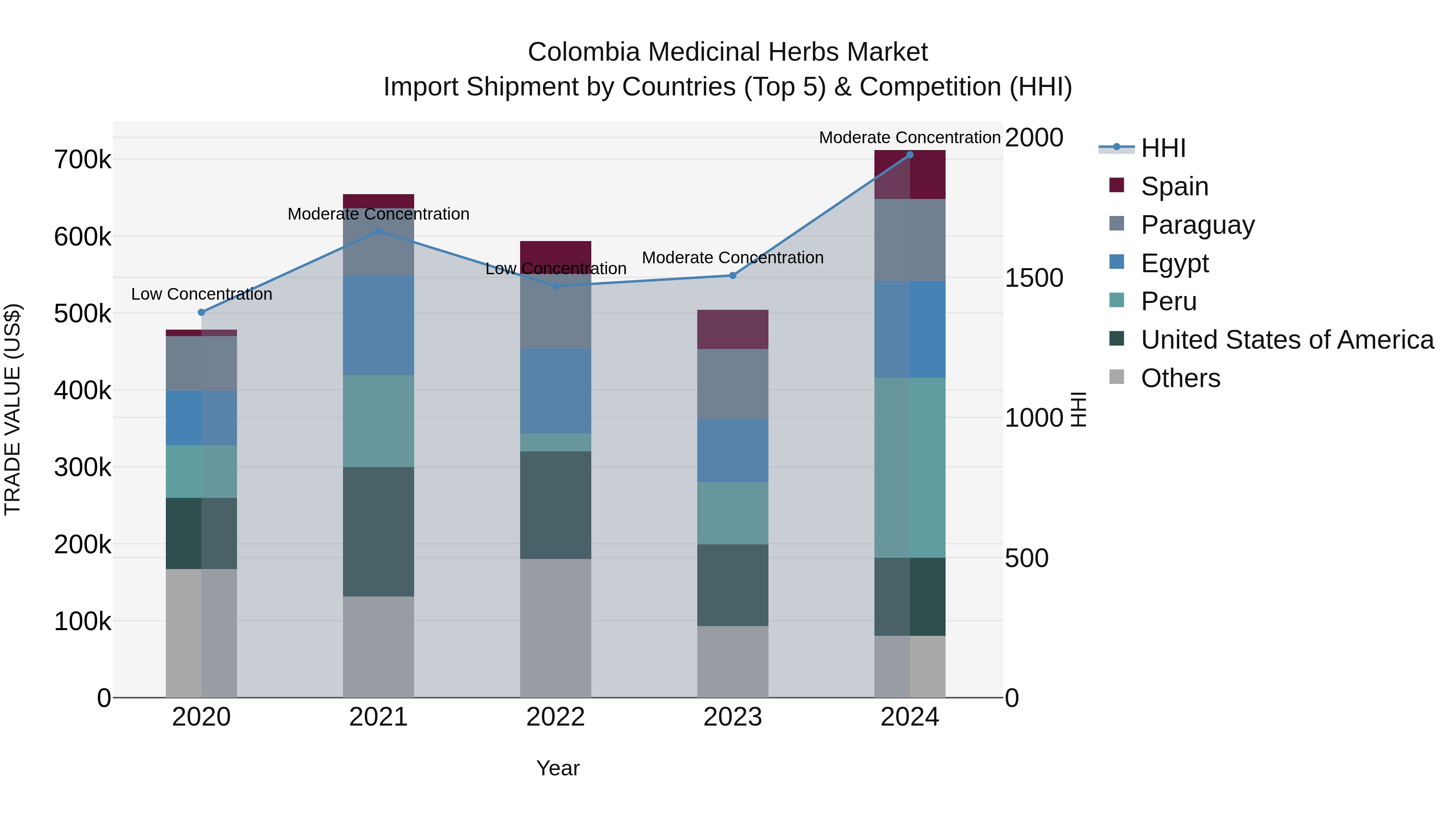
Colombia Medicinal Herbs Market Overview
The Colombia Medicinal Herbs Market is experiencing significant growth driven by increasing consumer awareness of the benefits of herbal remedies and a growing demand for natural healthcare products. The market is characterized by a wide variety of indigenous plants and herbs with medicinal properties, such as coca leaves, guava leaves, and soursop. Key factors contributing to market growth include the rise in chronic diseases, a shift towards preventive healthcare practices, and a preference for organic and sustainable products. The market is also benefiting from government initiatives promoting the cultivation and use of medicinal herbs. However, challenges such as lack of standardization, limited research, and regulatory issues pose potential barriers to market expansion. Overall, the Colombia Medicinal Herbs Market presents opportunities for local producers and international companies looking to capitalize on the growing trend towards natural health remedies.
Colombia Medicinal Herbs Market Trends
Currently, the Colombia Medicinal Herbs Market is experiencing a surge in demand driven by growing consumer interest in natural and alternative healthcare options. There is a notable increase in the use of traditional medicinal herbs such as aloe vera, chamomile, and coca leaf, as well as a growing awareness of the health benefits associated with these herbs. The market is also witnessing a rise in the cultivation of medicinal herbs due to favorable climatic conditions in Colombia, leading to an increase in domestic production. Moreover, there is a growing trend towards sustainable and organic practices in herb cultivation, catering to the preferences of environmentally conscious consumers. Overall, the Colombia Medicinal Herbs Market is poised for continued growth as consumers seek out natural remedies and wellness products.
Colombia Medicinal Herbs Market Challenges
In the Colombia Medicinal Herbs Market, some key challenges include regulatory hurdles related to licensing and certification processes, quality control issues, limited access to financing for small-scale herb producers, competition from larger companies, and the need for more research and development to establish the efficacy and safety of medicinal herbs. Additionally, the lack of standardized production practices and market fragmentation can make it difficult for consumers to trust the quality and consistency of herbal products. Addressing these challenges would require collaboration between government agencies, industry stakeholders, and research institutions to streamline regulations, improve infrastructure, provide training and resources to small producers, and promote consumer education and awareness about the benefits of medicinal herbs.
Colombia Medicinal Herbs Market Investment Opportunities
Investment opportunities in the Colombia Medicinal Herbs Market are abundant due to the country`s rich biodiversity and growing global demand for natural health products. Investors can consider opportunities in cultivating, processing, and exporting medicinal herbs such as coca leaves, guayusa, and sacha inchi. With Colombia`s favorable climate and diverse ecosystems, there is potential for sustainable cultivation practices and high-quality production. Additionally, the increasing consumer interest in natural remedies and wellness products presents a promising market for medicinal herbs. Investing in research and development to explore new medicinal plant species and innovative product formulations can also create competitive advantages in the market. Overall, the Colombia Medicinal Herbs Market offers investors the chance to participate in a growing industry with strong export potential and opportunities for value-added products.
Colombia Medicinal Herbs Market Government Policy
In Colombia, the government has implemented various policies to regulate the Medicinal Herbs Market. The country`s Ministry of Health oversees the cultivation, production, and commercialization of medicinal herbs, ensuring compliance with quality and safety standards. The government has also established guidelines for the registration and licensing of herbal products to guarantee their effectiveness and safety for consumers. Additionally, Colombia has implemented initiatives to promote research and development in the medicinal herbs sector, aiming to enhance innovation and competitiveness in the industry. Overall, these policies aim to ensure the sustainable growth of the Medicinal Herbs Market in Colombia while safeguarding public health and consumer interests.
Colombia Medicinal Herbs Market Future Outlook
The future outlook for the Colombia Medicinal Herbs Market appears promising, driven by increasing consumer awareness regarding the benefits of natural remedies and a growing demand for alternative healthcare solutions. The market is expected to witness steady growth due to a rise in health-conscious individuals seeking herbal products for various health conditions. Additionally, the government`s support for the cultivation and export of medicinal herbs is likely to boost the market further. With a rich biodiversity and favorable climate for herb cultivation, Colombia is well-positioned to become a key player in the global medicinal herbs market. Market players can capitalize on this trend by expanding their product offerings, investing in research and development, and leveraging sustainable practices to meet the growing demand for high-quality medicinal herbs.
Key Highlights of the Report:
- Colombia Medicinal Herbs Market Outlook
- Market Size of Colombia Medicinal Herbs Market, 2024
- Forecast of Colombia Medicinal Herbs Market, 2031
- Historical Data and Forecast of Colombia Medicinal Herbs Revenues & Volume for the Period 2021 - 2031
- Colombia Medicinal Herbs Market Trend Evolution
- Colombia Medicinal Herbs Market Drivers and Challenges
- Colombia Medicinal Herbs Price Trends
- Colombia Medicinal Herbs Porter's Five Forces
- Colombia Medicinal Herbs Industry Life Cycle
- Historical Data and Forecast of Colombia Medicinal Herbs Market Revenues & Volume By Type for the Period 2021 - 2031
- Historical Data and Forecast of Colombia Medicinal Herbs Market Revenues & Volume By Horsetail for the Period 2021 - 2031
- Historical Data and Forecast of Colombia Medicinal Herbs Market Revenues & Volume By Dandelion for the Period 2021 - 2031
- Historical Data and Forecast of Colombia Medicinal Herbs Market Revenues & Volume By Echinacea for the Period 2021 - 2031
- Historical Data and Forecast of Colombia Medicinal Herbs Market Revenues & Volume By Valerian for the Period 2021 - 2031
- Historical Data and Forecast of Colombia Medicinal Herbs Market Revenues & Volume By St. John??s Wort for the Period 2021 - 2031
- Historical Data and Forecast of Colombia Medicinal Herbs Market Revenues & Volume By Lemon Balm for the Period 2021 - 2031
- Historical Data and Forecast of Colombia Medicinal Herbs Market Revenues & Volume By Yarrow for the Period 2021 - 2031
- Historical Data and Forecast of Colombia Horsetail Medicinal Herbs Market Revenues & Volume By Calendula for the Period 2021 - 2031
- Historical Data and Forecast of Colombia Medicinal Herbs Market Revenues & Volume By Nature for the Period 2021 - 2031
- Historical Data and Forecast of Colombia Medicinal Herbs Market Revenues & Volume By Organic for the Period 2021 - 2031
- Historical Data and Forecast of Colombia Medicinal Herbs Market Revenues & Volume By Conventional for the Period 2021 - 2031
- Historical Data and Forecast of Colombia Medicinal Herbs Market Revenues & Volume By Form for the Period 2021 - 2031
- Historical Data and Forecast of Colombia Medicinal Herbs Market Revenues & Volume By Whole for the Period 2021 - 2031
- Historical Data and Forecast of Colombia Medicinal Herbs Market Revenues & Volume By Powder for the Period 2021 - 2031
- Historical Data and Forecast of Colombia Medicinal Herbs Market Revenues & Volume By Liquid for the Period 2021 - 2031
- Historical Data and Forecast of Colombia Medicinal Herbs Market Revenues & Volume By End-Use for the Period 2021 - 2031
- Historical Data and Forecast of Colombia Medicinal Herbs Market Revenues & Volume By Medicinal Tea for the Period 2021 - 2031
- Historical Data and Forecast of Colombia Medicinal Herbs Market Revenues & Volume By Health Supplement for the Period 2021 - 2031
- Historical Data and Forecast of Colombia Medicinal Herbs Market Revenues & Volume By Nutritive Jams for the Period 2021 - 2031
- Historical Data and Forecast of Colombia Medicinal Herbs Market Revenues & Volume By Herbal Medicines for the Period 2021 - 2031
- Historical Data and Forecast of Colombia Medicinal Herbs Market Revenues & Volume By Cosmeceuticals for the Period 2021 - 2031
- Historical Data and Forecast of Colombia Medicinal Herbs Market Revenues & Volume By Other Uses for the Period 2021 - 2031
- Colombia Medicinal Herbs Import Export Trade Statistics
- Market Opportunity Assessment By Type
- Market Opportunity Assessment By Nature
- Market Opportunity Assessment By Form
- Market Opportunity Assessment By End-Use
- Colombia Medicinal Herbs Top Companies Market Share
- Colombia Medicinal Herbs Competitive Benchmarking By Technical and Operational Parameters
- Colombia Medicinal Herbs Company Profiles
- Colombia Medicinal Herbs Key Strategic Recommendations






































