Colombia Organic Food Market Size, Share & Growth Rate
The Colombia Organic Food Market was estimated at USD 226 Million in 2025 and is projected to reach USD 307 Million by 2032, growing at a CAGR of 4.5% from 2026 to 2032. This trajectory is underpinned by a growing middle-class population that increasingly prioritizes health and wellness, alongside government initiatives that promote organic farming and sustainable practices. As consumers shift towards healthier choices, the demand for organic products is expected to intensify, driving market expansion.
Colombia Organic Food Market Year-wise Growth Rate and Key Drivers
This graph highlights how the Colombia Organic Food Market has steadily grown over the years, supported by major growth factors.
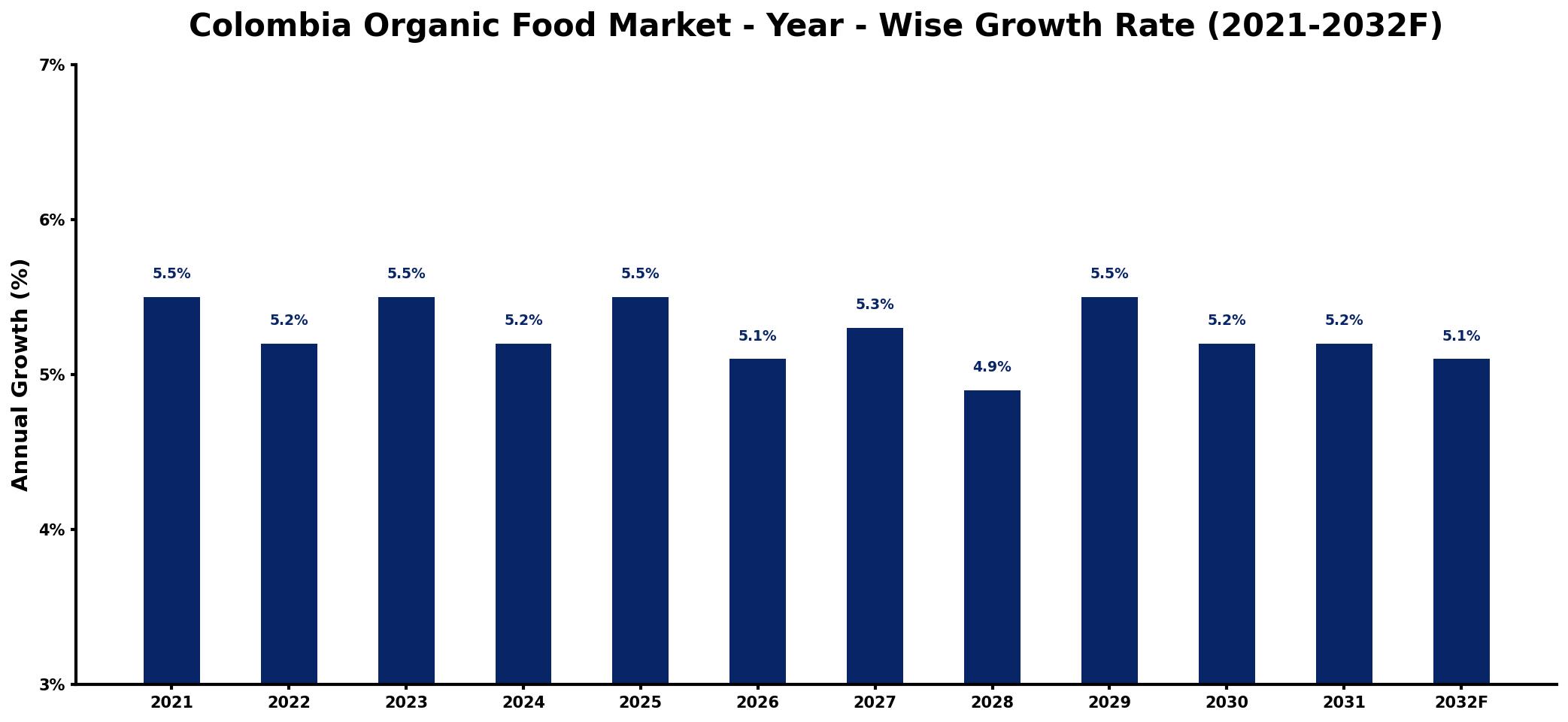
The table below presents the year‑wise growth rates along with the key drivers influencing the market
| Year | Growth Rate | Major Drivers |
| 2021 | 5.5% | Rising consumer health consciousness |
| 2022 | 5.2% | Increased investment in agriculture |
| 2023 | 5.5% | Growing popularity of sustainability |
| 2024 | 5.2% | Expansion of retail distribution channels |
| 2025 | 5.5% | Surge in online shopping trends |
| 2026 | 5.1% | Development of local farming initiatives |
| 2027 | 5.3% | Heightened awareness of nutrition benefits |
| 2028 | 4.9% | Emergence of eco-friendly packaging solutions |
| 2029 | 5.5% | Strengthening of certification programs |
| 2030 | 5.2% | Boost in community supported agriculture |
| 2031 | 5.2% | Enhanced educational campaigns on benefits |
| 2032 | 5.1% | Supportive government policies for agriculture |
Note: Market size estimations and growth projections presented in this report are based on 6Wresearch's proprietary forecasting methodology, utilizing the latest available industry data, government publications, and primary research inputs.
Colombia Organic Food Market Synopsis
The Colombian organic food market is witnessing significant momentum, fueled by rising awareness of health and environmental benefits among consumers. While the market has been growing steadily, the potential for future expansion remains robust as more people embrace organic lifestyles.
Currently, a diverse range of organic offerings—including fruits, vegetables, dairy, and meat—are contributing to market dynamics. With a mix of domestic production and imports, the competitive landscape is evolving as local producers enhance their organic portfolios to meet rising consumer expectations.
Colombia Organic Food Market Key Takeaways
- The market is projected to grow from USD 226 Million in 2025 to USD 307 Million by 2032.
- Government initiatives support organic farming practices, enhancing production capabilities.
- Both domestic and international players are focusing on quality, certification, and sustainability.
- E-commerce platforms and specialized organic stores are becoming increasingly popular among consumers.
- Consumer awareness of health benefits is driving the demand for organic food options.
Evaluation of Restraints in Colombia Organic Food Market
Despite the favorable growth trajectory, the Colombia organic food market faces notable restraints that hinder its full potential. Limited consumer awareness regarding the benefits of organic products still prevails, leading to a smaller market size compared to conventional food alternatives. Additionally, the organic certification process is often complex and costly, posing challenges for small-scale farmers looking to transition to organic practices. Coupled with logistical difficulties in distribution and storage, these factors create barriers to widespread accessibility and affordability of organic options.
Colombia Organic Food Market Trends
A key trend shaping the Colombia Organic Food Market is the growing consumer emphasis on health and sustainability. This shift is reflected in the rising demand for organic fruits, vegetables, dairy, and meat products. Moreover, the adoption of e-commerce platforms is revolutionizing the way consumers access organic goods, allowing for greater convenience and variety. Emerging technologies in organic farming are also enhancing productivity and sustainability, driving further interest in organic practices.
Colombia Organic Food Market Opportunities
Significant investment opportunities are available within the Colombia Organic Food Market as demand for healthy and sustainable food products rises. Investors can support local organic farmers or participate in the organic food retail chain to capitalize on market growth. Moreover, government incentives for transitioning to organic agriculture provide an encouraging framework for those looking to invest in this sector. The emphasis on ethical consumption positions the market as ripe for innovation and expansion.
Government Initiatives in the Colombia Organic Food Market
The Colombian government has been proactive in fostering the growth of the organic food sector through several policies and initiatives. The National Development Plan for Organic Agriculture is a cornerstone program aimed at promoting sustainable practices and increasing organic production. The Ministry of Agriculture and Rural Development supports organic farmers with training, technical assistance, and financial incentives, enhancing both competitiveness and sustainability. These initiatives are crucial for bolstering the organic sector's viability on both domestic and international stages.
Future Insights of the Colombia Organic Food Market
Looking ahead to 2026-2032, the Colombia Organic Food Market is poised for continued growth as consumer preferences shift towards health-conscious and environmentally sustainable choices. Rising disposable incomes are likely to further fuel demand for organic products. The government's ongoing support for organic farming, combined with the expanding retail infrastructure and e-commerce platforms, presents a favorable environment for producers and retailers alike. Consequently, the market is set to evolve, offering exciting opportunities for innovation and market entry.
Colombia Organic Food Market Latest Developments (2025 - 2026)
Recent developments in the Colombia Organic Food Market indicate a growing emphasis on sustainability and transparency. Industry players are focusing on enhancing supply chain practices to ensure the authenticity and quality of organic products. Moreover, there has been an uptick in collaboration between local farmers and e-commerce platforms, aiming to increase the accessibility of organic goods to a broader consumer base. These trends highlight the market's responsive nature to consumer demands for healthier food options.
Colombia Organic Food Market - Key Attractiveness of the Report
- 10 Years of Market Numbers
- Historical Data Starting from 2022 to 2025
- Base Year: 2025
- Forecast Data until 2032
- Key Performance Indicators Impacting the Market
- Major Upcoming Developments and Projects
Key Highlights of the Report:
- Colombia Organic Food Market Outlook
- Market Size of Colombia Organic Food Market, 2025
- Forecast of Colombia Organic Food Market, 2032
- Historical Data and Forecast of Colombia Organic Food Revenues & Volume for the Period 2022-2032F
- Colombia Organic Food Market Trend Evolution
- Colombia Organic Food Market Drivers and Challenges
- Colombia Organic Food Price Trends
- Colombia Organic Food Porter's Five Forces
- Colombia Organic Food Industry Life Cycle
- Historical Data and Forecast of Colombia Organic Food Market Revenues & Volume By Food Type for the Period 2022-2032F
- Historical Data and Forecast of Colombia Organic Food Market Revenues & Volume By Fruit & Vegetables for the Period 2022-2032F
- Historical Data and Forecast of Colombia Organic Food Market Revenues & Volume By Meat for the Period 2022-2032F
- Historical Data and Forecast of Colombia Organic Food Market Revenues & Volume By Fish & Poultry for the Period 2022-2032F
- Historical Data and Forecast of Colombia Organic Food Market Revenues & Volume By Dairy Products for the Period 2022-2032F
- Historical Data and Forecast of Colombia Organic Food Market Revenues & Volume By Frozen & Processed Foods for the Period 2022-2032F
- Historical Data and Forecast of Colombia Organic Food Market Revenues & Volume By Others for the Period 2022-2032F
- Historical Data and Forecast of Colombia Organic Food Market Revenues & Volume By Application for the Period 2022-2032F
- Historical Data and Forecast of Colombia Organic Food Market Revenues & Volume By Commercial for the Period 2022-2032F
- Historical Data and Forecast of Colombia Organic Food Market Revenues & Volume By Cosmetics & Personal Care for the Period 2022-2032F
- Historical Data and Forecast of Colombia Organic Food Market Revenues & Volume By Households for the Period 2022-2032F
- Historical Data and Forecast of Colombia Organic Food Market Revenues & Volume By Others for the Period 2022-2032F
- Colombia Organic Food Import Export Trade Statistics
- Market Opportunity Assessment By Food Type
- Market Opportunity Assessment By Application
- Colombia Organic Food Top Companies Market Share
- Colombia Organic Food Competitive Benchmarking By Technical and Operational Parameters
- Colombia Organic Food Company Profiles
- Colombia Organic Food Key Strategic Recommendations






































