Colombia Perchloroethylene Market Size, Share & Growth Rate
The Colombia Perchloroethylene Market was estimated at USD 435 Million in 2025 and is projected to reach USD 619 Million by 2032, growing at a CAGR of 5.2% from 2026 to 2032. This growth trajectory is primarily fueled by the rising demand from the textile and dry cleaning sectors, which are essential for the nations economic landscape. Furthermore, increasing awareness regarding environmental sustainability is prompting a shift towards the adoption of PCE as a more eco-friendly cleaning solution.
Colombia Perchloroethylene Market Year-wise Growth Rate and Key Drivers
This graph highlights how the Colombia Perchloroethylene Market has steadily grown over the years, supported by major growth factors.
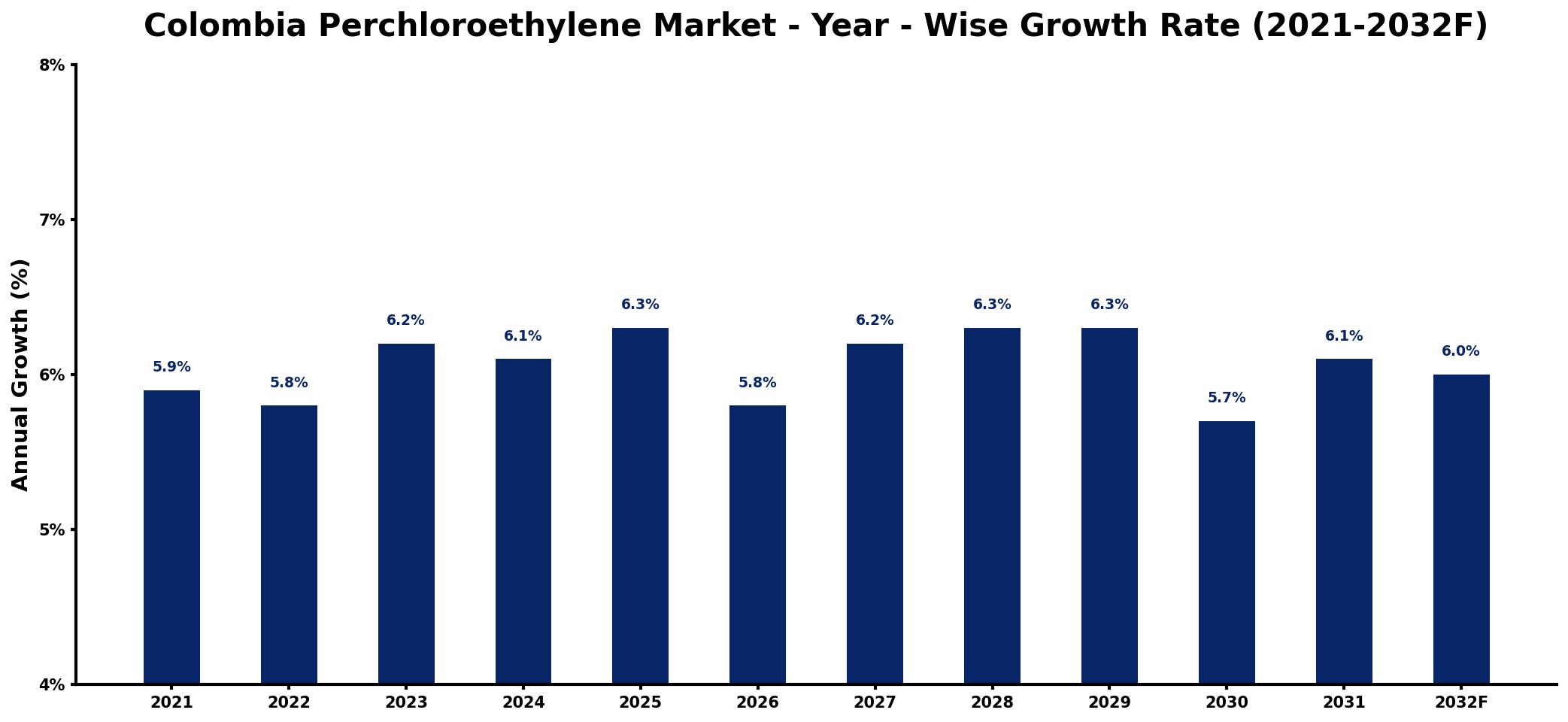
The table below presents the year‑wise growth rates along with the key drivers influencing the market
| Year | Growth Rate | Major Drivers |
| 2021 | 5.9% | Increased demand from dry cleaning |
| 2022 | 5.8% | Growth in textile manufacturing sector |
| 2023 | 6.2% | Expansion of automotive repair services |
| 2024 | 6.1% | Rising investments in industrial cleaning |
| 2025 | 6.3% | Boost in chemical processing industries |
| 2026 | 5.8% | Increased usage in electronics cleaning |
| 2027 | 6.2% | enhanced product quality standards |
| 2028 | 6.3% | expanding healthcare application demand |
| 2029 | 6.3% | Rising demand from healthcare applications |
| 2030 | 5.7% | Stabilization in manufacturing investments |
| 2031 | 6.1% | Increased focus on environmental regulations |
| 2032 | 6.0% | increased pharmaceutical industry usage |
Note: Market size estimations and growth projections presented in this report are based on 6Wresearch's proprietary forecasting methodology, utilizing the latest available industry data, government publications, and primary research inputs.
Colombia Perchloroethylene Market Synopsis
In Colombia, the textile industry represents one of the largest consumers of perchloroethylene, leveraging its superior stain removal properties to maintain fabric quality. Additionally, the dry cleaning sector is adopting PCE more widely as stringent regulations encourage cleaner and safer operational practices.
As industries increasingly prioritize effective cleaning solutions, the push for compliance with environmental regulations is driving innovations in the market. Manufacturers are keenly focused on developing PCE formulations that minimize environmental impact while maximizing cleaning efficiency.
Colombia Perchloroethylene Market Key Takeaways
- The market is primarily driven by robust demand from textiles, dry cleaning, and metal degreasing sectors.
- Stringent environmental regulations are shaping product formulations and operational practices.
- Innovation is essential, as manufacturers focus on sustainability and eco-friendly alternatives.
- Investment opportunities abound in production and distribution, spurred by industry growth.
- The government is actively regulating PCE usage to protect health and the environment.
Evaluation of Restraints in Colombia Perchloroethylene Market
Despite the promising growth prospects, the Colombia Perchloroethylene Market faces significant restraints stemming from increasing environmental regulations. These restrictions impact the manufacturing and use of PCE due to its potential adverse effects on human health and the environment. Moreover, competition from alternative eco-friendly cleaning solutions poses a challenge for traditional PCE applications. Fluctuating raw material prices and currency exchange rates further contribute to profitability pressures for stakeholders in this market, necessitating adaptive strategies and innovative practices.
Colombia Perchloroethylene Market Trends
Emerging trends in the Colombia Perchloroethylene Market include a marked shift towards sustainable cleaning technologies. Companies are increasingly integrating advanced equipment to improve efficiency while simultaneously reducing their ecological footprint. Furthermore, the growing consumer demand for environmentally responsible products is prompting businesses to adopt PCE formulations that align with these preferences. The trend toward digital transformation within operational processes is also noticeable, enhancing efficiency and regulatory compliance.
Colombia Perchloroethylene Market Opportunities
The Colombia Perchloroethylene Market offers significant investment opportunities, particularly as the countrys textile and dry cleaning industries continue to thrive. Investors can capitalize on the rising demand for PCE within professional cleaning sectors, especially as companies look for effective and compliant cleaning solutions. Additionally, advancements in technology present avenues for creating innovative, sustainable products that address both consumer needs and regulatory standards, making this market a compelling prospect for long-term investment.
Government Initiatives in the Colombia Perchloroethylene Market
The Colombian government has enacted several regulations aimed at managing the use and emissions of perchloroethylene within the market. The Ministry of Environment and Sustainable Development has established permissible limits to safeguard both human health and environmental integrity. Businesses are required to secure permits for PCE usage and comply with strict monitoring and reporting of emissions. Additionally, disposal guidelines for perchloroethylene waste are enforced to prevent soil and water contamination, reflecting the governments commitment to fostering sustainable practices in this sector.
Future Insights of the Colombia Perchloroethylene Market
The future of the Colombia Perchloroethylene Market looks promising, driven by continuous growth in key sectors like textiles, automotive, and dry cleaning. Demand for PCE is expected to expand, aligning with the growing necessity for effective cleaning agents in industrial applications. Heightened environmental regulations will likely steer companies towards adopting more sustainable practices, fostering innovation in cleaner technologies. As businesses adapt to the shifting landscape, the market is poised for steady growth and transformative advancements through 2032.
Colombia Perchloroethylene Market Latest Developments (2025 - 2026)
Recent developments in the Colombia Perchloroethylene Market have focused on enhancing product formulations to meet new environmental standards. Companies are exploring eco-friendly alternatives to traditional PCE, driven by consumer preferences and regulatory pressures. Additionally, the integration of advanced technologies in cleaning processes is becoming more prevalent as industries aim to optimize operational efficiency while adhering to sustainability guidelines. This evolving landscape is indicative of a proactive approach to addressing both market demands and environmental responsibilities.
Colombia Perchloroethylene Market - Key Attractiveness of the Report
- 10 Years of Market Numbers
- Historical Data Starting from 2022 to 2025
- Base Year: 2025
- Forecast Data until 2032
- Key Performance Indicators Impacting the Market
- Major Upcoming Developments and Projects
Key Highlights of the Report:
- Colombia Perchloroethylene Market Outlook
- Market Size of Colombia Perchloroethylene Market, 2025
- Forecast of Colombia Perchloroethylene Market, 2032
- Historical Data and Forecast of Colombia Perchloroethylene Revenues & Volume for the Period 2022-2032F
- Colombia Perchloroethylene Market Trend Evolution
- Colombia Perchloroethylene Market Drivers and Challenges
- Colombia Perchloroethylene Price Trends
- Colombia Perchloroethylene Porter's Five Forces
- Colombia Perchloroethylene Industry Life Cycle
- Historical Data and Forecast of Colombia Perchloroethylene Market Revenues & Volume By Type for the Period 2022-2032F
- Historical Data and Forecast of Colombia Perchloroethylene Market Revenues & Volume By Ethylene Oxychlorination for the Period 2022-2032F
- Historical Data and Forecast of Colombia Perchloroethylene Market Revenues & Volume By Acetylene Method for the Period 2022-2032F
- Historical Data and Forecast of Colombia Perchloroethylene Market Revenues & Volume By Ethylene Direct Chlorination for the Period 2022-2032F
- Historical Data and Forecast of Colombia Perchloroethylene Market Revenues & Volume By End-use for the Period 2022-2032F
- Historical Data and Forecast of Colombia Perchloroethylene Market Revenues & Volume By Dry Cleaning Agent for the Period 2022-2032F
- Historical Data and Forecast of Colombia Perchloroethylene Market Revenues & Volume By Solvent for the Period 2022-2032F
- Historical Data and Forecast of Colombia Perchloroethylene Market Revenues & Volume By Others for the Period 2022-2032F
- Colombia Perchloroethylene Import Export Trade Statistics
- Market Opportunity Assessment By Type
- Market Opportunity Assessment By End-use
- Colombia Perchloroethylene Top Companies Market Share
- Colombia Perchloroethylene Competitive Benchmarking By Technical and Operational Parameters
- Colombia Perchloroethylene Company Profiles
- Colombia Perchloroethylene Key Strategic Recommendations






































