Germany Perchloroethylene Market Size, Share & Growth Rate
The Germany Perchloroethylene Market was estimated at USD 116 Million in 2025 and is projected to reach USD 125 Million by 2032, growing at a CAGR of 1.1% from 2026 to 2032. This growth trajectory is driven primarily by escalating demand from the textile, automotive, and metal cleaning industries, where perchloroethylene serves as a vital solvent. Furthermore, the increasing adoption of stringent environmental regulations is steering industries towards using more eco-friendly solvents, thereby enhancing the prospects for perchloroethylene in Germany.
Germany Perchloroethylene Market Year-wise Growth Rate and Key Drivers
This graph highlights how the Germany Perchloroethylene Market has steadily grown over the years, supported by major growth factors.
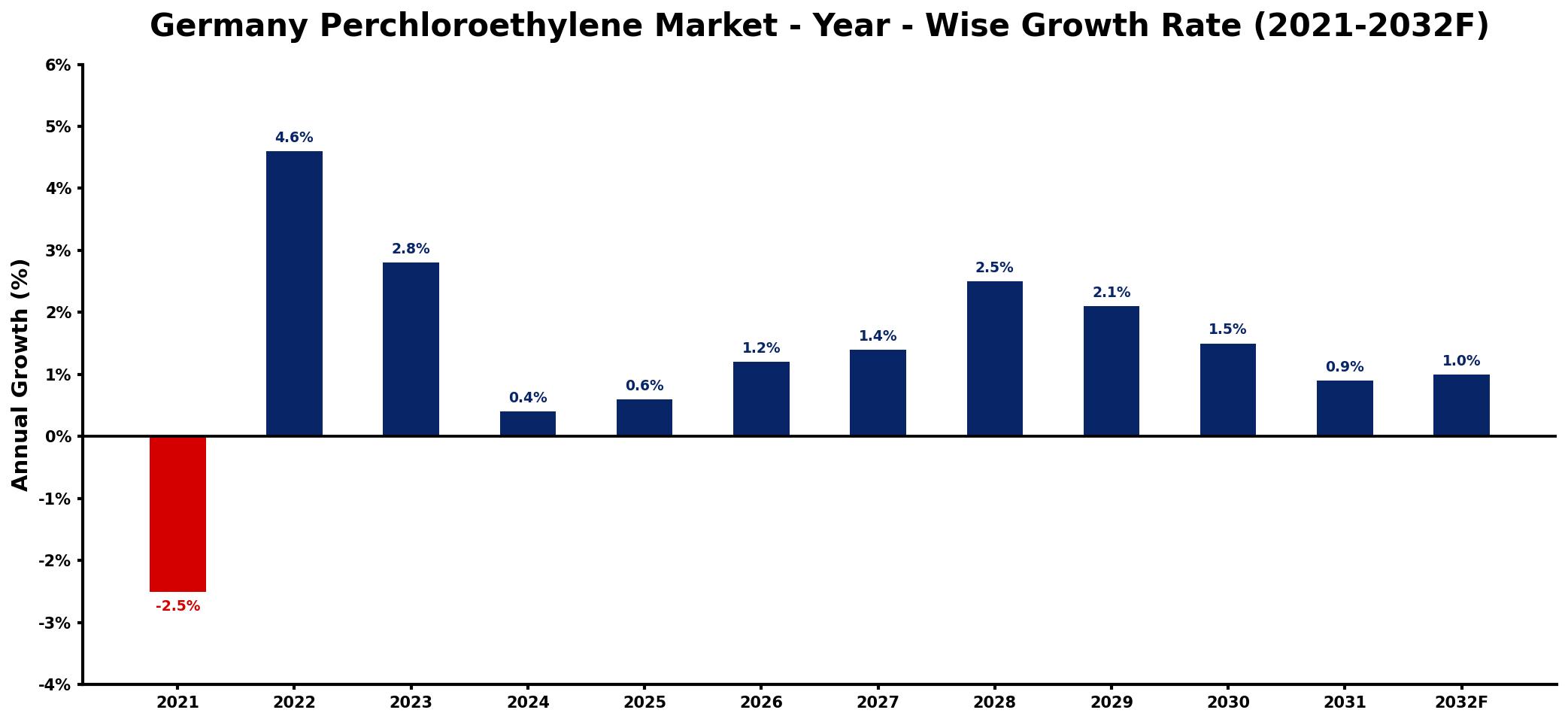
The table below presents the year‑wise growth rates along with the key drivers influencing the market
| Year | Growth Rate | Major Drivers |
| 2021 | -2.5% | Decrease in industrial cleaning usage |
| 2022 | 4.6% | Rising demand from textile industry |
| 2023 | 2.8% | Growth in dry cleaning services |
| 2024 | 0.4% | Expansion of automotive repair sector |
| 2025 | 0.6% | Increased investments in manufacturing |
| 2026 | 1.2% | Higher consumption in electronics sector |
| 2027 | 1.4% | Surge in commercial laundry services |
| 2028 | 2.5% | Boost in construction and renovation |
| 2029 | 2.1% | Growing environmental compliance requirements |
| 2030 | 1.5% | Increased focus on recycling processes |
| 2031 | 0.9% | strengthening underlying market demand |
| 2032 | 1.0% | increased production capacity utilization |
Note: Market size estimations and growth projections presented in this report are based on 6Wresearch's proprietary forecasting methodology, utilizing the latest available industry data, government publications, and primary research inputs.
Germany Perchloroethylene Market Synopsis
The strongest force currently shaping the Germany Perchloroethylene Market is the increasing regulatory pressure to adopt safer, environmentally-friendly solvents. These regulations aim to mitigate health risks and promote sustainable practices across key industries like dry cleaning and automotive manufacturing. As a result, industries are now turning to perchloroethylene as a viable alternative amidst a shift towards compliance and sustainability.
In addition to regulatory pressures, there is a growing emphasis on advancing technological solutions that enhance the efficiency and safety of perchloroethylene use. The automotive sector, in particular, is increasingly reliant on perchloroethylene for cleaning automotive parts, aligning with their broader goals of reducing emissions and enhancing fuel efficiency, thus driving the market's expansion.
Germany Perchloroethylene Market Key Takeaways
- Demand for perchloroethylene is primarily fueled by the textile, automotive, and metal cleaning sectors.
- Stringent environmental regulations are leading to a shift towards safer, eco-friendly solvents, benefitting the market.
- Technological advancements are improving the safety and efficiency of perchloroethylene applications.
- The market is seeing increased investment in R&D to explore new applications for perchloroethylene products.
- Opportunities for growth lie in sustainable practices and innovative production processes.
Evaluation of Restraints in Germany Perchloroethylene Market
Despite its growth prospects, the Germany Perchloroethylene Market faces significant restraints due to increasing regulatory scrutiny aimed at reducing the environmental and health impacts of this chemical. Concerns surrounding perchloroethylene's classification as a hazardous substance have led to restrictions on its usage, which in turn limits market demand. As companies navigate these regulatory landscapes, they are challenged to balance compliance with competitiveness, particularly in the face of emerging bio-based alternatives and other solvent technologies.
Germany Perchloroethylene Market Trends
The market is currently witnessing trends that focus on sustainability and technological innovation. As industries adopt greener production methodologies, the demand for bio-based alternatives to perchloroethylene is rising, pushing manufacturers to explore eco-friendly formulations. Additionally, advancements in extraction and purification technologies are enhancing the efficiency of perchloroethylene applications, making it a more attractive option for various cleaning processes.
Germany Perchloroethylene Market Opportunities
Investment opportunities within the Germany Perchloroethylene Market are promising, particularly due to the increasing demand across diverse industrial applications. As sectors like dry cleaning and automotive repair seek to comply with rigorous environmental standards, companies specializing in the manufacture and distribution of perchloroethylene stand to benefit. Furthermore, ongoing research into improving production efficiency and minimizing the environmental impact presents avenues for innovative solutions, making the market an appealing prospect for investors.
Government Initiatives in the Germany Perchloroethylene Market
The German government has enacted stringent regulations aimed at controlling the use and emissions of perchloroethylene, classifying it as a hazardous substance due to its potential health risks. Policies include limits on emissions, mandatory safe handling protocols, and incentives for the adoption of alternative solvents. The government is also actively promoting research into less harmful chemicals, aligning industry practices with national health and environmental goals.
Future Insights of the Germany Perchloroethylene Market
Looking ahead from 2026 to 2032, the Germany Perchloroethylene Market is expected to sustain its growth, albeit while navigating complex regulatory challenges. The continued reliance on perchloroethylene for various applications in key industries will maintain demand, particularly as industries innovate towards greener practices. As manufacturers pivot towards safer production methods and the exploration of alternative solvents gains momentum, the market will need to adapt and evolve to meet the changing landscape of industrial cleaning.
Germany Perchloroethylene Market Latest Developments (2025 - 2026)
The landscape of the Germany Perchloroethylene Market has seen notable shifts recently, with companies increasingly focusing on compliance with new environmental regulations. Many are investing in technologies that enhance the safety and efficiency of perchloroethylene use. Moreover, there is a significant emphasis on R&D initiatives aimed at discovering new, less harmful alternatives, reflecting a broader trend within the industry toward sustainable practices and innovation.
Germany Perchloroethylene Market - Key Attractiveness of the Report
- 10 Years of Market Numbers
- Historical Data Starting from 2022 to 2025
- Base Year: 2025
- Forecast Data until 2032
- Key Performance Indicators Impacting the Market
- Major Upcoming Developments and Projects
Key Highlights of the Report:
- Germany Perchloroethylene Market Outlook
- Market Size of Germany Perchloroethylene Market, 2025
- Forecast of Germany Perchloroethylene Market, 2032
- Historical Data and Forecast of Germany Perchloroethylene Revenues & Volume for the Period 2022-2032F
- Germany Perchloroethylene Market Trend Evolution
- Germany Perchloroethylene Market Drivers and Challenges
- Germany Perchloroethylene Price Trends
- Germany Perchloroethylene Porter's Five Forces
- Germany Perchloroethylene Industry Life Cycle
- Historical Data and Forecast of Germany Perchloroethylene Market Revenues & Volume By Type for the Period 2022-2032F
- Historical Data and Forecast of Germany Perchloroethylene Market Revenues & Volume By Ethylene Oxychlorination for the Period 2022-2032F
- Historical Data and Forecast of Germany Perchloroethylene Market Revenues & Volume By Acetylene Method for the Period 2022-2032F
- Historical Data and Forecast of Germany Perchloroethylene Market Revenues & Volume By Ethylene Direct Chlorination for the Period 2022-2032F
- Historical Data and Forecast of Germany Perchloroethylene Market Revenues & Volume By End-use for the Period 2022-2032F
- Historical Data and Forecast of Germany Perchloroethylene Market Revenues & Volume By Dry Cleaning Agent for the Period 2022-2032F
- Historical Data and Forecast of Germany Perchloroethylene Market Revenues & Volume By Solvent for the Period 2022-2032F
- Historical Data and Forecast of Germany Perchloroethylene Market Revenues & Volume By Others for the Period 2022-2032F
- Germany Perchloroethylene Import Export Trade Statistics
- Market Opportunity Assessment By Type
- Market Opportunity Assessment By End-use
- Germany Perchloroethylene Top Companies Market Share
- Germany Perchloroethylene Competitive Benchmarking By Technical and Operational Parameters
- Germany Perchloroethylene Company Profiles
- Germany Perchloroethylene Key Strategic Recommendations






































