Nigeria Perchloroethylene Market Size, Share & Growth Rate
The Nigeria Perchloroethylene Market was estimated at USD 1057 Million in 2025 and is projected to reach USD 1519 Million by 2032, growing at a CAGR of 5.3% from 2026 to 2032. This growth trajectory is primarily fueled by rising industrial activities, particularly in urban areas, where sectors like dry cleaning and textile processing are gaining momentum. Furthermore, increasing awareness about environmental compliance and the advantages of perchloroethylene as a solvent are bolstering the market's expansion.
Nigeria Perchloroethylene Market Year-wise Growth Rate and Key Drivers
This graph highlights how the Nigeria Perchloroethylene Market has steadily grown over the years, supported by major growth factors.
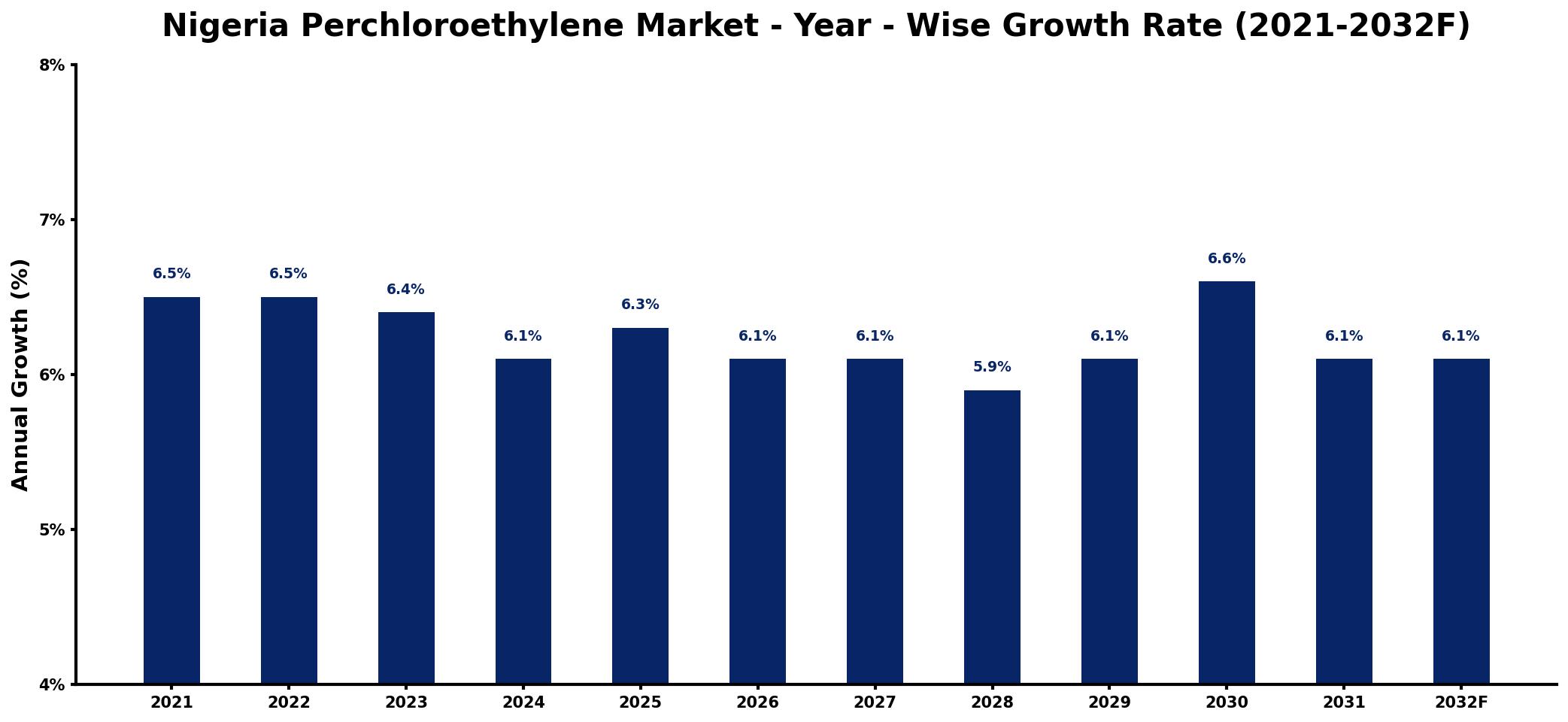
The table below presents the year‑wise growth rates along with the key drivers influencing the market
| Year | Growth Rate | Major Drivers |
| 2021 | 6.5% | Increased industrial cleaning demand |
| 2022 | 6.5% | Expanding textile processing sector |
| 2023 | 6.4% | Growing automotive maintenance services |
| 2024 | 6.1% | Rising dry cleaning establishments |
| 2025 | 6.3% | Enhanced regulatory support initiatives |
| 2026 | 6.1% | Strengthened logistics and distribution |
| 2027 | 6.1% | Higher demand from manufacturing |
| 2028 | 5.9% | Emergence of new cleaning technologies |
| 2029 | 6.1% | Boost in environmental compliance standards |
| 2030 | 6.6% | Investments in chemical production facilities |
| 2031 | 6.1% | Widespread adoption of eco-friendly practices |
| 2032 | 6.1% | Increased focus on sustainable solutions |
Note: Market size estimations and growth projections presented in this report are based on 6Wresearch's proprietary forecasting methodology, utilizing the latest available industry data, government publications, and primary research inputs.
Nigeria Perchloroethylene Market Synopsis
The most significant force shaping the Nigeria Perchloroethylene Market right now is the surging demand from the dry cleaning and textile industries. This is largely due to the rapid urbanization and industrialization occurring in Nigeria, where consumers are increasingly seeking high-quality cleaning solutions.
Additionally, the emphasis on eco-friendly alternatives and regulatory compliance is influencing market dynamics. As industries adapt to more stringent environmental standards, the exploration of safer and more sustainable formulations of perchloroethylene is becoming vital for businesses aiming to remain competitive.
Nigeria Perchloroethylene Market Key Takeaways
- The market is underpinned by strong demand from the textile and dry cleaning sectors.
- Stringent regulations are driving the adoption of environmentally friendly alternatives.
- Technological advancements are leading to the creation of more efficient perchloroethylene formulations.
- Investment opportunities are on the rise, influenced by Nigeria's expanding industrial landscape.
- Supply chain challenges persist due to reliance on imports and regulatory compliance issues.
Evaluation of Restraints in Nigeria Perchloroethylene Market
Despite the encouraging growth prospects, the Nigeria Perchloroethylene Market faces several restraints. A significant barrier is the limited awareness of perchloroethylene among potential users, which hinders its adoption across various industries. Furthermore, the existing regulatory frameworks may not be adequately enforced, leading to concerns about safe handling and disposal practices. The market also grapples with inconsistent supply and fluctuating quality due to reliance on imports. This precarious situation is compounded by competitive pressures from alternative solvents, making it essential for industry stakeholders to focus on raising awareness and improving regulatory measures.
Nigeria Perchloroethylene Market Trends
Current trends in the Nigeria Perchloroethylene Market indicate a shift towards sustainability. Manufacturers are increasingly developing eco-friendly formulations that not only meet industry standards but also align with consumer expectations for safer products. Additionally, technological advancements are enabling more efficient production processes, thereby reducing costs and improving product availability. There's also a notable trend of businesses expanding their distribution networks to capture emerging market opportunities, further enhancing access to perchloroethylene across various regions in Nigeria.
Nigeria Perchloroethylene Market Opportunities
The Nigeria Perchloroethylene Market presents several lucrative investment opportunities. The ongoing expansion of the manufacturing sector, especially in dry cleaning and textile processing, is a key driver for demand. Additionally, with the government's push for industrial development and sustainability, opportunities to invest in production facilities or supply chain enhancements are emerging. Investors can capitalize on the growing demand for perchloroethylene by focusing on innovative applications and environmentally compliant practices that can distinguish their offerings in a competitive landscape.
Government Initiatives in the Nigeria Perchloroethylene Market
The Nigerian government has been proactive in implementing various policies to regulate the Perchloroethylene market. Agencies such as the National Environmental Regulations and Standards Enforcement Agency (NESREA) oversee the enforcement of environmental regulations while the Standards Organization of Nigeria (SON) ensures product quality standards. Moreover, the National Agency for Food and Drug Administration and Control (NAFDAC) plays a crucial role in regulating the importation of perchloroethylene, guaranteeing compliance with health and safety standards. These initiatives aim to foster a responsible and sustainable market environment.
Future Insights of the Nigeria Perchloroethylene Market
Looking ahead, the Nigeria Perchloroethylene Market is expected to continue its growth trajectory driven by increasing demand from the textile and dry cleaning sectors. The ongoing focus on eco-friendly solvents and regulatory compliance will likely shape the future landscape, encouraging manufacturers to innovate. However, potential price fluctuations and public health concerns regarding perchloroethylene may present challenges. With strategic initiatives to address these issues, the market is well-positioned for stable growth between 2026 and 2032.
Nigeria Perchloroethylene Market Latest Developments (2025 - 2026)
Recent industry developments indicate a heightened focus on sustainability in the Nigeria Perchloroethylene Market. Companies are investing in research and development to formulate greener alternatives while ensuring compliance with evolving regulations. Additionally, there is a noticeable trend towards forming strategic alliances to enhance supply chain efficiency and improve market reach. This collaborative approach is expected to play a critical role in navigating the challenges posed by regulatory requirements and market competition.
Nigeria Perchloroethylene Market - Key Attractiveness of the Report
- 10 Years of Market Numbers
- Historical Data Starting from 2022 to 2025
- Base Year: 2025
- Forecast Data until 2032
- Key Performance Indicators Impacting the Market
- Major Upcoming Developments and Projects
Key Highlights of the Report:
- Nigeria Perchloroethylene Market Outlook
- Market Size of Nigeria Perchloroethylene Market, 2025
- Forecast of Nigeria Perchloroethylene Market, 2032
- Historical Data and Forecast of Nigeria Perchloroethylene Revenues & Volume for the Period 2022-2032F
- Nigeria Perchloroethylene Market Trend Evolution
- Nigeria Perchloroethylene Market Drivers and Challenges
- Nigeria Perchloroethylene Price Trends
- Nigeria Perchloroethylene Porter's Five Forces
- Nigeria Perchloroethylene Industry Life Cycle
- Historical Data and Forecast of Nigeria Perchloroethylene Market Revenues & Volume By Type for the Period 2022-2032F
- Historical Data and Forecast of Nigeria Perchloroethylene Market Revenues & Volume By Ethylene Oxychlorination for the Period 2022-2032F
- Historical Data and Forecast of Nigeria Perchloroethylene Market Revenues & Volume By Acetylene Method for the Period 2022-2032F
- Historical Data and Forecast of Nigeria Perchloroethylene Market Revenues & Volume By Ethylene Direct Chlorination for the Period 2022-2032F
- Historical Data and Forecast of Nigeria Perchloroethylene Market Revenues & Volume By End-use for the Period 2022-2032F
- Historical Data and Forecast of Nigeria Perchloroethylene Market Revenues & Volume By Dry Cleaning Agent for the Period 2022-2032F
- Historical Data and Forecast of Nigeria Perchloroethylene Market Revenues & Volume By Solvent for the Period 2022-2032F
- Historical Data and Forecast of Nigeria Perchloroethylene Market Revenues & Volume By Others for the Period 2022-2032F
- Nigeria Perchloroethylene Import Export Trade Statistics
- Market Opportunity Assessment By Type
- Market Opportunity Assessment By End-use
- Nigeria Perchloroethylene Top Companies Market Share
- Nigeria Perchloroethylene Competitive Benchmarking By Technical and Operational Parameters
- Nigeria Perchloroethylene Company Profiles
- Nigeria Perchloroethylene Key Strategic Recommendations






































