Kuwait Perchloroethylene Market Size, Share & Growth Rate
The Kuwait Perchloroethylene Market was estimated at USD 1191 Million in 2025 and is projected to reach USD 2098 Million by 2032, growing at a CAGR of 8.4% from 2026 to 2032. This upward trajectory is primarily driven by the expanding dry cleaning and textile sectors, which are witnessing significant growth owing to urbanization and rising disposable incomes. Additionally, a shift towards environmentally safer alternatives has prompted industries to adopt perchloroethylene, further boosting market demand.
Kuwait Perchloroethylene Market Year-wise Growth Rate and Key Drivers
This graph highlights how the Kuwait Perchloroethylene Market has steadily grown over the years, supported by major growth factors.
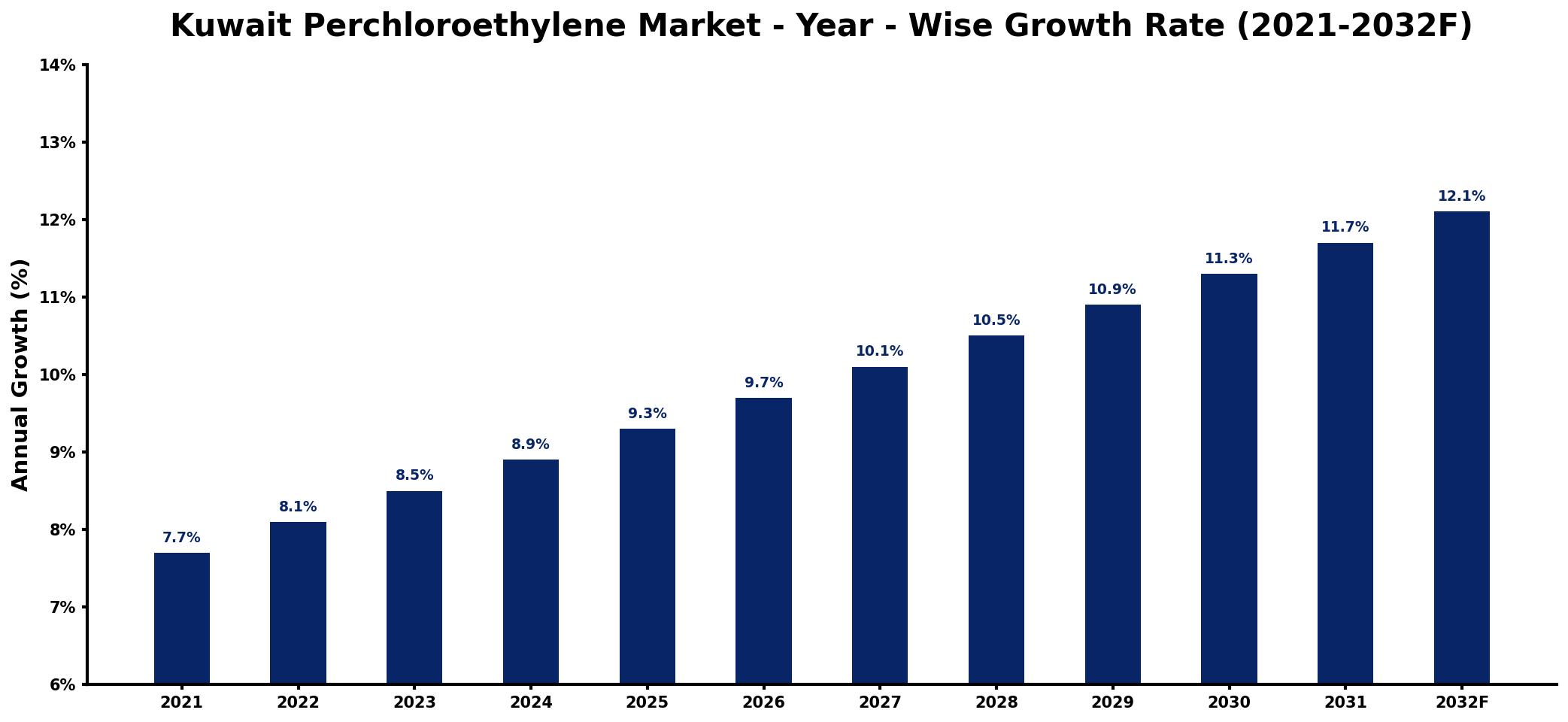
The table below presents the year‑wise growth rates along with the key drivers influencing the market
| Year | Growth Rate | Major Drivers |
| 2021 | 7.7% | Increased industrial cleaning requirements |
| 2022 | 8.1% | Rising demand in textile sector |
| 2023 | 8.5% | Growth in automotive maintenance services |
| 2024 | 8.9% | Expansion of dry cleaning businesses |
| 2025 | 9.3% | Higher investments in manufacturing |
| 2026 | 9.7% | Surge in electronics cleaning applications |
| 2027 | 10.1% | Enhanced regulations on solvent use |
| 2028 | 10.5% | Growing awareness of environmental safety |
| 2029 | 10.9% | Increase in research and development |
| 2030 | 11.3% | stronger distribution network expansion |
| 2031 | 11.7% | Boost in aerospace maintenance needs |
| 2032 | 12.1% | rising export shipment volumes |
Note: Market size estimations and growth projections presented in this report are based on 6Wresearch's proprietary forecasting methodology, utilizing the latest available industry data, government publications, and primary research inputs.
Kuwait Perchloroethylene Market Synopsis
In Kuwait, the dry cleaning sector is a crucial consumer of perchloroethylene, leveraging its superior solvent properties for effective cleaning. As the urban population expands, the demand for laundry and garment care services is expected to rise, fueling market growth.
Moreover, the textile industry in Kuwait is experiencing a renaissance, which is further intensifying the need for high-quality cleaning agents like perchloroethylene. This demand is compounded by government regulations mandating safer chemical alternatives, enhancing the appeal of perchloroethylene as a viable choice in industrial applications.
Kuwait Perchloroethylene Market Key Takeaways
- Strong growth in the dry cleaning and textile industries is propelling demand for perchloroethylene.
- Environmental regulations are influencing a shift towards safer chemical alternatives, supporting market expansion.
- Investment in advanced production technologies is enhancing product efficiency and quality.
- Fluctuating raw material prices and environmental concerns pose challenges that need careful navigation.
- Kuwait's strategic location offers lucrative export opportunities to neighboring markets.
Evaluation of Restraints in Kuwait Perchloroethylene Market
Despite the promising outlook, the Kuwait Perchloroethylene Market faces several restraints. Notably, fluctuations in raw material costs can disrupt pricing strategies and profit margins for manufacturers. Regulatory changes, particularly those aimed at enhancing environmental protection, might also affect production processes and compliance costs. Furthermore, the growing demand for eco-friendly alternatives is pushing companies to adapt swiftly, often requiring significant investment in research and innovation. As market saturation increases, competition could further intensify, potentially limiting growth prospects for existing players.
Kuwait Perchloroethylene Market Trends
Current trends in the Kuwait Perchloroethylene Market include a marked increase in eco-conscious practices within the textile and dry cleaning sectors. Companies are investing in product innovations aimed at reducing environmental footprints. Additionally, the adoption of advanced technologies in production processes is enhancing the quality and efficiency of perchloroethylene, making it a preferred choice in various industrial applications. A heightened awareness of sustainability is steering both consumers and businesses toward greener alternatives, positioning perchloroethylene as a transitional product during this shift.
Kuwait Perchloroethylene Market Opportunities
The market offers substantial investment opportunities, particularly in the development of production facilities that emphasize sustainable practices. As the government promotes industrial growth, stakeholders can capitalize on the rising demand for effective cleaning solvents. Additionally, the strategic geographical location of Kuwait enhances potential for export, especially to burgeoning markets across the Middle East. There exists a clear avenue for developing eco-friendly formulations of perchloroethylene, which could provide a competitive edge in an increasingly regulatory-driven landscape.
Government Initiatives in the Kuwait Perchloroethylene Market
The Kuwaiti government has implemented various policies focusing on environmental regulations and safety standards in the Perchloroethylene Market. These regulations are designed to control the production, import, and use of perchloroethylene, with the intent of minimizing environmental impacts and enhancing public health. By encouraging the adoption of alternative eco-friendly solvents, the government aims to transition the industry towards safer, more sustainable practices. Such initiatives are crucial in supporting a clean environment while still promoting industrial growth.
Future Insights of the Kuwait Perchloroethylene Market
Looking ahead to 2026-2032, the future of the Kuwait Perchloroethylene Market appears optimistic. With robust demand expected from the textile, automotive, and metalworking industries, the market is likely to witness steady expansion. The growing emphasis on sustainability and adherence to environmental regulations will encourage innovation, leading to improved formulations and applications. As Kuwait continues to diversify its economy and bolster industrial sectors, opportunities for growth and investment in the perchloroethylene domain will likely flourish.
Kuwait Perchloroethylene Market Latest Developments (2025 - 2026)
Recent developments in the Kuwait Perchloroethylene Market indicate a shift towards more sustainable practices, with several companies exploring innovative formulations and production methods. Industry participants are increasingly participating in collaborative initiatives aimed at reducing environmental impacts. Moreover, investments in technology are being prioritized to enhance the efficiency and safety of perchloroethylene products. The regulatory landscape remains dynamic, with ongoing adjustments reflecting the growing global emphasis on environmental stewardship and public health.
Kuwait Perchloroethylene Market - Key Attractiveness of the Report
- 10 Years of Market Numbers
- Historical Data Starting from 2022 to 2025
- Base Year: 2025
- Forecast Data until 2032
- Key Performance Indicators Impacting the Market
- Major Upcoming Developments and Projects
Key Highlights of the Report:
- Kuwait Perchloroethylene Market Outlook
- Market Size of Kuwait Perchloroethylene Market, 2025
- Forecast of Kuwait Perchloroethylene Market, 2032
- Historical Data and Forecast of Kuwait Perchloroethylene Revenues & Volume for the Period 2022-2032F
- Kuwait Perchloroethylene Market Trend Evolution
- Kuwait Perchloroethylene Market Drivers and Challenges
- Kuwait Perchloroethylene Price Trends
- Kuwait Perchloroethylene Porter's Five Forces
- Kuwait Perchloroethylene Industry Life Cycle
- Historical Data and Forecast of Kuwait Perchloroethylene Market Revenues & Volume By Type for the Period 2022-2032F
- Historical Data and Forecast of Kuwait Perchloroethylene Market Revenues & Volume By Ethylene Oxychlorination for the Period 2022-2032F
- Historical Data and Forecast of Kuwait Perchloroethylene Market Revenues & Volume By Acetylene Method for the Period 2022-2032F
- Historical Data and Forecast of Kuwait Perchloroethylene Market Revenues & Volume By Ethylene Direct Chlorination for the Period 2022-2032F
- Historical Data and Forecast of Kuwait Perchloroethylene Market Revenues & Volume By End-use for the Period 2022-2032F
- Historical Data and Forecast of Kuwait Perchloroethylene Market Revenues & Volume By Dry Cleaning Agent for the Period 2022-2032F
- Historical Data and Forecast of Kuwait Perchloroethylene Market Revenues & Volume By Solvent for the Period 2022-2032F
- Historical Data and Forecast of Kuwait Perchloroethylene Market Revenues & Volume By Others for the Period 2022-2032F
- Kuwait Perchloroethylene Import Export Trade Statistics
- Market Opportunity Assessment By Type
- Market Opportunity Assessment By End-use
- Kuwait Perchloroethylene Top Companies Market Share
- Kuwait Perchloroethylene Competitive Benchmarking By Technical and Operational Parameters
- Kuwait Perchloroethylene Company Profiles
- Kuwait Perchloroethylene Key Strategic Recommendations






































