Bahrain Perchloroethylene Market Size, Share & Growth Rate
The Bahrain Perchloroethylene Market was estimated at USD 811 Million in 2025 and is projected to reach USD 1405 Million by 2032, growing at a CAGR of 8.2% from 2026 to 2032. This growth trajectory is primarily driven by the persistent demand for perchloroethylene in traditional sectors such as dry cleaning and metal degreasing, despite increasing regulatory scrutiny. Moreover, a gradual shift towards safer and environmentally-friendly cleaning solutions is pushing the market to innovate, as businesses seek compliance with evolving standards while maintaining operational efficiency.
Bahrain Perchloroethylene Market Year-wise Growth Rate and Key Drivers
This graph highlights how the Bahrain Perchloroethylene Market has steadily grown over the years, supported by major growth factors.
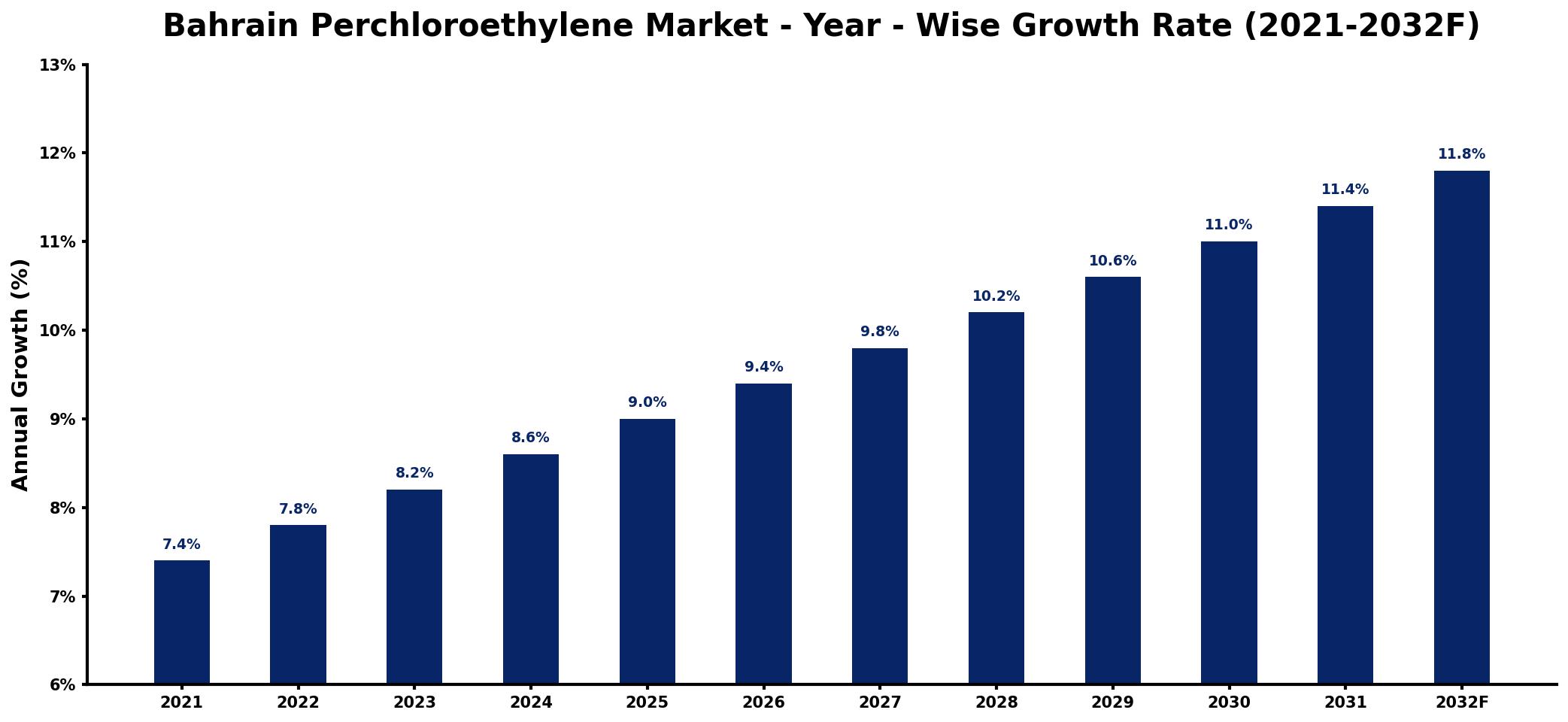
The table below presents the year‑wise growth rates along with the key drivers influencing the market
| Year | Growth Rate | Major Drivers |
| 2021 | 7.4% | Rising demand from textile industry |
| 2022 | 7.8% | Increased production in dry cleaning |
| 2023 | 8.2% | Growth in automotive maintenance services |
| 2024 | 8.6% | Expansion of industrial cleaning applications |
| 2025 | 9.0% | Surge in electronics manufacturing needs |
| 2026 | 9.4% | Investment in chemical processing facilities |
| 2027 | 9.8% | Higher usage in metal degreasing |
| 2028 | 10.2% | Boost in pharmaceutical manufacturing processes |
| 2029 | 10.6% | Growing need for precision cleaning |
| 2030 | 11.0% | Increased focus on sustainable practices |
| 2031 | 11.4% | strengthening underlying market demand |
| 2032 | 11.8% | rising export shipment volumes |
Note: Market size estimations and growth projections presented in this report are based on 6Wresearch's proprietary forecasting methodology, utilizing the latest available industry data, government publications, and primary research inputs.
Bahrain Perchloroethylene Market Synopsis
In recent years, the Bahrain Perchloroethylene Market has exhibited stable demand due to its essential role in dry cleaning and industrial applications. However, the landscape is shifting as concerns regarding health and environmental impacts heighten, prompting a reevaluation of its use in favor of safer alternatives.
This markets future is marked by innovation and transformation, where traditional applications may decline, paving the way for modern cleaning technologies. While the legacy of perchloroethylene remains significant, the ongoing transition to eco-friendly solvents suggests an imperative need for adaptation within the sector.
Bahrain Perchloroethylene Market Key Takeaways
- The market is poised for growth despite increasing regulatory pressures.
- Environmental concerns are reshaping the industry's landscape and driving innovation.
- Traditional applications are under scrutiny, leading to declining use.
- Investors are encouraged to explore opportunities in safer alternatives and technologies.
- Government regulations are pushing compliance and supporting the market's transformation.
Evaluation of Restraints in Bahrain Perchloroethylene Market
The Bahrain Perchloroethylene Market faces several significant constraints that limit its expansion. The increasing enforcement of stringent environmental regulations and health safety measures has made it challenging for businesses to continue utilizing perchloroethylene without incurring substantial compliance costs. As traditional dry-cleaning establishments decline, the market is pressured further, forcing stakeholders to navigate an increasingly competitive landscape. Additionally, the reliance on imported chemicals adds another layer of complexity, as local users grapple with rising operational costs and regulatory compliance associated with hazardous material handling.
Bahrain Perchloroethylene Market Trends
Current trends in the Bahrain Perchloroethylene Market indicate a significant shift towards reformulation and technological upgrades in cleaning processes. End-users are increasingly adopting alternatives such as hydrocarbon and silicone-based solvents, reflecting a broader industry trend towards safety and sustainability. Additionally, advancements in recycling technologies are gaining traction, enabling the recovery and reuse of chemicals to comply with environmental regulations. This transformation not only mitigates health risks but also allows businesses to remain competitive amid tightening regulations.
Bahrain Perchloroethylene Market Opportunities
Amid regulatory constraints and shifting market dynamics, opportunities for investment in the Bahrain Perchloroethylene Market remain promising. Companies focusing on safer handling technologies, innovative recycling systems, and development of compliant substitutes can position themselves advantageously. Furthermore, as the market grapples with the transition to greener solvents, there is significant potential for entrepreneurs to develop new formulations and processes that align with both market demands and environmental standards.
Government Initiatives in the Bahrain Perchloroethylene Market
The Bahrain government is actively involved in regulating the use of perchloroethylene through stringent chemical safety and hazardous materials policies. The Supreme Council for Environment (SCE) imposes rigorous controls on the importation, storage, and handling of this solvent, addressing environmental and health risks associated with its use. As part of its commitment to international environmental treaties, such as the Stockholm Convention, the government is fostering initiatives that encourage the transition towards safer alternatives, promoting sustainability in industrial practices.
Future Insights of the Bahrain Perchloroethylene Market
Looking ahead to 2026-2032, the Bahrain Perchloroethylene Market is expected to undergo significant transformation. The ongoing pressures from regulatory bodies, combined with the rising demand for sustainable practices, will likely drive further innovation in cleaning technologies. As traditional uses of perchloroethylene decline, the market could witness a resurgence of interest in eco-friendly alternatives, thereby reshaping the landscape. Companies that adapt quickly and align their strategies with these emerging trends will likely find themselves at the forefront of the market's evolution.
Bahrain Perchloroethylene Market Latest Developments (2025 - 2026)
In the past year, the Bahrain Perchloroethylene Market has seen a marked shift towards sustainable practices, with many businesses evaluating their cleaning processes in light of environmental concerns. There has been a notable increase in discussions regarding the adoption of alternative solvents, reflecting a growing consciousness about health and safety. Moreover, industry stakeholders are increasingly collaborating to explore innovative solutions that meet regulatory standards while fulfilling market needs.
Bahrain Perchloroethylene Market - Key Attractiveness of the Report
- 10 Years of Market Numbers
- Historical Data Starting from 2022 to 2025
- Base Year: 2025
- Forecast Data until 2032
- Key Performance Indicators Impacting the Market
- Major Upcoming Developments and Projects
Key Highlights of the Report:
- Bahrain Perchloroethylene Market Outlook
- Market Size of Bahrain Perchloroethylene Market, 2025
- Forecast of Bahrain Perchloroethylene Market, 2032
- Historical Data and Forecast of Bahrain Perchloroethylene Revenues & Volume for the Period 2022-2032F
- Bahrain Perchloroethylene Market Trend Evolution
- Bahrain Perchloroethylene Market Drivers and Challenges
- Bahrain Perchloroethylene Price Trends
- Bahrain Perchloroethylene Porter's Five Forces
- Bahrain Perchloroethylene Industry Life Cycle
- Historical Data and Forecast of Bahrain Perchloroethylene Market Revenues & Volume By Type for the Period 2022-2032F
- Historical Data and Forecast of Bahrain Perchloroethylene Market Revenues & Volume By Ethylene Oxychlorination for the Period 2022-2032F
- Historical Data and Forecast of Bahrain Perchloroethylene Market Revenues & Volume By Acetylene Method for the Period 2022-2032F
- Historical Data and Forecast of Bahrain Perchloroethylene Market Revenues & Volume By Ethylene Direct Chlorination for the Period 2022-2032F
- Historical Data and Forecast of Bahrain Perchloroethylene Market Revenues & Volume By End-use for the Period 2022-2032F
- Historical Data and Forecast of Bahrain Perchloroethylene Market Revenues & Volume By Dry Cleaning Agent for the Period 2022-2032F
- Historical Data and Forecast of Bahrain Perchloroethylene Market Revenues & Volume By Solvent for the Period 2022-2032F
- Historical Data and Forecast of Bahrain Perchloroethylene Market Revenues & Volume By Others for the Period 2022-2032F
- Bahrain Perchloroethylene Import Export Trade Statistics
- Market Opportunity Assessment By Type
- Market Opportunity Assessment By End-use
- Bahrain Perchloroethylene Top Companies Market Share
- Bahrain Perchloroethylene Competitive Benchmarking By Technical and Operational Parameters
- Bahrain Perchloroethylene Company Profiles
- Bahrain Perchloroethylene Key Strategic Recommendations






































