Hungary Perchloroethylene Market Size, Share & Growth Rate
The Hungary Perchloroethylene Market was estimated at USD 227 Million in 2025 and is projected to reach USD 306 Million by 2032, growing at a CAGR of 4.4% from 2026 to 2032. This growth trajectory is driven by the expanding textile and automotive sectors, which rely heavily on perchloroethylene for various applications such as dry cleaning and metal degreasing. Coupled with increasing urbanization and rising disposable incomes, these sectors are pushing demand higher.
Hungary Perchloroethylene Market Year-wise Growth Rate and Key Drivers
This graph highlights how the Hungary Perchloroethylene Market has steadily grown over the years, supported by major growth factors.
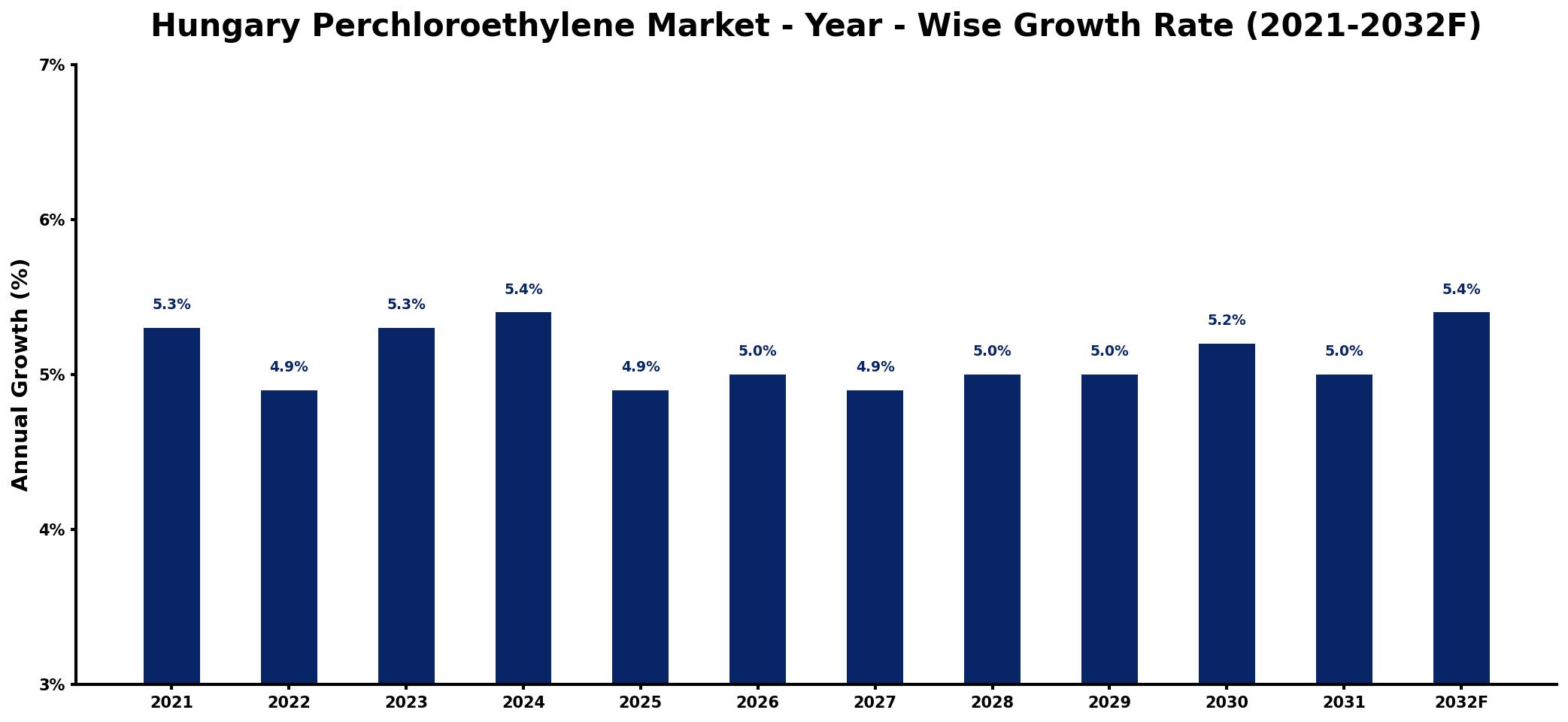
The table below presents the year‑wise growth rates along with the key drivers influencing the market
| Year | Growth Rate | Major Drivers |
| 2021 | 5.3% | Rising demand in dry cleaning |
| 2022 | 4.9% | Growth in automotive industry applications |
| 2023 | 5.3% | Increased investments in textiles |
| 2024 | 5.4% | Expansion of chemical manufacturing facilities |
| 2025 | 4.9% | Higher demand from electronics sector |
| 2026 | 5.0% | enhanced product quality standards |
| 2027 | 4.9% | Surge in environmental regulations compliance |
| 2028 | 5.0% | Increased use in degreasing agents |
| 2029 | 5.0% | increased domestic production output |
| 2030 | 5.2% | growing commercial sector adoption |
| 2031 | 5.0% | improved raw material availability |
| 2032 | 5.4% | Increased focus on sustainable practices |
Note: Market size estimations and growth projections presented in this report are based on 6Wresearch's proprietary forecasting methodology, utilizing the latest available industry data, government publications, and primary research inputs.
Hungary Perchloroethylene Market Synopsis
Recent momentum in the Hungary Perchloroethylene Market reflects a strong demand across multiple industries, particularly textiles and automotive. As the market evolves, it is shifting towards more sustainable practices, prompted by regulatory pressures and a growing consumer awareness of eco-friendly solutions. In the coming years, innovation will play a crucial role in shaping the market, with a focus on high-performance, low-impact products.
As industry players adapt to the evolving landscape, challenges such as fluctuating raw material prices and increasing competition from alternative solvents will need to be navigated. However, investment in R&D for sustainable production methods and the development of strategic partnerships may provide a pathway for companies to enhance their market position.
Hungary Perchloroethylene Market Key Takeaways
- The market is heavily influenced by the textile, automotive, and dry-cleaning sectors, which are experiencing increased growth.
- Regulatory frameworks are leading to a shift towards more sustainable practices and eco-friendly alternatives.
- Investment in innovative technologies is critical for reducing environmental impacts associated with perchloroethylene usage.
- The rise of strategic collaborations among industry players is enhancing product offerings and market presence.
- Overall market growth is expected as Hungary's industrial sector continues to expand in the coming years.
Evaluation of Restraints in Hungary Perchloroethylene Market
The Hungary Perchloroethylene Market faces several restraints that could hinder its growth potential. Chief among these are the stringent regulations imposed on the use and emission of perchloroethylene, necessitating compliance that can be costly for manufacturers. Furthermore, rising public and governmental awareness about environmental issues is prompting industries to explore alternative cleaning solutions, thereby putting pressure on traditional perchloroethylene markets. Companies must proactively address these challenges through innovation and adaptation to remain competitive and compliant.
Hungary Perchloroethylene Market Trends
Current trends in the Hungary Perchloroethylene Market indicate a strong move towards sustainable and environmentally friendly practices. Manufacturers are increasingly investing in research to develop low-emission products, in response to regulations aimed at reducing harmful solvent use. Concurrently, there is a growing preference for high-quality perchloroethylene products that provide enhanced efficiency and performance. Furthermore, we are witnessing an increase in collaborations among companies to enhance their technological capabilities and expand their market reach.
Hungary Perchloroethylene Market Opportunities
Investment opportunities within the Hungary Perchloroethylene Market are vast, especially as demand surges in sectors like dry cleaning and automotive manufacturing. The shift towards environmentally friendly solutions opens avenues for investments in innovative production technologies that align with regulatory frameworks. Additionally, as the automotive sector expands, there is potential for greater demand for perchloroethylene in metal degreasing processes, presenting lucrative opportunities for market players.
Government Initiatives in the Hungary Perchloroethylene Market
The Hungarian government is actively working on policies aimed at regulating the use of perchloroethylene to ensure environmental protection and worker safety. These initiatives include strict emissions standards, guidelines for safe handling and disposal practices, and mandates for regular monitoring of perchloroethylene levels in industrial applications. Such regulations demonstrate the government's commitment to aligning with international standards and minimizing health risks associated with chemical exposure.
Future Insights of the Hungary Perchloroethylene Market
Looking ahead to 2026-2032, the Hungary Perchloroethylene market is positioned for significant growth, driven by the expanding demand from both the textile and automotive industries. Innovations in production processes and the increasing availability of eco-friendly alternatives are likely to redefine market dynamics. As public consciousness shifts towards sustainability, companies that adapt and innovate are likely to prosper in this evolving landscape.
Hungary Perchloroethylene Market Latest Developments (2025 - 2026)
Recent developments within the Hungary Perchloroethylene Market indicate a notable focus on sustainability and compliance. Industry stakeholders are increasingly collaborating on initiatives aimed at reducing environmental impacts and improving safety standards. Technological advancements in production and processing methods are also being prioritized, alongside a growing interest in sustainable alternatives to traditional perchloroethylene applications.
Hungary Perchloroethylene Market - Key Attractiveness of the Report
- 10 Years of Market Numbers
- Historical Data Starting from 2022 to 2025
- Base Year: 2025
- Forecast Data until 2032
- Key Performance Indicators Impacting the Market
- Major Upcoming Developments and Projects
Key Highlights of the Report:
- Hungary Perchloroethylene Market Outlook
- Market Size of Hungary Perchloroethylene Market, 2025
- Forecast of Hungary Perchloroethylene Market, 2032
- Historical Data and Forecast of Hungary Perchloroethylene Revenues & Volume for the Period 2022-2032F
- Hungary Perchloroethylene Market Trend Evolution
- Hungary Perchloroethylene Market Drivers and Challenges
- Hungary Perchloroethylene Price Trends
- Hungary Perchloroethylene Porter's Five Forces
- Hungary Perchloroethylene Industry Life Cycle
- Historical Data and Forecast of Hungary Perchloroethylene Market Revenues & Volume By Type for the Period 2022-2032F
- Historical Data and Forecast of Hungary Perchloroethylene Market Revenues & Volume By Ethylene Oxychlorination for the Period 2022-2032F
- Historical Data and Forecast of Hungary Perchloroethylene Market Revenues & Volume By Acetylene Method for the Period 2022-2032F
- Historical Data and Forecast of Hungary Perchloroethylene Market Revenues & Volume By Ethylene Direct Chlorination for the Period 2022-2032F
- Historical Data and Forecast of Hungary Perchloroethylene Market Revenues & Volume By End-use for the Period 2022-2032F
- Historical Data and Forecast of Hungary Perchloroethylene Market Revenues & Volume By Dry Cleaning Agent for the Period 2022-2032F
- Historical Data and Forecast of Hungary Perchloroethylene Market Revenues & Volume By Solvent for the Period 2022-2032F
- Historical Data and Forecast of Hungary Perchloroethylene Market Revenues & Volume By Others for the Period 2022-2032F
- Hungary Perchloroethylene Import Export Trade Statistics
- Market Opportunity Assessment By Type
- Market Opportunity Assessment By End-use
- Hungary Perchloroethylene Top Companies Market Share
- Hungary Perchloroethylene Competitive Benchmarking By Technical and Operational Parameters
- Hungary Perchloroethylene Company Profiles
- Hungary Perchloroethylene Key Strategic Recommendations






































