Slovakia Perchloroethylene Market Size, Share & Growth Rate
The Slovakia Perchloroethylene Market was estimated at USD 1206 Million in 2025 and is projected to reach USD 1752 Million by 2032, growing at a CAGR of 5.5% from 2026 to 2032. This growth is primarily fueled by increasing demand from dry cleaning services, automotive applications, and metal degreasing industries. As Slovakia's economy continues to develop, the rise in disposable income is expected to further enhance the demand for cleaning services, thus driving the market for perchloroethylene.
Slovakia Perchloroethylene Market Year-wise Growth Rate and Key Drivers
This graph highlights how the Slovakia Perchloroethylene Market has steadily grown over the years, supported by major growth factors.
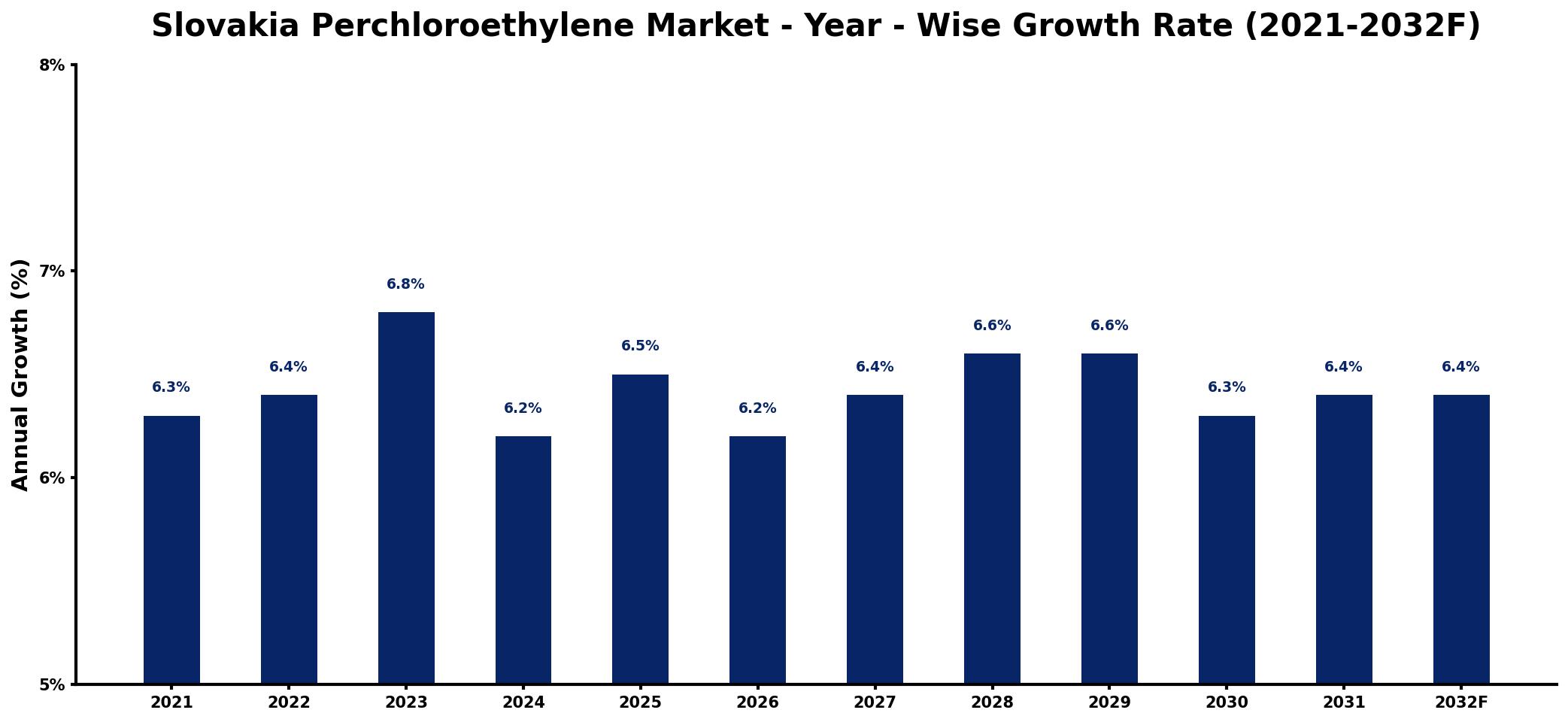
The table below presents the year‑wise growth rates along with the key drivers influencing the market
| Year | Growth Rate | Major Drivers |
| 2021 | 6.3% | Rising demand in dry cleaning |
| 2022 | 6.4% | Increased industrial applications growth |
| 2023 | 6.8% | Expansion of automotive cleaning services |
| 2024 | 6.2% | Growing environmental regulations compliance |
| 2025 | 6.5% | Emergence of new cleaning technologies |
| 2026 | 6.2% | Higher investments in manufacturing processes |
| 2027 | 6.4% | Strengthening partnerships with industries |
| 2028 | 6.6% | Surge in consumer awareness initiatives |
| 2029 | 6.6% | Development of innovative recycling methods |
| 2030 | 6.3% | Focus on sustainable cleaning solutions |
| 2031 | 6.4% | Growing presence in textile sector |
| 2032 | 6.4% | rising end-use demand growth |
Note: Market size estimations and growth projections presented in this report are based on 6Wresearch's proprietary forecasting methodology, utilizing the latest available industry data, government publications, and primary research inputs.
Slovakia Perchloroethylene Market Synopsis
The most significant force shaping the Slovakia Perchloroethylene market currently is the expanding dry cleaning industry. As consumer preferences shift towards convenience and high-quality cleaning solutions, dry cleaning services are witnessing robust growth, thereby sustaining the demand for perchloroethylene.
Additionally, the automotive and metal degreasing sectors are also pivotal, utilizing perchloroethylene for effective cleaning and degreasing of components. However, environmental regulations concerning the use of perchloroethylene are increasingly influencing operational practices within these industries, pushing for more sustainable alternatives.
Slovakia Perchloroethylene Market Key Takeaways
- The market is experiencing steady growth, driven by increased demand from the dry cleaning and automotive sectors.
- Environmental regulations are prompting a shift towards eco-friendly alternatives to perchloroethylene.
- Investment in research and development is essential for companies to innovate and comply with regulations.
- Government initiatives are supporting sustainable practices, influencing market dynamics.
- The future of the market looks promising with projections of significant growth by 2032.
Evaluation of Restraints in Slovakia Perchloroethylene Market
Despite its growth potential, the Slovakia Perchloroethylene market faces notable restraints. Stricter environmental regulations are imposing compliance costs, compelling businesses to reassess their operational frameworks. The awareness around the health risks associated with perchloroethylene is escalating, driving companies to consider alternative solvents that are perceived as safer and environmentally friendly. The transition towards these alternatives may limit the growth of perchloroethylene in the long run, as companies strive to align with evolving consumer expectations and regulatory pressures.
Slovakia Perchloroethylene Market Trends
Current trends in the Slovakia Perchloroethylene market show a growing emphasis on sustainability and innovation. Companies are increasingly investing in green technologies and eco-friendly solvents to mitigate health risks and environmental impact. Additionally, there is an upward trend in the consolidation of businesses within the market, as firms seek to enhance their capabilities in response to regulatory challenges. This focus on sustainable practices is redefining competitive strategies among market players.
Slovakia Perchloroethylene Market Opportunities
Investment opportunities in the Slovakia Perchloroethylene market are diverse and promising. As demand continues to rise in the dry cleaning and automotive industries, manufacturers have ample potential for growth. Moreover, there is a burgeoning market for eco-friendly alternatives, providing avenues for innovation and development. Collaborations with local businesses and government initiatives aimed at sustainability can enhance market reach and profitability, particularly for those willing to pivot towards greener solutions.
Government Initiatives in the Slovakia Perchloroethylene Market
The Slovak government has enacted several regulations to mitigate the environmental and health impacts associated with perchloroethylene use. Strict guidelines on emissions and handling practices are in place to ensure compliance and promote safety. Furthermore, ongoing governmental efforts to encourage the use of alternative solvents indicate a commitment to sustainable industrial practices, providing a framework for businesses to adapt and innovate within the market.
Future Insights of the Slovakia Perchloroethylene Market
The outlook for the Slovakia Perchloroethylene market from 2026 to 2032 appears optimistic, with consistent demand anticipated from sectors such as dry cleaning, automotive, and textile processing. Technological advancements in production methods are likely to enhance efficiency and reduce environmental impact, ensuring perchloroethylene remains a relevant choice amid growing regulatory scrutiny. Overall, the combination of market demand and innovation promises to secure a favorable trajectory for the industry.
Slovakia Perchloroethylene Market Latest Developments (2025 - 2026)
Recent industry developments indicate a noticeable shift towards the adoption of eco-friendly practices among companies in the Slovakia Perchloroethylene market. There has been a concerted effort to develop greener alternatives, as manufacturers are becoming more proactive in compliance with upcoming environmental regulations. Additionally, there is increased collaboration between industry stakeholders and governmental bodies to promote sustainable solutions, reflecting a broader commitment to environmental responsibility.
Slovakia Perchloroethylene Market - Key Attractiveness of the Report
- 10 Years of Market Numbers
- Historical Data Starting from 2022 to 2025
- Base Year: 2025
- Forecast Data until 2032
- Key Performance Indicators Impacting the Market
- Major Upcoming Developments and Projects
Key Highlights of the Report:
- Slovakia Perchloroethylene Market Outlook
- Market Size of Slovakia Perchloroethylene Market, 2025
- Forecast of Slovakia Perchloroethylene Market, 2032
- Historical Data and Forecast of Slovakia Perchloroethylene Revenues & Volume for the Period 2022-2032F
- Slovakia Perchloroethylene Market Trend Evolution
- Slovakia Perchloroethylene Market Drivers and Challenges
- Slovakia Perchloroethylene Price Trends
- Slovakia Perchloroethylene Porter's Five Forces
- Slovakia Perchloroethylene Industry Life Cycle
- Historical Data and Forecast of Slovakia Perchloroethylene Market Revenues & Volume By Type for the Period 2022-2032F
- Historical Data and Forecast of Slovakia Perchloroethylene Market Revenues & Volume By Ethylene Oxychlorination for the Period 2022-2032F
- Historical Data and Forecast of Slovakia Perchloroethylene Market Revenues & Volume By Acetylene Method for the Period 2022-2032F
- Historical Data and Forecast of Slovakia Perchloroethylene Market Revenues & Volume By Ethylene Direct Chlorination for the Period 2022-2032F
- Historical Data and Forecast of Slovakia Perchloroethylene Market Revenues & Volume By End-use for the Period 2022-2032F
- Historical Data and Forecast of Slovakia Perchloroethylene Market Revenues & Volume By Dry Cleaning Agent for the Period 2022-2032F
- Historical Data and Forecast of Slovakia Perchloroethylene Market Revenues & Volume By Solvent for the Period 2022-2032F
- Historical Data and Forecast of Slovakia Perchloroethylene Market Revenues & Volume By Others for the Period 2022-2032F
- Slovakia Perchloroethylene Import Export Trade Statistics
- Market Opportunity Assessment By Type
- Market Opportunity Assessment By End-use
- Slovakia Perchloroethylene Top Companies Market Share
- Slovakia Perchloroethylene Competitive Benchmarking By Technical and Operational Parameters
- Slovakia Perchloroethylene Company Profiles
- Slovakia Perchloroethylene Key Strategic Recommendations






































