Colombia Ploughing and Cultivating Machinery Market Size, Share & Growth Rate
The Colombia Ploughing and Cultivating Machinery Market was estimated at USD 197 Million in 2025 and is projected to reach USD 278 Million by 2032, growing at a CAGR of 5.0% from 2026 to 2032. This growth trajectory is largely attributed to the increasing mechanization in Colombia's agricultural sector, coupled with government initiatives aimed at modernizing farming practices. As farmers adopt innovative technologies to enhance productivity and combat challenges like soil erosion, the market is poised for substantial expansion.
Colombia Ploughing and Cultivating Machinery Market Year-wise Growth Rate and Key Drivers
This graph highlights how the Colombia Ploughing and Cultivating Machinery Market has steadily grown over the years, supported by major growth factors.
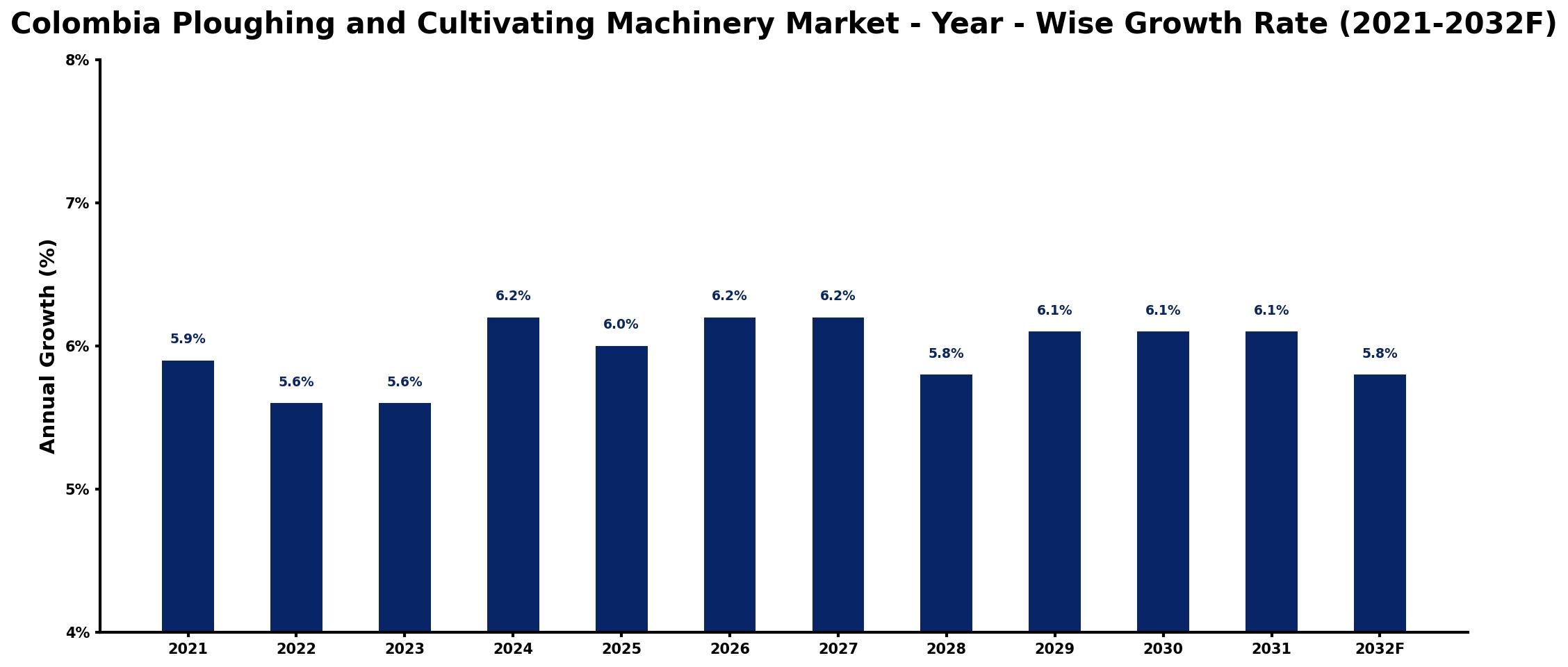
The table below presents the year‑wise growth rates along with the key drivers influencing the market
| Year | Growth Rate | Major Drivers |
| 2021 | 5.9% | Rising agricultural investments drive demand |
| 2022 | 5.6% | Increased adoption of technology solutions |
| 2023 | 5.6% | Growing awareness of sustainable practices |
| 2024 | 6.2% | Expansion of export markets observed |
| 2025 | 6.0% | Enhanced government support initiatives launched |
| 2026 | 6.2% | Surge in organic farming practices |
| 2027 | 6.2% | Improved access to financing options |
| 2028 | 5.8% | Strengthened agricultural cooperatives form |
| 2029 | 6.1% | strengthening international trade flows |
| 2030 | 6.1% | Emergence of precision farming techniques |
| 2031 | 6.1% | Increased partnerships between stakeholders |
| 2032 | 5.8% | Focus on climate-resilient agriculture strategies |
Note: Market size estimations and growth projections presented in this report are based on 6Wresearch's proprietary forecasting methodology, utilizing the latest available industry data, government publications, and primary research inputs.
Colombia Ploughing and Cultivating Machinery Market Synopsis
In recent years, the Colombian ploughing and cultivating machinery market has seen a significant push towards mechanization, driven by the need for higher agricultural efficiency. This momentum is expected to evolve into a broader adoption of advanced machinery, as the sector shifts its focus towards sustainability and technological integration.
Looking ahead, the market is set to embrace an array of innovations that cater to local agricultural needs. With a landscape characterized by diverse soil conditions and farming practices, the demand for customized, efficient machinery will only grow. As farmers increasingly recognize the benefits of mechanized equipment, the market is anticipated to expand at a steady pace.
Colombia Ploughing and Cultivating Machinery Market Key Takeaways
- The market is driven by rising mechanization and government incentives promoting modern farming techniques.
- Technological advancements, including GPS and variable rate technologies, are gaining traction.
- There is a growing emphasis on sustainable practices, particularly conservation tillage and reduced tillage equipment.
- Small-scale farmers are increasingly seeking versatile machinery that addresses their unique needs.
- Investment opportunities exist in providing quality machinery and fostering partnerships with local distributors.
Evaluation of Restraints in Colombia Ploughing and Cultivating Machinery Market
Despite the positive outlook for the Colombian ploughing and cultivating machinery market, several factors impede its growth. The high cost of modern machinery continues to be a significant barrier for many small-scale farmers, who often lack access to adequate financing options. Furthermore, there is a notable gap in awareness regarding the benefits of newer technologies, which hampers adoption rates. The prevalence of counterfeit machinery also poses risks, as low-quality products can negatively affect performance, leading to potential reluctance among farmers to invest in mechanization.
Colombia Ploughing and Cultivating Machinery Market Trends
Current trends in the Colombia ploughing and cultivating machinery market underscore a shift towards smarter, more efficient equipment. Farmers are increasingly integrating features such as GPS guidance systems and automatic depth control into their operations, enhancing productivity while reducing labor costs. Additionally, there's a marked rise in demand for environmentally friendly solutions, such as conservation tillage practices. The market also reflects a growing preference for smaller, adaptable machinery tailored to the needs of diverse farming operations, demonstrating a commitment to innovation and sustainability.
Colombia Ploughing and Cultivating Machinery Market Opportunities
The Colombia ploughing and cultivating machinery market is ripe with investment opportunities. As the government actively supports agricultural modernization, there is a burgeoning demand for cutting-edge machinery that can meet the challenges posed by local farming conditions. Investors are well-positioned to supply high-quality equipment and develop partnerships with local entities to enhance market penetration. Moreover, advancements in technology present a fertile ground for innovations that cater specifically to Colombian agricultural practices, promising robust growth prospects for stakeholders in this sector.
Government Initiatives in the Colombia Ploughing and Cultivating Machinery Market
The Colombian government has implemented various initiatives to stimulate the ploughing and cultivating machinery market. These include financial incentives and subsidies aimed at encouraging farmers to invest in modern machinery. Additionally, there are programs designed to improve access to credit and training for farmers, enhancing their capacity to utilize advanced technologies effectively. Such policies are instrumental in fostering a more efficient agricultural landscape and promoting sustainable practices across the sector.
Future Insights of the Colombia Ploughing and Cultivating Machinery Market
Looking towards 2026-2032, the Colombia ploughing and cultivating machinery market is set for continued growth as the focus on mechanization intensifies. Rising demand for efficient farming solutions, coupled with government support for agricultural innovation, will drive expansion. The pressure to enhance crop yields to meet escalating food demands will further bolster the need for advanced ploughing and cultivating machinery. With Colombia's favorable agro-climatic conditions and a strong agricultural foundation, the market's prospects appear bright, poised for substantial evolution in the coming years.
Colombia Ploughing and Cultivating Machinery Market Latest Developments (2025 - 2026)
In recent months, the industry has witnessed a notable increase in investments geared towards sustainable agricultural technologies. Manufacturers are prioritizing research and development to create machinery that can withstand Colombia's diverse terrains and soil conditions. Additionally, there has been an uptick in collaborative efforts between technology firms and local manufacturers aimed at enhancing product offerings. These developments indicate a market increasingly focused on aligning with both agricultural efficiency and environmental sustainability.
Colombia Ploughing and Cultivating Machinery Market - Key Attractiveness of the Report
- 10 Years of Market Numbers
- Historical Data Starting from 2022 to 2025
- Base Year: 2025
- Forecast Data until 2032
- Key Performance Indicators Impacting the Market
- Major Upcoming Developments and Projects
Key Highlights of the Report:
- Colombia Ploughing and Cultivating Machinery Market Outlook
- Market Size of Colombia Ploughing and Cultivating Machinery Market, 2025
- Forecast of Colombia Ploughing and Cultivating Machinery Market, 2032
- Historical Data and Forecast of Colombia Ploughing and Cultivating Machinery Revenues & Volume for the Period 2022-2032F
- Colombia Ploughing and Cultivating Machinery Market Trend Evolution
- Colombia Ploughing and Cultivating Machinery Market Drivers and Challenges
- Colombia Ploughing and Cultivating Machinery Price Trends
- Colombia Ploughing and Cultivating Machinery Porter's Five Forces
- Colombia Ploughing and Cultivating Machinery Industry Life Cycle
- Historical Data and Forecast of Colombia Ploughing and Cultivating Machinery Market Revenues & Volume By Type for the Period 2022-2032F
- Historical Data and Forecast of Colombia Ploughing and Cultivating Machinery Market Revenues & Volume By Ploughs for the Period 2022-2032F
- Historical Data and Forecast of Colombia Ploughing and Cultivating Machinery Market Revenues & Volume By Harrows for the Period 2022-2032F
- Historical Data and Forecast of Colombia Ploughing and Cultivating Machinery Market Revenues & Volume By Others for the Period 2022-2032F
- Historical Data and Forecast of Colombia Ploughing and Cultivating Machinery Market Revenues & Volume By Application for the Period 2022-2032F
- Historical Data and Forecast of Colombia Ploughing and Cultivating Machinery Market Revenues & Volume By Soil Loosening for the Period 2022-2032F
- Historical Data and Forecast of Colombia Ploughing and Cultivating Machinery Market Revenues & Volume By Clod Size Reduction for the Period 2022-2032F
- Historical Data and Forecast of Colombia Ploughing and Cultivating Machinery Market Revenues & Volume By Clod Sorting for the Period 2022-2032F
- Historical Data and Forecast of Colombia Ploughing and Cultivating Machinery Market Revenues & Volume By Others for the Period 2022-2032F
- Colombia Ploughing and Cultivating Machinery Import Export Trade Statistics
- Market Opportunity Assessment By Type
- Market Opportunity Assessment By Application
- Colombia Ploughing and Cultivating Machinery Top Companies Market Share
- Colombia Ploughing and Cultivating Machinery Competitive Benchmarking By Technical and Operational Parameters
- Colombia Ploughing and Cultivating Machinery Company Profiles
- Colombia Ploughing and Cultivating Machinery Key Strategic Recommendations






































