Russia Ploughing and Cultivating Machinery Market Size, Share & Growth Rate
The Russia Ploughing and Cultivating Machinery Market was estimated at USD 130 Million in 2025 and is projected to reach USD 142 Million by 2032, growing at a CAGR of 1.3% from 2026 to 2032. This upward trajectory is primarily fueled by the increasing mechanization of agriculture and a robust push from the government to enhance agricultural efficiency. As farmers seek to modernize their practices, demand for innovative ploughing and cultivating solutions is steadily rising, creating a conducive environment for market expansion.
Russia Ploughing and Cultivating Machinery Market Year-wise Growth Rate and Key Drivers
This graph highlights how the Russia Ploughing and Cultivating Machinery Market has steadily grown over the years, supported by major growth factors.
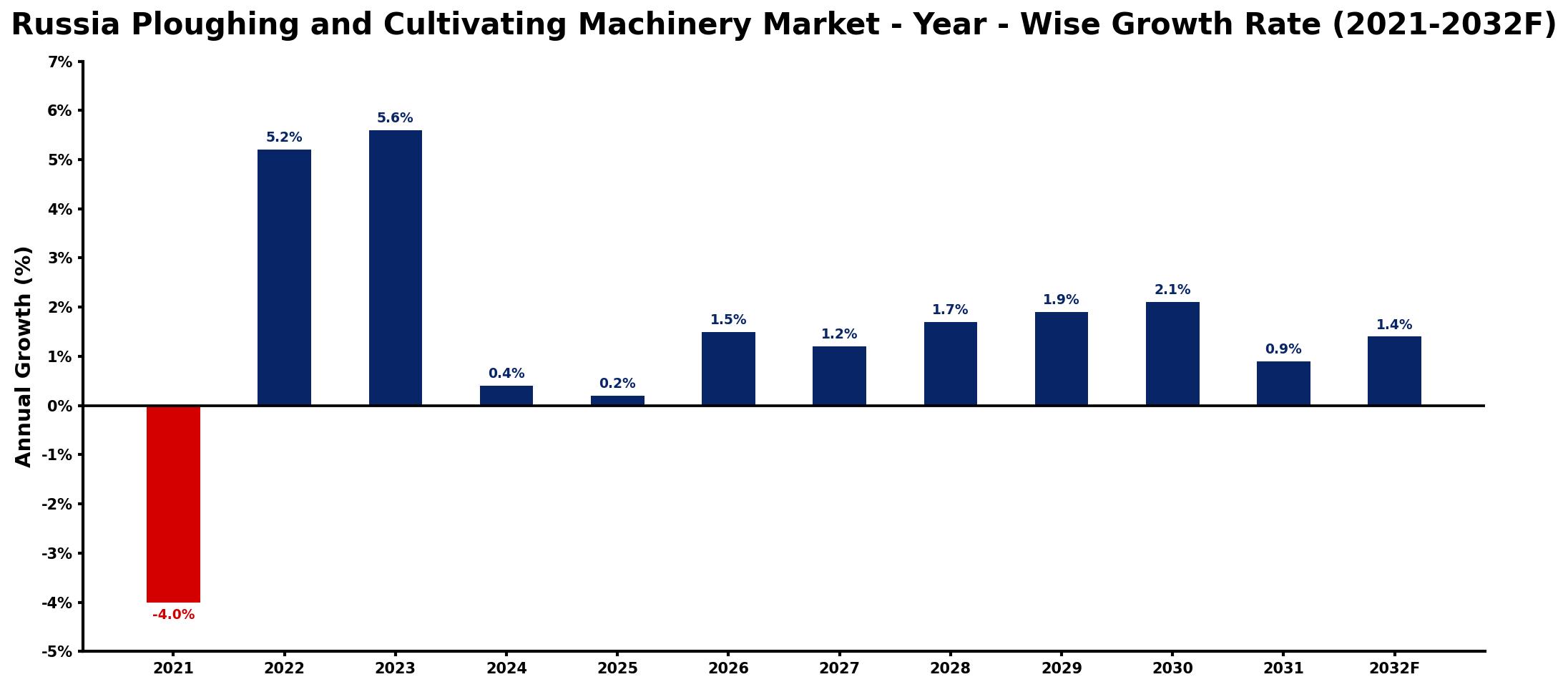
The table below presents the year‑wise growth rates along with the key drivers influencing the market
| Year | Growth Rate | Major Drivers |
| 2021 | -4.0% | Supply chain disruptions hamper production |
| 2022 | 5.2% | Increased agricultural investments drive demand |
| 2023 | 5.6% | expanding healthcare application demand |
| 2024 | 0.4% | Technological advancements enhance efficiency |
| 2025 | 0.2% | improved processing technologies adoption |
| 2026 | 1.5% | Sustainable farming practices gain traction |
| 2027 | 1.2% | Government incentives support equipment upgrades |
| 2028 | 1.7% | Expanding export markets fuel growth |
| 2029 | 1.9% | Rising farmer income boosts spending |
| 2030 | 2.1% | Innovative financing options attract buyers |
| 2031 | 0.9% | growing emerging market penetration |
| 2032 | 1.4% | increased pharmaceutical industry usage |
Note: Market size estimations and growth projections presented in this report are based on 6Wresearch's proprietary forecasting methodology, utilizing the latest available industry data, government publications, and primary research inputs.
Russia Ploughing and Cultivating Machinery Market Synopsis
The demand for high-quality ploughing and cultivating machinery in Russia is being driven by the need to improve soil fertility and maximize crop yields. Domestic manufacturers have established a solid foothold, leveraging advanced technologies to meet the evolving needs of the agricultural sector.
Additionally, as Russian farmers increasingly adopt practices aligned with precision agriculture, the market is witnessing a significant shift towards multi-functional machinery capable of performing diverse tasks, from ploughing to fertilizing. This versatility is enhancing operational efficiency and cost-effectiveness across agricultural operations.
Russia Ploughing and Cultivating Machinery Market Key Takeaways
- The market is driven by modern agricultural practices and government initiatives aimed at improving productivity.
- Technological advancements in machinery are fostering a trend towards precision farming.
- Domestic manufacturers are leading the market, supported by favorable policies that encourage local production.
- Farmers are increasingly looking for versatile machinery to streamline farming operations and reduce costs.
- The market's growth is bolstered by available subsidies for purchasing agricultural machinery.
Evaluation of Restraints in Russia Ploughing and Cultivating Machinery Market
Despite the positive growth trajectory, the market faces constraints stemming from economic fluctuations and the volatility of oil prices, which significantly affect agricultural profitability. Furthermore, the competitive landscape is increasingly intense, with both domestic and international manufacturers striving for market share, often leading to price wars. Infrastructure limitations in rural areas may further complicate distribution and after-sales service, while regulatory challenges can inhibit machinery import and export flows, potentially stifling growth opportunities for manufacturers.
Russia Ploughing and Cultivating Machinery Market Trends
The current landscape of the Russia Ploughing and Cultivating Machinery Market is characterized by a rising demand for advanced technology integration, particularly in precision agriculture. Farmers are increasingly utilizing GPS, sensors, and automation to enhance efficiency. Concurrently, there is a marked trend towards sustainability as growers aim to minimize environmental impact while optimizing resource utilization. Versatile machinery is gaining traction, enabling farmers to perform multiple functions with a single piece of equipment, thus reducing operational costs and enhancing productivity.
Russia Ploughing and Cultivating Machinery Market Opportunities
Investors in the Russia Ploughing and Cultivating Machinery Market should be particularly attentive to the burgeoning demand for innovative technologies like autonomous tractors and precision farming tools. The governments support in the form of subsidies for machinery purchases presents a favorable investment climate. Opportunities also exist for collaboration with local manufacturers and distributors, allowing investors to tap into the modernization wave sweeping across Russian agriculture.
Government Initiatives in the Russia Ploughing and Cultivating Machinery Market
The Russian government has actively implemented various policies aimed at bolstering the agricultural machinery sector. Import tariffs on foreign agricultural machinery are designed to safeguard domestic producers, thereby promoting local manufacturing. Subsidies are allocated to support domestic innovation and modernization efforts, which enhances the competitiveness of local players in the market. Additionally, strict quality standards ensure that machinery adheres to safety and performance benchmarks, fostering consumer confidence in locally produced equipment.
Future Insights of the Russia Ploughing and Cultivating Machinery Market
Looking ahead, the Russia Ploughing and Cultivating Machinery Market is set to experience moderate yet steady growth through 2026-2032. The ongoing modernization of farming techniques, coupled with government backing for mechanization, is anticipated to fuel increased productivity. However, factors such as fluctuating raw material costs and economic instability may pose challenges that could influence market dynamics. Overall, the sector is well-positioned to benefit from technological advancements and a shift towards more efficient agricultural practices.
Russia Ploughing and Cultivating Machinery Market Latest Developments (2025 - 2026)
Recent developments in the market have highlighted a surge in interest towards integrating digital technologies within agricultural machinery. Industry stakeholders are focusing on enhancing product lines with smart technologies that facilitate data-driven farming decisions. There has also been a notable increase in partnerships between manufacturers and tech companies to innovate machinery functionalities, aligning with the growing trend of precision agriculture.
Russia Ploughing and Cultivating Machinery Market - Key Attractiveness of the Report
- 10 Years of Market Numbers
- Historical Data Starting from 2022 to 2025
- Base Year: 2025
- Forecast Data until 2032
- Key Performance Indicators Impacting the Market
- Major Upcoming Developments and Projects
Key Highlights of the Report:
- Russia Ploughing and Cultivating Machinery Market Outlook
- Market Size of Russia Ploughing and Cultivating Machinery Market, 2025
- Forecast of Russia Ploughing and Cultivating Machinery Market, 2032
- Historical Data and Forecast of Russia Ploughing and Cultivating Machinery Revenues & Volume for the Period 2022-2032F
- Russia Ploughing and Cultivating Machinery Market Trend Evolution
- Russia Ploughing and Cultivating Machinery Market Drivers and Challenges
- Russia Ploughing and Cultivating Machinery Price Trends
- Russia Ploughing and Cultivating Machinery Porter's Five Forces
- Russia Ploughing and Cultivating Machinery Industry Life Cycle
- Historical Data and Forecast of Russia Ploughing and Cultivating Machinery Market Revenues & Volume By Type for the Period 2022-2032F
- Historical Data and Forecast of Russia Ploughing and Cultivating Machinery Market Revenues & Volume By Ploughs for the Period 2022-2032F
- Historical Data and Forecast of Russia Ploughing and Cultivating Machinery Market Revenues & Volume By Harrows for the Period 2022-2032F
- Historical Data and Forecast of Russia Ploughing and Cultivating Machinery Market Revenues & Volume By Others for the Period 2022-2032F
- Historical Data and Forecast of Russia Ploughing and Cultivating Machinery Market Revenues & Volume By Application for the Period 2022-2032F
- Historical Data and Forecast of Russia Ploughing and Cultivating Machinery Market Revenues & Volume By Soil Loosening for the Period 2022-2032F
- Historical Data and Forecast of Russia Ploughing and Cultivating Machinery Market Revenues & Volume By Clod Size Reduction for the Period 2022-2032F
- Historical Data and Forecast of Russia Ploughing and Cultivating Machinery Market Revenues & Volume By Clod Sorting for the Period 2022-2032F
- Historical Data and Forecast of Russia Ploughing and Cultivating Machinery Market Revenues & Volume By Others for the Period 2022-2032F
- Russia Ploughing and Cultivating Machinery Import Export Trade Statistics
- Market Opportunity Assessment By Type
- Market Opportunity Assessment By Application
- Russia Ploughing and Cultivating Machinery Top Companies Market Share
- Russia Ploughing and Cultivating Machinery Competitive Benchmarking By Technical and Operational Parameters
- Russia Ploughing and Cultivating Machinery Company Profiles
- Russia Ploughing and Cultivating Machinery Key Strategic Recommendations






































