Colombia Radioactive Waste Management Market Size, Share & Growth Rate
The Colombia Radioactive Waste Management Market was estimated at USD 292 Million in 2025 and is projected to reach USD 380 Million by 2032, growing at a CAGR of 3.8% from 2026 to 2032. This growth trajectory is propelled by the expanding nuclear energy sector, which is increasingly becoming a crucial part of Colombia's energy mix. The rising applications of medical radioisotopes in diagnostics and treatment further underscore the pressing need for advanced waste management solutions that adhere to stringent regulatory frameworks.
Colombia Radioactive Waste Management Market Year-wise Growth Rate and Key Drivers
This graph highlights how the Colombia Radioactive Waste Management Market has steadily grown over the years, supported by major growth factors.
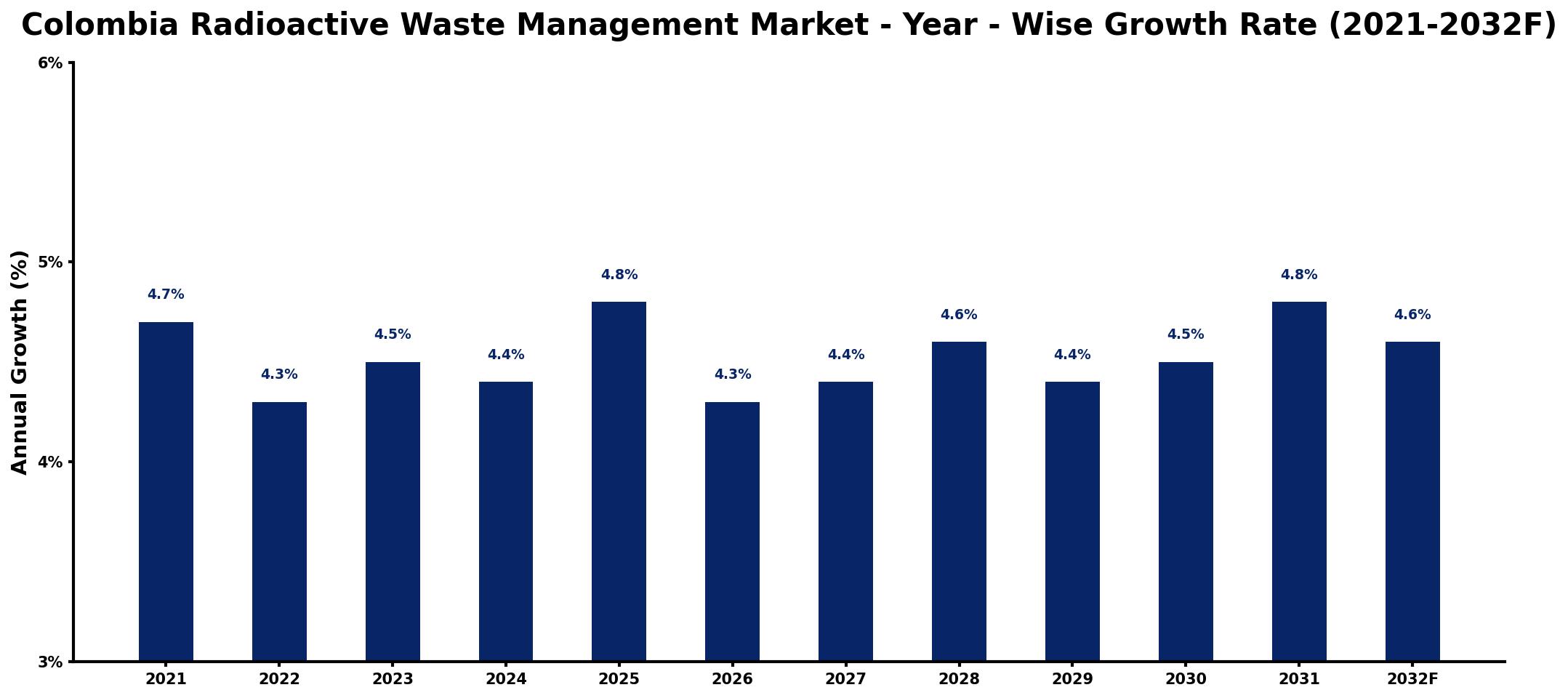
The table below presents the year‑wise growth rates along with the key drivers influencing the market
| Year | Growth Rate | Major Drivers |
| 2021 | 4.7% | Increased investment in environmental technologies |
| 2022 | 4.3% | Growing regulatory frameworks for safety |
| 2023 | 4.5% | Rising public awareness of sustainability |
| 2024 | 4.4% | Expansion of nuclear energy initiatives |
| 2025 | 4.8% | Technological advancements in disposal methods |
| 2026 | 4.3% | Strengthened international collaboration efforts |
| 2027 | 4.4% | Emerging markets for recycling solutions |
| 2028 | 4.6% | growing regional consumption patterns |
| 2029 | 4.4% | Growing demand for clean energy |
| 2030 | 4.5% | rising demand from electronics |
| 2031 | 4.8% | Development of innovative containment strategies |
| 2032 | 4.6% | Strengthened partnerships within industry sectors |
Note: Market size estimations and growth projections presented in this report are based on 6Wresearch's proprietary forecasting methodology, utilizing the latest available industry data, government publications, and primary research inputs.
Colombia Radioactive Waste Management Market Synopsis
A critical component driving the Colombia Radioactive Waste Management Market is the increasing generation of radioactive waste from nuclear power plants and healthcare facilities. As Colombia seeks to enhance its nuclear capabilities for energy generation, the demand for effective collection, treatment, and disposal of radioactive materials becomes paramount.
Moreover, the medical sector's reliance on radioisotopes for cancer treatment and diagnostic imaging is growing, which intensifies the urgency for compliant waste management solutions. This burgeoning demand requires innovative approaches to ensure that waste disposal aligns with environmental standards and public safety initiatives.
Colombia Radioactive Waste Management Market Key Takeaways
- The Colombian government is implementing stringent regulations to ensure safe handling and disposal of radioactive waste.
- Public awareness and concerns about radioactive waste are driving investments in waste management technologies and infrastructure.
- Technological advancements are enhancing the efficiency of waste treatment and disposal processes.
- Long-term storage and transportation of radioactive materials present unique logistical challenges in the market.
- Healthcare sector expansion significantly contributes to increasing volumes of radioactive waste generation.
Evaluation of Restraints in Colombia Radioactive Waste Management Market
While the market for radioactive waste management in Colombia is set for growth, it faces several limitations. Regulatory compliance remains a prominent challenge; navigating complex regulations requires significant investment from companies. Additionally, public perception of nuclear waste disposal can hinder the establishment of new facilities, as communities may resist having such sites located nearby. Furthermore, the absence of adequately equipped disposal facilities complicates the logistics surrounding waste transportation and long-term storage, increasing operational risks and costs for waste management providers.
Colombia Radioactive Waste Management Market Trends
One notable trend shaping the Colombia Radioactive Waste Management Market is the integration of digital technologies, such as IoT and AI, into waste management operations. These technologies enhance monitoring and reporting efficiencies, facilitating regulatory compliance and improving operational safety. Additionally, the push for sustainability is encouraging companies to explore more environmentally friendly waste management practices, such as recycling and repurposing materials where feasible.
Colombia Radioactive Waste Management Market Opportunities
Opportunities for growth within the Colombian radioactive waste management sector are expanding, particularly in developing advanced treatment technologies and expanding waste storage capacity. As public and private sectors increasingly collaborate on nuclear energy projects, there exists a growing need for comprehensive waste management plans. Furthermore, international partnerships could enhance knowledge sharing and bring in advanced technologies that can address the unique challenges faced by Colombia.
Government Initiatives in the Colombia Radioactive Waste Management Market
The Colombian government is taking proactive steps to ensure the responsible management of radioactive waste. This includes establishing clear policies that regulate the entire lifecycle of radioactive materials—from generation to disposal. Licensing requirements for waste management facilities are being enforced, alongside rigorous safety standards for transportation and storage. Public education initiatives are also underway, aimed at raising awareness about the risks associated with radioactive waste and the significance of safe management practices.
Future Insights of the Colombia Radioactive Waste Management Market
Looking ahead to 2026-2032, the Colombia Radioactive Waste Management Market is anticipated to evolve in response to increasing regulatory pressures and technological advancements. As Colombia continues to invest in its nuclear sector for energy generation, the demand for sophisticated waste management solutions will likely intensify. Moreover, heightened public and governmental scrutiny will drive innovation, focusing on safety, efficiency, and environmental sustainability in waste handling and disposal processes.
Colombia Radioactive Waste Management Market Latest Developments (2025 - 2026)
Recent developments in the Colombian radioactive waste management sector reflect a commitment to advancing safety and compliance. New regulatory measures are being introduced to streamline waste handling processes, while initiatives to enhance public engagement around radioactive waste issues are gaining momentum. Furthermore, there is a noticeable uptick in collaborations between public and private sectors, aiming to leverage innovative technologies for waste management and storage solutions.
Colombia Radioactive Waste Management Market - Key Attractiveness of the Report
- 10 Years of Market Numbers
- Historical Data Starting from 2022 to 2025
- Base Year: 2025
- Forecast Data until 2032
- Key Performance Indicators Impacting the Market
- Major Upcoming Developments and Projects
Key Highlights of the Report:
- Colombia Radioactive Waste Management Market Outlook
- Market Size of Colombia Radioactive Waste Management Market, 2025
- Forecast of Colombia Radioactive Waste Management Market, 2032
- Historical Data and Forecast of Colombia Radioactive Waste Management Revenues & Volume for the Period 2022-2032F
- Colombia Radioactive Waste Management Market Trend Evolution
- Colombia Radioactive Waste Management Market Drivers and Challenges
- Colombia Radioactive Waste Management Price Trends
- Colombia Radioactive Waste Management Porter's Five Forces
- Colombia Radioactive Waste Management Industry Life Cycle
- Historical Data and Forecast of Colombia Radioactive Waste Management Market Revenues & Volume By Type for the Period 2022-2032F
- Historical Data and Forecast of Colombia Radioactive Waste Management Market Revenues & Volume By Exempt Waste and Very Low-Level Waste(VLLW) for the Period 2022-2032F
- Historical Data and Forecast of Colombia Radioactive Waste Management Market Revenues & Volume By Low-Level Waste(LLW) for the Period 2022-2032F
- Historical Data and Forecast of Colombia Radioactive Waste Management Market Revenues & Volume By Intermediate-Level Waste(ILW) for the Period 2022-2032F
- Historical Data and Forecast of Colombia Radioactive Waste Management Market Revenues & Volume By High-Level Waste(HLW) for the Period 2022-2032F
- Historical Data and Forecast of Colombia Radioactive Waste Management Market Revenues & Volume By Application for the Period 2022-2032F
- Historical Data and Forecast of Colombia Radioactive Waste Management Market Revenues & Volume By Industrial for the Period 2022-2032F
- Historical Data and Forecast of Colombia Radioactive Waste Management Market Revenues & Volume By Utility for the Period 2022-2032F
- Colombia Radioactive Waste Management Import Export Trade Statistics
- Market Opportunity Assessment By Type
- Market Opportunity Assessment By Application
- Colombia Radioactive Waste Management Top Companies Market Share
- Colombia Radioactive Waste Management Competitive Benchmarking By Technical and Operational Parameters
- Colombia Radioactive Waste Management Company Profiles
- Colombia Radioactive Waste Management Key Strategic Recommendations






































