Colombia Retail Market Size, Share & Growth Rate
The Colombia Retail Market was estimated at USD 684 Million in 2025 and is projected to reach USD 1286 Million by 2032, growing at a CAGR of 9.4% from 2026 to 2032. This robust growth trajectory is fueled by an expanding middle class and increasing disposable incomes, which are driving demand for a wide range of retail products and services. Coupled with urbanization and advancements in e-commerce infrastructure, the market is poised for dynamic development as consumer behavior continues to evolve.
Colombia Retail Market Year-wise Growth Rate and Key Drivers
This graph highlights how the Colombia Retail Market has steadily grown over the years, supported by major growth factors.
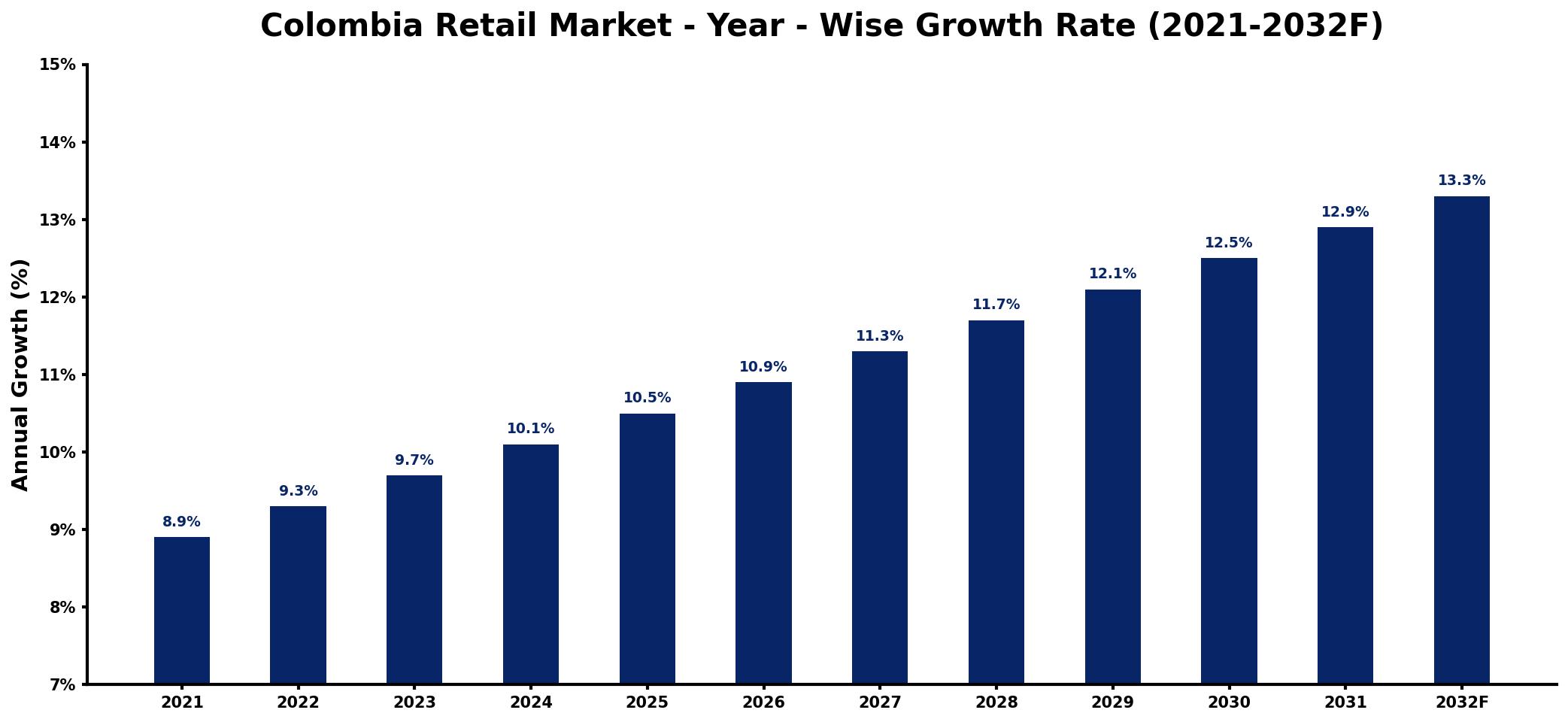
The table below presents the year‑wise growth rates along with the key drivers influencing the market
| Year | Growth Rate | Major Drivers |
| 2021 | 8.9% | Rising consumer spending habits |
| 2022 | 9.3% | Growth in e-commerce platforms |
| 2023 | 9.7% | Increased foreign investment influx |
| 2024 | 10.1% | Expansion of local brands presence |
| 2025 | 10.5% | Emergence of sustainable products |
| 2026 | 10.9% | Technological advancements in logistics |
| 2027 | 11.3% | Shift towards online shopping trends |
| 2028 | 11.7% | Growing demand for convenience stores |
| 2029 | 12.1% | Increase in urban population density |
| 2030 | 12.5% | Development of new shopping centers |
| 2031 | 12.9% | Surge in mobile payment adoption |
| 2032 | 13.3% | Diversification of consumer product offerings |
Note: Market size estimations and growth projections presented in this report are based on 6Wresearch's proprietary forecasting methodology, utilizing the latest available industry data, government publications, and primary research inputs.
Colombia Retail Market Synopsis
In recent years, Colombia's retail sector has emerged as a vibrant environment, showcasing a blend of traditional marketplaces and modern retail formats. Supermarkets, department stores, and shopping malls are thriving, catering to a consumer base that is increasingly seeking convenience and quality.
E-commerce is rapidly reshaping the landscape, with more Colombians embracing online shopping for its variety and ease. This digital transformation, coupled with a strong preference for international brands and sustainability, is driving retailers to adapt and innovate.
Colombia Retail Market Key Takeaways
- The retail sector is supported by a growing middle class with increasing purchasing power.
- Investment in e-commerce and omnichannel strategies is crucial for modern retailers.
- Consumer preferences are shifting towards sustainable and ethically sourced products.
- Infrastructure development is necessary to address logistical challenges in reaching consumers.
- Regulatory frameworks aim to promote fair competition and protect consumer rights.
Evaluation of Restraints in Colombia Retail Market
Despite the positive outlook, the Colombia retail market faces several constraints. The intense competition between domestic and international retailers creates significant pricing pressure, necessitating innovative differentiation strategies. Additionally, logistical inefficiencies stemming from inadequate infrastructure can hinder operations, particularly in less urbanized areas. Furthermore, political and economic instability can affect consumer confidence, leading to fluctuations in spending patterns. These factors underscore the need for retailers to navigate a complex regulatory environment while remaining agile in response to market dynamics.
Colombia Retail Market Trends
Several key trends are influencing the Colombia retail market. A notable rise in e-commerce has prompted traditional retailers to enhance their online offerings, ensuring a seamless shopping experience across digital and physical platforms. Moreover, there is a marked shift towards sustainability, with consumers increasingly favoring eco-friendly products and responsible business practices. Retailers are responding by integrating sustainable sourcing and transparent supply chains into their operations.
Additionally, advancements in data analytics and artificial intelligence are enabling businesses to create personalized shopping experiences, fostering customer loyalty in a competitive landscape. As these trends continue to evolve, retailers must remain adaptable to meet the shifting demands of consumers.
Colombia Retail Market Opportunities
The Colombia retail market offers a wealth of investment opportunities as consumer demand for quality products and services expands. Retailers can capitalize on the urbanization trend by exploring growth in secondary cities and towns, where infrastructure improvements are paving the way for retail expansion. The burgeoning e-commerce sector presents a unique avenue for online retailers, while established retail chains and franchising ventures also show promise. Innovating unique retail concepts that resonate with local consumer preferences can further enhance the attractiveness of this growing market.
Government Initiatives in the Colombia Retail Market
The Colombian government has implemented various initiatives to support the retail sector, promoting healthy competition and consumer protection. Policies such as free trade agreements and tax incentives are designed to foster a favorable business environment for retailers. Furthermore, regulations ensure consumer rights are upheld through safety standards and transparency requirements. The government also actively supports small and medium-sized enterprises in the retail space with funding programs and training initiatives, reflecting its commitment to stimulating economic growth in the sector.
Future Insights of the Colombia Retail Market
Looking ahead to 2026-2032, the Colombia retail market appears positioned for significant growth, driven by an improving economic landscape and rising consumer confidence. The ongoing urbanization and modernization of retail infrastructure will further enhance market opportunities. E-commerce is expected to continue its rapid expansion, creating new avenues for retailers to reach consumers. However, stakeholders must remain vigilant, as competition from international players and economic volatility could pose challenges. Overall, the focus on delivering diverse and personalized shopping experiences will be essential for success in this evolving market.
Colombia Retail Market Latest Developments (2025 - 2026)
In the past year, the Colombian retail market has witnessed a surge in investment towards digital transformation, with retailers emphasizing enhanced online platforms and integrated shopping experiences. Furthermore, initiatives focusing on sustainability have gained traction, as businesses increasingly adopt eco-friendly practices. Additionally, the government has introduced new regulatory frameworks aimed at easing market entry for foreign investors, thereby fostering a more competitive environment. These developments signal a proactive approach within the retail sector, striving to meet the demands of modern consumers.
Colombia Retail Market - Key Attractiveness of the Report
- 10 Years of Market Numbers
- Historical Data Starting from 2022 to 2025
- Base Year: 2025
- Forecast Data until 2032
- Key Performance Indicators Impacting the Market
- Major Upcoming Developments and Projects
Key Highlights of the Report:
- Colombia Retail Market Outlook
- Market Size of Colombia Retail Market, 2025
- Forecast of Colombia Retail Market, 2032
- Historical Data and Forecast of Colombia Retail Revenues & Volume for the Period 2022-2032F
- Colombia Retail Market Trend Evolution
- Colombia Retail Market Drivers and Challenges
- Colombia Retail Price Trends
- Colombia Retail Porter's Five Forces
- Colombia Retail Industry Life Cycle
- Historical Data and Forecast of Colombia Retail Market Revenues & Volume By Product for the Period 2022-2032F
- Historical Data and Forecast of Colombia Retail Market Revenues & Volume By Food and Beverages for the Period 2022-2032F
- Historical Data and Forecast of Colombia Retail Market Revenues & Volume By Personal and Household Care for the Period 2022-2032F
- Historical Data and Forecast of Colombia Retail Market Revenues & Volume By Apparel for the Period 2022-2032F
- Historical Data and Forecast of Colombia Retail Market Revenues & Volume By Footwear and Accessories for the Period 2022-2032F
- Historical Data and Forecast of Colombia Retail Market Revenues & Volume By Furniture for the Period 2022-2032F
- Historical Data and Forecast of Colombia Retail Market Revenues & Volume By Toys for the Period 2022-2032F
- Historical Data and Forecast of Colombia Retail Market Revenues & Volume By Electronic and Household Appliances for the Period 2022-2032F
- Historical Data and Forecast of Colombia Food and Beverages Retail Market Revenues & Volume By Other Products for the Period 2022-2032F
- Historical Data and Forecast of Colombia Retail Market Revenues & Volume By Distribution Channel for the Period 2022-2032F
- Historical Data and Forecast of Colombia Retail Market Revenues & Volume By Supermarkets/Hypermarkets for the Period 2022-2032F
- Historical Data and Forecast of Colombia Retail Market Revenues & Volume By Convenience Stores for the Period 2022-2032F
- Historical Data and Forecast of Colombia Retail Market Revenues & Volume By Department Stores for the Period 2022-2032F
- Historical Data and Forecast of Colombia Retail Market Revenues & Volume By Specialty Stores for the Period 2022-2032F
- Historical Data and Forecast of Colombia Retail Market Revenues & Volume By Online for the Period 2022-2032F
- Historical Data and Forecast of Colombia Retail Market Revenues & Volume By Other Distribution Channels for the Period 2022-2032F
- Colombia Retail Import Export Trade Statistics
- Market Opportunity Assessment By Product
- Market Opportunity Assessment By Distribution Channel
- Colombia Retail Top Companies Market Share
- Colombia Retail Competitive Benchmarking By Technical and Operational Parameters
- Colombia Retail Company Profiles
- Colombia Retail Key Strategic Recommendations






































