Colombia Ultra Thin Glass Market Size, Share & Growth Rate
The Colombia Ultra Thin Glass Market was estimated at USD 929 Million in 2025 and is projected to reach USD 1324 Million by 2032, growing at a CAGR of 5.2% from 2026 to 2032. This trajectory is primarily fueled by increasing demand across multiple sectors, especially electronics and automotive, where lightweight and high-performance materials are becoming essential. Additionally, the architectural glazing sector is embracing ultra-thin glass for its aesthetic and functional benefits, further enhancing market growth.
Colombia Ultra Thin Glass Market Year-wise Growth Rate and Key Drivers
This graph highlights how the Colombia Ultra Thin Glass Market has steadily grown over the years, supported by major growth factors.
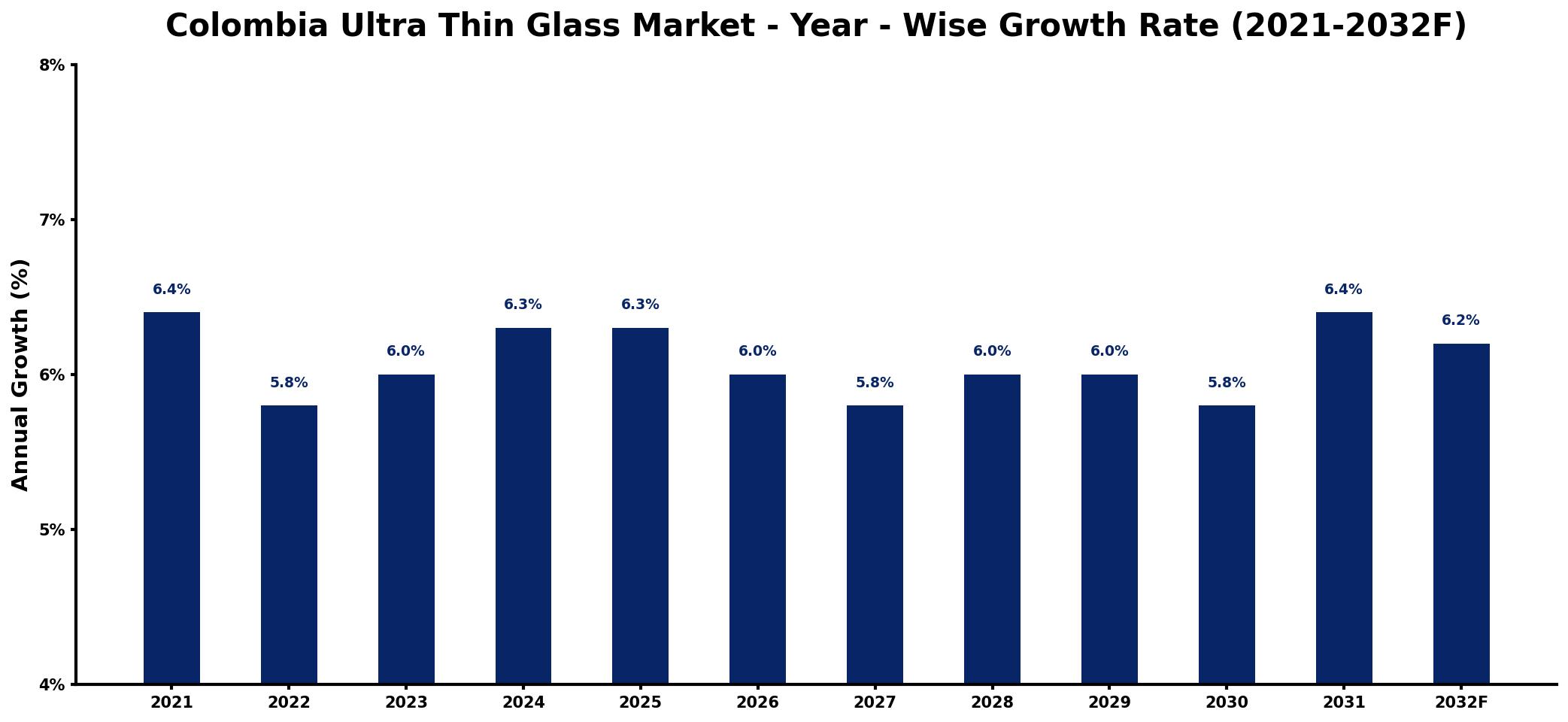
The table below presents the year‑wise growth rates along with the key drivers influencing the market
| Year | Growth Rate | Major Drivers |
| 2021 | 6.4% | Rising demand from construction industry |
| 2022 | 5.8% | Increased investment in technology |
| 2023 | 6.0% | Growing interest in sustainable materials |
| 2024 | 6.3% | Expansion of electronic device market |
| 2025 | 6.3% | Boost in automotive sector applications |
| 2026 | 6.0% | Surge in architectural design trends |
| 2027 | 5.8% | Development of renewable energy projects |
| 2028 | 6.0% | Increase in consumer electronics production |
| 2029 | 6.0% | Growth of luxury home market |
| 2030 | 5.8% | Emergence of smart building technologies |
| 2031 | 6.4% | Rising popularity of minimalist design |
| 2032 | 6.2% | rising procurement volume requirements |
Note: Market size estimations and growth projections presented in this report are based on 6Wresearch's proprietary forecasting methodology, utilizing the latest available industry data, government publications, and primary research inputs.
Colombia Ultra Thin Glass Market Synopsis
The most significant force shaping the Colombia Ultra Thin Glass Market is the surge in consumer electronics driven by the trend toward miniaturization and sleek design. These advancements necessitate the integration of ultra-thin glass in various applications, from smartphones to cutting-edge foldable displays.
Moreover, the automotive industry is transitioning to more sophisticated display technologies, boosting the demand for ultra-thin glass solutions. This shift not only enhances vehicle aesthetics but also improves functionality, positioning the market for sustained growth.
Colombia Ultra Thin Glass Market Key Takeaways
- The market is driven by innovations in glass manufacturing techniques enhancing strength and flexibility.
- Consumer electronics, automotive, and construction sectors are the primary adopters of ultra-thin glass.
- New applications such as wearable devices are creating fresh demand in the market.
- Regulatory standards will continue to influence quality and production processes in the industry.
- Increased focus on design aesthetics and performance in electronics is propelling market dynamics.
Evaluation of Restraints in Colombia Ultra Thin Glass Market
Despite its promising growth, the Colombia Ultra Thin Glass Market faces significant challenges. The need for consistent quality and performance can hinder manufacturers, as achieving precise thickness control and ensuring surface finishing during production are critical. Transportation and handling issues further complicate the production process, often resulting in increased costs and potential delays. Moreover, as emerging technologies evolve, the demand for compatibility with various applications will pose ongoing challenges for stakeholders.
Colombia Ultra Thin Glass Market Trends
Current trends in the Colombia Ultra Thin Glass Market indicate a clear move towards sustainable practices. As environmental concerns grow, there is an increasing emphasis on eco-friendly production methods, which may soon influence manufacturing practices across the board. Additionally, the integration of smart glass technology—where glass can change properties in response to external stimuli—represents a significant trend that could redefine architectural and automotive applications.
Colombia Ultra Thin Glass Market Opportunities
Genuine growth opportunities lie within the expansion of foldable and flexible display technologies, particularly in consumer electronics. As companies innovate to produce thinner and lighter products, ultra-thin glass is poised to become an integral component. Furthermore, the rising trend of sustainable building practices offers potential for increased demand in architectural applications, as ultra-thin glass provides both aesthetic value and energy efficiency.
Government Initiatives in the Colombia Ultra Thin Glass Market
Government regulations surrounding the ultra-thin glass market primarily revolve around manufacturing standards and building codes. Compliance with safety regulations for electronic displays and architectural glazing products is becoming increasingly stringent. Public spending initiatives aimed at modernizing infrastructure, including green building certifications, will likely provide additional avenues for growth within the sector, promoting sustainable practices in ultra-thin glass production.
Future Insights of the Colombia Ultra Thin Glass Market
Looking ahead to 2026-2032, the Colombia Ultra Thin Glass Market is expected to navigate a landscape characterized by technological innovation and heightened demand across multiple sectors. As manufacturers adopt advanced techniques to enhance product performance, the market will likely see increased penetration in new applications, including smart textiles and augmented reality devices. The drive for sustainability and efficiency will further compel industries to invest in ultra-thin glass solutions, solidifying its position as a pivotal material for the future.
Colombia Ultra Thin Glass Market Latest Developments (2025 - 2026)
Recent developments in the Colombia Ultra Thin Glass Market show a notable shift towards enhanced manufacturing processes, with advancements aimed at increasing yield while reducing waste. The exploration of partnerships between technology firms and glass manufacturers is also gaining momentum, focusing on integrating ultra-thin glass into innovative product designs. Furthermore, ongoing discussions about regulatory changes are expected to shape the landscape for quality assurance in the coming years, ensuring the market adapts to emerging standards.
Colombia Ultra Thin Glass Market - Key Attractiveness of the Report
- 10 Years of Market Numbers
- Historical Data Starting from 2022 to 2025
- Base Year: 2025
- Forecast Data until 2032
- Key Performance Indicators Impacting the Market
- Major Upcoming Developments and Projects
Key Highlights of the Report:
- Colombia Ultra Thin Glass Market Outlook
- Market Size of Colombia Ultra Thin Glass Market, 2025
- Forecast of Colombia Ultra Thin Glass Market, 2032
- Historical Data and Forecast of Colombia Ultra Thin Glass Revenues & Volume for the Period 2022-2032F
- Colombia Ultra Thin Glass Market Trend Evolution
- Colombia Ultra Thin Glass Market Drivers and Challenges
- Colombia Ultra Thin Glass Price Trends
- Colombia Ultra Thin Glass Porter's Five Forces
- Colombia Ultra Thin Glass Industry Life Cycle
- Historical Data and Forecast of Colombia Ultra Thin Glass Market Revenues & Volume By Thickness for the Period 2022-2032F
- Historical Data and Forecast of Colombia Ultra Thin Glass Market Revenues & Volume By <0.1mm for the Period 2022-2032F
- Historical Data and Forecast of Colombia Ultra Thin Glass Market Revenues & Volume By 0.1mm-0.5mm for the Period 2022-2032F
- Historical Data and Forecast of Colombia Ultra Thin Glass Market Revenues & Volume By 0.5mm-1.0mm for the Period 2022-2032F
- Historical Data and Forecast of Colombia Ultra Thin Glass Market Revenues & Volume By Manufacturing Process for the Period 2022-2032F
- Historical Data and Forecast of Colombia Ultra Thin Glass Market Revenues & Volume By Float for the Period 2022-2032F
- Historical Data and Forecast of Colombia Ultra Thin Glass Market Revenues & Volume By Fusion for the Period 2022-2032F
- Historical Data and Forecast of Colombia Ultra Thin Glass Market Revenues & Volume By Down-Draw for the Period 2022-2032F
- Historical Data and Forecast of Colombia Ultra Thin Glass Market Revenues & Volume By Application for the Period 2022-2032F
- Historical Data and Forecast of Colombia Ultra Thin Glass Market Revenues & Volume By Semiconductor Substrate for the Period 2022-2032F
- Historical Data and Forecast of Colombia Ultra Thin Glass Market Revenues & Volume By Touch Panel Display for the Period 2022-2032F
- Historical Data and Forecast of Colombia Ultra Thin Glass Market Revenues & Volume By Fingerprint Sensor for the Period 2022-2032F
- Historical Data and Forecast of Colombia Ultra Thin Glass Market Revenues & Volume By Others for the Period 2022-2032F
- Historical Data and Forecast of Colombia Ultra Thin Glass Market Revenues & Volume By End-use Industry for the Period 2022-2032F
- Historical Data and Forecast of Colombia Ultra Thin Glass Market Revenues & Volume By Consumer Electronics for the Period 2022-2032F
- Historical Data and Forecast of Colombia Ultra Thin Glass Market Revenues & Volume By Automotive & Transportation for the Period 2022-2032F
- Historical Data and Forecast of Colombia Ultra Thin Glass Market Revenues & Volume By Medical & Healthcare for the Period 2022-2032F
- Historical Data and Forecast of Colombia Ultra Thin Glass Market Revenues & Volume By Others for the Period 2022-2032F
- Colombia Ultra Thin Glass Import Export Trade Statistics
- Market Opportunity Assessment By Thickness
- Market Opportunity Assessment By Manufacturing Process
- Market Opportunity Assessment By Application
- Market Opportunity Assessment By End-use Industry
- Colombia Ultra Thin Glass Top Companies Market Share
- Colombia Ultra Thin Glass Competitive Benchmarking By Technical and Operational Parameters
- Colombia Ultra Thin Glass Company Profiles
- Colombia Ultra Thin Glass Key Strategic Recommendations






































