Czech Republic Ultra Thin Glass Market Size, Share & Growth Rate
The Czech Republic Ultra Thin Glass Market was estimated at USD 285 Million in 2025 and is projected to reach USD 381 Million by 2032, growing at a CAGR of 4.2% from 2026 to 2032. This trajectory is primarily driven by the burgeoning demand from sectors such as consumer electronics and construction, where lightweight, high-strength materials are increasingly sought after. Additionally, the push towards sustainable construction practices amplifies the adoption of ultra-thin glass in energy-efficient building designs, propelling market dynamics.
Czech Republic Ultra Thin Glass Market Year-wise Growth Rate and Key Drivers
This graph highlights how the Czech Republic Ultra Thin Glass Market has steadily grown over the years, supported by major growth factors.
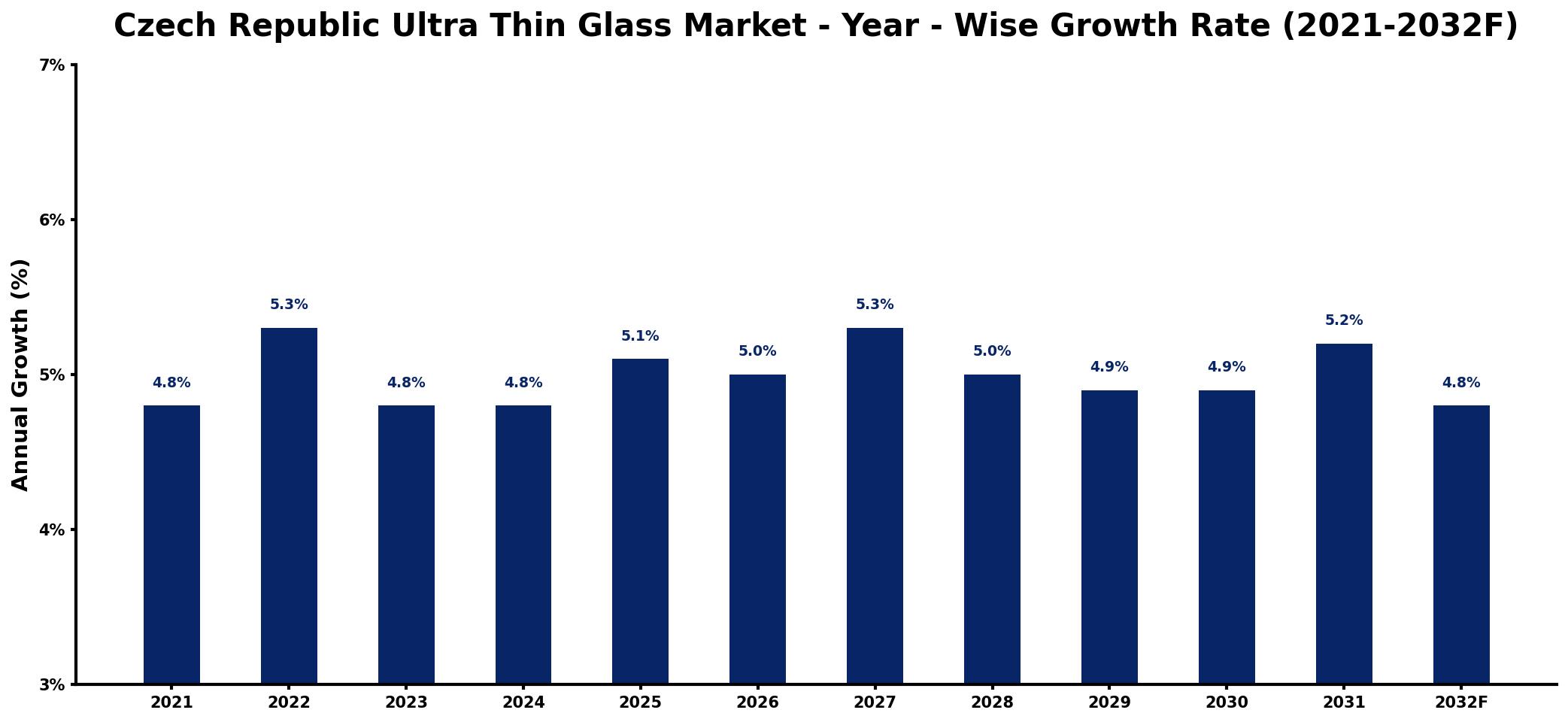
The table below presents the year‑wise growth rates along with the key drivers influencing the market
| Year | Growth Rate | Major Drivers |
| 2021 | 4.8% | Rising demand from electronics sector |
| 2022 | 5.3% | Increased investments in renewable energy |
| 2023 | 4.8% | Growing popularity in automotive applications |
| 2024 | 4.8% | Expansion of construction projects nationwide |
| 2025 | 5.1% | Technological advancements enhancing production |
| 2026 | 5.0% | Emerging trends in sustainable design |
| 2027 | 5.3% | Boost in consumer electronics innovation |
| 2028 | 5.0% | Heightened focus on energy efficiency |
| 2029 | 4.9% | Increased use in architectural designs |
| 2030 | 4.9% | Growing preference for lightweight materials |
| 2031 | 5.2% | growing commercial sector adoption |
| 2032 | 4.8% | Rising applications in smart technology |
Note: Market size estimations and growth projections presented in this report are based on 6Wresearch's proprietary forecasting methodology, utilizing the latest available industry data, government publications, and primary research inputs.
Czech Republic Ultra Thin Glass Market Synopsis
Recently, the Czech Republic has witnessed a notable uptick in ultra-thin glass applications, particularly within the consumer electronics realm, as manufacturers strive for more innovative and lightweight designs. This momentum is expected to escalate, given the market's adaptability to advancements in manufacturing technologies and growing environmental concerns.
Looking ahead, the market is poised for consistent growth, driven by research and development efforts that aim to enhance production efficiency and product capabilities. As various industries expand their use of ultra-thin glass, from automotive displays to sophisticated architectural designs, the landscape will transform, presenting new challenges and opportunities.
Czech Republic Ultra Thin Glass Market Key Takeaways
- Significant growth anticipated from the electronics and construction sectors, with increased demand for lightweight materials.
- Innovation in manufacturing processes is fostering cost-effective production, thereby enhancing market accessibility.
- Environmental consciousness among builders and homeowners is driving the use of ultra-thin glass in sustainable construction.
- The competitive landscape remains challenging, with established international brands holding substantial market share.
- Research collaborations between the government and academic institutions are expected to further propel market advancements.
Evaluation of Restraints in Czech Republic Ultra Thin Glass Market
Despite its robust growth trajectory, the Czech Republic ultra-thin glass market faces several constraints. The high production costs associated with specialized manufacturing processes limit access for emerging players, creating a landscape where established brands maintain a competitive edge through economies of scale. Furthermore, the market is vulnerable to fluctuations in demand from key industries, particularly electronics and automotive, which can introduce volatility. There is also a pressing need for continuous innovation to keep pace with evolving consumer preferences and technological advancements.
Czech Republic Ultra Thin Glass Market Trends
Several trends are currently influencing the Czech Republic ultra-thin glass market. The rise of smart devices is driving the demand for thinner and more durable display technologies, making ultra-thin glass an essential material. Concurrently, the construction industry is increasingly embracing glass solutions for their aesthetic appeal and energy efficiency, aligning with global sustainability goals. Additionally, the integration of advanced manufacturing techniques, such as automated processes and improved coating technologies, is further enhancing product performance.
Czech Republic Ultra Thin Glass Market Opportunities
Opportunities abound for growth in the Czech Republic ultra-thin glass market, particularly as demand for innovative applications expands. Investments in research and development can lead to breakthroughs in product capabilities, appealing to various sectors. Moreover, the ongoing shift towards energy-efficient construction presents a lucrative avenue for the adoption of ultra-thin glass in building designs. Collaborations with tech companies to develop cutting-edge applications in display technologies also represent significant growth potential.
Government Initiatives in the Czech Republic Ultra Thin Glass Market
The Czech government is actively fostering an environment conducive to innovation and technological advancement within the ultra-thin glass market. By supporting research and development initiatives in material science, the government encourages collaboration between industry and academia. Additionally, policies aimed at promoting environmentally sustainable practices are influencing manufacturing processes and waste management in the sector, ultimately aligning with global sustainability targets.
Future Insights of the Czech Republic Ultra Thin Glass Market
As we look to the future, the Czech Republic ultra-thin glass market is expected to evolve significantly between 2026 and 2032. The continual demand for lighter and more durable materials in consumer electronics will be a primary driver. Simultaneously, advancements in manufacturing technology are likely to enhance production efficiency, reducing costs and expanding accessibility for local manufacturers. With increasing environmental regulations, the market may also see a pivot towards more sustainable manufacturing practices, paving the way for a broader acceptance of ultra-thin glass in various applications.
Czech Republic Ultra Thin Glass Market Latest Developments (2025 - 2026)
In recent months, the Czech Republic ultra-thin glass market has seen a flurry of activity, driven by technological advancements and rising consumer demand. Notably, several companies are exploring collaborations to develop innovative glass solutions tailored for both electronics and architectural applications. Research initiatives focused on enhancing the performance characteristics of ultra-thin glass are gaining momentum, with a clear focus on meeting stringent environmental standards. Additionally, manufacturers are increasingly investing in automation technologies to streamline production processes, highlighting a trend towards efficiency and sustainability.
Czech Republic Ultra Thin Glass Market - Key Attractiveness of the Report
- 10 Years of Market Numbers
- Historical Data Starting from 2022 to 2025
- Base Year: 2025
- Forecast Data until 2032
- Key Performance Indicators Impacting the Market
- Major Upcoming Developments and Projects
Key Highlights of the Report:
- Czech Republic Ultra Thin Glass Market Outlook
- Market Size of Czech Republic Ultra Thin Glass Market, 2025
- Forecast of Czech Republic Ultra Thin Glass Market, 2032
- Historical Data and Forecast of Czech Republic Ultra Thin Glass Revenues & Volume for the Period 2022-2032F
- Czech Republic Ultra Thin Glass Market Trend Evolution
- Czech Republic Ultra Thin Glass Market Drivers and Challenges
- Czech Republic Ultra Thin Glass Price Trends
- Czech Republic Ultra Thin Glass Porter's Five Forces
- Czech Republic Ultra Thin Glass Industry Life Cycle
- Historical Data and Forecast of Czech Republic Ultra Thin Glass Market Revenues & Volume By Thickness for the Period 2022-2032F
- Historical Data and Forecast of Czech Republic Ultra Thin Glass Market Revenues & Volume By <0.1mm for the Period 2022-2032F
- Historical Data and Forecast of Czech Republic Ultra Thin Glass Market Revenues & Volume By 0.1mm-0.5mm for the Period 2022-2032F
- Historical Data and Forecast of Czech Republic Ultra Thin Glass Market Revenues & Volume By 0.5mm-1.0mm for the Period 2022-2032F
- Historical Data and Forecast of Czech Republic Ultra Thin Glass Market Revenues & Volume By Manufacturing Process for the Period 2022-2032F
- Historical Data and Forecast of Czech Republic Ultra Thin Glass Market Revenues & Volume By Float for the Period 2022-2032F
- Historical Data and Forecast of Czech Republic Ultra Thin Glass Market Revenues & Volume By Fusion for the Period 2022-2032F
- Historical Data and Forecast of Czech Republic Ultra Thin Glass Market Revenues & Volume By Down-Draw for the Period 2022-2032F
- Historical Data and Forecast of Czech Republic Ultra Thin Glass Market Revenues & Volume By Application for the Period 2022-2032F
- Historical Data and Forecast of Czech Republic Ultra Thin Glass Market Revenues & Volume By Semiconductor Substrate for the Period 2022-2032F
- Historical Data and Forecast of Czech Republic Ultra Thin Glass Market Revenues & Volume By Touch Panel Display for the Period 2022-2032F
- Historical Data and Forecast of Czech Republic Ultra Thin Glass Market Revenues & Volume By Fingerprint Sensor for the Period 2022-2032F
- Historical Data and Forecast of Czech Republic Ultra Thin Glass Market Revenues & Volume By Others for the Period 2022-2032F
- Historical Data and Forecast of Czech Republic Ultra Thin Glass Market Revenues & Volume By End-use Industry for the Period 2022-2032F
- Historical Data and Forecast of Czech Republic Ultra Thin Glass Market Revenues & Volume By Consumer Electronics for the Period 2022-2032F
- Historical Data and Forecast of Czech Republic Ultra Thin Glass Market Revenues & Volume By Automotive & Transportation for the Period 2022-2032F
- Historical Data and Forecast of Czech Republic Ultra Thin Glass Market Revenues & Volume By Medical & Healthcare for the Period 2022-2032F
- Historical Data and Forecast of Czech Republic Ultra Thin Glass Market Revenues & Volume By Others for the Period 2022-2032F
- Czech Republic Ultra Thin Glass Import Export Trade Statistics
- Market Opportunity Assessment By Thickness
- Market Opportunity Assessment By Manufacturing Process
- Market Opportunity Assessment By Application
- Market Opportunity Assessment By End-use Industry
- Czech Republic Ultra Thin Glass Top Companies Market Share
- Czech Republic Ultra Thin Glass Competitive Benchmarking By Technical and Operational Parameters
- Czech Republic Ultra Thin Glass Company Profiles
- Czech Republic Ultra Thin Glass Key Strategic Recommendations






































