United Kingdom (UK) Ultra Thin Glass Market Size, Share & Growth Rate
The United Kingdom (UK) Ultra Thin Glass Market was estimated at USD 248 Million in 2025 and is projected to reach USD 309 Million by 2032, growing at a CAGR of 3.2% from 2026 to 2032. This growth trajectory reflects the increasing demand for high-performance glass substrates driven by advancements in display technologies and the proliferation of flexible electronics. As industries continue to innovate, ultra-thin glass is positioned to play a crucial role in the design and functionality of next-generation devices across various applications.
United Kingdom (UK) Ultra Thin Glass Market Year-wise Growth Rate and Key Drivers
This graph highlights how the United Kingdom (UK) Ultra Thin Glass Market has steadily grown over the years, supported by major growth factors.
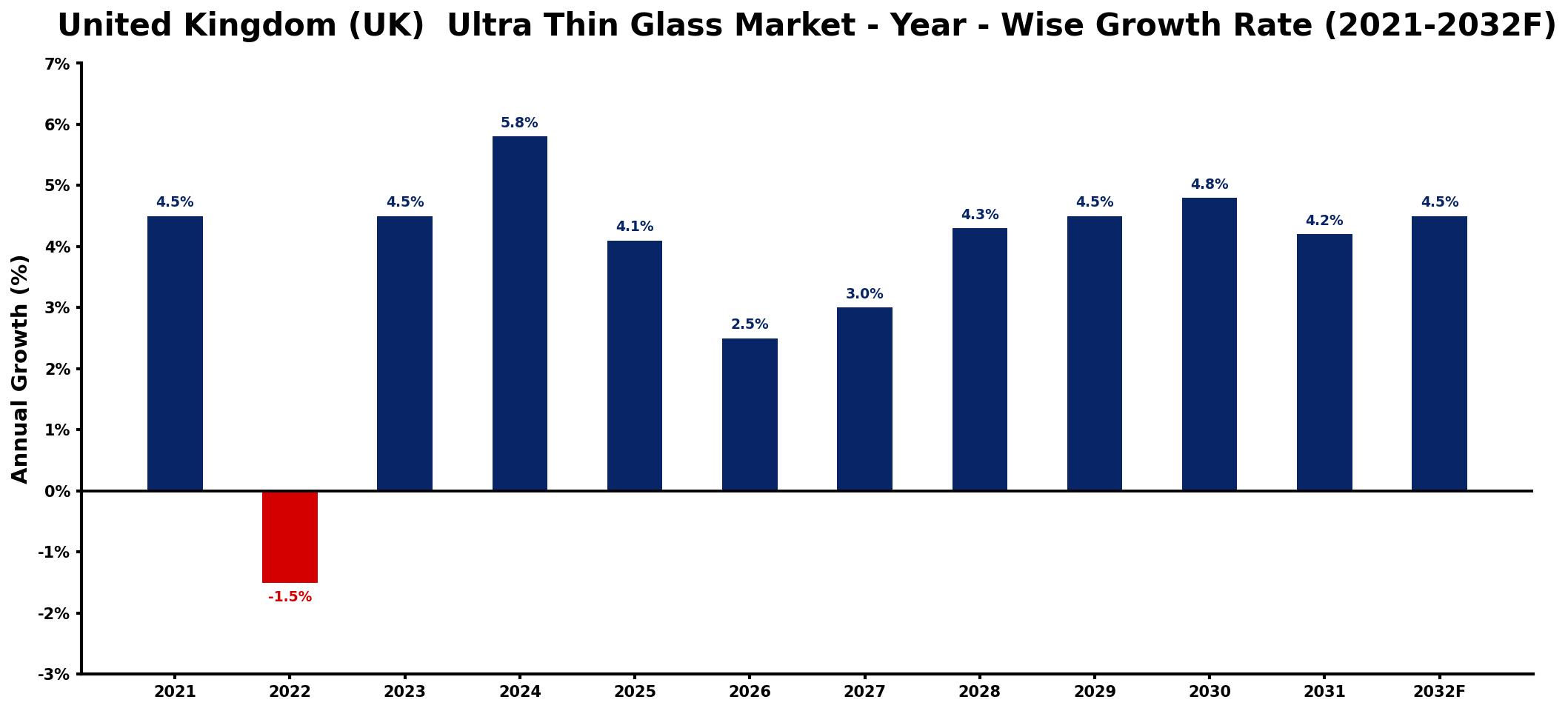
The table below presents the year‑wise growth rates along with the key drivers influencing the market
| Year | Growth Rate | Major Drivers |
| 2021 | 4.5% | Rising demand from electronics sector |
| 2022 | -1.5% | Slowdown in construction investments |
| 2023 | 4.5% | Increased applications in automotive sector |
| 2024 | 5.8% | Growth in renewable energy projects |
| 2025 | 4.1% | Expansion of consumer electronics market |
| 2026 | 2.5% | Surge in architectural innovations |
| 2027 | 3.0% | Advancements in mobile technology usage |
| 2028 | 4.3% | Higher investments in technology startups |
| 2029 | 4.5% | Emerging trends in smart homes |
| 2030 | 4.8% | Increased focus on sustainability practices |
| 2031 | 4.2% | Growing interest in luxury products |
| 2032 | 4.5% | growing automotive sector requirements |
Note: Market size estimations and growth projections presented in this report are based on 6Wresearch's proprietary forecasting methodology, utilizing the latest available industry data, government publications, and primary research inputs.
United Kingdom (UK) Ultra Thin Glass Market Synopsis
A notable trend in the UK ultra-thin glass market is the growing utilization of these materials in smartphones and tablets, where lightweight and durable substrates are essential. The rising popularity of OLED displays and solar panels further underscores the market's potential, as consumers and manufacturers alike seek enhanced optical clarity and mechanical performance.
To accommodate evolving consumer preferences, manufacturers are focusing on innovations in glass fabrication techniques. This includes advancements in chemical strengthening and roll-to-roll production methods, which not only improve product quality but also enhance manufacturing efficiency, thereby aligning with sustainability goals in the industry.
United Kingdom (UK) Ultra Thin Glass Market Key Takeaways
- Market growth is propelled by technological advancements in display and electronic manufacturing.
- Ultra-thin glass is increasingly used in flexible and curved devices, enhancing user experience.
- Regulatory frameworks support product safety and environmental sustainability in glass manufacturing.
- Competition from global manufacturers and alternative materials is intensifying market dynamics.
- Investment in advanced glass processing technologies is critical for maintaining competitive advantage.
Evaluation of Restraints in United Kingdom (UK) Ultra Thin Glass Market
Despite its growth potential, the UK ultra-thin glass market faces several restraints that could hinder its progress. The inherent fragility of ultra-thin materials poses risks during manufacturing and end-user applications, demanding higher standards in production and handling. Furthermore, competition from established global manufacturers and alternative substrate materials complicates the landscape, as stakeholders must differentiate their offerings to capture market share. Additionally, adherence to stringent regulatory standards for product durability and optical clarity adds complexity to compliance processes and product development timelines.
United Kingdom (UK) Ultra Thin Glass Market Trends
Current trends in the UK ultra-thin glass market highlight a significant shift towards sustainable manufacturing practices. Manufacturers are increasingly exploring eco-friendly glass recycling initiatives and energy-efficient production methods. Moreover, advancements in coating technologies are enabling higher performance in optical applications, positioning ultra-thin glass as a preferred choice for next-generation electronic devices. The rise of personalized consumer electronics is also influencing design choices, leading to increased demand for customizable glass solutions.
United Kingdom (UK) Ultra Thin Glass Market Opportunities
Genuine growth opportunities in the UK ultra-thin glass market lie in the intersection of technology and sustainability. Investments in R&D for novel glass processing techniques, such as hybrid materials that combine properties of glass and other substrates, present a pathway for innovation. Collaborations with electronic OEMs and optical engineers can lead to tailored solutions that meet specific industry needs. Furthermore, as the market shifts towards flexible and foldable devices, companies that adapt quickly will likely capture a larger share of the emerging segments.
Government Initiatives in the United Kingdom (UK) Ultra Thin Glass Market
The UK government emphasizes the importance of innovation in display technologies and electronic manufacturing through various policies. Regulatory frameworks are in place to ensure the safety and performance standards of ultra-thin glass products, which further supports the industry's growth. Public spending initiatives aimed at research and development in sustainable manufacturing processes, including float glass production and recycling strategies, demonstrate a commitment to fostering a competitive and environmentally responsible sector.
Future Insights of the United Kingdom (UK) Ultra Thin Glass Market
Looking ahead to 2026-2032, the UK ultra-thin glass market is expected to continue its upward trajectory, driven by ongoing advancements in technology and materials science. The increasing integration of smart technologies into everyday devices will further elevate the demand for high-quality glass substrates. As consumer preferences shift towards more versatile and adaptable electronics, manufacturers must remain agile, investing in innovation and sustainable practices to meet evolving market needs.
United Kingdom (UK) Ultra Thin Glass Market Latest Developments (2025 - 2026)
Recent developments in the UK ultra-thin glass market indicate a growing emphasis on sustainable manufacturing practices and the enhancement of product performance. Innovations in glass coating technologies are allowing manufacturers to produce substrates that not only meet but exceed current industry standards for durability and optical clarity. Additionally, collaborations between glass manufacturers and technology firms are becoming more common, paving the way for the introduction of highly customized glass solutions tailored to specific applications in the electronics sector.
United Kingdom (UK) Ultra Thin Glass Market - Key Attractiveness of the Report
- 10 Years of Market Numbers
- Historical Data Starting from 2022 to 2025
- Base Year: 2025
- Forecast Data until 2032
- Key Performance Indicators Impacting the Market
- Major Upcoming Developments and Projects
Key Highlights of the Report:
- United Kingdom (UK) Ultra Thin Glass Market Outlook
- Market Size of United Kingdom (UK) Ultra Thin Glass Market, 2025
- Forecast of United Kingdom (UK) Ultra Thin Glass Market, 2032
- Historical Data and Forecast of United Kingdom (UK) Ultra Thin Glass Revenues & Volume for the Period 2022-2032F
- United Kingdom (UK) Ultra Thin Glass Market Trend Evolution
- United Kingdom (UK) Ultra Thin Glass Market Drivers and Challenges
- United Kingdom (UK) Ultra Thin Glass Price Trends
- United Kingdom (UK) Ultra Thin Glass Porter's Five Forces
- United Kingdom (UK) Ultra Thin Glass Industry Life Cycle
- Historical Data and Forecast of United Kingdom (UK) Ultra Thin Glass Market Revenues & Volume By Thickness for the Period 2022-2032F
- Historical Data and Forecast of United Kingdom (UK) Ultra Thin Glass Market Revenues & Volume By <0.1mm for the Period 2022-2032F
- Historical Data and Forecast of United Kingdom (UK) Ultra Thin Glass Market Revenues & Volume By 0.1mm-0.5mm for the Period 2022-2032F
- Historical Data and Forecast of United Kingdom (UK) Ultra Thin Glass Market Revenues & Volume By 0.5mm-1.0mm for the Period 2022-2032F
- Historical Data and Forecast of United Kingdom (UK) Ultra Thin Glass Market Revenues & Volume By Manufacturing Process for the Period 2022-2032F
- Historical Data and Forecast of United Kingdom (UK) Ultra Thin Glass Market Revenues & Volume By Float for the Period 2022-2032F
- Historical Data and Forecast of United Kingdom (UK) Ultra Thin Glass Market Revenues & Volume By Fusion for the Period 2022-2032F
- Historical Data and Forecast of United Kingdom (UK) Ultra Thin Glass Market Revenues & Volume By Down-Draw for the Period 2022-2032F
- Historical Data and Forecast of United Kingdom (UK) Ultra Thin Glass Market Revenues & Volume By Application for the Period 2022-2032F
- Historical Data and Forecast of United Kingdom (UK) Ultra Thin Glass Market Revenues & Volume By Semiconductor Substrate for the Period 2022-2032F
- Historical Data and Forecast of United Kingdom (UK) Ultra Thin Glass Market Revenues & Volume By Touch Panel Display for the Period 2022-2032F
- Historical Data and Forecast of United Kingdom (UK) Ultra Thin Glass Market Revenues & Volume By Fingerprint Sensor for the Period 2022-2032F
- Historical Data and Forecast of United Kingdom (UK) Ultra Thin Glass Market Revenues & Volume By Others for the Period 2022-2032F
- Historical Data and Forecast of United Kingdom (UK) Ultra Thin Glass Market Revenues & Volume By End-use Industry for the Period 2022-2032F
- Historical Data and Forecast of United Kingdom (UK) Ultra Thin Glass Market Revenues & Volume By Consumer Electronics for the Period 2022-2032F
- Historical Data and Forecast of United Kingdom (UK) Ultra Thin Glass Market Revenues & Volume By Automotive & Transportation for the Period 2022-2032F
- Historical Data and Forecast of United Kingdom (UK) Ultra Thin Glass Market Revenues & Volume By Medical & Healthcare for the Period 2022-2032F
- Historical Data and Forecast of United Kingdom (UK) Ultra Thin Glass Market Revenues & Volume By Others for the Period 2022-2032F
- United Kingdom (UK) Ultra Thin Glass Import Export Trade Statistics
- Market Opportunity Assessment By Thickness
- Market Opportunity Assessment By Manufacturing Process
- Market Opportunity Assessment By Application
- Market Opportunity Assessment By End-use Industry
- United Kingdom (UK) Ultra Thin Glass Top Companies Market Share
- United Kingdom (UK) Ultra Thin Glass Competitive Benchmarking By Technical and Operational Parameters
- United Kingdom (UK) Ultra Thin Glass Company Profiles
- United Kingdom (UK) Ultra Thin Glass Key Strategic Recommendations






































