Colombia Wine production Machinery Market Summary
The colombia wine production machinery market was estimated at USD 266 Million in 2025 and is projected to reach USD 357 Million by 2032, growing at a CAGR of 5.1% from 2026 to 2032.
Colombia Wine production Machinery Market Year-wise Growth Rate and Key Drivers
This graph highlights how the Colombia Wine production Machinery Market has steadily grown over the past five years, supported by major growth factors.
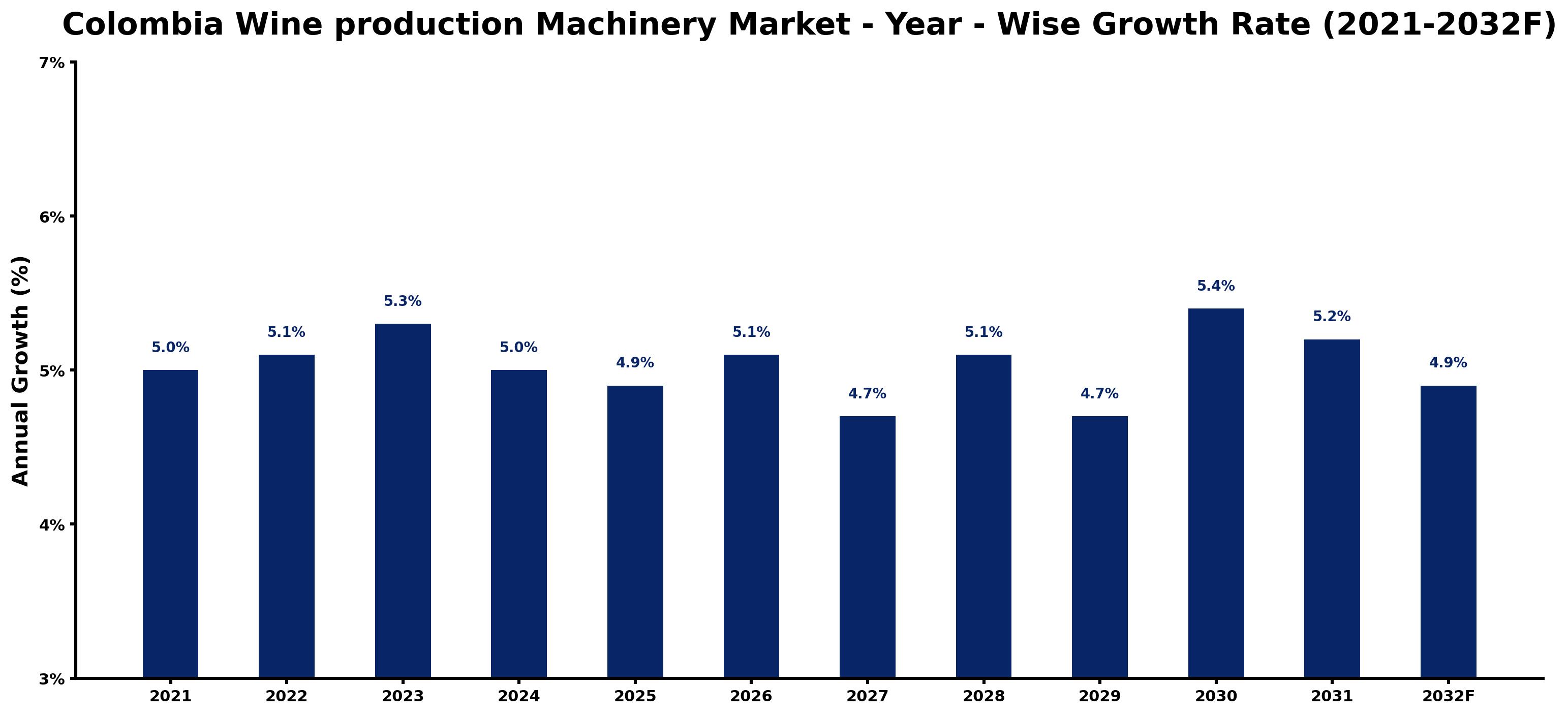
The table below presents the year wise growth rates along with the key drivers influencing the market
| Year | Growth Rate | Major Drivers |
| 2021 | 5.0% | Colombian wineries seek modern machinery to enhance production efficiency and quality. |
| 2022 | 5.1% | Sustainable practices gain traction, prompting investments in eco-friendly wine production technology. |
| 2023 | 5.3% | Local consumption trends shift, requiring machinery tailored for diverse regional varietals. |
| 2024 | 5.0% | Emerging vineyards expand, driving demand for advanced crush and fermentation equipment. |
| 2025 | 4.9% | Technological innovations in automation streamline processes and reduce labor costs for producers. |
| 2026 | 5.1% | Increased exports of Colombian wine necessitate enhanced packaging and bottling solutions. |
| 2027 | 4.7% | Consumer interest in premium wines boosts investments in high-end wine production machinery. |
| 2028 | 5.1% | Partnerships between local wineries and machinery suppliers foster knowledge sharing and growth. |
| 2029 | 4.7% | E-commerce trends push wineries to adopt machinery that supports direct-to-consumer distribution. |
| 2030 | 5.4% | Climate change impacts prompt investment in equipment that addresses specific environmental challenges. |
| 2031 | 5.2% | Government incentives for agricultural modernization stimulate machinery upgrades in wine regions. |
| 2032 | 4.9% | Technological integration in the supply chain enhances overall operational effectiveness for wineries. |
Note - Market size estimations and growth projections presented in this report are based on 6Wresearch's advanced forecasting approach, validated with industry datasets as of June 2026.
Colombia Wine production Machinery Market Synopsis
The Colombia Wine production Machinery Market is projected to reach 5.1% and witness significant growth during the forecast period (2026-2032). This growth is attributed to a burgeoning interest in wine consumption across Colombia, which reflects a broader global trend. Several factors are propelling the market forward, including increases in disposable income, evolving consumer tastes favoring premium wines, and the expansion of vineyard land. Consequently, wineries are investing in advanced machinery to optimize production processes, thereby ensuring high product quality.
Colombia Wine production Machinery Market Growth Drivers
Several key drivers are influencing the Colombia Wine production Machinery Market. The following factors are critical to the continuous growth of this sector:
- Increasing disposable income levels are allowing consumers to explore higher-priced wine options, prompting wineries to enhance their production capabilities.
- Changing consumer preferences towards premium, high-quality wines are encouraging wineries to invest in advanced machinery for improved production efficiency.
- The notable increase in vineyard acreage within Colombia has created a higher demand for specialized wine production equipment, leading to market expansion.
- Technological advancements in wine production machinery, including automation and digitalization, are driving efficiency and output quality.
- A growing trend towards sustainable practices among wineries is prompting investments in energy-efficient machinery, which aids both production and environmental goals.
Colombia Wine production Machinery Market Trends and Opportunities
The Colombia Wine production Machinery Market is currently witnessing several notable trends that present considerable opportunities:
- Wineries are increasingly adopting automation technologies to streamline production processes, thus enhancing both efficiency and consistency.
- The introduction of automated bottling lines and temperature-controlled fermentation tanks reflects a broader demand for innovative solutions in the market.
- There is a significant focus on sustainability, with wineries leaning towards eco-friendly production practices and energy-efficient machinery.
- Research and development initiatives are gaining traction, aimed at creating cutting-edge machinery tailored to the unique requirements of Colombian wine producers.
- As the market grows, opportunities are arising for investment in niche machinery specialties, such as grape sorting and quality control technologies.
Colombia Wine production Machinery Market Challenges and Restraints
Despite the positive outlook, the Colombia Wine production Machinery Market faces several challenges:
- The high cost of importing specialized wine production machinery is a significant barrier for smaller wineries, which can impact overall production costs.
- Limited domestic manufacturing capabilities often result in dependence on foreign suppliers, complicating maintenance and operational support.
- A lack of standardized regulations around machinery quality can lead to inconsistent operational efficiency among wineries.
- There's an evident shortage of skilled labor and technical expertise required to operate and maintain advanced wine production machinery.
- Market volatility due to fluctuating demand for wines can make it challenging for producers to justify heavy investments in new machinery.
Colombia Wine production Machinery Market Investment Opportunities
The expanding nature of the Colombia Wine production Machinery Market presents substantial investment opportunities:
- Investing in state-of-the-art machinery, including fermentation tanks and bottling lines, can yield high returns as wineries scale up operations to meet demand.
- There is a rising interest in sustainable production methods, opening avenues for investments in eco-friendly machinery tailored to reduce environmental impacts.
- With the growing popularity of Colombian wines, both local and international investors may find opportunities in introducing innovative technologies to the market.
- Partnerships with local wineries for the development of specialized machinery could provide long-term advantages for companies focused on market growth.
- The need for modernization in existing wineries creates a fertile ground for strategic investments aimed at upgrading outdated production equipment.
Colombia Wine production Machinery Market Government Investment and Initiatives
The Colombian government is actively fostering growth in the wine production machinery market through various initiatives:
- Tax incentives have been introduced for companies investing in modern machinery and technological upgrades, stimulating sector growth.
- Financial grants available for research and development projects are designed to enhance innovation within the wine production machinery sector.
- The government has prioritized improving infrastructure related to both the import and export of wine production machinery, facilitating smoother logistics.
- Public investment in education and training programs aims to develop a skilled workforce capable of operating advanced wine production equipment.
- Collaborations between government entities and private sector stakeholders are being encouraged to stimulate investment and technological advancements in the market.
Colombia Wine production Machinery Market Latest Developments (May 2025 - June 2026)
During the period from May 2025 to June 2026, several key developments have characterized the Colombia Wine production Machinery Market:
- Wineries have ramped up investments in automation technologies, significantly enhancing operational efficiency and product consistency.
- New regulations promoting sustainability in production practices have resulted in increased interest in energy-efficient machinery options.
- Collaborative efforts between local manufacturers and international technology providers have facilitated the introduction of state-of-the-art production equipment.
- Market dynamics have increasingly reflected consumer trends favoring organic and high-quality wines, which are driving machinery requirements.
- Public initiatives supporting research and development for innovative machinery solutions have gained momentum, emphasizing long-term growth in the sector.
Colombia Wine production Machinery Market - Key Attractiveness of the Report
- 10 Years of Market Numbers
- Historical Data Starting from 2022 to 2025
- Base Year: 2025
- Forecast Data until 2032
- Key Performance Indicators Impacting the Market
- Major Upcoming Developments and Projects
Key Highlights of the Report:
- Colombia Wine production Machinery Market Outlook
- Market Size of Colombia Wine production Machinery Market, 2025
- Forecast of Colombia Wine production Machinery Market, 2032F
- Historical Data and Forecast of Colombia Wine production Machinery Revenues & Volume for the Period 2022-2032F
- Colombia Wine production Machinery Market Trend Evolution
- Colombia Wine production Machinery Market Drivers and Challenges
- Colombia Wine production Machinery Price Trends
- Colombia Wine production Machinery Porter's Five Forces
- Colombia Wine production Machinery Industry Life Cycle
- Historical Data and Forecast of Colombia Wine production Machinery Market Revenues & Volume By Type for the Period 2022-2032F
- Historical Data and Forecast of Colombia Wine production Machinery Market Revenues & Volume By Tanks & fermenters for the Period 2022-2032F
- Historical Data and Forecast of Colombia Wine production Machinery Market Revenues & Volume By Crushing & Pressing Equipment for the Period 2022-2032F
- Historical Data and Forecast of Colombia Wine production Machinery Market Revenues & Volume By Temperature Control Equipment for the Period 2022-2032F
- Historical Data and Forecast of Colombia Wine production Machinery Market Revenues & Volume By Filtration Equipment for the Period 2022-2032F
- Historical Data and Forecast of Colombia Wine production Machinery Market Revenues & Volume By Others for the Period 2022-2032F
- Colombia Wine production Machinery Import Export Trade Statistics
- Market Opportunity Assessment By Type
- Colombia Wine production Machinery Top Companies Market Share
- Colombia Wine production Machinery Competitive Benchmarking By Technical and Operational Parameters
- Colombia Wine production Machinery Company Profiles
- Colombia Wine production Machinery Key Strategic Recommendations






































