Congo Ceiling Tiles Market: Top 5 Importing Countries and Market Competition (HHI) Analysis
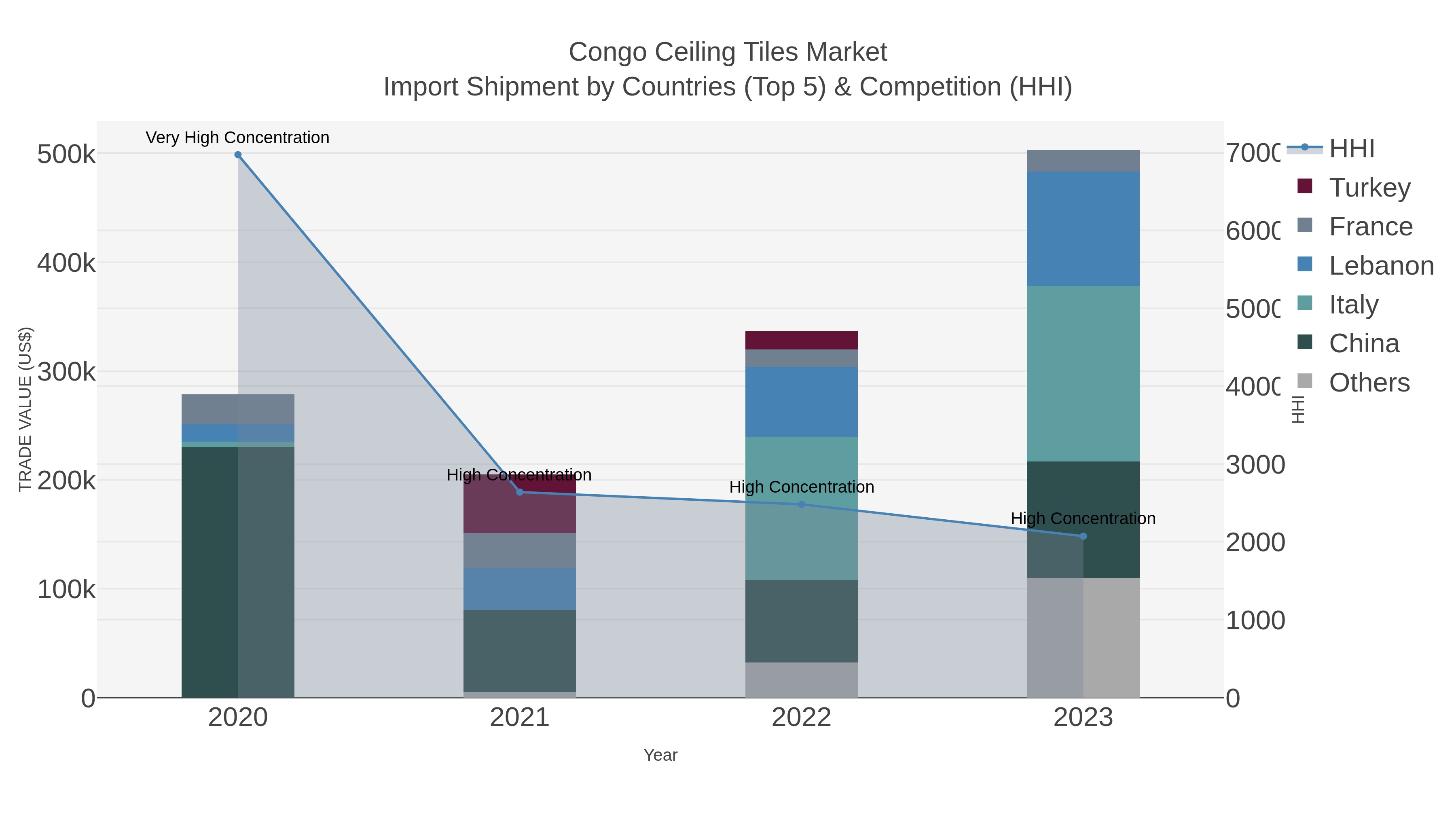
The Congo ceiling tiles import market in 2023 saw a significant growth rate of 49.35%, with a high concentration of top exporters such as Italy, China, Lebanon, Germany, and Denmark. The Herfindahl-Hirschman Index (HHI) remained indicative of a concentrated market, reflecting the dominance of these key exporting countries. With a remarkable compound annual growth rate (CAGR) of 21.73%, the ceiling tiles industry in Congo continues to attract attention and investment from global players.
Congo Ceiling Tiles Market Overview
The ceiling tiles market in Congo faces both opportunities and challenges. The demand for ceiling tiles is driven by the ongoing construction boom in commercial and residential sectors. However, the market is hindered by a lack of local manufacturing facilities, which leads to high import costs. Additionally, the variability in quality and durability of imported tiles can affect market growth. Local manufacturers may find opportunities in producing cost-effective, high-quality ceiling tiles tailored to the regional climate and architectural styles.
Drivers of the market
The Congo ceiling tiles market is driven by a combination of factors that include urbanization, increasing construction activities, and the growing demand for aesthetic and functional interior solutions. Urbanization leads to the development of new residential and commercial spaces, thereby creating a substantial demand for ceiling tiles. Additionally, advancements in ceiling tile technology and materials enhance the aesthetic appeal and functionality of buildings, driving market growth. The need for better acoustics, insulation, and fire safety also contributes to the increasing adoption of ceiling tiles in various sectors.
Challenges of the market
The ceiling tiles market in Congo faces several challenges. Limited infrastructure and inconsistent supply chains impact the availability and distribution of ceiling tiles. Additionally, the market is affected by fluctuating raw material costs and lack of advanced manufacturing technologies. Economic instability and political uncertainty further contribute to market volatility, making it difficult for manufacturers and suppliers to establish a stable market presence.
Government Policy of the market
In the Congo ceiling tiles market, government policies play a crucial role in shaping the industry`s landscape. The government has been increasingly focusing on improving infrastructure and urban development, which drives demand for ceiling tiles. Policies promoting sustainable building practices and energy efficiency are particularly influential. For instance, regulations requiring the use of environmentally friendly materials in construction can boost the demand for green and recyclable ceiling tiles. Additionally, any changes in building codes or construction standards mandated by the government can directly affect market trends, pushing for innovations and compliance in ceiling tile products.
Key Highlights of the Report:
- Congo Ceiling Tiles Market Outlook
- Market Size of Congo Ceiling Tiles Market, 2024
- Forecast of Congo Ceiling Tiles Market, 2031
- Historical Data and Forecast of Congo Ceiling Tiles Revenues & Volume for the Period 2021-2031
- Congo Ceiling Tiles Market Trend Evolution
- Congo Ceiling Tiles Market Drivers and Challenges
- Congo Ceiling Tiles Price Trends
- Congo Ceiling Tiles Porter`s Five Forces
- Congo Ceiling Tiles Industry Life Cycle
- Historical Data and Forecast of Congo Ceiling Tiles Market Revenues & Volume By Material Type for the Period 2021-2031
- Historical Data and Forecast of Congo Ceiling Tiles Market Revenues & Volume By Mineral Wool for the Period 2021-2031
- Historical Data and Forecast of Congo Ceiling Tiles Market Revenues & Volume By Metal for the Period 2021-2031
- Historical Data and Forecast of Congo Ceiling Tiles Market Revenues & Volume By Gypsum for the Period 2021-2031
- Historical Data and Forecast of Congo Ceiling Tiles Market Revenues & Volume By Others for the Period 2021-2031
- Historical Data and Forecast of Congo Ceiling Tiles Market Revenues & Volume By Application for the Period 2021-2031
- Historical Data and Forecast of Congo Ceiling Tiles Market Revenues & Volume By Residential for the Period 2021-2031
- Historical Data and Forecast of Congo Ceiling Tiles Market Revenues & Volume By Non-residential for the Period 2021-2031
- Congo Ceiling Tiles Import Export Trade Statistics
- Market Opportunity Assessment By Material Type
- Market Opportunity Assessment By Application
- Congo Ceiling Tiles Top Companies Market Share
- Congo Ceiling Tiles Competitive Benchmarking By Technical and Operational Parameters
- Congo Ceiling Tiles Company Profiles
- Congo Ceiling Tiles Key Strategic Recommendations






































