Congo Cutting Equipment Market: Top 5 Importing Countries and Market Competition (HHI) Analysis
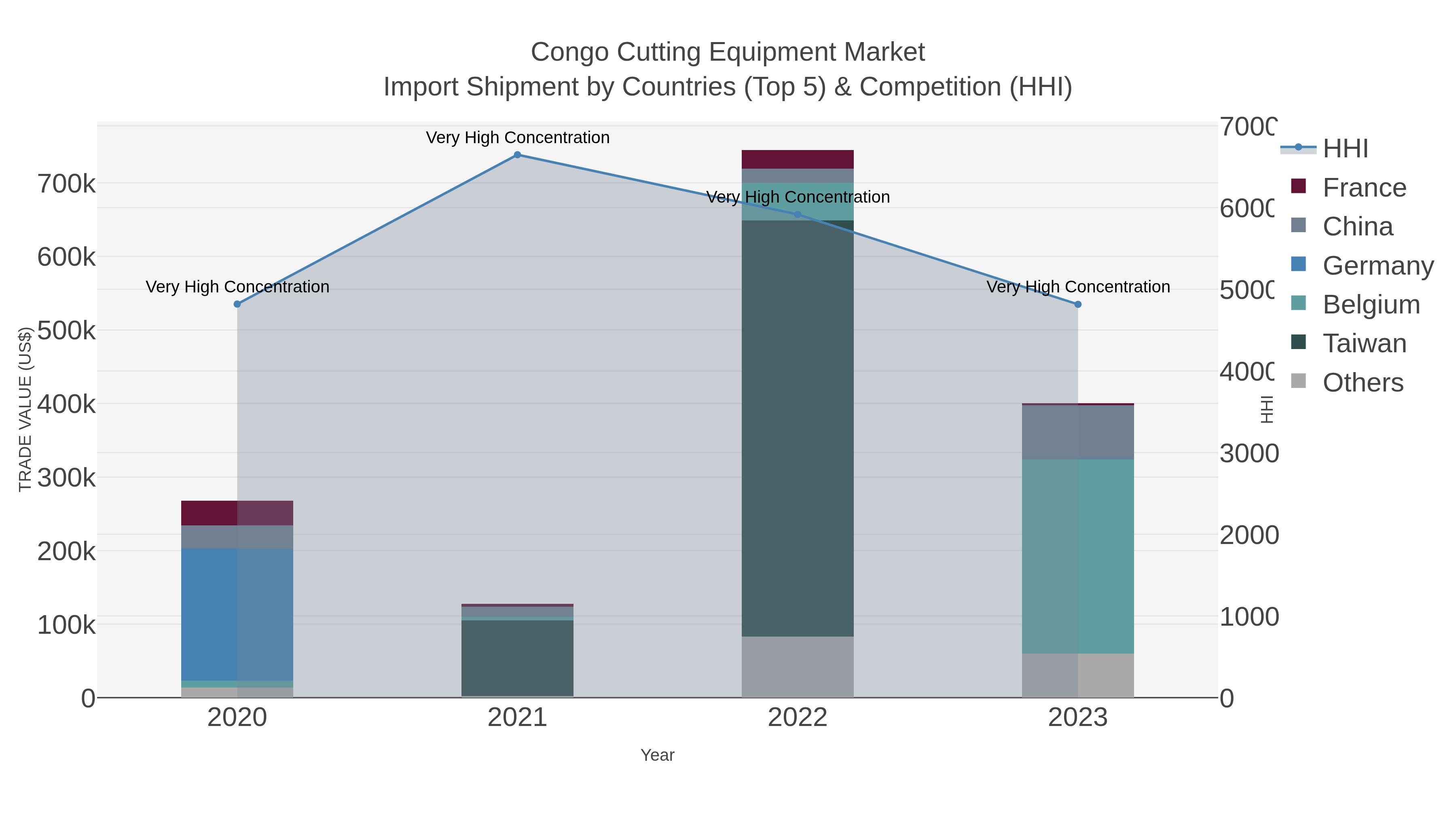
Despite a high level of market concentration in Congo cutting equipment import sector in 2023, the top exporters to the country included Belgium, China, Italy, Lebanon, and Vietnam. With a Compound Annual Growth Rate (CAGR) of 14.34%, the industry showed strong growth potential. However, the negative growth rate of -46.22% suggests a recent decline in import shipments, pointing to potential challenges or fluctuations in the market. Stakeholders should closely monitor these trends to make informed decisions and capitalize on opportunities for growth in the future.
Congo Cutting Equipment Market Overview
The Congo cutting equipment market covers a variety of machinery and tools used for cutting materials in various industries, including construction, manufacturing, and textiles. This market benefits from the expanding industrial sector and infrastructure development projects, which require efficient and precise cutting solutions. Technological advancements in cutting tools, such as automation and enhanced precision, are driving growth. The market is also influenced by the need for improved operational efficiency and productivity in industrial operations.
Drivers of the market
The cutting equipment market in Congo is primarily driven by the expanding construction and manufacturing sectors, which require advanced and efficient cutting tools for various applications. Infrastructure development projects, particularly in urban areas, are creating a surge in demand for cutting equipment. Moreover, the rise of industrialization and the adoption of automated and precision-cutting tools are contributing to market growth.
Challenges of the market
The cutting equipment market in Congo struggles with inadequate technological advancement and outdated machinery. Many local industries still rely on imported cutting tools, which increases operational costs. The high cost of maintenance and the absence of skilled labor to operate advanced cutting machines further inhibit market expansion. Political instability and inconsistent power supply also disrupt production processes.
Government Policy of the market
In the Congo Cutting Equipment Market, government policies focus on industrial safety standards and import regulations. The government enforces regulations to ensure that cutting equipment meets safety and operational standards, reducing the risk of accidents and improving workplace safety. Import policies and tariffs can affect the cost and availability of cutting equipment, with efforts to support local production potentially influencing market conditions. Additionally, policies promoting the adoption of advanced technology and automation in manufacturing can drive growth in the cutting equipment sector.
Key Highlights of the Report:
- Congo Cutting Equipment Market Outlook
- Market Size of Congo Cutting Equipment Market, 2024
- Forecast of Congo Cutting Equipment Market, 2031
- Historical Data and Forecast of Congo Cutting Equipment Revenues & Volume for the Period 2021-2031
- Congo Cutting Equipment Market Trend Evolution
- Congo Cutting Equipment Market Drivers and Challenges
- Congo Cutting Equipment Price Trends
- Congo Cutting Equipment Porter`s Five Forces
- Congo Cutting Equipment Industry Life Cycle
- Historical Data and Forecast of Congo Cutting Equipment Market Revenues & Volume By Equipment Type for the Period 2021-2031
- Historical Data and Forecast of Congo Cutting Equipment Market Revenues & Volume By Manual for the Period 2021-2031
- Historical Data and Forecast of Congo Cutting Equipment Market Revenues & Volume By Mechanized for the Period 2021-2031
- Historical Data and Forecast of Congo Cutting Equipment Market Revenues & Volume By Cutting Technology for the Period 2021-2031
- Historical Data and Forecast of Congo Cutting Equipment Market Revenues & Volume By Plasma cutting for the Period 2021-2031
- Historical Data and Forecast of Congo Cutting Equipment Market Revenues & Volume By Oxy-fuel cutting for the Period 2021-2031
- Historical Data and Forecast of Congo Cutting Equipment Market Revenues & Volume By Laser cutting for the Period 2021-2031
- Historical Data and Forecast of Congo Cutting Equipment Market Revenues & Volume By Waterjet cutting for the Period 2021-2031
- Historical Data and Forecast of Congo Cutting Equipment Market Revenues & Volume By Carbon arc cutting for the Period 2021-2031
- Historical Data and Forecast of Congo Cutting Equipment Market Revenues & Volume By End Use Industry for the Period 2021-2031
- Historical Data and Forecast of Congo Cutting Equipment Market Revenues & Volume By Construction for the Period 2021-2031
- Historical Data and Forecast of Congo Cutting Equipment Market Revenues & Volume By Heavy metal fabrication for the Period 2021-2031
- Historical Data and Forecast of Congo Cutting Equipment Market Revenues & Volume By Shipbuilding & offshore for the Period 2021-2031
- Historical Data and Forecast of Congo Cutting Equipment Market Revenues & Volume By Automotive for the Period 2021-2031
- Historical Data and Forecast of Congo Cutting Equipment Market Revenues & Volume By Others for the Period 2021-2031
- Historical Data and Forecast of Congo Cutting Equipment Market Revenues & Volume By Type for the Period 2021-2031
- Historical Data and Forecast of Congo Cutting Equipment Market Revenues & Volume By Equipment for the Period 2021-2031
- Historical Data and Forecast of Congo Cutting Equipment Market Revenues & Volume By Consumables/Accessories for the Period 2021-2031
- Congo Cutting Equipment Import Export Trade Statistics
- Market Opportunity Assessment By Equipment Type
- Market Opportunity Assessment By Cutting Technology
- Market Opportunity Assessment By End Use Industry
- Market Opportunity Assessment By Type
- Congo Cutting Equipment Top Companies Market Share
- Congo Cutting Equipment Competitive Benchmarking By Technical and Operational Parameters
- Congo Cutting Equipment Company Profiles
- Congo Cutting Equipment Key Strategic Recommendations






































